


Artificial intelligence is reshaping how brands manage Marketing Campaigns, Lead Nurturing, and B2B Marketing Strategies across digital channels. With AI-powered workflows, businesses can analyze customer behavior, automate repetitive tasks, and coordinate Marketing Operations more efficiently. eCommerce AI marketing is becoming especially important as online stores handle growing product catalogs, customer interactions, and personalized buying journeys.
Modern businesses also use Brand Monitoring to understand how customers respond to products, campaigns, and competitors. At the same time, Marketing Intelligence and digital commerce intelligence help teams turn large volumes of customer and sales data into actionable insights. AI agents take this process further by connecting analysis, decision-making, and execution within automated workflows.
What Are AI Agents in eCommerce Marketing?
AI agents are software systems designed to perform tasks with limited human intervention. Unlike traditional automation, which generally follows predefined rules, AI agents can analyze information, make context-based decisions, and adjust actions according to changing inputs.
In eCommerce, an AI agent can monitor customer activity, identify buying signals, recommend products, create campaign variations, respond to questions, and trigger follow-up actions. This makes Marketing Automation more adaptive and responsive.
For example, an AI agent can recognize that a visitor repeatedly viewed a particular product category. It can then coordinate a personalized recommendation, send a relevant message, and monitor whether the customer converts.
How AI Agents Are Transforming eCommerce Marketing
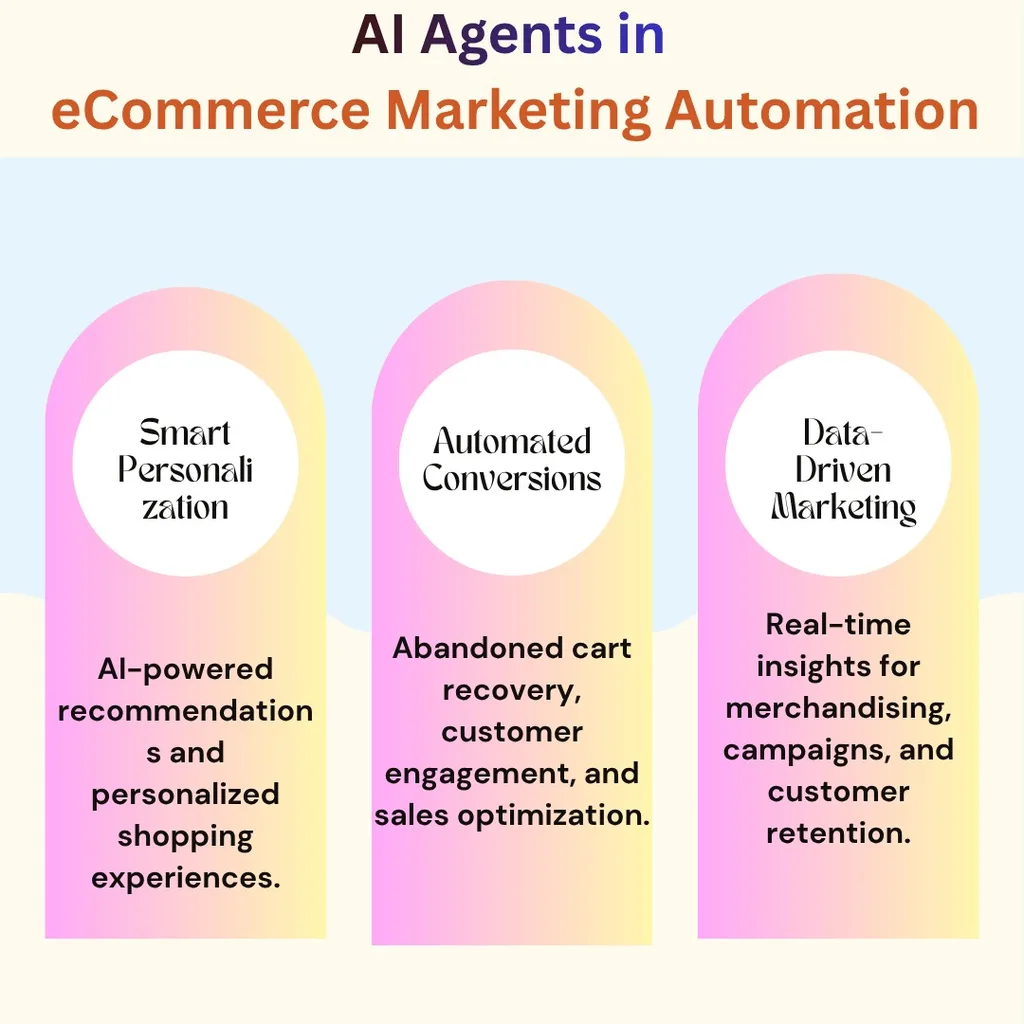
AI agents are increasingly being integrated across the customer journey. From product discovery to post-purchase engagement, they can coordinate multiple marketing activities.
| eCommerce Area | AI Agent Application | Potential Business Impact |
| Product Discovery | Personalized product suggestions | More relevant shopping experiences |
| Customer Engagement | Automated conversations and responses | Faster customer support |
| Retention | Personalized follow-ups | Stronger customer relationships |
| Sales | Automated recommendations and offers | More targeted sales opportunities |
| Analytics | Real-time behavioral analysis | Faster marketing decisions |
1. Smarter Product Recommendations
Traditional recommendation systems often depend on fixed rules or historical purchase patterns. AI-powered product recommendation systems can analyze browsing behavior, purchase history, product attributes, search activity, and customer preferences to produce more relevant suggestions.
With shopping personalization AI, an online store can dynamically adjust recommendations for individual visitors. One customer may see complementary accessories, while another may receive suggestions based on previous purchases.
AI agents can also monitor the performance of recommendations and adjust future suggestions based on engagement and conversion signals.
2. Personalized Customer Experiences
Personalization has moved beyond simply adding a customer’s name to an email. AI can help businesses personalize product listings, promotional messages, website experiences, and communication timing.
An AI agent can evaluate customer behavior and determine which products, content, or messages are more relevant to a particular audience segment.
This approach supports AI customer retention by helping brands maintain relevant communication after the first purchase.
AI Agents and Conversion Automation
One of the major applications of AI in online retail is conversion automation eCommerce. AI agents can monitor customer journeys and identify situations where a shopper may need additional information before completing a purchase.
For example, if customers frequently leave a product page after checking shipping information, an AI system can identify that pattern and help marketers improve the page or trigger an appropriate message.
This connects AI automation with Conversion Rate Optimization, allowing teams to continuously analyze customer journeys and identify potential friction points.
| Customer Journey Stage | AI Agent Function | Example |
| Awareness | Audience analysis | Identify high-interest segments |
| Consideration | Product recommendations | Suggest relevant products |
| Purchase | Conversion assistance | Address common objections |
| Abandonment | Recovery workflow | Trigger personalized reminders |
| Retention | Follow-up automation | Recommend complementary products |
AI Merchandising Tools for Digital Stores
Merchandising teams traditionally spend significant time analyzing products, categories, inventory, and customer demand. AI merchandising tools can automate many of these processes.
AI agents can analyze product performance and identify patterns such as:
- Products receiving high traffic but low conversions
- Categories experiencing increased demand
- Products frequently purchased together
- Search terms with growing interest
- Pricing or promotional patterns affecting sales
- Changes in customer preferences
This creates a more data-driven merchandising process while reducing the amount of manual analysis required.
Retail Marketing Automation
Retail marketing automation connects customer data with automated marketing activities. AI agents can help coordinate campaigns across email, websites, social media, messaging platforms, and other digital touchpoints.
Instead of manually creating separate workflows for every customer segment, marketers can use AI to identify behavioral patterns and adjust communication accordingly.
For example, an AI system could create one workflow for first-time shoppers, another for repeat buyers, and another for customers who have not purchased recently.
Abandoned Cart AI and Recovery
Cart abandonment remains an important challenge for online retailers. Abandoned cart AI can analyze why shoppers leave without completing purchases and determine which recovery actions may be appropriate.
An AI agent could consider factors such as:
- Previous purchase behavior
- Product value
- Customer engagement
- Time since cart abandonment
- Device and browsing behavior
- Previous response to promotional messages
Based on these signals, the system can coordinate a personalized reminder or alternative communication.
Rather than sending identical messages to every shopper, AI can help make recovery campaigns more context-aware.
AI Sales Optimization
AI sales optimization focuses on using customer and transaction data to improve sales processes. AI agents can identify high-intent visitors, recommend products, prioritize leads, and highlight potential opportunities for sales teams.
For example, an AI system can recognize when a customer repeatedly views a high-value product and notify the appropriate team or trigger a personalized sales workflow.
This can be especially useful for businesses with large product catalogs or complex customer journeys.
Digital Commerce Intelligence
Digital commerce intelligence brings together information from different sources, including website analytics, customer behavior, sales data, product performance, and marketing campaigns.
AI agents can process these signals continuously and identify changes that might otherwise take teams days or weeks to notice.
| Data Source | AI Analysis | Marketing Use |
| Website Behavior | Browsing and engagement patterns | Audience segmentation |
| Sales Data | Revenue and purchase trends | Sales planning |
| Product Data | Product performance | Merchandising decisions |
| Customer Data | Preferences and history | Personalization |
| Campaign Data | Engagement and conversion | Campaign optimization |
Multi-Location Marketing With AI Agents
Businesses operating across multiple cities, regions, or stores often need different marketing strategies for different locations. Multi-Location Marketing can become difficult when teams manage individual campaigns, local content, customer data, and performance reports manually.
AI agents can help coordinate location-specific marketing activities while maintaining brand consistency.
For example, a retail business can use AI to identify differences in customer preferences between locations and adapt messaging accordingly. Local campaigns can then be monitored through a centralized system.
Marketing Operations and Workflow Automation
AI agents can also support internal Marketing Operations. They can organize campaign data, monitor workflow status, generate reports, identify incomplete tasks, and coordinate repetitive activities.
This can reduce manual workload for marketing teams and allow professionals to spend more time on strategy, creative development, and customer experience.
A typical AI-powered workflow could include:
Data Collection → Customer Analysis → Decision → Content/Offer Creation → Campaign Execution → Performance Monitoring → Optimization
Chatbots in Modern Marketing
Chatbots in Modern Marketing have evolved beyond basic question-and-answer systems. AI-powered chatbots can understand customer intent, provide product information, recommend products, answer common questions, and support purchasing decisions.
When connected with customer and product data, an AI chatbot can provide more contextual assistance.
For example, a shopper asking about a laptop can receive information about specifications, accessories, compatibility, and related products without navigating through multiple pages.
Content Repurposing With AI
Content creation is another area where AI agents can support eCommerce teams. Content Repurposing allows businesses to transform one piece of content into multiple formats.
A product guide could become:
- Blog content
- Social media posts
- Email copy
- Product FAQs
- Short-form video scripts
- Ad variations
AI agents can help coordinate this process while keeping messaging aligned with the original content.
Understanding Consumer Trends Earlier
AI can analyze search activity, customer conversations, product interactions, social signals, and sales data to identify changes in demand. This can help businesses identify Consumer Trends Earlier and adjust campaigns or product strategies accordingly.
For example, if searches and product interactions around a particular category begin increasing, marketers can investigate the trend and respond with relevant content, merchandising, or promotional activity.
AI and Marketing Campaigns
AI agents can support the planning and execution of Marketing Campaigns by analyzing audience segments, campaign performance, and customer behavior.
Instead of relying only on historical campaign templates, AI can help identify which messages, products, and channels are generating stronger engagement.
This makes campaigns more adaptable and allows marketing teams to continuously improve their strategies.
The Role of AI in Conversion Rate Optimization
Conversion Rate Optimization increasingly relies on behavioral data. AI agents can examine where customers drop out of a buying journey and identify potential opportunities for improvement.
They may analyze:
- Landing-page engagement
- Product-page activity
- Search behavior
- Checkout abandonment
- CTA interactions
- Purchase patterns
AI can then help prioritize areas for testing and optimization.
Benefits of AI Agents in eCommerce Marketing
| Benefit | How AI Agents Help |
| Personalization | Adjust experiences based on customer behavior |
| Efficiency | Automate repetitive marketing workflows |
| Scalability | Handle large customer and product datasets |
| Speed | Analyze information in near real time |
| Optimization | Continuously evaluate campaign performance |
| Customer Retention | Support personalized post-purchase engagement |
Challenges of AI Agent Adoption
Despite their potential, AI agents require careful implementation. Businesses need reliable data, appropriate integrations, human oversight, and clear governance policies.
Common challenges include:
Data Quality
Poor or incomplete data can reduce the accuracy of AI-generated recommendations and decisions.
Integration
AI agents often need access to CRM, eCommerce platforms, analytics tools, inventory systems, and marketing platforms.
Privacy
Businesses must handle customer information responsibly and follow applicable privacy and data-protection requirements.
Human Oversight
AI-generated decisions should be monitored, particularly when they affect pricing, customer communication, or sensitive business processes.
Brand Consistency
Automated content and customer interactions should follow established brand guidelines.
The Future of AI Agents in eCommerce
The role of AI agents is likely to expand from individual marketing tasks toward interconnected marketing systems. Instead of using separate tools for recommendations, customer support, campaign automation, and analytics, businesses may increasingly use AI agents that coordinate multiple functions.
Future systems could connect customer behavior, product information, campaign performance, inventory signals, and sales data to create more responsive marketing workflows.
The most important shift is not simply automation. It is the ability to combine Marketing Intelligence, customer data, and automated execution within a connected workflow.
Conclusion
The rise of AI agents is changing how eCommerce businesses approach personalization, customer engagement, merchandising, sales, and Marketing Automation. Technologies such as eCommerce AI marketing, abandoned cart AI, AI merchandising tools, and shopping personalization AI allow businesses to automate more customer-facing and analytical processes.
As AI agents become more integrated with digital commerce platforms, businesses can build marketing workflows that continuously analyze customer behavior, execute actions, and measure results. However, effective implementation still depends on accurate data, thoughtful strategy, strong integrations, and human oversight.
Frequently Asked Questions
1. What are AI agents in eCommerce marketing?
AI agents are intelligent software systems that can analyze data, make context-based decisions, and perform marketing tasks with limited human intervention. They can support personalization, customer engagement, product recommendations, analytics, and campaign automation.
2. How do AI agents improve eCommerce personalization?
AI agents analyze customer behavior, browsing activity, purchase history, preferences, and engagement signals to provide more relevant product recommendations, content, offers, and communication.
3. Can AI agents help recover abandoned carts?
Yes. Abandoned cart AI can analyze customer behavior and trigger personalized recovery workflows based on factors such as cart value, browsing history, engagement, and timing.
4. What are AI merchandising tools?
AI merchandising tools use customer, product, sales, and behavioral data to support product discovery, category optimization, recommendations, demand analysis, and merchandising decisions.
5. What is the future of AI agents in eCommerce?
AI agents are expected to become more connected across marketing, sales, customer service, analytics, and merchandising. Their role may increasingly involve coordinating multiple workflows rather than performing isolated automation tasks.
