


AI is changing how Finance Teams manage complex financial operations, analyze data, and support strategic decisions. With AI Systems in Financial Services becoming increasingly data-driven, organizations are adopting intelligent technologies to reduce manual work and improve accuracy. Corporate finance AI can connect financial data, automate repetitive processes, and provide timely insights that support faster Financial Decision-Making.
Modern finance departments also rely on Trading, and Financial Modeling for Analysts to evaluate markets, investments, and business performance. At the same time, Financial Risk Monitoring helps organizations identify unusual patterns and potential risks earlier. These capabilities make AI Systems in Financial Services increasingly valuable for finance professionals working across Investment Banking Operations, FP&A, accounting, treasury, and risk functions.
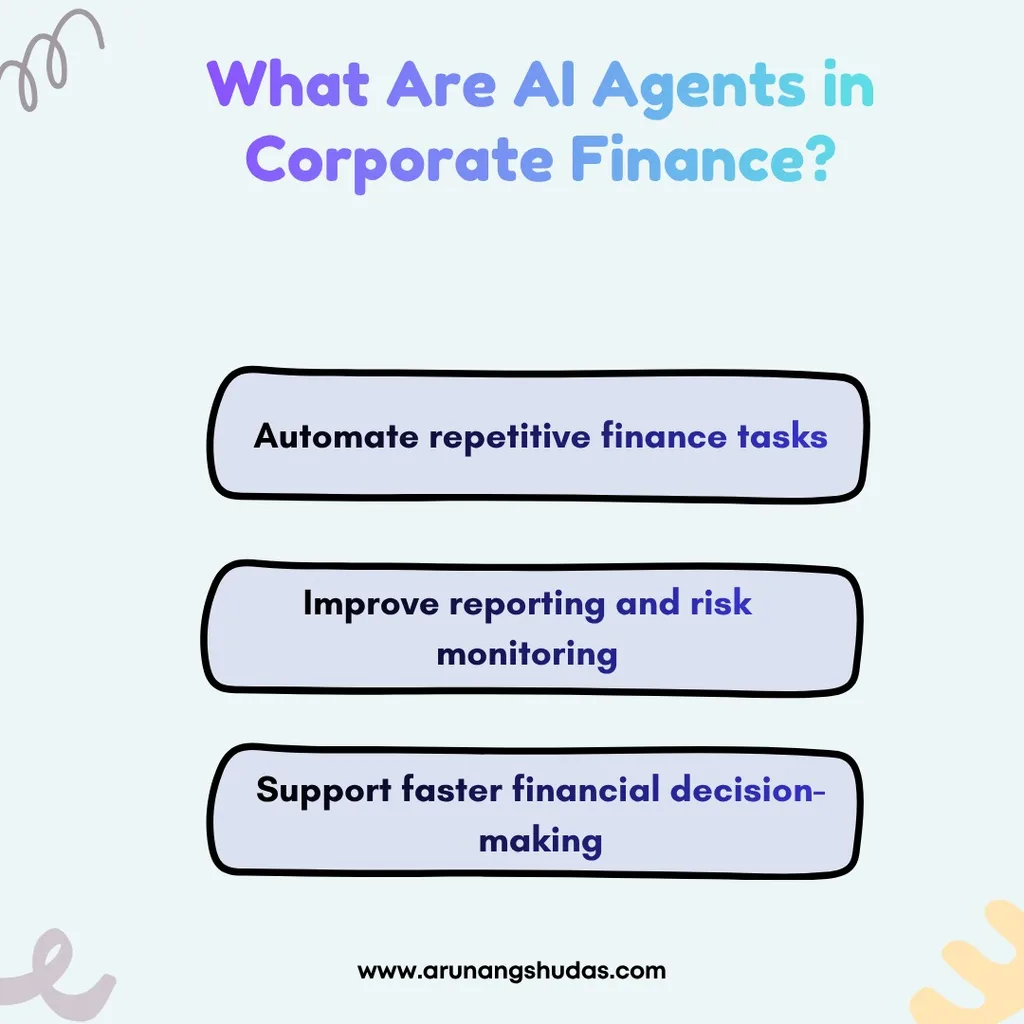
What Are AI Agents in Corporate Finance?
AI agents are intelligent software systems designed to perform tasks, analyze information, make recommendations, and complete workflows with limited human intervention. Unlike traditional automation, which usually follows predefined rules, AI agents can interpret data, identify patterns, respond to changing conditions, and support multiple stages of a financial process.
For example, an AI agent can collect financial information, analyze performance against targets, identify anomalies, prepare a management report, and highlight areas requiring attention. This capability is helping businesses move toward more connected and intelligent finance operations.
| Traditional Finance Process | AI-Agent-Enabled Process |
| Manual data collection | Automated data gathering |
| Spreadsheet-based analysis | AI-assisted analysis |
| Repetitive reporting | Automated report preparation |
| Manual variance checks | Intelligent anomaly detection |
| Separate financial workflows | Connected finance workflows |
1. FP&A Automation Reduces Manual Work
Financial planning and analysis teams often spend significant time collecting data, updating spreadsheets, preparing forecasts, and comparing actual results with budgets. FP&A automation can streamline many of these activities by connecting financial information from multiple sources and reducing repetitive manual processes.
AI agents can assist with forecasting, variance analysis, scenario planning, and management reporting. Instead of spending hours preparing data, finance professionals can focus more on interpreting results and supporting business strategy.
This makes modern financial planning systems more responsive and useful for organizations managing changing revenue, expenses, cash flow, and operational requirements.
2. Enterprise Budgeting AI Improves Planning
Budgeting can become complicated when organizations operate across multiple departments, locations, products, or business units. Enterprise budgeting AI can analyze historical spending, current financial performance, and business assumptions to support more accurate budgeting processes.
AI agents can also identify significant differences between planned and actual spending. Finance teams can then investigate these differences and adjust future allocations based on current business conditions.
| Finance Activity | Role of AI Agents | Potential Benefit |
| Budget preparation | Analyzes historical data | Faster planning |
| Forecasting | Identifies financial trends | Better projections |
| Variance analysis | Flags unusual differences | Faster investigation |
| Scenario planning | Models possible outcomes | Better preparedness |
| Expense monitoring | Tracks spending patterns | Improved control |
3. Intelligent Accounting Tools Improve Accuracy
Accounting teams handle large volumes of transactions and financial records. Intelligent accounting tools can help automate transaction classification, reconciliation, invoice processing, exception identification, and other repetitive accounting activities.
Rather than replacing financial professionals, these tools can reduce repetitive workloads and allow accountants to concentrate on complex transactions, controls, compliance, and financial analysis.
AI-powered Financial Automation Tools can also help standardize processes across departments and reduce the possibility of errors caused by repetitive manual data entry.
4. CFO Workflow Automation Connects Finance Processes
CFOs need information from accounting, FP&A, treasury, operations, sales, and other departments to make informed decisions. CFO workflow automation can connect these processes and provide executives with more timely financial information.
For example, an AI agent could monitor financial KPIs, summarize significant changes, identify unusual expenses, and prepare an executive briefing. This reduces the amount of time senior finance leaders spend gathering information manually.
The result is a more connected approach to finance transformation technology, where automation supports both daily operations and strategic planning.
5. Finance Productivity Tools Give Teams More Time for Strategy
Finance professionals often spend considerable time on repetitive activities such as spreadsheet updates, data reconciliation, report preparation, and information gathering. Finance productivity tools can automate parts of these workflows and make financial information easier to access.
AI assistants and agents can summarize large datasets, answer financial questions, compare reports, and highlight important changes. This allows finance professionals to dedicate more time to analysis, planning, and business partnering.
6. Operational Efficiency AI Streamlines Finance Operations
Finance departments increasingly need to accomplish more without continuously increasing operational workloads. Operational efficiency AI can identify repetitive processes, recommend workflow improvements, and automate routine activities.
For example, an AI system may identify that the same financial data is repeatedly transferred between multiple systems. Automating that process can reduce processing time while creating a more consistent flow of information.
| AI Capability | Finance Use Case | Business Impact |
| Data extraction | Collecting financial information | Less manual effort |
| Pattern recognition | Identifying financial trends | Faster analysis |
| Anomaly detection | Finding unusual transactions | Stronger controls |
| Natural language processing | Summarizing reports | Faster communication |
| Predictive analytics | Forecasting financial outcomes | Better planning |
7. Autonomous Reporting Systems Accelerate Financial Reporting
Financial reporting can involve gathering information from several systems, validating figures, creating charts, and preparing management summaries. Autonomous reporting systems can automate significant parts of this workflow.
AI agents can monitor financial data and generate preliminary reports when specific reporting conditions are met. They can also highlight unusual movements and provide explanations for significant changes.
Human review remains important, particularly for regulated reporting and material financial decisions, but automation can significantly reduce preparation time.
8. AI Supports Financial Market Intelligence
Corporate finance teams, investment professionals, and strategy departments increasingly need to monitor markets, competitors, industries, and economic developments. AI can process large volumes of financial information and identify relevant trends more quickly.
This makes Financial Market Intelligence a valuable area for AI adoption. AI agents can organize market information, summarize relevant developments, compare companies, and highlight changes that may affect financial planning or investment decisions.
9. AI Strengthens Fund Research and Trading Workflows
Investment-focused organizations deal with extensive market data, company information, research reports, and portfolio information. AI can support Fund Research and Trading by organizing research, summarizing market developments, monitoring predefined indicators, and assisting analysts with information processing.
However, AI-generated recommendations should be reviewed by qualified professionals before being used for investment decisions. Human oversight remains essential where financial consequences are significant.
10. Report Analysis Becomes Faster
Finance professionals frequently need to review annual reports, financial statements, management reports, research documents, and internal business reports. AI can accelerate Report Analysis by extracting important figures, identifying trends, comparing periods, and summarizing lengthy documents.
This can be particularly useful when analysts need to review multiple documents within a short period.
11. AI Improves Financial Risk Monitoring
Risk management requires continuous monitoring of financial activity. Financial Risk Monitoring systems can analyze transactions, financial indicators, and historical patterns to identify potential anomalies.
AI can support Risk Management by flagging unusual activities, monitoring predefined thresholds, and helping risk teams prioritize issues requiring human investigation.
The objective is not simply to automate risk decisions but to help professionals identify potentially important issues earlier.
12. Finance Transformation Technology Creates Connected Workflows
Organizations are moving away from isolated spreadsheets and disconnected finance applications toward integrated digital ecosystems. Finance transformation technology combines automation, analytics, AI, cloud platforms, and connected financial systems.
This transformation can help finance teams create a more centralized view of business performance while improving collaboration between accounting, FP&A, treasury, operations, and executive leadership.
| Finance Function | AI Application | Key Advantage |
| FP&A | Forecasting and scenario analysis | Faster planning |
| Accounting | Reconciliation and classification | Reduced manual work |
| Treasury | Cash-flow monitoring | Better visibility |
| Risk | Anomaly detection | Earlier risk identification |
| CFO Office | Executive reporting | Faster decision support |
13. AI Supports Investment Banking Operations
Investment banks process large amounts of financial data and research while managing complex workflows. AI can support Investment Banking Operations through document analysis, financial research, data extraction, workflow automation, and reporting.
For analysts, AI can reduce time spent searching through documents and organizing information. This creates more time for valuation, transaction analysis, client work, and strategic activities.
14. Fintech Companies Are Driving Finance Innovation
Fintech Companies are developing AI-powered solutions for accounting, payments, lending, investment analysis, risk management, financial reporting, and business finance.
As these technologies mature, corporate finance teams have access to more specialized tools that can integrate AI into specific financial workflows instead of relying only on general-purpose software.
15. Financial Decision-Making Becomes More Data-Driven
One of the most important advantages of AI in finance is its ability to combine large amounts of information and present relevant insights quickly. Better access to timely data can support Financial Decision-Making across budgeting, forecasting, investment analysis, risk assessment, and resource allocation.
AI does not eliminate the need for financial judgment. Instead, it can provide finance professionals with better information to evaluate different options.
Key Benefits of AI Agents for Corporate Finance
AI agents are becoming essential because they can support several finance functions simultaneously rather than improving only one isolated process.
| Benefit | How AI Agents Help |
| Productivity | Automate repetitive finance tasks |
| Accuracy | Reduce manual data-processing errors |
| Speed | Accelerate reporting and analysis |
| Visibility | Connect financial information |
| Risk control | Identify unusual patterns |
| Decision support | Provide timely financial insights |
Challenges Finance Teams Should Consider
Despite their benefits, AI agents require careful implementation. Organizations need reliable data, appropriate security controls, clear approval workflows, and human oversight.
Finance leaders should also consider how AI systems access sensitive financial information. Access permissions, audit trails, model governance, regulatory requirements, and data quality should be part of the implementation strategy.
AI should therefore be introduced as part of a broader finance transformation program rather than simply adding another software tool.
The Future of AI Agents in Corporate Finance
The role of AI agents is likely to expand as organizations connect more financial and operational data. Future systems may be able to monitor financial performance continuously, prepare forecasts, identify emerging risks, and recommend actions based on predefined business rules.
The biggest opportunity is not replacing finance professionals. It is allowing them to spend less time on repetitive processes and more time on strategic analysis, business partnering, and decision-making.
For organizations investing in corporate finance AI, the combination of automation, intelligent analytics, and human expertise can create a more responsive and productive finance function.
Frequently Asked Questions
1. Why are AI agents becoming important for corporate finance teams?
AI agents can automate repetitive financial tasks, analyze large datasets, support forecasting, monitor risks, and accelerate reporting. This allows finance professionals to focus more on strategic analysis and decision-making.
2. How does AI help with FP&A?
AI supports FP&A through automated forecasting, variance analysis, scenario planning, budgeting, and financial reporting. FP&A automation can reduce manual spreadsheet work and provide faster access to financial insights.
3. Can AI agents replace finance professionals?
AI agents are primarily designed to assist finance professionals rather than completely replace them. Human judgment remains important for financial decisions, regulatory compliance, risk assessment, and strategic planning.
4. How does AI improve financial risk management?
AI can continuously analyze financial data, identify unusual patterns, monitor predefined thresholds, and alert teams to potential issues. This can make Risk Management more proactive while keeping final decisions under appropriate human oversight.
5. What should companies consider before implementing AI in finance?
Companies should evaluate data quality, cybersecurity, system integration, regulatory requirements, access controls, auditability, human oversight, and the specific financial workflows that would benefit most from automation.
