


Affiliate marketing has become an important revenue channel for brands looking to build partnerships, reach targeted audiences, and increase conversions. With the rise of Influencer Marketing Campaigns, businesses are also using AI-driven tools to improve Lead Nurturing, support B2B Marketing Strategies, and strengthen Brand Monitoring. At the same time, affiliate marketing AI is helping marketing teams manage large partner networks while reducing repetitive manual work.
Modern affiliate programs involve multiple activities, including partner recruitment, campaign management, commission calculations, content coordination, performance analysis, and payment processing. Managing these tasks manually can create delays and data inconsistencies. AI agents are changing this process by connecting these activities through partner management automation, allowing businesses to manage partnerships more efficiently.
What Are AI Agents in Affiliate Marketing?
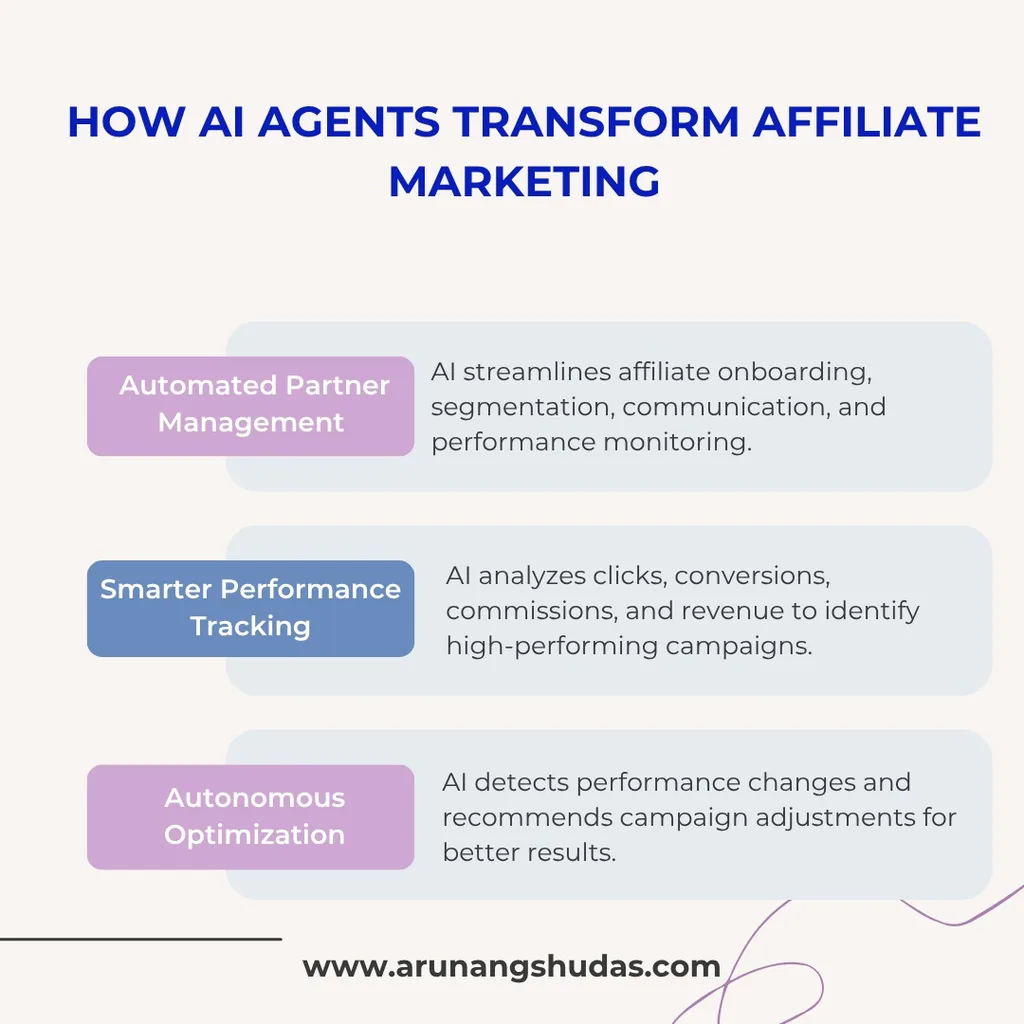
AI agents are software systems that can analyze information, make decisions, perform tasks, and respond to changing conditions with limited human intervention. In affiliate marketing, these systems can monitor campaigns, identify high-performing partners, analyze customer behavior, and recommend actions based on real-time data.
Unlike traditional automation, which generally follows predefined rules, AI agents can use data and contextual signals to determine what action should happen next. This makes them useful for managing complex affiliate programs with hundreds or thousands of partners.
For example, an AI agent can identify an affiliate whose conversion rate is increasing, analyze the campaign responsible for that growth, and recommend increasing promotional support for that partner.
The Role of AI in Partner Management
Managing affiliate relationships requires continuous communication, performance reviews, onboarding, contract management, and campaign coordination. Digital partnership AI can support these activities by organizing partner information and identifying important changes in affiliate performance.
AI-powered systems can categorize affiliates according to factors such as traffic quality, conversion rate, revenue contribution, audience relevance, and engagement. Marketing teams can then prioritize relationships that are likely to generate stronger business results.
This approach also supports intelligent affiliate workflows, where different activities can be connected instead of being handled separately by different team members.
Key Partner Management Activities
| Activity | Traditional Approach | AI-Enabled Approach |
| Partner onboarding | Manual forms and reviews | Automated data collection and evaluation |
| Partner segmentation | Spreadsheet-based grouping | AI-driven partner classification |
| Communication | Manual follow-ups | Automated personalized communication |
| Performance review | Periodic reporting | Continuous performance monitoring |
| Partner prioritization | Based on basic metrics | Based on multiple performance signals |
AI-Powered Commission Tracking
Commission management is one of the most sensitive areas of affiliate operations because inaccurate calculations can affect both business revenue and partner relationships. Commission tracking AI can analyze transactions, attribution information, conversion data, and commission rules to identify discrepancies.
AI systems can also flag unusual commission patterns. For example, if a partner suddenly generates a large volume of conversions that differs significantly from historical behavior, the system can alert the marketing team for further investigation.
Automated commission management can therefore reduce spreadsheet dependency while improving transparency between brands and affiliates.
| Commission Management Area | AI Capability | Business Benefit |
| Transaction validation | Checks transaction data | Reduces reporting errors |
| Commission calculation | Applies predefined rules | Saves processing time |
| Anomaly detection | Identifies unusual patterns | Supports fraud monitoring |
| Payment preparation | Organizes approved commissions | Simplifies financial operations |
| Reporting | Creates performance summaries | Improves visibility |
Affiliate Analytics Automation
Affiliate programs generate large amounts of data from clicks, impressions, conversions, revenue, customer behavior, and partner activity. Manually reviewing all this information can make it difficult for marketers to identify meaningful trends.
Affiliate analytics automation helps transform raw campaign data into useful insights. AI systems can compare partners, campaigns, products, traffic sources, and customer segments to identify which combinations are producing better results.
This supports Marketing Intelligence by helping teams move from simple reporting toward data-informed decision-making.
For example, instead of only showing that an affiliate generated 500 conversions, an AI system can analyze whether those conversions came from new customers, which products performed best, and whether the resulting revenue justified the commission expense.
AI and Performance Marketing Systems
Affiliate programs rarely operate independently from other marketing channels. Their performance can be affected by search campaigns, social media, email marketing, influencer activity, paid advertising, and content marketing.
Modern performance marketing systems can bring these data points together to create a broader view of campaign performance. AI agents can compare affiliate-generated revenue with other acquisition channels and identify opportunities for better budget allocation.
This also makes it easier to connect affiliate performance with Marketing Automation and other digital marketing processes.
| Performance Area | Data Analyzed by AI | Possible Action |
| Traffic | Visits, clicks, sources | Prioritize strong traffic sources |
| Engagement | Sessions, interactions | Improve campaign content |
| Conversions | Orders, leads, sales | Increase support for high-performing partners |
| Revenue | Sales and customer value | Optimize partner investment |
| Customer quality | Repeat purchases and retention | Focus on valuable audiences |
Autonomous Campaign Optimization
One of the biggest advantages of AI agents is their ability to respond to changing campaign conditions. Autonomous campaign optimization allows systems to continuously evaluate performance and recommend or execute adjustments based on predefined business rules.
An AI agent could identify that a particular affiliate campaign is generating a higher conversion rate than another campaign and recommend reallocating promotional resources. It could also identify declining performance and suggest changes to creative assets, landing pages, offers, or partner incentives.
This capability becomes particularly useful during seasonal campaigns when customer demand can change rapidly.
Marketing Revenue AI and Revenue Forecasting
Marketing teams need to understand not only how much revenue an affiliate campaign has generated but also how much revenue it could generate in the future.
Marketing revenue AI can use historical performance, customer behavior, campaign trends, and partner activity to support revenue forecasting. These insights can help businesses estimate potential returns from affiliate partnerships and make better planning decisions.
AI-based forecasting can also highlight potential risks. If a campaign depends heavily on a small number of partners, the system may identify this concentration as a potential revenue risk.
Influencer Affiliate Systems
Influencer partnerships have become increasingly connected with affiliate marketing. Instead of paying influencers only for promotional exposure, brands can use affiliate links, discount codes, and tracked conversions to connect creator activity directly with sales.
Influencer affiliate systems can track creator-specific links, coupon codes, content performance, conversions, and revenue. AI can then compare influencers based on both audience engagement and actual commercial outcomes.
This helps brands distinguish between high engagement and high business value.
| Influencer Metric | What It Indicates | AI Application |
| Engagement rate | Audience interaction | Identifies active communities |
| Click-through rate | Interest in promotion | Evaluates content effectiveness |
| Conversion rate | Purchase intent | Measures sales effectiveness |
| Revenue per influencer | Commercial contribution | Supports partner prioritization |
| Repeat customer rate | Long-term value | Identifies quality audiences |
Intelligent Affiliate Workflows
Affiliate operations often involve multiple repetitive steps. An affiliate may need to be approved, added to a campaign, provided with promotional assets, monitored, evaluated, and paid.
Intelligent affiliate workflows can connect these activities into a coordinated process. For example, when an affiliate reaches a specific performance threshold, an AI-driven workflow can notify the account manager, recommend a new campaign, and update the partner’s performance segment.
This reduces operational delays and gives marketing teams more time to focus on strategy and relationship building.
Chatbots in Modern Marketing and Affiliate Support
Communication is another area where AI can improve affiliate operations. Chatbots in Modern Marketing can answer common affiliate questions about commission rates, campaign requirements, promotional assets, tracking links, payment schedules, and program policies.
Instead of waiting for a marketing manager to respond to routine questions, affiliates can receive immediate assistance. More complex issues can then be transferred to human team members.
This combination of automation and human support can improve the overall affiliate experience without removing personal relationship management.
Content Repurposing for Affiliate Campaigns
Affiliate partners often require different types of promotional material for different platforms. A single product campaign may need blog content, social media posts, email copy, short videos, and promotional captions.
AI can assist with Content Repurposing by adapting approved campaign messaging into different formats while maintaining consistent brand guidelines.
For example, a long product guide can be converted into social captions, email content, short-form video scripts, and affiliate promotional copy. Human marketers can then review and approve the final assets before publication.
Using Consumer Trends Earlier
Understanding customer behavior is essential for affiliate campaign planning. AI systems can monitor search behavior, content engagement, purchasing patterns, and campaign responses to identify Consumer Trends Earlier.
Early trend identification can help marketers provide relevant promotional materials to affiliates before demand reaches its peak. This can be particularly useful for seasonal products, emerging categories, and rapidly changing consumer preferences.
AI and Conversion Rate Optimization
Traffic alone does not guarantee affiliate revenue. Businesses also need to ensure that visitors arriving through affiliate channels complete desired actions.
AI can support Conversion Rate Optimization by analyzing landing-page behavior, customer journeys, product interactions, and conversion patterns. The system can identify where users are dropping off and suggest areas for improvement.
For example, if traffic from a particular affiliate is strong but conversions remain low, the issue may be related to landing-page relevance, offer positioning, page speed, or checkout friction.
How AI Agents Change Affiliate Marketing Operations
AI agents are moving affiliate marketing from disconnected manual activities toward interconnected, data-driven operations. Instead of relying on separate spreadsheets for partner management, commission tracking, campaign reporting, and analytics, businesses can connect these processes through AI-powered systems.
The result is a more responsive affiliate operation where marketing teams can identify opportunities faster, manage partners more efficiently, and allocate resources based on performance.
| Traditional Affiliate Operations | AI-Driven Operations |
| Manual partner reviews | Automated partner analysis |
| Spreadsheet-based commission tracking | AI-assisted commission monitoring |
| Periodic campaign reports | Continuous performance analysis |
| Manual campaign adjustments | Automated optimization recommendations |
| Separate marketing data | Connected performance insights |
Benefits of AI Agents for Affiliate Marketing
The adoption of AI agents can provide several operational and strategic benefits:
- Reduced manual workload: Routine administrative tasks can be automated.
- Faster decision-making: AI can process large amounts of campaign data quickly.
- Improved partner management: Affiliates can be segmented according to performance and potential.
- Better commission accuracy: Automated tracking can reduce calculation errors.
- Stronger campaign optimization: Performance changes can be identified earlier.
- Improved scalability: Businesses can manage larger partner networks without increasing manual workload at the same rate.
- Better revenue visibility: Marketing teams can connect partner activity with business outcomes.
Challenges of Using AI Agents in Affiliate Marketing
Although AI can improve affiliate operations, businesses still need to consider data quality, privacy, attribution accuracy, system integration, and human oversight.
AI recommendations are only as reliable as the data used to generate them. Incorrect tracking information can result in misleading insights. Similarly, fully automated decisions may not always consider relationship factors that experienced affiliate managers understand.
For this reason, businesses should use AI agents as part of a controlled operating model that combines automation with human review.
The Future of AI-Driven Affiliate Marketing
The future of affiliate marketing is likely to involve deeper integration between AI agents, customer data platforms, marketing automation tools, analytics systems, and partner management platforms.
AI agents may increasingly handle routine decisions while marketers focus on strategic relationships, creative direction, brand positioning, and business growth.
As these systems mature, affiliate marketing can become more predictive and responsive. Instead of simply measuring what happened, AI-driven operations can help teams understand what is likely to happen next and determine which actions may produce better outcomes.
Conclusion
AI agents are reshaping affiliate marketing operations by connecting partner management, analytics, commission tracking, campaign optimization, content workflows, and revenue analysis. Technologies such as affiliate marketing AI, commission tracking AI, and affiliate analytics automation are helping businesses reduce repetitive work while improving operational visibility.
The most effective approach is not to replace marketing teams but to give them intelligent systems that handle repetitive analysis and workflows. With the right balance between automation and human judgment, brands can build scalable affiliate programs that respond faster to market changes and create stronger long-term partnerships.
Frequently Asked Questions
1. How do AI agents improve affiliate marketing operations?
AI agents can automate partner management, commission tracking, performance analysis, reporting, campaign monitoring, and workflow management. They can also identify patterns and recommend actions based on campaign data.
2. Can AI automate affiliate commission tracking?
Yes. AI-powered commission systems can process transaction data, apply commission rules, identify unusual patterns, and support automated reporting. Human review can still be used for exceptions and disputed transactions.
3. How can AI help manage affiliate partners?
AI can evaluate partners based on metrics such as traffic quality, conversion rate, revenue, engagement, and customer value. It can then support segmentation, communication, performance monitoring, and partner prioritization.
4. Can AI optimize affiliate campaigns automatically?
AI can monitor campaign performance and identify opportunities for optimization. Depending on the system and business rules, it can provide recommendations or automate specific actions such as adjusting campaign priorities, identifying underperforming partners, or reallocating promotional resources.
5. Will AI replace affiliate marketing managers?
AI is more likely to automate repetitive operational tasks than completely replace affiliate marketing managers. Human professionals remain important for relationship building, strategic planning, negotiation, creative decisions, and handling complex partner situations.
