


The demand for Full Stack Developers continues to grow as businesses seek professionals who can manage both front-end and back-end development. Whether you’re preparing for your first technical interview or applying for a senior role, understanding the most common full stack developer interview questions can significantly improve your chances of success. Recruiters also combine these interviews with software engineering interview questions, basic technical interview questions, and even AI engineer interview questions to evaluate your analytical thinking and adaptability.
Modern hiring processes no longer focus only on coding skills. Employers often include full stack interview questions, interview questions on machine learning, front developer interview questions, system design, API development, and database concepts to assess whether candidates can build scalable, production-ready applications. Preparing these concepts in advance helps candidates perform confidently during technical rounds.
What Does a Full Stack Developer Do?
A Full Stack Developer works on both the client-side and server-side of an application. They are responsible for designing user interfaces, building APIs, managing databases, implementing authentication, and deploying applications.
Typical technologies include:
- HTML5
- CSS3
- JavaScript
- React.js
- Angular
- Vue.js
- Node.js
- Express.js
- Java Spring Boot
- Python Django
- MongoDB
- MySQL
- PostgreSQL
- Git
- Docker
Basic Full Stack Developer Interview Questions
1. What is Full Stack Development?
Full Stack Development refers to building both the frontend and backend of a web application.
Example:
An E-commerce website includes:
- React frontend
- Node.js backend
- MongoDB database
- REST API for communication
2. Explain Frontend vs Backend
| Frontend | Backend |
| User Interface | Business Logic |
| HTML, CSS, JS | Java, Node.js, Python |
| Runs in Browser | Runs on Server |
| React, Angular | Spring Boot, Express |
3. What is REST API?
One of the most common restful api interview questions is explaining REST.
REST API allows applications to communicate over HTTP using methods like:
- GET
- POST
- PUT
- DELETE
- PATCH
Example
GET /users
Returns all users.
4. Difference Between GET and POST
| GET | POST |
| Fetch Data | Create Data |
| Visible in URL | Hidden in Body |
| Faster | More Secure |
| Cacheable | Not Cached |
5. What is MVC Architecture?
MVC stands for
- Model
- View
- Controller
Example
React → View
Node.js → Controller
MongoDB → Model
This architecture improves maintainability.
HTML Interview Questions
What are Semantic Tags?
Semantic tags improve SEO and accessibility.
Examples
<header>

<section>

<article>

<footer>

<nav>
Difference Between Div and Span
| Div | Span |
| Block Element | Inline Element |
| New Line | Same Line |
| Large Layout | Small Content |
What is Local Storage?
Local Storage stores browser data permanently until manually removed.
Example
localStorage.setItem("username","John")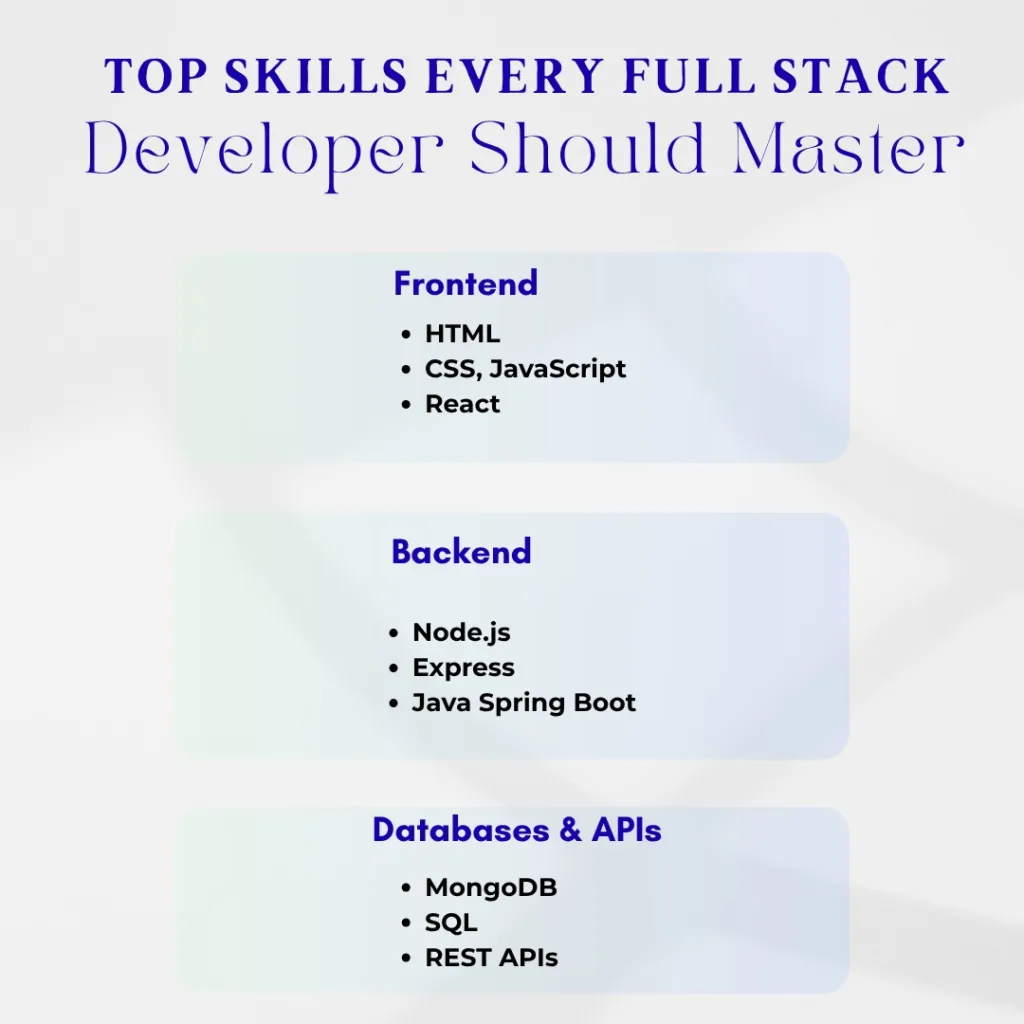
CSS Interview Questions
Difference Between Flexbox and Grid
| Flexbox | Grid |
| One Dimension | Two Dimension |
| Row OR Column | Row AND Column |
| Navigation Bars | Complete Layout |
Explain CSS Box Model
The Box Model contains
- Margin
- Border
- Padding
- Content
Example
- Margin
- Border
- Padding
- Content
JavaScript Interview Questions
Explain Hoisting
Hoisting moves variable declarations to the top before execution.
Example
console.log(a)

var a=10
Output
undefined
Difference Between == and ===
5=="5"

true
5==="5"

false
What is Closure?
A closure allows an inner function to access variables from its outer function.
Example
function outer(){

let a=10;

return function(){

console.log(a)

}

}
Explain Event Loop
The Event Loop handles asynchronous operations like
- API Calls
- Timers
- Promises
Example
console.log("Start")

setTimeout(()=>{

console.log("End")

},0)

console.log("Middle")
Output
Start

Middle

End
React Interview Questions
What is React?
React is a JavaScript library used to build reusable UI components.
Advantages
- Virtual DOM
- Fast Rendering
- Component-Based Architecture
What are Hooks?
Hooks allow state management inside functional components.
Popular Hooks
- useState
- useEffect
- useContext
- useMemo
- useRef
Example
const [count,setCount]=useState(0)
Props vs State
| Props | State |
| Read Only | Mutable |
| Parent Controls | Component Controls |
| External Data | Internal Data |
Node.js Interview Questions
Why Use Node.js?
Node.js uses a non-blocking architecture making it suitable for
- Chat Applications
- APIs
- Streaming Platforms
What is Express.js?
Express is a lightweight Node.js framework used for creating REST APIs.
Example
app.get("/users",(req,res)=>{

res.send("Users")

})
Database Interview Questions
SQL vs MongoDB
| SQL | MongoDB |
| Tables | Documents |
| Fixed Schema | Flexible Schema |
| MySQL | MongoDB |
What is Normalization?
Normalization removes duplicate data and improves consistency.
ACID Properties
- Atomicity
- Consistency
- Isolation
- Durability
Authentication Interview Questions
JWT Authentication
JWT consists of
- Header
- Payload
- Signature
Flow

User Login

↓

Server verifies credentials

↓

JWT Generated

↓

Frontend stores token

↓

Every request sends JWT
Git Interview Questions
Common Git Commands
git clone

git status

git add .

git commit

git push

git pull
Java Full Stack Developer Interview Questions
Many companies ask full stack java developer interview questions, interview questions for full stack java developer, and java full stack developer interview questions to assess Spring Boot, Hibernate, Microservices, Maven, and Java Collections.
Popular questions include:
- What is Dependency Injection?
- Explain Spring Boot Auto Configuration.
- Difference between HashMap and ConcurrentHashMap.
- What is Hibernate?
- Explain Microservices Architecture.
Backend Questions for Interview
Frequently asked backend questions for interview include:
- Explain REST vs GraphQL.
- What is API Gateway?
- What is Redis?
- Difference between SQL and NoSQL.
- Explain Load Balancing.
- What are WebSockets?
- What is Rate Limiting?
- Explain Caching.
- What is JWT Authentication?
- Difference between PUT and PATCH.
Interview Questions for Data Structures and Algorithms
Almost every company asks interview questions for data structures and algorithms before hiring Full Stack Developers.
Common topics include:
- Arrays
- Linked Lists
- Trees
- Graphs
- Stacks
- Queues
- Dynamic Programming
- Recursion
- Binary Search
- Hashing
Example:
Q: Reverse a linked list.
Approach: Use three pointers—previous, current, and next—to reverse links iteratively in O(n) time and O(1) space.
Coding Interview Questions with Solutions
Typical coding interview questions with solutions include:
- Two Sum
- Palindrome Check
- Merge Two Sorted Arrays
- Valid Parentheses
- Longest Substring Without Repeating Characters
Example:

function palindrome(str){

return str===str.split("").reverse().join("")

}
Top System Design Interview Questions
Senior roles often include top system design interview questions such as:
- Design WhatsApp
- Design YouTube
- Design URL Shortener
- Design Uber
- Design Netflix
- Design Instagram Feed
- Design Payment Gateway
Candidates should understand scalability, load balancing, caching, databases, microservices, and message queues.
FAQs
1. What are the most common full stack developer interview questions?
They include HTML, CSS, JavaScript, React, Node.js, databases, REST APIs, Git, authentication, and system design.
2. Are software engineering interview questions asked in Full Stack interviews?
Yes. Employers assess problem-solving, OOP concepts, design patterns, and coding skills alongside full stack technologies.
3. How should I prepare for senior developer interview questions?
Focus on architecture, scalability, microservices, leadership experience, performance optimization, and system design.
4. Why are restful api interview questions important?
REST APIs are essential for communication between frontend and backend services, making them a key interview topic.
5. Which topics should beginners prioritize?
Start with HTML, CSS, JavaScript, React, Node.js, SQL, MongoDB, Git, APIs, authentication, and basic DSA before moving to advanced concepts.
