


Front-end development continues to be one of the most sought-after skills in the software industry. Whether you’re applying for your first role or preparing for a senior position, understanding the most common front end developer interview questions can significantly improve your chances of success. Recruiters assess candidates on HTML, CSS, JavaScript, React, APIs, Git, browser performance, and problem-solving skills. In many modern technical hiring processes, candidates may also encounter broader topics such as machine learning engineer interview questions to evaluate analytical thinking, programming fundamentals, and adaptability across different technology domains.
If you’re searching for front developer interview questions, front end web developer interview questions, interview questions for a front end developer, or frontend developer interview questions, this guide covers the most frequently asked topics. It also touches on concepts from software engineering interview questions, associate software engineer interview questions, senior developer interview questions, coding interview questions with solutions, backend questions for interview, restful api interview questions, full stack developer interview questions, and top system design interview questions.
Why Are Front-End Developer Interviews Important?
Employers look for developers who can build responsive, accessible, and high-performing applications. During interviews, candidates are evaluated on:
- HTML fundamentals
- CSS layouts and responsive design
- JavaScript concepts
- React or other frameworks
- REST API integration
- Git and version control
- Browser optimization
- Debugging and problem-solving
- Communication skills
Skills Required for Front-End Developers
| Skill | Importance | Common Interview Topics |
| HTML | High | Semantic HTML, Forms |
| CSS | High | Flexbox, Grid, Media Queries |
| JavaScript | Very High | ES6, DOM, Closures |
| React | High | Components, Hooks |
| Git | Medium | Branching, Merge |
| APIs | High | REST API Integration |
| Performance | High | Lazy Loading, Optimization |
Top Front-End Developer Interview Questions
1. What is HTML?
HTML (HyperText Markup Language) structures web pages using elements such as headings, paragraphs, forms, tables, images, and links.
2. What are Semantic HTML Elements?
Semantic tags like <header>, <section>, <article>, <nav>, and <footer> clearly describe content, improving SEO, accessibility, and maintainability.
3. Difference Between HTML and HTML5
| HTML | HTML5 |
| Older version | Latest version |
| Limited multimedia | Native audio and video support |
| No semantic tags | Semantic elements included |
| Limited APIs | Canvas, Local Storage, Geolocation |
4. What is the Difference Between Block and Inline Elements?
Block elements occupy the full width available (div, section, p), whereas inline elements occupy only the required space (span, a, strong).
5. What is CSS?
CSS controls the appearance of webpages by managing layouts, colors, typography, spacing, animations, and responsive designs.
6. What are Flexbox and CSS Grid?
Flexbox is a one-dimensional layout system ideal for aligning items in rows or columns. CSS Grid is a two-dimensional layout system suitable for complex page layouts.
7. What is Responsive Web Design?
Responsive design ensures websites adapt smoothly across desktops, tablets, and mobile devices using media queries, flexible images, Flexbox, and CSS Grid.
8. What are Media Queries?
Media queries apply CSS rules based on device characteristics such as screen width, making responsive layouts possible.
9. What is JavaScript?
JavaScript is the programming language that adds interactivity to websites through DOM manipulation, event handling, animations, and API communication.
10. Difference Between var, let, and const
| Keyword | Scope | Reassignment |
| var | Function | Yes |
| let | Block | Yes |
| const | Block | No |
11. Difference Between == and ===
== compares values after type conversion, while === compares both value and data type.
12. What is the DOM?
The Document Object Model (DOM) represents HTML as a tree structure, allowing JavaScript to modify webpage content dynamically.
13. What is Event Bubbling?
Event bubbling means an event starts from the target element and propagates upward through its parent elements.
14. What are JavaScript Closures?
Closures allow functions to retain access to variables from their outer scope even after the outer function has finished executing.
15. What is Hoisting?
Hoisting moves variable and function declarations to the top of their scope before execution. It mainly affects var and function declarations.
16. What is Event Delegation?
Event delegation attaches a single event listener to a parent element to handle events from multiple child elements efficiently.
17. What is Local Storage?
Local Storage stores browser data permanently until it is manually removed, making it useful for user preferences and cached information.
18. What is Session Storage?
Session Storage stores data only for the current browser session and clears it when the tab is closed.
19. What is React?
React is a JavaScript library for building reusable, component-based user interfaces using Virtual DOM and JSX.
20. What are React Components?
Components are reusable UI building blocks. React supports functional and class components, with functional components being the preferred modern approach.
21. What are Props and State?
Props transfer data from parent to child components and are read-only. State stores dynamic data within a component and updates the UI when changed.
22. What are React Hooks?
Hooks such as useState, useEffect, useMemo, useCallback, and useRef simplify state management and lifecycle operations in functional components.
23. What is Virtual DOM?
The Virtual DOM compares UI changes before updating the real DOM, reducing unnecessary rendering and improving application performance.
24. What is Git?
Git is a distributed version control system that enables developers to track code changes, collaborate efficiently, and manage project history.
25. What is a REST API?
A REST API enables communication between front-end and back-end applications using HTTP methods like GET, POST, PUT, PATCH, and DELETE. REST APIs are among the most common topics in restful api interview questions and backend questions for interview.
26. What is the JavaScript Event Loop?
The Event Loop allows JavaScript to handle asynchronous operations while remaining single-threaded. It executes code from the call stack and processes callbacks from task queues once the stack is empty.
27. What are Promises?
Promises handle asynchronous operations and have three states:
- Pending
- Fulfilled
- Rejected
28. Difference Between Async/Await and Promises
| Async/Await | Promises |
| Cleaner syntax | Uses .then() chaining |
| Easier debugging | Can become nested |
| Looks synchronous | Purely asynchronous |
29. What is Debouncing?
Debouncing delays function execution until a user stops triggering an event. It is commonly used in search boxes, autocomplete fields, and window resize events.
30. What is Throttling?
Throttling limits how frequently a function executes during continuous events such as scrolling or resizing, improving application performance.
31. How Do You Optimize Front-End Performance?
Common optimization techniques include:
- Minifying CSS and JavaScript
- Lazy loading
- Code splitting
- Image optimization
- Browser caching
- CDN usage
- Tree shaking
These topics frequently appear in senior developer interview questions and frontend developer interview questions.
32. What is Lazy Loading?
Lazy loading delays loading images or components until they are required, reducing initial page load time and improving Core Web Vitals.
33. What is Code Splitting?
Code splitting divides JavaScript into smaller bundles so only the required code loads initially, improving website performance.
34. What is useEffect?
The useEffect Hook manages side effects such as:
- API calls
- Timers
- Event listeners
- Subscriptions
35. Difference Between useMemo and useCallback
| useMemo | useCallback |
| Memoizes computed values | Memoizes functions |
| Returns calculated value | Returns function reference |
| Optimizes expensive calculations | Prevents unnecessary function recreation |
36. What is Context API?
Context API allows global data sharing across React components without excessive prop drilling. It is commonly used for themes, authentication, and language settings.
37. What is Redux?
Redux is a predictable state management library that manages application state using a Store, Actions, Reducers, and Dispatch.
38. What is React Router?
React Router enables navigation between pages in Single Page Applications without refreshing the browser.
39. What is Angular CLI?
Angular CLI automates project creation, testing, serving, building, and deployment, making Angular development faster and more efficient.
40. What is Vue.js?
Vue.js is a progressive JavaScript framework that provides reactive data binding, reusable components, Virtual DOM, and an easy learning curve.
41. What is Browser Caching?
Browser caching stores static website resources locally so repeat visits load much faster and require fewer server requests.
42. Difference Between Server-Side Rendering (SSR) and Client-Side Rendering (CSR)
| Server-Side Rendering | Client-Side Rendering |
| HTML generated on server | HTML rendered in browser |
| Better SEO | Better interactivity |
| Faster first paint | Faster navigation after loading |
| Ideal for content sites | Ideal for web applications |
43. What is Cross-Site Scripting (XSS)?
XSS is a security vulnerability where attackers inject malicious JavaScript into webpages. Prevent it by validating input, escaping output, and implementing Content Security Policy (CSP).
44. What is JWT Authentication?
JWT (JSON Web Token) securely authenticates users. After login, the server issues a token that the browser sends with every protected API request.
45. How Do You Integrate REST APIs?
Best practices include:
- Use Fetch API or Axios.
- Handle loading and error states.
- Validate responses.
- Cache frequently used data.
- Secure API requests.
REST API integration is one of the most common topics in restful api interview questions and full stack developer interview questions.
46. What is Webpack?
Webpack is a module bundler that optimizes JavaScript, CSS, and assets through code splitting, tree shaking, and plugin support.
47. What is Unit Testing?
Unit testing verifies individual functions or components in isolation. Popular tools include Jest, Vitest, and Jasmine.
48. What is CI/CD?
Continuous Integration and Continuous Deployment automate building, testing, and deploying applications, reducing manual effort and improving release quality.
49. What is Front-End System Design?
Front-end system design focuses on building scalable applications through reusable components, efficient state management, optimized API communication, caching, and performance improvements. This topic is becoming increasingly common in top system design interview questions.
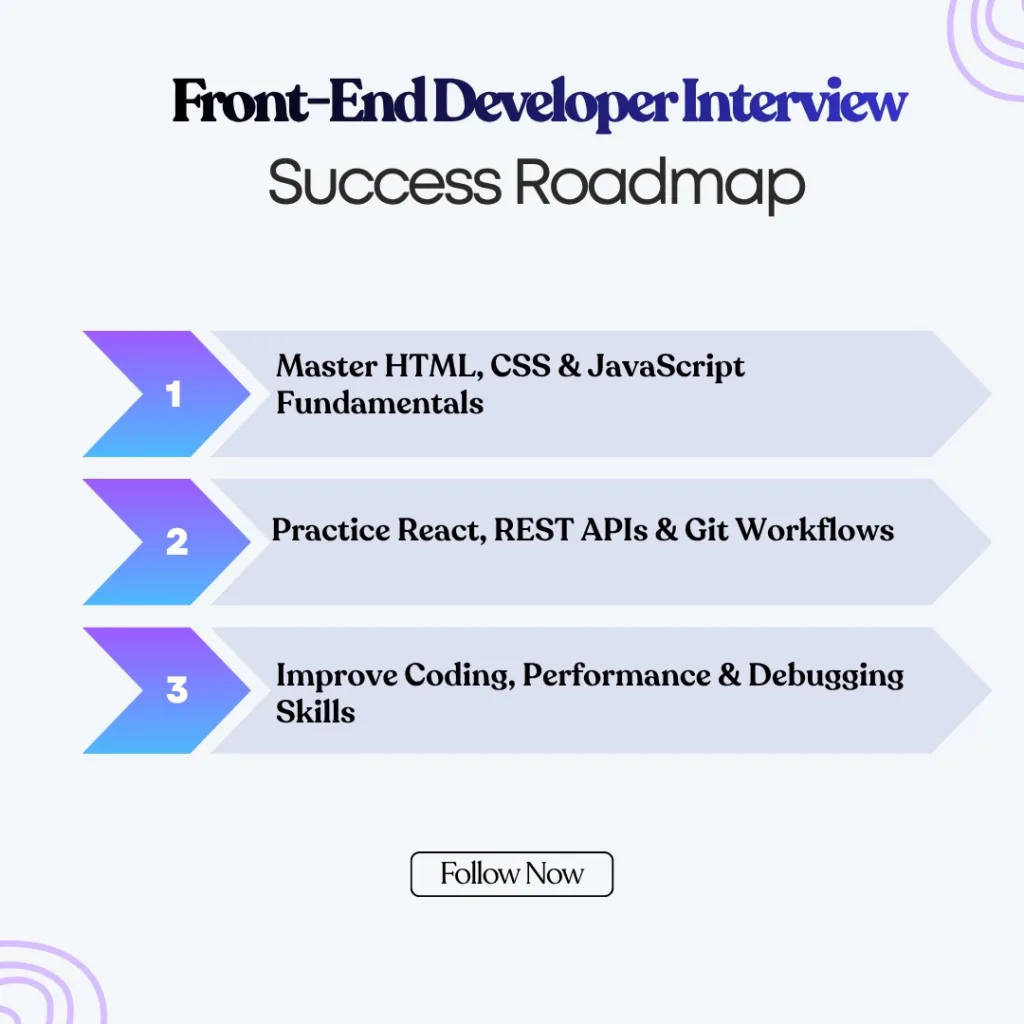
50. How Should You Prepare for a Front-End Developer Interview?
A successful preparation strategy includes:
- Master HTML, CSS, and JavaScript fundamentals.
- Build React, Angular, or Vue projects.
- Practice coding problems regularly.
- Understand REST APIs and Git workflows.
- Optimize application performance.
- Revise browser rendering and debugging.
- Participate in mock interviews.
- Build a strong portfolio showcasing real-world projects.

Conclusion
Preparing for front end developer interview questions requires more than memorizing definitions. Employers seek candidates who understand web fundamentals, write clean and maintainable code, optimize application performance, and solve real-world challenges effectively. Strong knowledge of HTML, CSS, JavaScript, React, browser rendering, APIs, Git, testing, and performance optimization will help you succeed in technical interviews.
Whether you’re preparing for front developer interview questions, front end web developer interview questions, interview questions for a front end developer, frontend developer interview questions, or front end web development interview questions, consistent practice is the key to success. Alongside reviewing software engineering interview questions, associate software engineer interview questions, senior developer interview questions, coding interview questions with solutions, backend questions for interview, restful api interview questions, full stack developer interview questions, and top system design interview questions, you’ll be well-equipped to confidently tackle technical interviews and secure your next front-end development role.
Frequently Asked Questions (FAQs)
1. Which topics are most important for front-end developer interviews?
Focus on HTML5, CSS3, JavaScript (ES6+), React, Angular or Vue, responsive design, browser rendering, REST APIs, Git, performance optimization, and debugging.
2. Are coding questions asked in front-end interviews?
Yes. Most companies include JavaScript coding challenges involving arrays, strings, DOM manipulation, objects, event handling, and algorithms. Practicing coding interview questions with solutions is highly recommended.
3. Do front-end interviews include Data Structures and Algorithms?
Many product-based companies ask interview questions for data structures and algorithms, covering arrays, linked lists, stacks, queues, trees, sorting, searching, and recursion.
4. How are front-end interviews different from full-stack interviews?
Front-end interviews focus on UI development, browser behavior, accessibility, and performance. Full stack developer interview questions additionally cover databases, server-side development, authentication, deployment, and backend architecture.
5. How can I prepare for senior front-end developer interviews?
Build production-ready projects, strengthen JavaScript fundamentals, master React or Angular, practice system design, optimize application performance, review design patterns, and solve coding problems consistently.
