


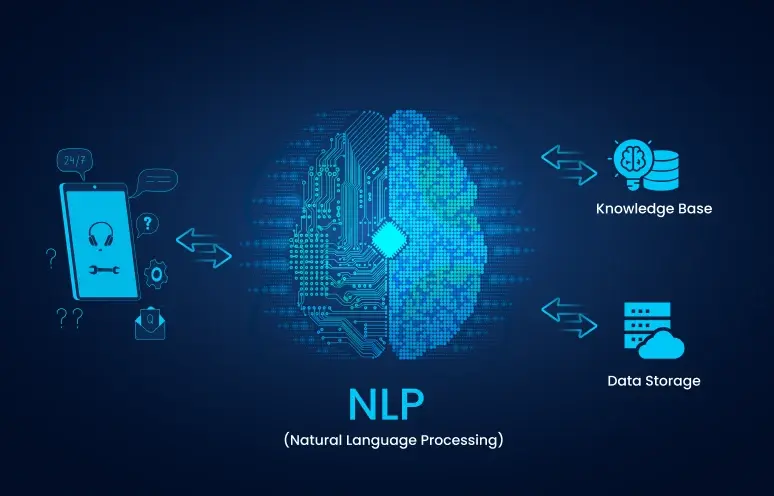
Every time you type a question into Google or ask Siri for the weather, you’re experiencing the invisible hand of Natural Language Processing (NLP). This branch of artificial intelligence is fundamentally reshaping our digital interactions by teaching machines to comprehend human language with remarkable nuance.
Understanding how NLP improves search engines and powers voice assistants reveals the critical technology behind our most common daily tech rituals, moving us from simple keyword matching to true conversational understanding.
Table of Contents
The Foundational Shift: From Keywords to Context
For decades, search engines operated on a relatively simple premise: match the words in a query to the words on a webpage. This keyword-centric approach was brittle, often failing to grasp the user’s true intent. The integration of advanced natural language processing changed everything. Modern search engine algorithms now use NLP to parse the grammatical structure, interpret semantic meaning, and understand the contextual goal behind a string of words.
This shift is why a search for “how to fix a flat bike tire” returns helpful step-by-step guides instead of just pages containing those words in isolation. This is the core of how NLP improves search engines: it transforms them from dumb matching machines into intelligent interpreters of human need.
How NLP Improves Search Engines: Core Mechanisms
The application of NLP in search is multifaceted, enhancing every stage from query processing to result ranking.
- Query Understanding & Intent Recognition: This is where NLP begins its work. When you type “apple,” advanced search engine algorithms use NLP to disambiguate whether you intend to find information about the fruit, the tech company, or the record label. It analyzes your search history, location, and the structure of the query to classify intent into categories like “informational,” “navigational,” “commercial,” or “transactional.”
- Semantic Search & Entity Recognition: NLP moves beyond keywords to understand concepts and relationships. It identifies “entities” (people, places, things) and understands how they connect. A search for “presidents born in Texas” requires the system to know that “Lyndon B. Johnson” and “Dwight D. Eisenhower” are entities of the type “person” and “president,” and that “Texas” is a “place.” This semantic understanding allows for profoundly more accurate results.
- Contextualizing with Transformer Models (like BERT): A landmark in how NLP improves search engines was Google’s BERT update. Models like BERT analyze the full context of every word in a query by looking at the words that come before and after it. This is crucial for understanding prepositions and conversational phrases. For example, in the query “can you get medicine for someone pharmacy,” BERT helps understand that “for someone” is critical context, signaling the user needs information about prescription pickup policies, not just general pharmacy locations.
- Content Analysis & Ranking: On the other side, NLP analyzes the content on web pages. It assesses topic relevance, expertise, authoritativeness, and trustworthiness (concepts central to E-E-A-T) by understanding the content’s semantic depth and quality, not just keyword density. This ensures that pages genuinely answering the user’s intent rank highest.
The Voice Revolution: The Role of NLP in Voice Assistants

Voice interfaces present a unique challenge: processing spontaneous, conversational speech. NLP in voice assistants is the specialized technology stack that makes this possible, creating a seamless pipeline from sound to action.
- Automatic Speech Recognition (ASR): The first step is converting spoken audio into text. While not NLP per se, modern ASR is heavily augmented by natural language processing models to handle accents, dialects, and ambient noise, producing an accurate transcript.
- Natural Language Understanding (NLU) for Voice: This is the critical component of NLP in voice assistants. The NLU module must handle the informality of spoken language—fragments, filler words (“um,” “like”), and vague references (“that thing we saw yesterday”). It performs intent classification and entity extraction from the spoken transcript. For the command “Remind me to call Mom when I get to the grocery store,” it extracts the intent “create_reminder,” the entity “Mom,” and the location-based trigger “grocery store.”
- Dialogue Management & Conversational Context: Unlike a single search query, voice interactions are often multi-turn conversations. NLP in voice assistants enables context tracking. If you ask, “Who directed Inception?” and then follow up with “How old is he?”, the system uses NLP to know “he” refers to Christopher Nolan. This management of the dialogue state is essential for natural interaction.
- Natural Language Generation (NLG): Finally, the assistant’s response must be spoken back. NLP generates a concise, natural-sounding text response (e.g., “Christopher Nolan is 53 years old.”), which is then converted to speech via Text-to-Speech (TTS) synthesis.
Synergy in Action: Voice Search as the Convergence Point
Voice search is the perfect example of these technologies converging. When you ask a smart speaker “Where’s the nearest open pharmacy?”, the process involves:
- ASR converts speech to text.
- Search-focused NLP interprets the query, understanding “nearest” implies location-based ranking and “open” requires checking real-time hours data.
- The search engine algorithms, powered by semantic understanding, retrieve and rank local pharmacy results.
- NLG formulates the top result into a spoken answer: “The closest open pharmacy is CVS on Main Street, 0.5 miles away. It closes at 10 PM.”
This seamless flow from voice to answer is only possible because of deep integration between NLP in voice assistants and NLP improves search engines.
Future Trends and Challenges

The future of NLP in voice assistants and search is moving toward even greater contextual and personal awareness. Multimodal models will process voice, text, and visual cues simultaneously (e.g., showing a recipe on a screen while reading steps aloud).
Challenges remain, including handling complex multi-hop questions, eliminating bias from training data, and preserving user privacy in always-listening environments. However, the trajectory is clear: NLP will continue to make interactions more intuitive, anticipatory, and conversational.
Conclusion
The profound impact of how NLP improves search engines and transforms NLP in voice assistants is undeniable. By enabling machines to grasp meaning, context, and intent, natural language processing has turned search into an intelligent discovery tool and voice assistants into proactive helpers.
This evolution from static keyword systems to dynamic, understanding interfaces represents one of the most significant advancements in human-computer interaction. As search engine algorithms and voice technologies continue to be refined by ever-more-sophisticated NLP, our digital experiences will become increasingly seamless, personalized, and, ultimately, more human.
Frequently Asked Questions (FAQs)
1. How does NLP for search differ from traditional keyword matching?
Traditional keyword matching is a literal, statistical process. It counts how many times query words appear on a page. NLP improves search engines by adding a layer of understanding. It analyzes synonyms, sentence structure, and user intent. For example, a keyword system might match a query for “Java programming” with a page about coffee in Indonesia.
2. Why do voice assistants sometimes misunderstand my question?
Misunderstandings in NLP in voice assistants often occur at the intersection of speech recognition and language understanding. Background noise, strong accents, or mumbled speech can cause ASR errors, creating garbled text for the NLU to parse. Furthermore, ambiguous phrasing, complex questions, or references to personal context the assistant lacks can challenge the NLU module.
3. Do all search engines use the same NLP technology?
While the core principles of natural language processing for search are universal, the specific models and implementations are proprietary and vary. Google’s use of BERT and MUM is a benchmark, but other engines like Microsoft Bing have their own equivalent models (e.g., Microsoft’s Prometheus).
