



The AI analytics tools every marketer should use in 2026 are not optional add-ons—they are the difference between guessing and knowing. Traditional analytics (Google Analytics, Excel dashboards, manual reporting) tell you what happened yesterday. AI analytics tell you what will happen tomorrow, why it will happen, and what to do about it. According to a 2026 Forrester study, marketers who use AI analytics tools are 3.4x more likely to hit their revenue targets than those relying on legacy reporting.
This guide covers the AI analytics tools every marketer should use across five categories: customer behavior prediction, campaign attribution, content performance, sentiment analysis, and real-time personalization. Whether you are a solo marketer or lead a team of 20, these marketing AI analytics tools will double your reporting speed and improve forecast accuracy. We will also cover pricing, integration requirements, and implementation timelines for each tool.
Table of Contents
AI Analytics Tools Every Marketer Should Use: Top 5 Categories
Let’s break down the specific AI analytics tools every marketer should use by function. Each category solves a distinct problem that legacy tools cannot address.
1. Predictive Customer Analytics: Pecan AI

The first category of AI analytics tools every marketer should use is predictive customer analytics. Traditional analytics answer “how many visitors did we get?” Predictive analytics answer “which of today’s visitors will buy within 7 days?” This is the core of marketing AI analytics—moving from descriptive to prescriptive.
Pecan AI is the leading predictive marketing tool for this use case. It connects to your CRM, website event data, and email platform. Within 24 hours, it builds a model that scores every lead on “likelihood to convert.” You then route high-scoring leads to sales and low-scoring leads to nurture campaigns. Early users report 2-3x higher conversion rates on the same traffic.
Other AI analytics tools every marketer should use in this category include Albert.ai (for e-commerce) and MadKudu (for B2B SaaS). Pricing ranges from $500-$2,000/month for mid-market companies. Implementation takes 2-4 weeks. The ROI: a 20% increase in conversion rates on existing traffic.
2. AI-Powered Marketing Attribution: Northbeam
The second category of AI analytics tools every marketer should use is multi-touch attribution. Legacy attribution (last-click or first-click) lies. It gives 100% credit to the last ad clicked, ignoring the podcast, LinkedIn post, and word-of-mouth referral that built awareness.
Northbeam uses predictive marketing tools to solve this. It ingests all your touchpoints (ads, email, organic social, direct, referrals) and uses media mix modeling (MMM) to assign fractional credit to each channel. The result: you know exactly which channels drive incrementally, not just correlation.
For performance marketers, Northbeam is among the AI analytics tools every marketer should use because it prevents budget waste. You discover that your YouTube ads are driving 40% of branded search conversions, even though last-click gave them 5% credit. You reallocate budget accordingly. Pricing starts at $800/month. ROI is typically 5-10x in ad spend efficiency.
3. Content Performance Prediction: Cortex
The third category of AI analytics tools every marketer should use is content performance prediction. You spend hours creating blog posts, videos, and social media content. But which topics will actually drive traffic? Cortex predicts this before you write a single word.
Cortex analyzes your past content performance plus competitor performance plus trending topics. It then scores potential topics on “predicted traffic” and “predicted engagement.” For example, “How to use AI for email marketing” scores 92/100. “Best CRMs for small business” scores 34/100. You write the 92. You skip the 34.
Among marketing AI analytics tools, Cortex is unique because it also predicts optimal content format. Some topics work better as video, some as long-form blog posts, some as Twitter threads. The AI recommends based on your audience’s past behavior. Pricing is $300-$1,000/month. ROI is a 50% reduction in content that fails to drive traffic.
4. Real-Time Sentiment Analysis: Brand24 AI
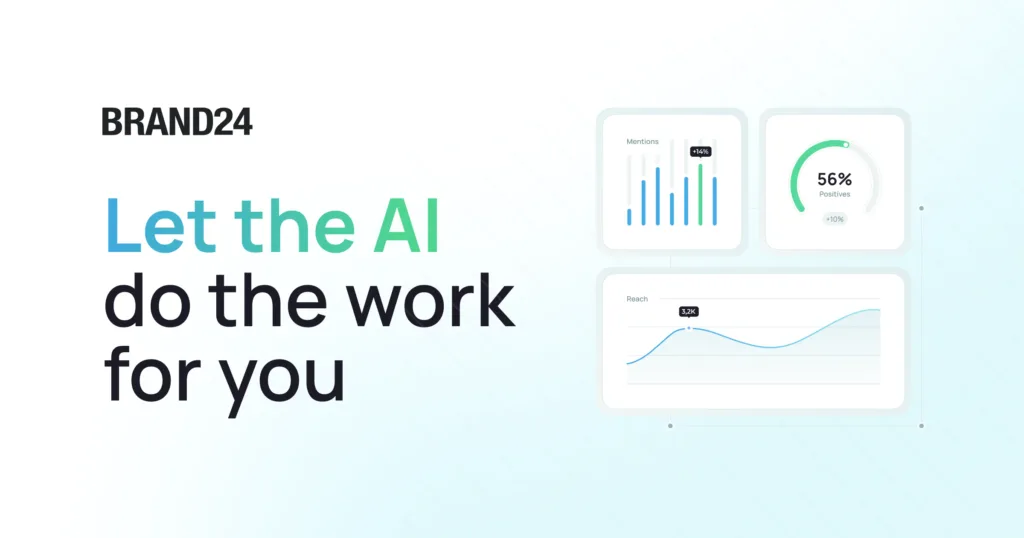
The fourth category of AI analytics tools every marketer should use is real-time sentiment analysis. By the time you see a brand crisis on Twitter, it is often too late. Brand24 AI monitors millions of social posts, reviews, forums, and news sites in real time. It alerts you when sentiment drops below a threshold (e.g., “negative mentions up 300% in the last hour”).
But Brand24 goes beyond alerting. It uses predictive marketing tools to forecast whether a negative trend will grow or fade. A single angry customer with 10 followers will fade. An influencer with 500k followers complaining will explode. The AI distinguishes and recommends action: “Respond within 2 hours” vs. “Ignore.”
These AI analytics tools every marketer should use for reputation management cost $150-$500/month. ROI is avoiding a single brand crisis (which can cost $50k-$500k in lost revenue and repair).
5. Customer Journey Orchestration: Insider

The fifth category of AI analytics tools every marketer should use is customer journey orchestration. Traditional marketing automation sends emails based on time (day 3 after signup). Insider sends experiences based on predicted next action.
Insider’s AI analyzes each user’s behavior and predicts “what will they do next?” If the prediction is “likely to churn,” Insider shows a retention offer. If “likely to upgrade,” it shows a case study. If “likely to buy accessories,” it shows a cross-sell. This is real-time marketing AI analytics applied to every user session.
For e-commerce and B2B SaaS, Insider is among the AI analytics tools every marketer should use because it personalizes without manual rules. Pricing starts at $1,000/month. ROI is a 15-30% lift in conversion rates from existing traffic.
How to Choose AI Analytics Tools Every Marketer Should Use
With hundreds of options, how do you select the AI analytics tools every marketer should use for your specific situation? Follow this framework.
Step 1: Identify your biggest reporting gap. Do you not know which channels drive revenue? Start with attribution (Northbeam). Do you waste budget on low-performing content? Start with prediction (Cortex). Do you miss brand crises? Start with sentiment (Brand24).
Step 2: Start with one tool. Do not buy five at once. The AI analytics tools every marketer should use for your business depend on your maturity. A solo marketer needs different tools than an enterprise team.
Step 3: Demand a pilot. Every vendor should offer a 14-30 day free trial or a “success guarantee” (pay only if you see ROI). Do not sign 12-month contracts for your first predictive marketing tool.
Step 4: Integrate before buying. The AI analytics tools every marketer should use must connect to your data stack (CRM, website analytics, ad platforms). If integration requires weeks of engineering work, choose a different tool.
Implementation Roadmap for AI Analytics Tools
Here is a 90-day plan to deploy the AI analytics tools every marketer should use.
Month 1: Deploy Pecan AI or Northbeam for attribution/prediction. Connect your data. Run in “read-only” mode to validate accuracy.
Month 2: Deploy Cortex for content prediction. Use it to plan your next 20 blog posts or videos. Compare predicted vs. actual traffic.
Month 3: Deploy Brand24 for sentiment monitoring. Set up alerts. Create a response protocol for negative spikes.
By day 90, you will have a complete stack of marketing AI analytics tools that predict customer behavior, attribute revenue accurately, forecast content performance, and monitor brand health in real time.
Common Mistakes When Adopting AI Analytics Tools
Avoid these three errors.
Mistake #1: Buying tools before cleaning data. AI analytics tools every marketer should use are only as good as your input data. If your CRM has duplicate records or your website tracking is broken, fix that first. Budget 2-4 weeks for data cleanup.
Mistake #2: Ignoring the learning curve. AI analytics tools require 2-4 weeks of learning before they produce accurate predictions. Do not judge after 3 days. Run parallel reporting (old vs. new) for 30 days.
Mistake #3: Failing to act on insights. The best predictive marketing tools are useless if you ignore their recommendations. Build a weekly “AI insights review” into your team’s calendar. Assign owners to each action item.
The Future of AI Analytics for Marketers
By 2028, AI analytics tools every marketer should use will be bundled into single platforms (HubSpot AI, Salesforce Einstein, Adobe Sensei). Standalone tools will consolidate. Real-time predictions will be the default—batch reporting will seem archaic. Marketers who master AI analytics today will be directors and VPs tomorrow. Those who ignore it will struggle to explain why their campaigns failed.
Final Verdict
The AI analytics tools every marketer should use in 2026 are Pecan AI (predictive analytics), Northbeam (attribution), Cortex (content prediction), Brand24 (sentiment), and Insider (journey orchestration). Start with one tool based on your biggest reporting gap. Clean your data first. Run a pilot. Act on insights weekly. Within 90 days, you will forecast revenue more accurately, reduce wasted ad spend, and catch brand crises before they explode. The tools are ready. Are you?
Frequently Asked Questions (FAQs)
Q1: What is the most affordable AI analytics tool for a solo marketer?
For solo marketers or small businesses (under $1M revenue), start with Brand24 AI ($150/month) for sentiment monitoring or Cortex ($300/month) for content prediction. Both offer free trials. Avoid Pecan AI and Northbeam (enterprise pricing, $800+/month) until you have budget. Also consider Google Analytics 4 (free) with its new “predictive audiences” feature—it predicts purchase likelihood and churn risk at no cost. While GA4 is not as powerful as paid marketing AI analytics tools, it is an excellent starting point.
Q2: How long does it take to see ROI from AI analytics tools?
Predictive marketing tools show initial ROI in 30-60 days. Pecan AI needs 2-4 weeks of historical data to build accurate models. Northbeam needs 30-60 days of multi-channel data for reliable attribution. Cortex shows ROI immediately: you stop writing low-potential content on day one. Brand24 shows ROI the first time it catches a brand crisis before it goes viral. Overall, expect 60-90 days for full stack ROI. Most AI analytics tools every marketer should use pay for themselves within 3-6 months through ad spend savings or increased conversion rates.
Q3: Do I need a data scientist to use AI analytics tools?
No. The AI analytics tools every marketer should use are designed for marketers, not data scientists. Pecan AI has a “no-code” interface where you select your data sources and goal (e.g., “predict which leads will convert”). Northbeam automatically builds media mix models without SQL. Cortex requires only your content library. However, you do need basic data literacy: understanding what a “confidence interval” means and why correlation is not causation. Budget 2-3 days of training per tool. Vendors provide free onboarding.
Q4: Can I use free or open-source AI analytics instead of paid tools?
Yes, but with significant trade-offs. Google Analytics 4 (free) includes predictive audiences. Apache Superset (open-source) can connect to AI models you build yourself. R or Python with scikit-learn lets you build custom marketing AI analytics for zero software cost. However, you will spend 20-50 hours on setup, integration, and maintenance. For most marketers, paid tools ($150-$2,000/month) are cheaper than their own time. The exception is enterprise companies with dedicated data science teams—they may prefer custom open-source solutions for full control.
