


The marketing landscape is rapidly evolving, and AI is becoming a core driver of this transformation. Traditional marketing teams often spend significant time on repetitive tasks such as campaign setup, audience segmentation, performance tracking, and content distribution. Today, AI are reshaping these processes by creating smarter, faster, and more adaptive systems that improve efficiency and business outcomes.
Modern businesses are increasingly adopting AI marketing automation solutions to streamline daily operations and eliminate manual bottlenecks. Rather than acting as simple automation software, AI can independently analyze data, make decisions, optimize campaigns, and continuously learn from outcomes. Similar to Agentic Automation in Legal Work, where intelligent systems automate contract analysis and compliance processes, AI in marketing are transforming how organizations manage and optimize workflows at scale.
What Are AI Agents in Digital Marketing?
AI agents are intelligent systems designed to perform specific marketing functions with minimal human intervention. Unlike conventional tools that execute fixed rules, AI understand context, process large volumes of information, and adapt based on changing user behavior.
The rise of digital marketing AI has enabled organizations to move beyond basic automation and toward dynamic decision-making systems that improve performance in real time.
Examples include:
- Automated campaign optimization
- Personalized customer communication
- Predictive lead scoring
- Real-time audience segmentation
- AI-powered content recommendations
- Dynamic budget allocation
These capabilities contribute significantly to better customer experiences and increased operational efficiency.
Key Ways AI Agents Are Transforming Marketing Workflows
1. Intelligent Campaign Planning and Optimization
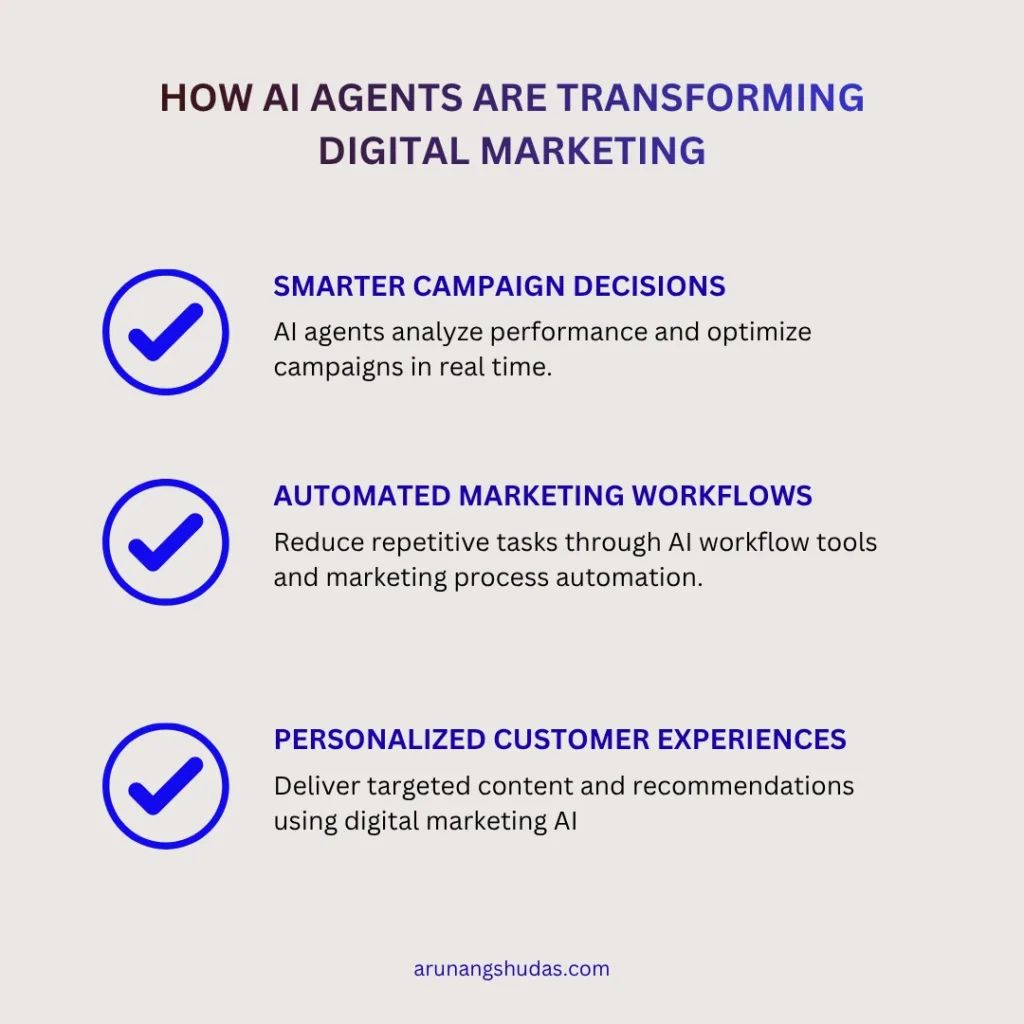
Marketing teams no longer need to manually monitor every campaign metric. Through intelligent campaign management, AI can:
- Analyze campaign performance continuously
- Identify high-performing audience segments
- Suggest budget reallocations
- Predict campaign outcomes
- Pause underperforming ads automatically
Example:
An e-commerce company running paid advertising campaigns across Google and social media channels can use AI to automatically shift spending toward platforms delivering the highest return on investment.
This reduces manual intervention while improving campaign effectiveness.
2. Enhanced Content Creation Systems
Content production often requires extensive time and resources. Modern AI content systems help marketing teams accelerate the content lifecycle.
AI agents can:
- Generate blog topics
- Draft marketing copy
- Personalize email content
- Create social media captions
- Suggest SEO improvements
For example, a marketing team launching a new product can use AI systems to generate multiple versions of ad copy for different customer personas.
This enables faster production cycles and consistent messaging across channels.
3. Improved Marketing Productivity
One of the biggest advantages of AI agents is increased efficiency. Marketing productivity AI enables organizations to reduce repetitive work and allow teams to focus on strategy and creativity.
Common tasks handled by AI include:
- Report generation
- Lead qualification
- Email scheduling
- Customer journey mapping
- Performance monitoring
Benefits include:
- Faster execution
- Reduced human error
- Better resource utilization
- Increased team output
4. Smarter Workflow Management
Organizations are now using AI workflow tools to automate complex marketing processes.
Examples include:
- Customer onboarding workflows
- Multi-channel campaign execution
- Data synchronization
- Lead nurturing pipelines
AI agents can connect multiple systems and execute tasks automatically, creating seamless operational processes.
This is driving a shift toward AI-driven marketing operations, where entire workflows function intelligently with limited manual oversight.
5. Scaling Enterprise Marketing Operations
Large organizations manage vast amounts of customer data and campaign activities. Traditional processes often struggle to scale efficiently.
With enterprise marketing automation, companies can:
- Coordinate global campaigns
- Manage large customer databases
- Personalize communication at scale
- Automate reporting systems
AI agents can operate across departments, improving collaboration and reducing operational complexity.
Benefits of AI Content Systems
| AI Content Capability | Workflow Improvement |
| Automated Blog Suggestions | Faster content planning |
| AI Copywriting Assistance | Reduced writing time |
| Personalized Email Content | Better engagement rates |
| SEO Recommendations | Improved search visibility |
| Multi-Channel Content Generation | Consistent brand messaging |
Emerging AI Agent Capabilities Beyond Marketing
The evolution of AI agents extends beyond marketing use cases and influences multiple business functions.
Agentic Automation in Legal Work
AI agents are increasingly supporting legal teams by reviewing contracts, identifying risks, and automating documentation processes. This demonstrates how intelligent systems can handle highly structured workflows beyond marketing environments.
Memory for Agents
Advanced AI systems now incorporate Memory for Agents, allowing them to retain context from previous interactions. In marketing, this means AI can remember customer preferences, campaign history, and behavioral patterns to improve personalization.
Product Management Agents
Organizations are also adopting Product Management Agents that help teams analyze user feedback, prioritize feature requests, and manage product roadmaps.
Executive Agents
Businesses are beginning to use Executive Agents to assist leadership teams with meeting summaries, strategic reporting, and data-driven recommendations.
State Management in Long-Running Agents
Complex workflows often involve processes running over extended periods. State Management in Long-Running Agents enables AI systems to maintain continuity, track progress, and execute tasks reliably across multiple stages.
How AI Workflow Tools Improve Operations
| Workflow Area | AI-Driven Improvement |
| Customer Onboarding | Faster automated engagement |
| Campaign Execution | Real-time coordination across channels |
| Data Synchronization | Reduced manual data handling |
| Lead Nurturing | Personalized communication sequences |
| Analytics Reporting | Automated performance tracking |
Business Benefits of AI Agent Adoption
Organizations implementing autonomous marketing systems and marketing process automation are experiencing measurable benefits:
- Increased campaign efficiency
- Better customer targeting
- Faster decision-making
- Reduced operational costs
- Higher conversion rates
- Improved personalization
- Greater scalability
The Future of Marketing Workflows
The future of marketing is moving toward interconnected intelligent systems where AI agents collaborate across channels and departments. Businesses adopting AI -driven marketing operations are likely to gain competitive advantages through speed, accuracy, and personalization.
As AI marketing automation continues to evolve, AI agents will shift from supporting teams to becoming active participants in decision-making and operational execution.
Organizations that embrace these technologies today are positioning themselves for a future where marketing becomes more intelligent, adaptive, and outcome-driven.
Frequently Asked Questions (FAQs)
1. What are AI agents in digital marketing?
AI agents are intelligent systems that automate marketing tasks, analyze customer data, optimize campaigns, and make decisions with minimal human intervention.
2. How do AI agents improve marketing workflows?
AI agents improve workflows by automating repetitive tasks, optimizing campaigns in real time, personalizing communication, and increasing operational efficiency.
3. What is the difference between AI automation and AI agents?
Traditional automation follows predefined rules, while AI agents can learn from data, adapt to user behavior, and make intelligent decisions independently.
4. Can small businesses use AI marketing automation?
Yes, small businesses can use AI marketing automation to improve productivity, reduce operational costs, and manage campaigns more effectively without large teams.
5. What industries are using AI agents besides marketing?
Industries such as legal services, product management, finance, customer support, and executive operations are increasingly adopting AI agents for workflow automation and intelligent decision-making.
