


Financial Decision-Making has become increasingly data-driven as Fintech Companies adopt technologies that can accelerate Report Analysis and strengthen Risk Management. Traditional financial automation tools have helped organizations reduce repetitive manual work, but newer Autonomous AI Agents are changing how finance teams approach complex, multi-step processes. Rather than simply following predefined instructions, AI-driven systems can interpret information, make context-aware decisions, and take action across connected applications.
For finance leaders, the comparison is no longer simply about replacing spreadsheets or automating individual tasks. Modern systems can support Financial Decision-Making, help Fintech Companies improve Report Analysis, and provide continuous Risk Management capabilities. The key question is whether organizations should continue relying primarily on rule-based automation or move toward systems capable of managing workflows with greater autonomy.
What Are Traditional Financial Automation Tools?
Traditional financial automation tools are designed to execute predefined, repeatable processes. They typically rely on rules, templates, scripts, integrations, and scheduled workflows. Robotic Process Automation (RPA), for example, can extract information from applications, transfer data between systems, generate reports, and perform repetitive reconciliation tasks.
These systems remain valuable because their behavior is predictable. When a process is stable and clearly defined, rule-based automation can deliver consistent results with relatively low complexity.
However, traditional automation can become difficult to maintain when processes involve unstructured information, changing business conditions, or frequent exceptions. A workflow may require human intervention whenever an unexpected document, transaction, or business scenario appears.
What Are Autonomous AI Agents?
Autonomous AI Agents are software systems designed to perceive information, reason about objectives, use tools, and execute multi-step tasks with limited human intervention.
Instead of simply following a fixed sequence, an agent can determine what needs to happen next based on the available information and the desired outcome. For example, an agent supporting a finance team might review a company report, identify unusual financial trends, gather supporting information, summarize findings, and route the analysis to the appropriate stakeholder.
This makes agents particularly relevant for complex processes where the path to completion is not always identical.
AI Agents vs RPA
The distinction between AI agents vs RPA is primarily about adaptability and autonomy.
RPA is generally strongest when the organization has a clearly defined process with predictable inputs and outputs. AI agents are more useful when the workflow requires interpretation, reasoning, prioritization, or dynamic decision-making.
| Feature | Traditional RPA | Autonomous AI Agents |
| Process structure | Fixed and rule-based | Dynamic and goal-oriented |
| Data | Mostly structured | Structured and unstructured |
| Decision-making | Predefined rules | Context-aware reasoning |
| Exceptions | Often require human intervention | Can assess and respond to many exceptions |
| Workflow changes | Usually require configuration | Can adapt within defined objectives |
| Best use case | Repetitive processes | Complex multi-step workflows |
How Intelligent Automation Is Changing Finance
Intelligent automation finance strategies combine automation with AI, analytics, natural-language processing, and decision-support capabilities. Instead of automating only individual actions, organizations can automate larger portions of a business process.
For example, an accounts payable workflow can move beyond invoice data extraction. An intelligent system could identify invoices, compare them with purchase orders, detect anomalies, request missing information, route exceptions, and provide a summary to the finance team.
This evolution is contributing to broader enterprise finance automation, where organizations seek to automate processes across accounting, treasury, FP&A, compliance, investment research, and financial operations.
Workflow Orchestration and Business Process AI
Modern workflow orchestration AI can coordinate multiple applications, data sources, models, and business rules within a single process.
Traditional automation often treats each task independently. An orchestration layer can instead connect the tasks into an end-to-end workflow.
For example:
- Retrieve financial statements.
- Extract relevant metrics.
- Compare current performance with historical results.
- Identify unusual movements.
- Research potential explanations.
- Generate an analytical summary.
- Escalate material issues.
- Record the completed workflow.
This is where business process AI can provide significant value. The system is not merely performing a single automated action; it is coordinating several activities toward a defined business objective.
Autonomous Workflow Systems vs Rule-Based Automation
Autonomous workflow systems are particularly useful when business processes contain uncertainty. Financial workflows frequently involve incomplete information, changing requirements, and exceptions that cannot be anticipated through static rules alone.
However, autonomy does not mean removing controls. Financial institutions still need permissions, audit trails, approval thresholds, data governance, and human oversight for sensitive activities.
| Dimension | Rule-Based Automation | Autonomous Workflow Systems |
| Logic | Explicit rules | Goals, context, and reasoning |
| Adaptability | Limited | Higher |
| Human involvement | Frequent for exceptions | Focused on oversight and approvals |
| Unstructured data | Limited capability | Stronger capability |
| Scalability | Process-dependent | Potentially broader |
| Governance | Relatively straightforward | Requires stronger AI controls |
Applications in Financial Services
The use cases for AI extend across multiple financial functions.
Financial Research Workflows
AI can accelerate Financial Research Workflows by collecting information from approved sources, organizing documents, comparing companies, extracting important metrics, and preparing research summaries.
Analysts can spend more time evaluating conclusions instead of manually gathering and organizing information.
Private Equity Due Diligence
In Private Equity Due Diligence, AI systems can help review large volumes of financial documents, identify important contractual terms, summarize company performance, and highlight areas requiring additional investigation.
The technology does not eliminate investment judgment. Instead, it can reduce the amount of manual information processing required before professionals make decisions.
Financial Modeling for Analysts
AI can support Financial Modeling for Analysts by helping organize historical financial data, identify relevant assumptions, explain model relationships, and assist with scenario analysis.
Human analysts should continue to validate assumptions and outputs, particularly when models influence investment or corporate decisions.
AI Agents in Wealth Management
AI Agents in Wealth Management can assist with portfolio research, client reporting, document preparation, financial education, and workflow coordination.
Because wealth management involves sensitive client information and regulated activities, agent-based systems require appropriate authorization, monitoring, and human review.
Financial Risk Monitoring
AI can support Financial Risk Monitoring by continuously evaluating transactions, financial indicators, market information, and operational signals.
Unlike periodic manual reviews, an AI-enabled monitoring system can potentially identify patterns as they emerge and prioritize issues for investigation.
AI Operations Finance and Intelligent Enterprise Systems
AI operations finance focuses on applying AI to the day-to-day activities required to operate finance organizations efficiently.
This can include:
- Financial reporting
- Reconciliation
- Expense management
- Forecasting
- Treasury operations
- Compliance monitoring
- Document processing
- Management reporting
- Financial research
- Exception handling
At a broader organizational level, intelligent enterprise systems connect AI capabilities with enterprise applications, data platforms, and governance mechanisms.
The goal is not simply to introduce AI into individual departments. It is to create connected processes that can operate across organizational boundaries.
Comparing Efficiency, Cost, and Scalability
A useful finance technology comparison should consider more than automation percentages. Organizations should evaluate implementation costs, maintenance requirements, reliability, governance, scalability, and the complexity of the processes being automated.
| Evaluation Area | Traditional Automation | Autonomous AI |
| Implementation | Often faster for defined tasks | More complex |
| Maintenance | Rules may require frequent updates | Models and agent behavior require monitoring |
| Flexibility | Lower | Higher |
| Processing unstructured data | Limited to moderate | Strong |
| Operational predictability | High | Requires controls and monitoring |
| Best ROI | High-volume repetitive tasks | Complex knowledge workflows |
Where AI Efficiency Tools Make the Most Sense
AI efficiency tools are most valuable when employees spend significant time performing repetitive cognitive work rather than purely mechanical tasks.
Examples include:
- Reviewing lengthy financial documents
- Preparing recurring research summaries
- Monitoring financial indicators
- Comparing multiple reports
- Investigating anomalies
- Coordinating information across systems
- Preparing management updates
Organizations should not automatically replace every existing automation system with AI. Stable, deterministic processes may continue to be better suited to conventional automation.
AI Systems in Financial Services: Key Considerations
The adoption of AI Systems in Financial Services requires a strong governance framework. Financial organizations need to understand what an AI system can access, what actions it can perform, and when a human must approve its decisions.
Important considerations include:
- Data privacy
- Access controls
- Model validation
- Auditability
- Explainability
- Human oversight
- Cybersecurity
- Regulatory compliance
- Accuracy monitoring
- Vendor risk management
Autonomous systems should operate within clearly defined boundaries rather than receiving unrestricted access to financial systems.
When Should Companies Choose Traditional Automation?
Traditional automation can remain the better choice when:
- The process is highly predictable.
- Inputs and outputs are structured.
- Rules rarely change.
- Audit requirements favor deterministic behavior.
- The workflow does not require interpretation.
- The organization needs a simple and highly controlled solution.
For example, automatically moving a fixed data field from one enterprise application to another may not require an AI agent.
When Should Companies Consider Autonomous AI?
Autonomous AI can be more attractive when:
- Processes involve unstructured information.
- Employees must interpret documents.
- Workflows contain many exceptions.
- Multiple systems need to be coordinated.
- The process requires research or contextual analysis.
- Business conditions change frequently.
- The organization wants to automate knowledge-intensive work.
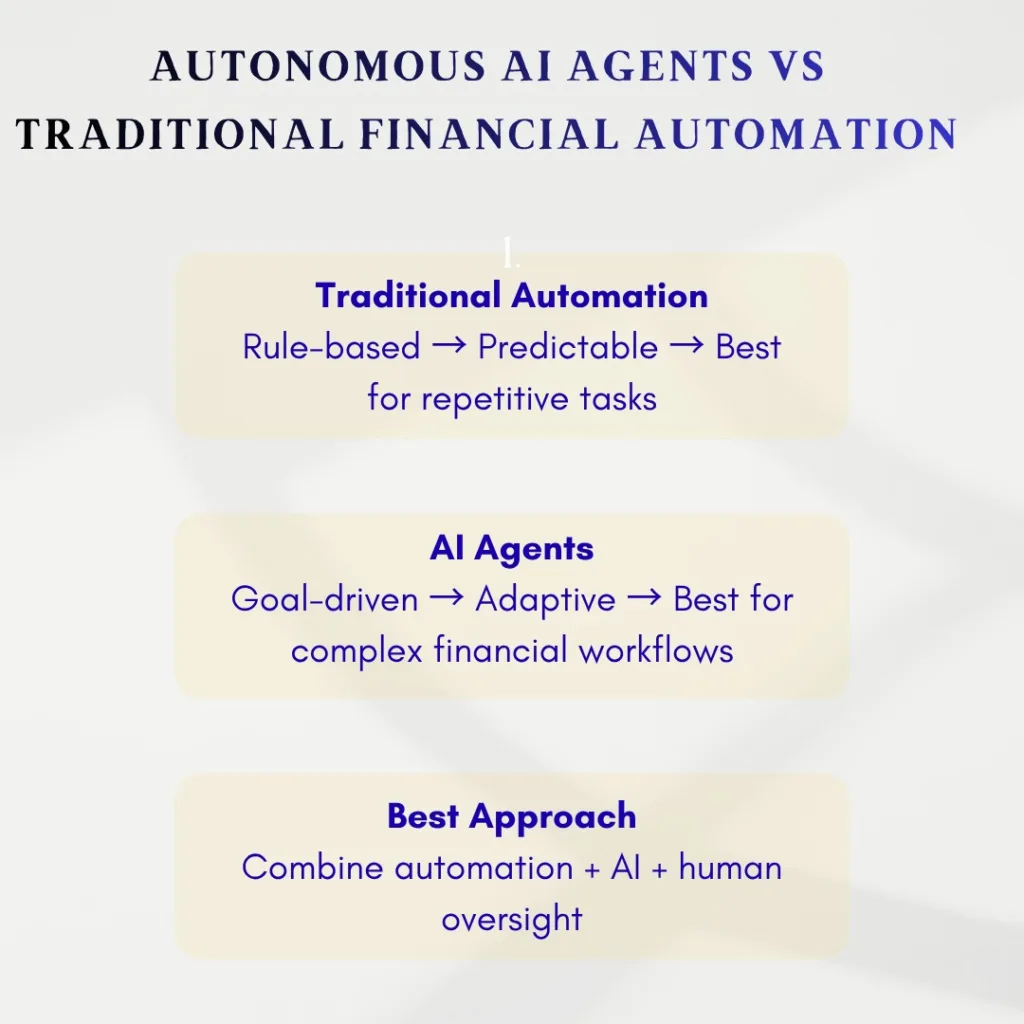
The strongest strategy is often hybrid rather than replacing one technology with another.
A Hybrid Approach to Financial Automation
A mature finance technology environment may combine RPA, APIs, traditional workflow systems, analytics, and AI agents.
For example, an enterprise could use RPA for deterministic data transfers, APIs for system integration, AI for document interpretation, and human approval for high-impact financial decisions.
This approach allows each technology to perform the work it handles best.
| Technology | Ideal Role | Example |
| RPA | Deterministic task automation | Data entry |
| APIs | System connectivity | Data synchronization |
| Workflow platforms | Process management | Approval routing |
| AI agents | Complex cognitive workflows | Research and investigation |
| Analytics | Insight generation | Financial performance analysis |
| Human experts | Judgment and accountability | Investment decisions |
The Future of Enterprise Finance Automation
The next generation of financial automation is likely to focus less on isolated task automation and more on end-to-end intelligent workflows.
AI agents may increasingly operate as digital coworkers that can gather information, coordinate tasks, perform analysis, and prepare outputs for human review.
However, successful adoption will depend on governance as much as technical capability. Financial organizations need to establish clear boundaries around autonomous actions, maintain auditability, and ensure that humans remain accountable for important decisions.
The most effective organizations will likely combine conventional automation with AI rather than treating them as competing technologies. The objective is not simply to automate more tasks; it is to build financial operations that are faster, more adaptive, measurable, and appropriately controlled.

FAQs
1. What is the main difference between AI agents and traditional financial automation?
Traditional automation generally follows predefined rules and workflows, while AI agents can interpret information, reason about objectives, and dynamically determine the next steps within defined boundaries.
2. Are autonomous AI agents better than RPA for finance?
Not necessarily. RPA remains highly effective for repetitive, predictable processes. AI agents are more appropriate for complex workflows involving unstructured information, exceptions, research, and contextual reasoning.
3. How can AI improve financial operations?
AI can reduce manual research, automate document analysis, identify anomalies, coordinate multi-step workflows, support reporting, and help finance professionals process large volumes of information more efficiently.
4. Can autonomous AI agents make financial decisions without humans?
They can perform certain decisions or actions within predefined permissions, but high-impact financial decisions should generally include appropriate human oversight, approval mechanisms, monitoring, and governance.
5. What should companies consider before adopting autonomous AI?
Companies should evaluate data quality, security, integration requirements, regulatory obligations, auditability, access controls, model performance, human oversight, and the potential return on investment.
