


The financial industry generates and reviews enormous volumes of corporate documents every year, making speed and accuracy more important than ever. Modern AI-powered solutions are transforming Investment Banking Operations by helping professionals process SEC filings, identify financial trends, and extract critical business insights in a fraction of the traditional time. As organizations manage increasing volumes of financial disclosures, SEC filing automation has become a valuable capability for improving efficiency while maintaining high standards of analysis.
At the same time, businesses are embracing AI to improve Financial Decision-Making across investment firms, accounting teams, and corporate finance departments. Intelligent platforms powered by annual report AI can process thousands of pages of financial reports while supporting Core Infrastructure for enterprise document management. These technologies reduce manual effort, accelerate research, and help analysts focus on strategic interpretation rather than repetitive document review.
Why SEC Filing Analysis Matters
Public companies listed in the United States must submit various filings to the Securities and Exchange Commission (SEC). These documents provide investors, analysts, regulators, and financial institutions with critical information regarding a company’s financial health, governance, operations, and potential risks.
Some of the most important SEC documents include:
- 10-K Annual Reports
- 10-Q Quarterly Reports
- 8-K Current Reports
- Proxy Statements
- S-1 Registration Statements
- Insider Trading Reports
Each filing may contain hundreds of pages filled with financial statements, legal disclosures, risk factors, accounting notes, and management commentary.
Traditionally, reviewing these reports has required hours—or even days—of manual work.
The Challenge of Manual Annual Report Analysis
Financial analysts often spend significant time reading and comparing lengthy reports.
Common challenges include:
- Thousands of pages to review
- Inconsistent document formatting
- Complex accounting language
- Hidden financial risks
- Cross-document comparisons
- Tight reporting deadlines
- Human error during manual review
These challenges have increased the demand for enterprise document AI, enabling organizations to automate repetitive document-intensive processes while improving consistency and analytical depth.
What Are AI Agents?
Autonomous AI Agents are intelligent software systems capable of understanding tasks, retrieving relevant information, analysing documents, reasoning over complex data, and generating actionable insights with minimal human intervention.
Unlike traditional automation tools that follow predefined rules, AI agents can:
- Understand natural language
- Interpret financial terminology
- Compare multiple reports
- Detect anomalies
- Summarise complex disclosures
- Generate recommendations
- Learn from previous analyses
For finance professionals, these capabilities significantly improve finance research automation while reducing the burden of repetitive document reviews.
How AI Agents Automate SEC Filing Analysis
Modern AI agents follow a structured workflow to process corporate filings efficiently.
Step 1: Document Collection
The system automatically gathers:
- SEC filings
- Annual reports
- Quarterly reports
- Earnings transcripts
- Investor presentations
This is where corporate filings AI reduces manual downloading and document organisation.
Step 2: Intelligent Document Parsing
AI extracts:
- Financial statements
- Balance sheets
- Income statements
- Cash flow statements
- Risk factors
- MD&A sections
- Footnotes
- Executive commentary
This enables advanced financial disclosure tools to organise information into searchable datasets.
Step 3: Financial Statement Extraction
The AI identifies:
- Revenue
- EBITDA
- Net income
- Operating expenses
- Debt
- Cash reserves
- Capital expenditure
- Margins
The extracted data supports highly accurate financial statement analysis across multiple reporting periods.
Step 4: Trend Detection
Rather than simply extracting numbers, AI agents identify:
- Revenue growth trends
- Profitability changes
- Cost increases
- Debt accumulation
- Liquidity concerns
- Margin compression
This supports stronger strategic analysis without requiring manual spreadsheet comparisons.
Step 5: Risk Identification
AI automatically highlights:
- Litigation risks
- Regulatory issues
- Accounting changes
- Going concern warnings
- Cybersecurity disclosures
- Supply chain risks
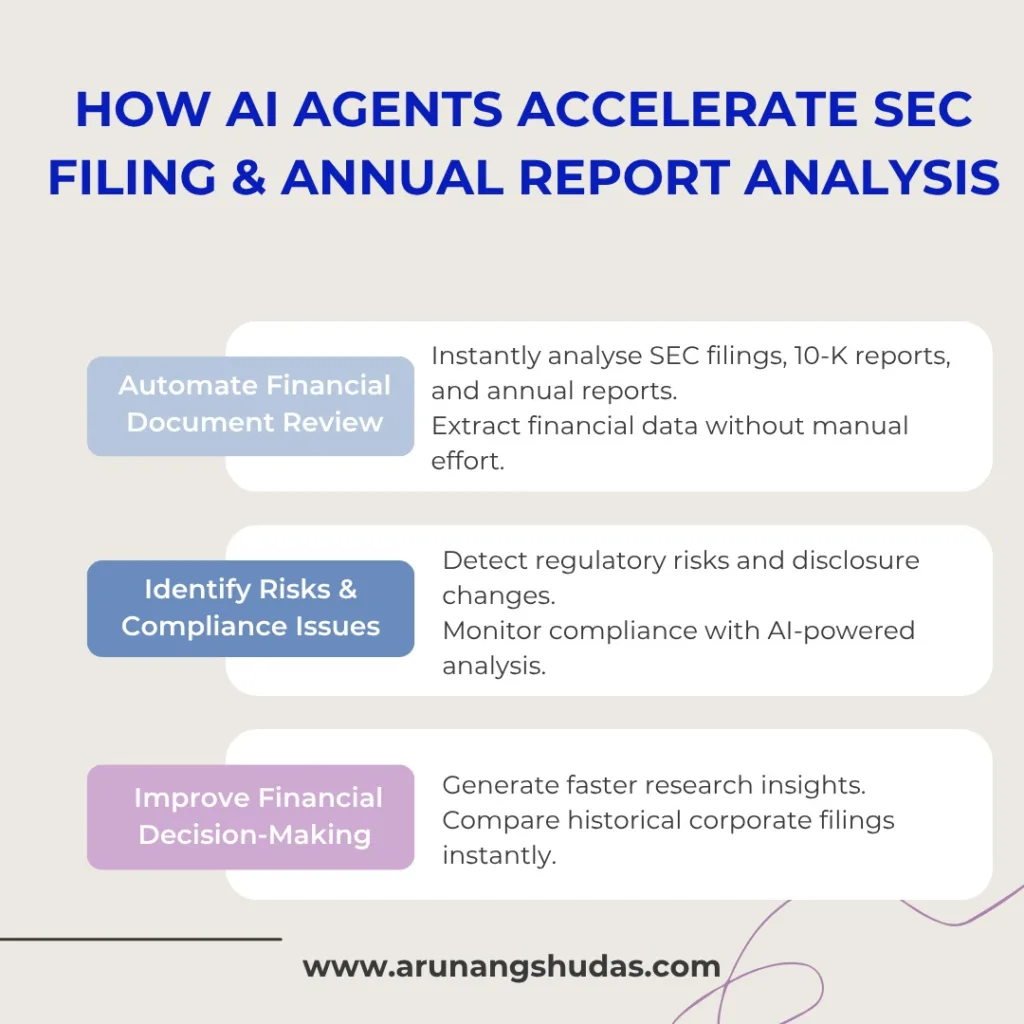
These capabilities are increasingly important for Financial Risk Monitoring within investment firms and corporate finance teams.
How Annual Report AI Improves Analyst Productivity
Financial professionals spend a significant portion of their time reading reports rather than analysing them.
AI dramatically changes this workflow by:
- Summarising reports
- Highlighting key metrics
- Identifying unusual disclosures
- Comparing previous filings
- Flagging inconsistencies
- Creating executive summaries
This allows analysts to focus on interpretation instead of manual document review.
AI for 10-K Analysis Automation
The annual 10-K report is one of the most comprehensive corporate disclosures.
Using 10-K analysis automation, AI agents can:
- Compare multiple years of reports
- Detect changes in accounting policies
- Highlight new risk factors
- Identify executive compensation changes
- Compare segment performance
- Analyse management commentary
- Detect unusual wording changes
This saves analysts countless hours during earnings seasons.
Manual vs AI-Based SEC Filing Analysis
| Activity | Manual Process | AI Agent Process |
| Document Collection | Manual downloads | Automatic retrieval |
| Financial Extraction | Spreadsheet entry | Instant extraction |
| Risk Review | Manual reading | AI-based detection |
| Trend Analysis | Time-consuming | Automated insights |
| Report Comparison | Manual comparison | Cross-document analysis |
| Executive Summary | Written manually | AI-generated summaries |
Regulatory Reporting AI Enhances Compliance
Compliance teams must ensure that financial disclosures meet regulatory requirements while identifying potential reporting issues.
Regulatory reporting AI assists by:
- Monitoring disclosure completeness
- Tracking reporting deadlines
- Detecting missing information
- Identifying policy inconsistencies
- Supporting internal audit teams
These capabilities strengthen governance while reducing manual compliance workloads.
AI Compliance Systems Reduce Operational Risk
Modern AI compliance systems continuously monitor financial documents for:
- Missing disclosures
- Regulatory changes
- Policy deviations
- ESG reporting requirements
- Internal compliance standards
Instead of periodic reviews, organisations gain continuous compliance monitoring.
Enterprise Document AI for Financial Organisations
Large financial institutions manage millions of documents annually.
Enterprise document AI supports:
- Document classification
- Metadata extraction
- Intelligent search
- Version comparison
- Secure document retrieval
- Knowledge management
These capabilities improve collaboration across finance, legal, audit, and compliance teams.
Key AI Features in Financial Document Analysis
| AI Capability | Business Benefit |
| Natural Language Processing | Understands financial language |
| Document Summarisation | Faster report review |
| Risk Detection | Early issue identification |
| Financial Extraction | Accurate data capture |
| Trend Analysis | Better forecasting |
| Cross-Document Comparison | Improved historical analysis |
| Automated Reporting | Reduced manual workload |
Financial Research Workflows Powered by AI
AI is reshaping Financial Research Workflows by automating repetitive research tasks.
Examples include:
- Company screening
- Financial ratio extraction
- Industry comparisons
- Historical filing analysis
- Earnings trend analysis
- Competitive benchmarking
Researchers can now analyse hundreds of companies in the time previously required for only a handful.
AI in Private Equity Due Diligence
Due diligence requires reviewing extensive financial and legal documentation.
AI supports Private Equity Due Diligence by:
- Analysing historical financial statements
- Identifying unusual liabilities
- Reviewing governance disclosures
- Detecting accounting changes
- Comparing acquisition targets
- Generating due diligence reports
This accelerates deal evaluation while improving consistency.
Financial Modeling for Analysts Using AI
Modern AI assists with Financial Modeling for Analysts by:
- Importing financial data
- Building forecast assumptions
- Updating historical models
- Detecting anomalies
- Calculating valuation metrics
- Supporting scenario planning
Instead of replacing analysts, AI enhances productivity and model accuracy.
AI Applications Across Financial Teams
| Department | AI Use Case |
| Investment Banking | SEC filing review |
| Equity Research | Financial trend analysis |
| Asset Management | Portfolio research |
| Private Equity | Due diligence |
| Compliance | Regulatory monitoring |
| Corporate Finance | Annual report analysis |
| Internal Audit | Risk assessment |
AI Agents in Wealth Management
Advisory firms increasingly rely on AI Agents in Wealth Management to process financial disclosures quickly.
Benefits include:
- Faster investment research
- Better portfolio monitoring
- Company performance tracking
- Earnings analysis
- Client reporting support
- Improved investment recommendations
Financial advisers receive relevant insights without manually reviewing every filing.
AI Systems in Financial Services
Across banks, investment firms, insurers, and accounting organisations, AI Systems in Financial Services are improving operational efficiency.
Typical applications include:
- Document intelligence
- Customer reporting
- Regulatory compliance
- Investment analysis
- Fraud detection
- Financial forecasting
- Research automation
These systems create scalable workflows while supporting better business outcomes.
Future of Corporate Filing Analysis
Future AI agents will become increasingly autonomous by:
- Monitoring filings in real time
- Explaining financial changes automatically
- Predicting regulatory risks
- Generating investment summaries
- Integrating with business intelligence platforms
- Supporting conversational financial research
As AI models continue to evolve, financial professionals will spend less time gathering information and more time making strategic decisions
Benefits of AI Agents for SEC Filing Analysis
| Benefit | Business Impact |
| Faster document review | Higher analyst productivity |
| Automated financial extraction | Improved data accuracy |
| Continuous compliance monitoring | Reduced regulatory risk |
| AI-generated summaries | Faster executive reporting |
| Historical comparisons | Better strategic insights |
| Scalable document processing | Lower operational costs |
| Enhanced research workflows | Improved investment decisions |
Best Practices for Implementing AI in Financial Analysis
To maximise the value of AI-driven SEC filing analysis, organisations should:
- Establish strong data governance policies.
- Validate AI-generated outputs with expert review.
- Integrate AI with existing financial systems.
- Maintain compliance with regulatory standards.
- Regularly update AI models using current financial reporting practices.
- Protect sensitive financial information through robust cybersecurity measures.
- Train finance teams to effectively collaborate with AI-powered tools.
A balanced approach combining human expertise and intelligent automation delivers the most reliable outcomes.

Conclusion
AI agents are redefining how finance professionals analyse SEC filings and annual reports. From SEC filing automation and 10-K analysis automation to financial statement analysis, regulatory reporting AI, and enterprise document AI, these technologies significantly reduce manual effort while improving speed, accuracy, and consistency.
As organisations continue to embrace Autonomous AI Agents, Financial Research Workflows, Private Equity Due Diligence, Financial Modeling for Analysts, AI Agents in Wealth Management, AI Systems in Financial Services, and Financial Risk Monitoring, AI will become an essential component of modern financial operations. Businesses that adopt these intelligent solutions today will be better positioned to manage growing regulatory demands, uncover valuable insights, and make faster, data-driven financial decisions.
Frequently Asked Questions (FAQs)
1. What is SEC filing automation?
SEC filing automation uses AI technologies to collect, organise, extract, and analyse information from SEC documents such as 10-K, 10-Q, and 8-K filings, reducing manual effort and improving accuracy.
2. How does annual report AI help financial analysts?
Annual report AI quickly summarises lengthy reports, extracts financial metrics, identifies trends, highlights risks, and enables analysts to focus on strategic evaluation rather than manual document review.
3. Can AI improve regulatory compliance?
Yes. Regulatory reporting AI and AI compliance systems continuously monitor disclosures, identify missing information, detect inconsistencies, and help organisations maintain compliance with evolving regulations.
4. Why is 10-K analysis automation important?
10-K analysis automation enables finance teams to compare historical filings, identify changes in financial performance, detect new risk factors, and produce insights much faster than traditional manual reviews.
5. Which industries benefit most from AI-powered financial document analysis?
Investment banks, private equity firms, asset managers, accounting firms, insurance companies, corporate finance teams, regulators, and wealth management firms all benefit from AI-driven financial document analysis, research automation, and compliance monitoring.
