


WordPress powers millions of websites worldwide, making WordPress development one of the most in-demand skills in the web development industry. Companies hiring WordPress developers often focus on plugin development, theme customization, performance optimization, security, and API integrations. Whether you are preparing for a junior or senior-level role, understanding advanced WordPress concepts can help you confidently answer technical interview questions.
Many recruiters combine wordpress interview questions with broader technical assessments such as backend questions for interview and coding interview questions with solutions to evaluate a candidate’s problem-solving ability. Advanced WordPress developers are expected to work with custom plugins, hooks, filters, databases, and third-party integrations while maintaining website performance and security.
In addition to WordPress-specific knowledge, hiring managers often include interview questions for data structures and algorithms and senior developer interview questions to assess coding standards, scalability thinking, and architectural decision-making. Developers who can handle custom themes, plugin architecture, and enterprise-level WordPress projects are highly valued across organizations.
Why Advanced WordPress Interviews Matter
Modern WordPress development goes beyond installing themes and plugins. Organizations want developers who can:
- Build custom plugins
- Create scalable themes
- Optimize website performance
- Secure WordPress applications
- Integrate third-party APIs
- Develop headless WordPress solutions
- Handle database optimization
- Troubleshoot complex WordPress issues
As a result, recruiters frequently include wp interview questions and practical coding challenges during the hiring process.
Core WordPress Plugin Development Interview Questions
| Question | Sample Answer |
| What is a WordPress plugin? | A plugin is a package of PHP code that extends WordPress functionality without modifying core files. |
| How do you create a custom plugin? | Create a plugin folder, add a PHP file with plugin headers, and hook custom functionality into WordPress actions and filters. |
| What are hooks in WordPress? | Hooks allow developers to modify WordPress behavior through actions and filters. |
| Difference between actions and filters? | Actions execute functions, while filters modify and return data. |
| Why should core files never be edited? | Updates overwrite modifications, causing functionality loss. |
| What is a plugin activation hook? | It runs code when a plugin is activated using register_activation_hook(). |
| What is a plugin deactivation hook? | Executes cleanup operations when a plugin is disabled. |
| How do you prevent plugin conflicts? | Use namespaces, unique function names, and follow coding standards. |
These are among the most common interview questions on wordpress asked during technical screening rounds.
Advanced Theme Development Interview Questions
1. What is the difference between a parent theme and a child theme?
A parent theme contains the primary functionality and styling, while a child theme inherits functionality and allows customization without affecting updates. Although this is a WordPress concept, recruiters may also combine it with seo marketing interview questions to evaluate a candidate’s understanding of website structure, performance, and search engine optimization best practices.
2. What files are required for a WordPress theme?
Required files include:
- style.css
- index.php
3. What are functions.php used for?
The functions.php file adds custom functionality to a WordPress theme and acts like a plugin for that specific theme.
4. Explain the WordPress Template Hierarchy.
The Template Hierarchy determines which template file WordPress loads based on content type and request.
5. What is get_template_part()?
It allows reusable template sections and improves code maintainability.
These advanced wordpress interview questions frequently appear in developer hiring assessments.
Theme Development and Customization Questions
| Question | Answer |
| What is a child theme? | A theme that inherits functionality from a parent theme. |
| What is Template Hierarchy? | A WordPress file-loading structure. |
| Purpose of functions.php? | Adds custom theme functionality. |
| How do you enqueue scripts? | wp_enqueue_script() and wp_enqueue_style(). |
| What is a custom post type? | A content type beyond posts and pages. |
| What are theme hooks? | Points where custom functionality can be added. |
| What is a widget area? | A dynamic content area registered in a theme. |
| What is Gutenberg? | WordPress block editor introduced in WordPress 5.0. |
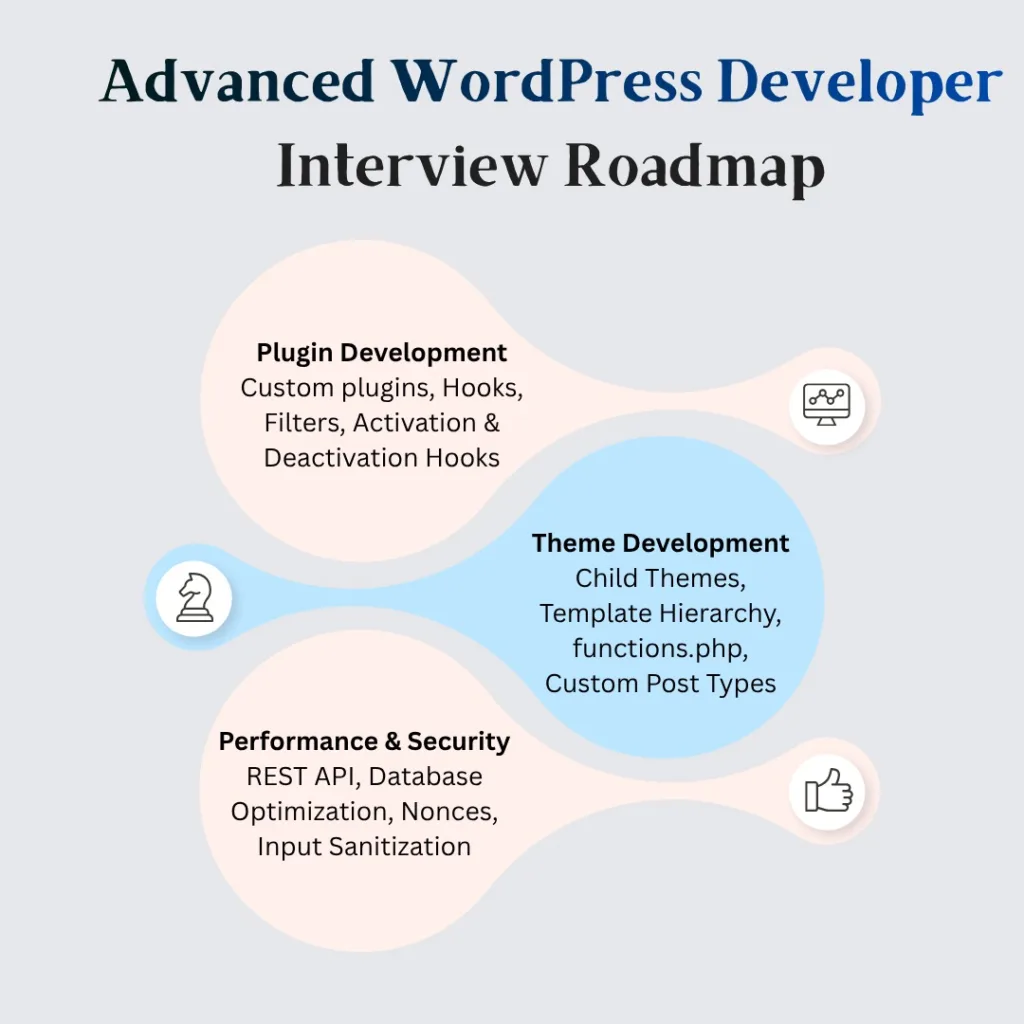
Database and Performance Optimization Questions
What database does WordPress use?
WordPress uses MySQL or MariaDB.
How can WordPress database performance be improved?
- Remove unnecessary revisions
- Optimize tables
- Use object caching
- Minimize database queries
What are transients in WordPress?
Transients provide temporary caching of data to reduce database load.
What is object caching?
Object caching stores frequently accessed data in memory to improve performance.
These advanced interview questions on wordpress help recruiters evaluate optimization skills.
Plugin Architecture and Security Questions
How do you secure WordPress forms?
- Input sanitization
- Data validation
- Nonce verification
- User capability checks
What are nonces?
Nonces protect forms from CSRF attacks.
How do you sanitize user input?
Functions include:

sanitize_text_field()

sanitize_email()

esc_url()
What is capability-based access control?
WordPress roles and capabilities determine what actions users can perform.
Security-related wp interview questions are increasingly common for enterprise projects.
WordPress Security Interview Questions
| Question | Answer |
| What is a nonce? | Security token protecting forms from CSRF attacks. |
| How do you sanitize input? | Using WordPress sanitization functions. |
| What is escaping output? | Preventing malicious code execution. |
| What are user roles? | Permission groups in WordPress. |
| How do you secure custom plugins? | Validation, sanitization, and access controls. |
| Why disable file editing? | Prevent unauthorized modifications. |
| What is SQL injection? | Malicious database query manipulation. |
| How do you prevent SQL injection? | Use prepared statements with $wpdb->prepare(). |
WordPress REST API Interview Questions
What is the WordPress REST API?
The REST API allows external applications to communicate with WordPress using HTTP requests.
Why is REST API important?
It enables:
- Mobile apps
- Headless CMS architecture
- Third-party integrations
What HTTP methods are commonly used?
- GET
- POST
- PUT
- DELETE
How do you create a custom REST endpoint?
Use register_rest_route() within a plugin or theme.
Many companies combine WordPress API discussions with restful api interview questions during technical interviews.
WordPress REST API Interview Questions
| Question | Answer |
| What is REST API? | Interface for external communication with WordPress. |
| What is a custom endpoint? | Developer-created API route. |
| What methods does REST API support? | GET, POST, PUT, DELETE. |
| What is authentication? | User identity verification. |
| What is headless WordPress? | WordPress used only as backend CMS. |
| How do you register routes? | register_rest_route(). |
| What format does REST API return? | JSON. |
| Why use REST API? | Integration and scalability. |
Advanced WordPress Coding Questions
Explain Actions and Filters with Examples
Actions trigger functionality:
add_action('init','custom_function');Filters modify data:
add_filter('the_content','modify_content');What is WP_Query?
WP_Query is a class used to retrieve posts from the WordPress database.
Difference Between get_posts() and WP_Query?
WP_Query offers more flexibility and customization.
What is the WordPress Loop?
The Loop displays content dynamically from database queries.
These are common interview questions on wordpress for experienced developers.
Cross-Technology Questions Often Asked with WordPress
Recruiters frequently combine WordPress assessments with other technical topics, including:
- seo interview question
- seo marketing interview questions
- interview questions on html css
- front developer interview questions
- full stack interview questions
- full stack developer interview questions
- interview questions on machine learning
- ai engineer interview questions
- top system design interview questions
This approach helps employers evaluate both WordPress expertise and overall development knowledge.
Tips to Crack a WordPress Developer Interview
- Understand WordPress architecture.
- Practice plugin development.
- Learn theme customization deeply.
- Master hooks and filters.
- Study REST API implementation.
- Understand database optimization.
- Focus on security best practices.
- Review coding standards.
- Build real-world projects.
- Prepare advanced wordpress interview questions and practical coding exercises.
FAQs
1. What are the most important WordPress developer interview topics?
Plugin development, theme customization, hooks, filters, security, REST API, database optimization, and performance tuning are the most important topics.
2. Are WordPress interviews only focused on CMS knowledge?
No. Advanced interviews may include full stack developer interview questions, API concepts, JavaScript, PHP, and database-related topics.
3. Why are REST API concepts important for WordPress developers?
Modern WordPress applications often integrate with mobile apps and third-party systems, making restful api interview questions highly relevant.
4. What coding skills should a senior WordPress developer have?
A senior developer should understand PHP, JavaScript, database optimization, design patterns, and advanced plugin architecture along with senior developer interview questions preparation.
5. Do recruiters ask SEO-related questions in WordPress interviews?
Yes. Since WordPress is widely used for content-driven websites, employers may include seo interview question and seo marketing interview questions alongside WordPress-specific topics.
