


Preparing for a web developer interview requires more than just knowing how to write code. Recruiters and hiring managers assess your understanding of HTML, CSS, JavaScript, problem-solving skills, and your ability to build responsive and interactive websites. Whether you’re preparing for front developer interview questions or revising interview questions on machine learning alongside web technologies, having a strong foundation in these core languages can significantly improve your interview performance.
Most companies also combine technical rounds with practical coding assessments. That’s why candidates preparing for full stack interview questions should first master HTML, CSS, and JavaScript before moving to advanced backend technologies. In this guide, you’ll find some of the most frequently asked interview questions along with simple explanations to help you answer confidently during technical interviews.
Why Learn HTML, CSS, and JavaScript?
HTML, CSS, and JavaScript are the building blocks of modern websites.
- HTML provides the page structure.
- CSS controls the design and layout.
- JavaScript makes websites interactive.
Whether you’re applying as a frontend developer, UI developer, or full-stack engineer, employers expect a solid understanding of these technologies.
HTML Interview Questions and Answers
1. What is HTML?
HTML (HyperText Markup Language) is the standard markup language used to create web pages. It defines the structure of a webpage using elements such as headings, paragraphs, links, tables, images, and forms.
HTML works together with CSS for styling and JavaScript for adding interactivity.
2. What are Semantic HTML Tags?
Semantic elements clearly describe their purpose to browsers, search engines, and screen readers.
Common semantic tags include:
<header>

<nav>

<main>

<section>

<article>

<footer>
Benefits include:
- Better SEO
- Improved accessibility
- Cleaner code
- Easier maintenance
3. What is the Difference Between HTML and HTML5?
HTML5 introduced several improvements over previous versions.
| Feature | HTML | HTML5 |
| Multimedia Support | External plugins required | Built-in audio and video |
| Semantic Tags | Limited | Many semantic elements |
| Storage | Cookies | Local Storage & Session Storage |
| Graphics | Limited | Canvas and SVG |
| Form Inputs | Basic | Email, Date, Range, Color, etc. |
4. What are Meta Tags?
Meta tags provide information about a webpage that isn’t displayed directly on the page.
Examples include:
- Character encoding
- Page description
- Viewport settings
- Author information
- Search engine instructions
Meta tags improve SEO and mobile responsiveness.
5. What is the Difference Between Block and Inline Elements?
Block Elements
- Start on a new line
- Occupy full width
Examples:
div

p

section

h1
Inline Elements
- Stay on the same line
- Occupy only required space
Examples:
- span
- a
- strong
- img
6. Why is the Alt Attribute Important?
The alt attribute provides alternative text for images.
Advantages:
- Improves accessibility
- Helps screen readers
- Improves SEO
- Displays text when images fail to load
7. What are Forms in HTML?
Forms collect user information.
Common form elements include:
- input
- textarea
- select
- checkbox
- radio button
- button
Forms are widely used in login pages, contact pages, and registration systems.
8. What are Data Attributes?
Custom data attributes allow developers to store extra information inside HTML elements.
Example:
<div data-id="101"></div>JavaScript can easily access these attributes to create dynamic applications.
HTML Interview Tips
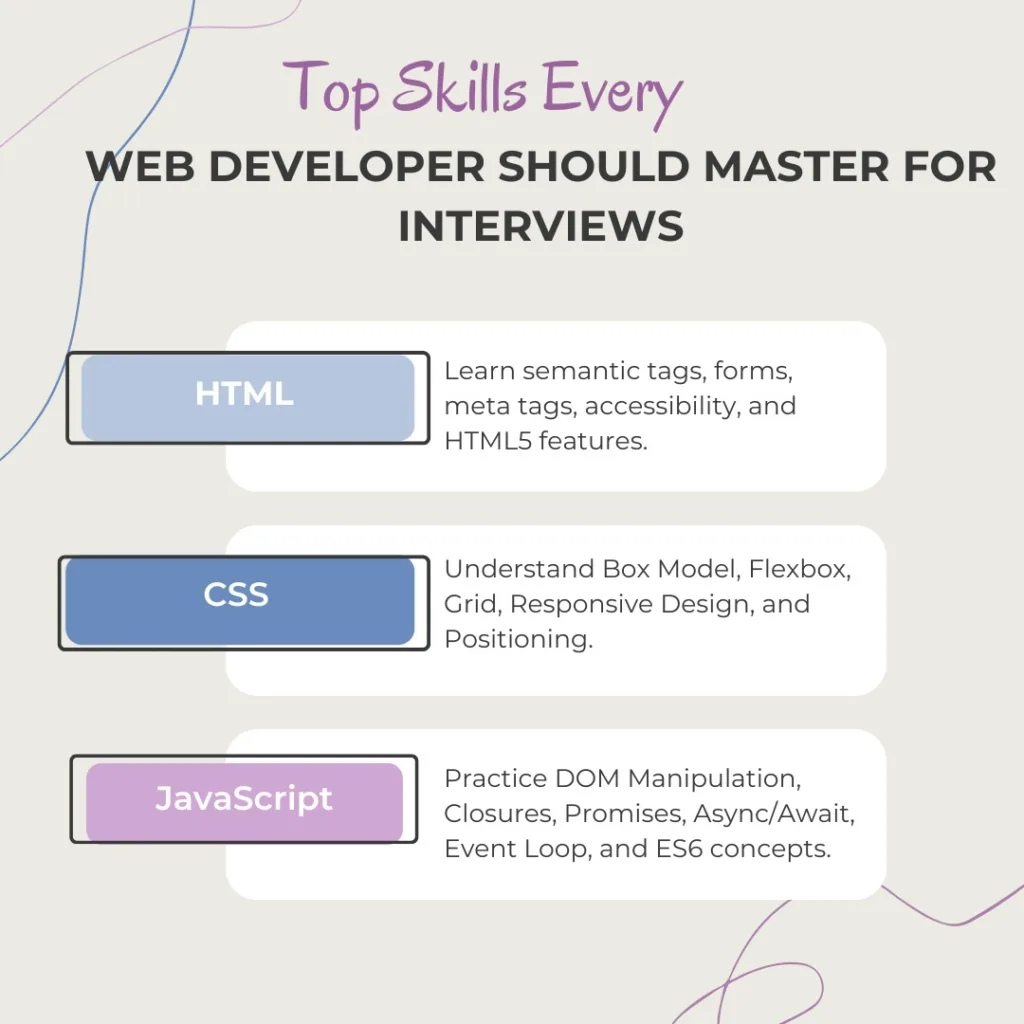
Candidates preparing for interview questions on html css should focus on:
- Semantic HTML
- Forms
- Accessibility
- HTML5 Features
- Tables
- Lists
- Media Elements
Interviewers often ask practical coding questions rather than theoretical definitions.
Frequently Asked HTML Topics
| Topic | Importance | Interview Frequency |
| HTML Structure | High | Very High |
| Semantic Tags | High | High |
| Forms | High | High |
| Meta Tags | Medium | Medium |
| Accessibility | High | High |
| HTML5 Features | High | High |
CSS Interview Questions and Answers
1. What is CSS?
CSS (Cascading Style Sheets) is used to style HTML pages.
It controls:
- Colors
- Fonts
- Layouts
- Animations
- Responsive Design
A website without CSS appears plain and difficult to use.
2. Explain the CSS Box Model.
Every HTML element is represented as a rectangular box consisting of:
- Content
- Padding
- Border
- Margin
Understanding the Box Model helps developers create consistent layouts.
3. What is the Difference Between ID and Class?
| ID | Class |
| Unique | Reusable |
| One element | Multiple elements |
| Uses # | Uses . |
| Higher specificity | Lower specificity |
4. What is Flexbox?
Flexbox is a one-dimensional layout model used for arranging elements.
Common properties include:
- display:flex
- justify-content
- align-items
- flex-wrap
- gap
Flexbox simplifies responsive layouts.
5. What is CSS Grid?
CSS Grid is a two-dimensional layout system.
Advantages:
- Complex layouts
- Better alignment
- Responsive design
- Easy spacing
Many companies now prefer Grid for modern UI development.
6. Explain Position Properties.
There are five positioning methods.
- Static
- Relative
- Absolute
- Fixed
- Sticky
Each controls how an element appears within the webpage.
7. What are Pseudo Classes?
Pseudo classes define the state of an element.
Examples:
:hover

:focus

:active

:visited

:first-child
These improve user interaction.
8. What are Media Queries
Media queries help websites adapt to different screen sizes.
They are essential for responsive web design.
Developers commonly optimize layouts for:
- Mobile
- Tablet
- Desktop
CSS Interview Preparation Tips
If you’re searching for css and html interview questions, concentrate on:
- Box Model
- Flexbox
- Grid
- Position
- Selectors
- Specificity
- Media Queries
- Responsive Design
These topics frequently appear in technical interviews for frontend roles.
Common CSS Interview Topics
| CSS Topic | Difficulty | Asked Frequently |
| Box Model | Easy | Yes |
| Flexbox | Medium | Yes |
| CSS Grid | Medium | Yes |
| Position | Medium | Yes |
| Selectors | Easy | Yes |
| Responsive Design | Medium | Very high |
| Animation | Medium | Moderate |
Preparing Beyond HTML and CSS
Besides frontend fundamentals, many organizations also include software engineering interview questions to evaluate problem-solving ability and coding practices. Having a clear understanding of web concepts alongside software engineering principles gives candidates an advantage during technical rounds.
JavaScript Interview Questions and Answers
1. What is JavaScript?
JavaScript is a high-level programming language used to create interactive and dynamic web applications. It works alongside HTML and CSS to add functionality such as animations, form validation, API calls, and dynamic content updates. JavaScript can run in both browsers and server environments like Node.js.
2. What are JavaScript Data Types?
JavaScript has two categories of data types.
Primitive Data Types
- String
- Number
- Boolean
- Null
- Undefined
- Symbol
- BigInt
Reference Data Types
- Object
- Array
- Function
- Date
Understanding data types is one of the most common html questions asked in interview because it demonstrates your knowledge of JavaScript fundamentals.
3. Explain the Difference Between == and ===.
The equality operators are frequently discussed in technical interviews.
| Operator | Description | Example |
| == | Compares values after type conversion | 5 == “5” → True |
| === | Compares both value and type | 5 === “5” → False |
Using === is recommended because it avoids unexpected type coercion.
4. What is the DOM?
The Document Object Model (DOM) is a tree-like representation of a webpage. JavaScript uses the DOM to modify elements, update content, change styles, and respond to user actions without reloading the page.
Common DOM methods include:
getElementById()

querySelector()

querySelectorAll()

createElement()

appendChild()
5. What are Closures?
A closure is a function that remembers variables from its outer scope even after the outer function has finished executing.
Closures are commonly used for:
- Data privacy
- Function factories
- Event handlers
- Callbacks
Interviewers often ask this to evaluate your understanding of JavaScript scope.
6. What is Hoisting?
Hoisting is JavaScript’s default behavior of moving declarations to the top of their scope before execution.
Important points:
- var declarations are hoisted and initialized as undefined.
- let and const are hoisted but remain in the Temporal Dead Zone until initialized.
7. What is Event Delegation?
Event delegation allows you to attach a single event listener to a parent element instead of multiple child elements.
Benefits include:
- Better performance
- Less memory usage
- Easier handling of dynamically created elements
8. What is the Event Loop?
JavaScript is single-threaded but supports asynchronous programming using the Event Loop.
The Event Loop manages:
- Call Stack
- Callback Queue
- Microtask Queue
This mechanism ensures that asynchronous tasks execute without blocking the main thread.
9. What are Promises?
Promises handle asynchronous operations.
A Promise has three states:
- Pending
- Fulfilled
- Rejected
Promises improve code readability compared to nested callbacks.
10. Explain Async/Await.
Async/Await is built on Promises and makes asynchronous code easier to understand.
Advantages include:
- Cleaner syntax
- Better error handling
- Improved readability
- Easier debugging
11. Difference Between var, let, and const
| Keyword | Scope | Redeclaration | Reassignment |
| var | Function | Yes | Yes |
| let | Block | No | Yes |
| const | Block | No | No |
This remains one of the most frequently asked javascript interview questions and answers pdf topics because it tests your understanding of variable scope.
12. What is JSON?
JSON (JavaScript Object Notation) is a lightweight format used for exchanging data between servers and applications.
It is widely used in REST APIs.
JavaScript Interview Preparation Tips
Candidates preparing for interview questions on css and html should also dedicate equal time to JavaScript. Interviewers often expect you to solve DOM manipulation, array methods, asynchronous programming, and ES6-related problems during live coding sessions.
REST API Interview Basics
Most frontend developers communicate with backend servers through REST APIs.
Common REST methods include:
- GET
- POST
- PUT
- PATCH
- DELETE
These concepts frequently appear in restful api interview questions, especially for frontend and full-stack developer positions.
Backend Knowledge for Frontend Developers
Even frontend engineers should understand backend fundamentals.
Some common backend questions for interview include:
- What is an API?
- What is authentication?
- What is authorization?
- Explain HTTP status codes.
- What is CORS?
- Difference between SQL and NoSQL databases.
Having backend knowledge improves collaboration with server-side developers.
Data Structures and Algorithms
Technical interviews often include coding rounds.
Popular interview questions for data structures and algorithms focus on:
- Arrays
- Strings
- Linked Lists
- Trees
- Hash Maps
- Queues
- Stacks
- Sorting
- Searching
- Recursion
Practicing these concepts helps improve logical thinking and coding efficiency.
Coding Interview Practice
Employers also ask real-world programming challenges.
Prepare coding interview questions with solutions such as:
- Reverse a string
- Find duplicate elements
- Check palindrome
- Two Sum problem
- Fibonacci sequence
- Merge sorted arrays
- Balanced parentheses
Writing clean, optimized code is often more important than simply reaching the correct answer.
System Design Basics
Senior-level interviews may include top system design interview questions.
Common topics include:
- URL Shortener
- Chat Application
- Notification System
- File Storage System
- Load Balancing
- Database Scaling
- Caching
While junior developers aren’t expected to master system design, understanding the basics demonstrates a broader technical perspective.
Full Stack Development Interview
If you’re preparing for full stack developer interview questions, you’ll need knowledge of:
- HTML
- CSS
- JavaScript
- React or Angular
- Node.js
- Express.js
- Databases
- REST APIs
- Authentication
- Deployment
Companies value developers who understand both client-side and server-side development.
Associate and Senior-Level Interview Expectations
Fresh graduates commonly face associate software engineer interview questions covering HTML, CSS, JavaScript fundamentals, logical reasoning, and simple coding tasks.
For experienced candidates, senior developer interview questions focus on:
- Architecture decisions
- Performance optimization
- Code reviews
- Design patterns
- Team collaboration
- Debugging complex applications
Interview expectations increase significantly with experience.
AI and Modern Development
With AI becoming part of software development, some organizations now include ai engineer interview questions to assess familiarity with AI tools, automation, prompt engineering, and machine learning concepts. Understanding how AI integrates into web applications can give candidates a competitive advantage.
Conclusion
Preparing for HTML, CSS, and JavaScript interviews requires more than memorizing definitions. Employers want candidates who understand how these technologies work together to build responsive, accessible, and interactive web applications. Along with strengthening your frontend knowledge, spend time practicing coding problems, learning REST APIs, understanding backend concepts, and improving communication skills.
The more projects you build and the more interview questions you practice, the more confident you’ll become during technical interviews. Consistent preparation and hands-on experience remain the most effective way to secure your next web development role.
FAQs
1. What HTML topics are most commonly asked in interviews?
Interviewers frequently ask about semantic HTML, forms, meta tags, accessibility, HTML5 features, tables, lists, multimedia elements, and document structure.
2. Which CSS concepts should I focus on?
Focus on the Box Model, Flexbox, CSS Grid, positioning, selectors, specificity, responsive design, animations, and media queries.
3. What JavaScript topics are essential for interviews?
Important topics include variables, scope, closures, promises, async/await, event loop, DOM manipulation, hoisting, ES6 features, and error handling.
4. Are coding questions asked in frontend interviews?
Yes. Most companies include coding exercises involving arrays, strings, DOM manipulation, JavaScript logic, debugging, and algorithm-based problems.
5. How can I prepare effectively for a web developer interview?
Practice HTML, CSS, and JavaScript daily, build real-world projects, solve coding challenges, revise browser concepts, understand REST APIs, and participate in mock interviews to improve both technical and communication skills.
