


The financial services industry is undergoing a major transformation as artificial intelligence becomes more integrated into investment management and advisory services. Today, wealth management AI solutions are helping financial advisors, institutions, and investors make better decisions through data-driven insights. Modern AI-powered systems use Context Management, State Management, and Product Management Agents to understand investor behavior, monitor portfolio performance, and provide highly personalized recommendations. These advancements are reshaping how investment decisions are made and delivered across the financial ecosystem.
The rise of personalized investing AI has enabled financial firms to move beyond traditional advisory models. By leveraging Context Management, State Management, and Product Management Agents, AI agents can analyze market trends, assess investor goals, and continuously adapt investment strategies. As a result, investors receive tailored recommendations that align with their risk tolerance, financial objectives, and changing market conditions. This evolution is driving the adoption of digital wealth platforms and creating a new era of intelligent financial services.
Understanding AI Agents in Wealth Management
AI agents are autonomous software systems designed to analyze data, learn from patterns, and make informed recommendations with minimal human intervention. In wealth management, these agents support investment decisions, risk analysis, and portfolio monitoring.
Modern wealth management AI platforms combine machine learning, predictive analytics, and automation to improve financial outcomes. Unlike traditional software, AI agents continuously learn from market behavior and investor preferences, making them valuable tools for long-term investment management.
Key Functions of AI Agents in Wealth Management
| Function | Description | Business Benefit |
| Portfolio Analysis | Evaluates investment performance | Better decision-making |
| Risk Assessment | Identifies potential risks | Improved risk management |
| Market Monitoring | Tracks market trends in real time | Faster responses |
| Investment Recommendations | Suggests personalized strategies | Enhanced returns |
| Client Communication | Automates investor updates | Better customer experience |
AI-powered systems are increasingly becoming the backbone of client advisory AI solutions used by financial institutions worldwide.
The Role of Robo Advisory Systems
One of the most popular applications of AI in finance is robo advisory systems. These platforms automate investment management by using algorithms to create and maintain portfolios based on investor goals.
Benefits of Robo Advisory Systems
| Benefit | Impact on Investors |
| Low Cost | Reduced advisory fees |
| Accessibility | Easy investment access |
| Automation | Minimal manual intervention |
| Personalization | Customized investment plans |
| Scalability | Supports large client bases |
By integrating robo advisory systems with asset allocation automation, financial firms can provide efficient and personalized services to thousands of investors simultaneously.
Personalized Investing Through AI
Traditional investment advice often relies on generalized financial models. In contrast, personalized investing AI analyzes individual investor behavior, spending habits, income patterns, and financial goals.
How AI Personalizes Investment Strategies
| Investor Data | AI Analysis | Outcome |
| Risk Tolerance | Risk Profiling | Suitable portfolio |
| Income Level | Investment Capacity | Customized allocation |
| Investment Goals | Goal Mapping | Long-term planning |
| Market Conditions | Predictive Analysis | Better timing |
| Behavioral Patterns | Sentiment Assessment | Personalized advice |
These capabilities make AI financial planning more accurate and responsive than traditional advisory methods.
Portfolio Optimization and Asset Allocation
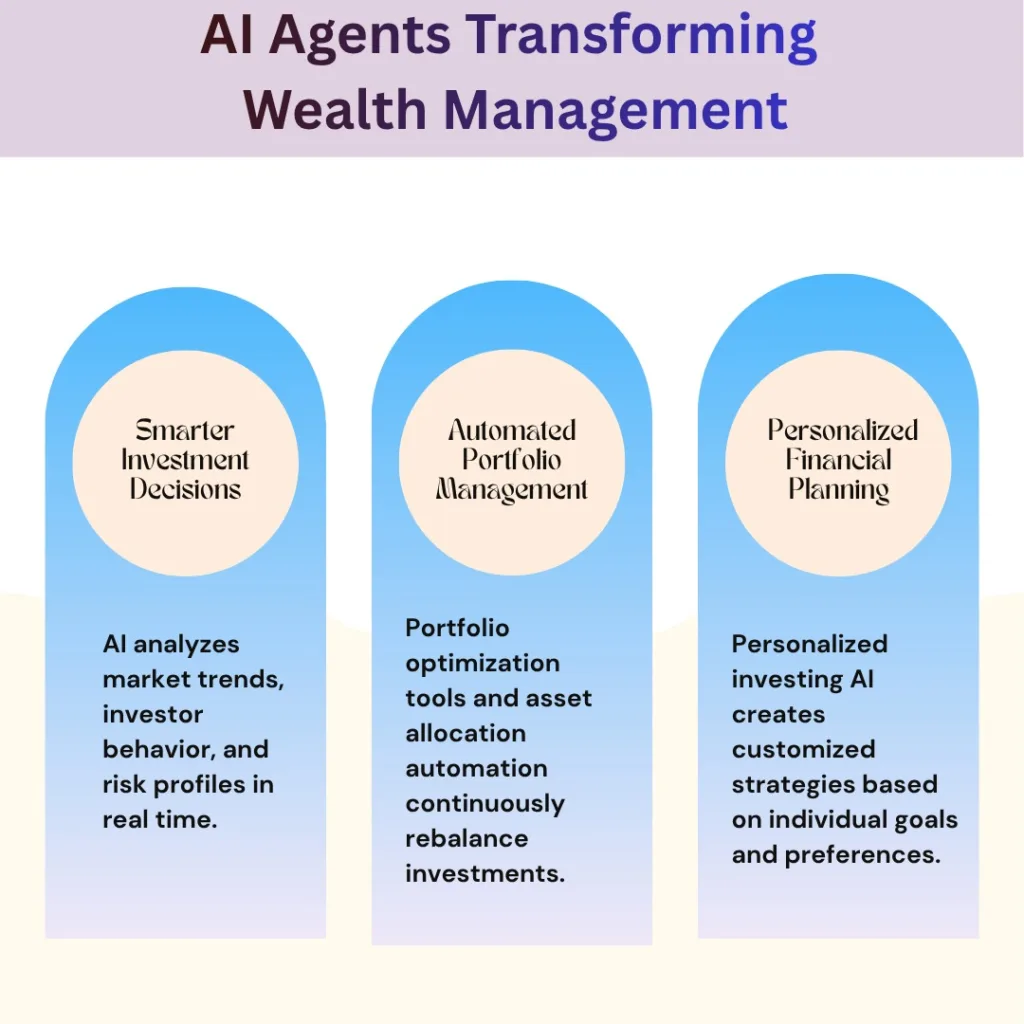
One of the most valuable uses of AI is portfolio construction. Modern portfolio optimization tools use advanced algorithms to maximize returns while minimizing risk.
Portfolio Optimization Features
| Feature | Purpose |
| Risk Modeling | Measures portfolio volatility |
| Diversification Analysis | Reduces concentration risk |
| Return Forecasting | Estimates future performance |
| Rebalancing Automation | Maintains target allocation |
| Scenario Testing | Evaluates market outcomes |
Combined with asset allocation automation, these systems continuously adjust investments to align with changing market conditions and investor objectives.
AI Financial Planning and Wealth Growth
Financial planning requires evaluating multiple variables, including income, expenses, taxes, retirement goals, and investment opportunities. Modern AI financial planning solutions can process these variables in seconds.
Key advantages include:
- Automated goal tracking
- Retirement planning support
- Tax optimization insights
- Cash flow analysis
- Investment forecasting
Many financial firms are now using fintech advisory technology to improve planning accuracy while reducing operational costs.
Autonomous Investment Systems: The Next Evolution
The future of investing lies in autonomous investment systems that can independently analyze markets, identify opportunities, and execute trades.
These intelligent systems offer:
- Real-time decision-making
- Automated portfolio management
- Continuous market monitoring
- Reduced emotional bias
- Faster execution
As Investing in Autonomous AI Agents becomes more mainstream, financial institutions will increasingly rely on AI to manage complex investment strategies.
Digital Wealth Platforms and Client Experience
Modern digital wealth platforms combine AI, automation, and user-friendly interfaces to deliver seamless investment experiences.
Core Components of Digital Wealth Platforms
| Component | Function |
| AI Analytics Engine | Generates insights |
| Portfolio Dashboard | Displays performance |
| Automated Advisory Tools | Provides recommendations |
| Risk Management Module | Monitors exposure |
| Client Communication Center | Enhances engagement |
The integration of client advisory AI allows investors to receive real-time guidance without needing constant interaction with human advisors.
Automate Financial Modeling with AI
Financial modeling has traditionally been a time-consuming process. Today, organizations can Automate Financial Modeling using AI-powered platforms.
Benefits include:
- Faster valuation analysis
- Improved forecasting accuracy
- Reduced human error
- Real-time model updates
- Enhanced strategic planning
These capabilities help wealth managers make more informed investment decisions and improve operational efficiency.
AI in Private Equity Due Diligence
AI is transforming Private Equity Due Diligence by accelerating data analysis and improving investment evaluations.
AI-powered due diligence can:
- Analyze financial statements
- Review legal documents
- Detect hidden risks
- Evaluate market opportunities
- Support acquisition decisions
This enables private equity firms to make faster and more confident investment decisions.
Enhancing Financial Research Workflows
Financial professionals spend significant time gathering and analyzing data. AI improves Financial Research Workflows by automating information collection and generating actionable insights.
Key applications include:
- Market trend analysis
- Earnings report reviews
- Competitive intelligence
- Investment screening
- Predictive forecasting
By streamlining Financial Research Workflows, firms can focus more on strategy and client engagement.
Challenges and Considerations
Despite the benefits of wealth management AI, organizations must address several challenges:
- Data privacy concerns
- Regulatory compliance requirements
- Algorithm transparency
- Cybersecurity risks
- Model accuracy validation
Financial institutions that effectively manage these challenges will gain a significant competitive advantage in the evolving investment landscape.

The Future of AI in Wealth Management
The future of wealth management will be increasingly driven by wealth management AI, robo advisory systems, personalized investing AI, and autonomous investment systems. AI agents will continue to improve portfolio management, automate advisory services, and enhance client experiences.
As digital wealth platforms, portfolio optimization tools, AI financial planning, client advisory AI, asset allocation automation, and fintech advisory technology become more sophisticated, investors will benefit from smarter, faster, and more personalized financial guidance. The continued adoption of Automate Financial Modeling, Investing in Autonomous AI Agents, Private Equity Due Diligence, and Financial Research Workflows will further accelerate innovation, making AI an essential component of modern wealth management.
FAQs
1. What is wealth management AI?
Wealth management AI refers to artificial intelligence technologies used to automate investment analysis, portfolio management, financial planning, and client advisory services.
2. How do robo advisory systems work?
Robo advisory systems use algorithms and investor data to create, manage, and rebalance investment portfolios automatically.
3. What are portfolio optimization tools?
Portfolio optimization tools use AI and analytics to allocate investments efficiently while balancing risk and return objectives.
4. Can AI replace human financial advisors?
AI can automate many advisory tasks, but human advisors still provide strategic guidance, relationship management, and complex financial planning support.
5. Why are autonomous investment systems important?
Autonomous investment systems improve investment efficiency by continuously analyzing markets, identifying opportunities, and executing decisions with minimal human intervention.
