


What is Context in Digital Workflows?
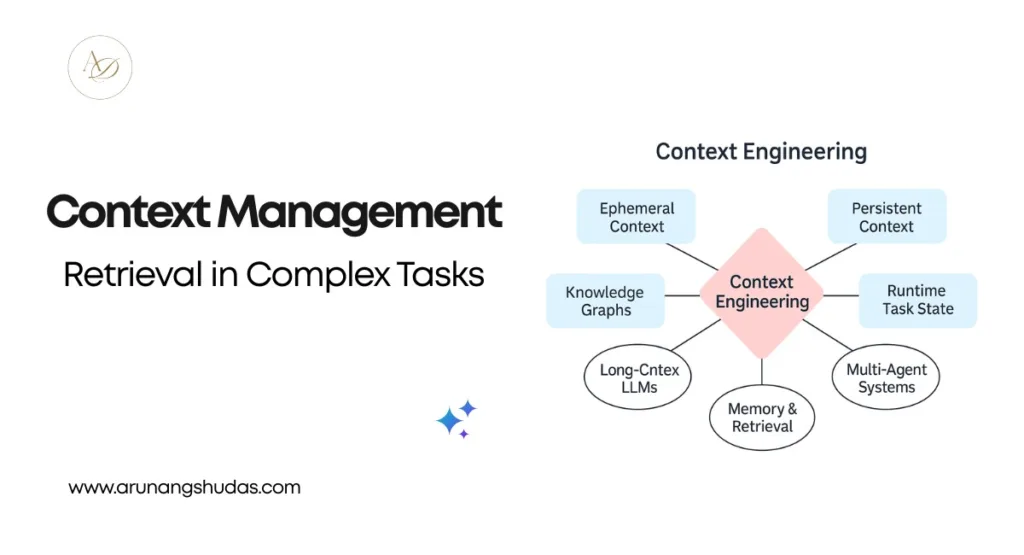
So when we refer to “context” it is information about information. In digital systems, context can be actions, past events, status or even future intentions. It’s like completing a jigsaw puzzle without knowing the topic; without context
In enterprise systems or systems with AI, context is applied to enhance decision making. If a user searches for pricing information, a system will display price information next time. This deeper knowledge turns information into insights.
This is because context is dynamic. Each click, search and action adds a new layer. Context management is powerful, but also difficult, because of this shifting data set.
Also Read: How Founders Can Build AI-First Departments Using Agents
Why Context Matters in Complex Tasks
Complex tasks, say, in product development, customer service or decision-making, have to be continuous. Without context, the system starts from zero each time, which is not only inefficient as time is wasted but also irritating as users become confused.
Take a call centre that doesn’t understand context and has the agent repeating the same questions to the customer. That’s bad context management. Conversely, a system that knows past issues can offer instant solutions.
Context improves:
- Decision accuracy
- User experience
- Operational efficiency
It’s not enough to store data – you need to be able to find it when you need it.
The Challenge of Context Overload
1. Fragmented Data Across Systems
The challenge of fragmentation You have data stored in your CRM, email, dashboard and chat app. They each contain a snippet of information, but not the whole story.
This leads to silos and it’s hard to generate a context. A product team, for instance, might have customer feedback in a survey tool and analytics in another. Integration provides a holistic understanding.
2. Impact on Decision-Making
If context is fragmented, decisions take longer, and are less precise. Groups make decisions based on intuition. This may result in missed opportunities, or worse, mistakes.
In rapidly changing environments, the ability to access context rapidly can make or break an operation. That’s why we give preference to a smooth integration of context.
Context Management in AI-Driven Environments
1. Role of AI in Context Handling
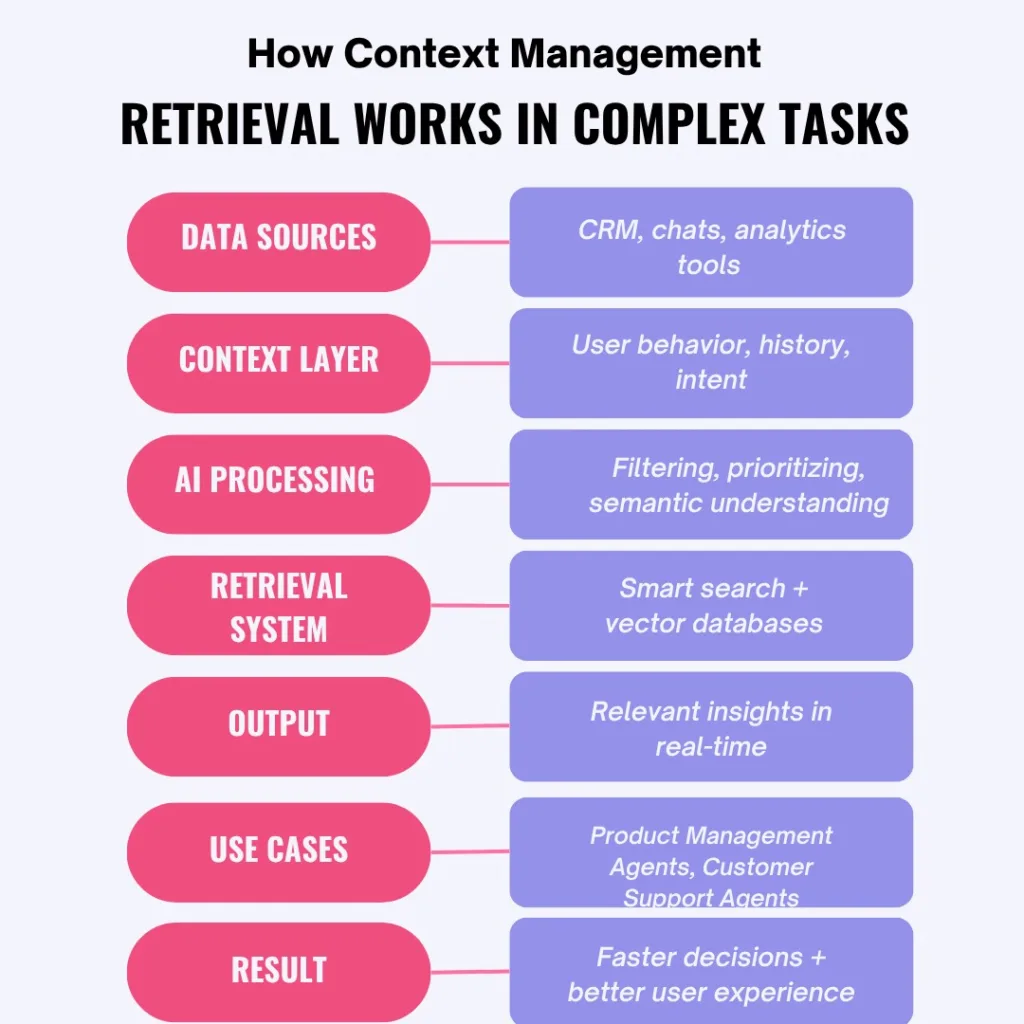
AI has changed the game. Rather than having to piece together information, AI can automatically gather, organise and understand context.
AI systems learn through interactions which aspects of a signal are relevant and which are noise. This allows the system to pay attention to important data and ignore less relevant data.
2. Examples in Real-World Applications
Think smart home assistants or algorithms suggesting a book or movie. They not only react, they predict. And they can make personalised suggestions based on historical data.
In the workplace, AI dashboards can show trends, predictions and even recommendations. Such smart approaches are enabled by proactive context management.
Retrieval Mechanisms for Complex Tasks
1. Search vs Intelligent Retrieval
Search systems are based on keywords. You enter a term, and it’s matched against stored information. Simple, but limited.
Smart search is different. It matches meaning, context and relationships. It understands the meaning behind words.
For instance, if you search for “customer issue with billing”, it could pull up documents containing information on statements, payment errors, or return policies – even if they don’t specifically mention these terms.
2. Semantic Understanding in Retrieval Systems
Semantic retrieval relies on natural language processing to comprehend queries like humans do. It’s based on relationships between concepts.
This method is particularly helpful in challenging tasks with complex queries. This helps users get appropriate results, despite imperfect queries.
Role of Product and Support Agents
1. How Product Management Agents Use Context
Product Management Agents use context to inform decision making. They interpret user interactions, market insights and feedback to inform development.
For instance, if users consistently leave a feature, context can tell you why. Is it too complex? Is it not visible enough? This helps to improve products.
Context also helps prioritise. Rather than assume customer needs, product teams can leverage customer data.
2. How Customer Support Agents Retrieve Context
Customer Support Agents solve problems in real-time. Context is critical here. When a customer engages, the agent must be able to quickly access the history of customer engagement and purchases, and see any logged issues.
Without it, support is sporadic, inefficient. With context, it’s proactive and tailored.
For example, if a customer has submitted multiple escalated tickets for the same issue, the system will automatically route that issue. This will help to reduce resolution time and increase customer satisfaction.
Also Read:- Tool Calling for Agents Using JSON Schemas & Error Handling
Tools and Techniques for Effective Context Management
1. Knowledge Graphs and Vector Databases
Context is managed in systems using techniques:
| Tool | Purpose | Benefit |
| Knowledge Graphs | Connect data points | Better relationship mapping |
| Vector Databases | Store semantic data | Faster intelligent retrieval |
| Context Engines | Process user interactions | Real-time insights |
Such technologies allow systems to not only understand what is present, but also how it relates.
2. Context Windows and Memory Systems
AI systems work with context windows – small memory spaces for recent interactions. These can be limiting.
To cancel this effect, systems have external memory components that enable storing context over a longer period. This means that critical data is preserved.
Best Practices for Managing Context
1. Structuring Data for Easy Retrieval
Organisation is the key to successful context management. Organising data to find it quickly
Some key practices include:
- Standardizing data formats
- Tagging and categorizing information
- Linking systems for access
Structuring data helps us better retrieve it.
2. Less Clutter, Better Relevant Results
Not all data is useful. Too often data is deadly. We want to cut the clutter and concentrate on the core.
This involves:
- Prioritizing high-value data
- Eliminating redundant information
- Continuously refining algorithms
Relevance is the key to effective context management.
Future Trends in Context Management
Autonomous Systems and Memory Evolution
It’s all about autonomous context management systems. These systems will not just record and recall information, but learn and respond to it as it happens.
Technologies based on AI will allow:
- Memory beyond the session
- Context-aware decision-making
- Completely personalised services
The demarcations between data and intelligence will be further blurred as systems grow smarter.
Conclusion
Managing and retrieving context is more important than ever. Understanding and harnessing context is critical in complex tasks. From Product Management Agents who make informed decisions to Customer Support Agents who solve problems, context is pivotal to smart systems.
It’s not about data, but understanding. With the right software, methods and approaches, businesses can leverage context to their advantage.
FAQs
1. What is context management in simple terms?
It involves gathering, organizing and using data to offer insights while performing tasks.
2. Why is context retrieval important?
It helps provide needed data during tasks to support efficient decision-making.
3. How do AI systems manage context?
They leverage machine learning, natural language processing and memory systems.
4. What tools are used for context management?
Knowledge graphs, vector databases and context engines are popular.
5. How does context improve customer support?
It provides access to contextual clues and quicker, more relevant responses.
