


Introduction: Why Finance Automation Is Reaching Its Limits
Finance teams have devoted a long time to get used to the accounting tools, ERP, and cloud-based billing systems, but many of them remain trapped. Bills are overdue, costs accumulate at the end of the month and predictions are received too late to be of use. Here is the tragedy of contemporary finance: the more advanced the instruments, the more the ancient issues. Conventional AI finance automation has streamlined work, rather than performance.
The use of manual approvals, spreadsheet dependencies and fragmented systems slows down everything. Through delayed revenue visibility (weeks), decision-making is reactive. And that is precisely what the finance intervene to provide the transition between the post-factum reporting of finance to a real-time financial wisdom that is driven by autonomous finance processes.
What Are Finance Agents? From Tools to Autonomous Financial Workflows
Finance agents are, in essence, intelligent goal-driven systems to execute financial workflow end to end. They are not merely helping human beings, but they represent finance teams. Consider them not so much in the form of software, but as a type of digital finance operator that never sleeps.
Financial AI can make decisions that are based on ambiguity, unlike traditional automation. They know context and also recall the previous transactions and make adjustments when the situations vary. When an invoice in a vendor does not reconcile with a contract or a partial payment is received, the agent does not panic or escalate. It examines, reconciles and clears up.
This move characterizes agentic finance AI, in which systems do not merely act according to rules but make choices within guardrails. That is what allows really independent accounting systems.
Finance Agents vs Traditional Finance Automation
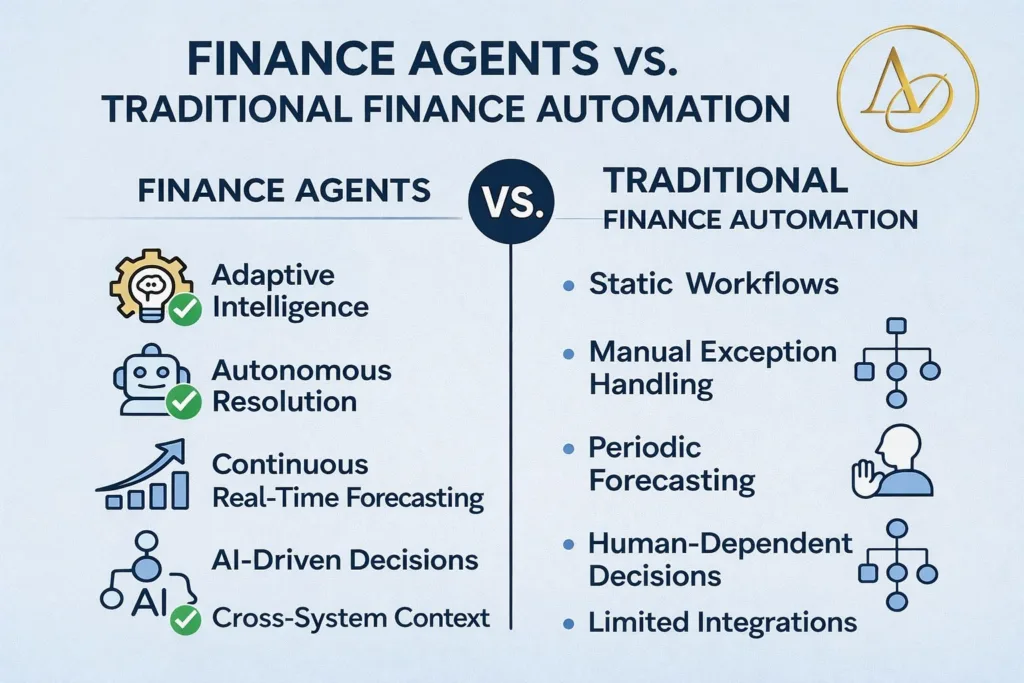
The conventional financial instruments are based on fixed rationality. They make assumptions of clean data, predictable workflow, and flawless inputs. The real finance does not often operate in such a manner. Sellers vary in terms, buyers pay late and costs do not always fall into easily manageable categories.
It is a paradise of finance agents. They are dynamically adapted and draw context out of CRMs, ERPs, bank feeds, and historical data to make real-time decisions.
| Capability | Traditional Finance Software | Finance Agents |
| Workflow execution | Rule-based | Adaptive and goal-driven |
| Exception handling | Human escalation | Autonomous resolution |
| Data sources | Limited integrations | Cross-system context |
| Forecasting | Periodic | Continuous & real-time |
| Decision-making | Human-led | AI-driven with oversight |
It is due to such comparisons as RPA vs AI agents. RPA copies clicks. Smart finance systems are intelligent.
Core Capabilities of Finance Agents
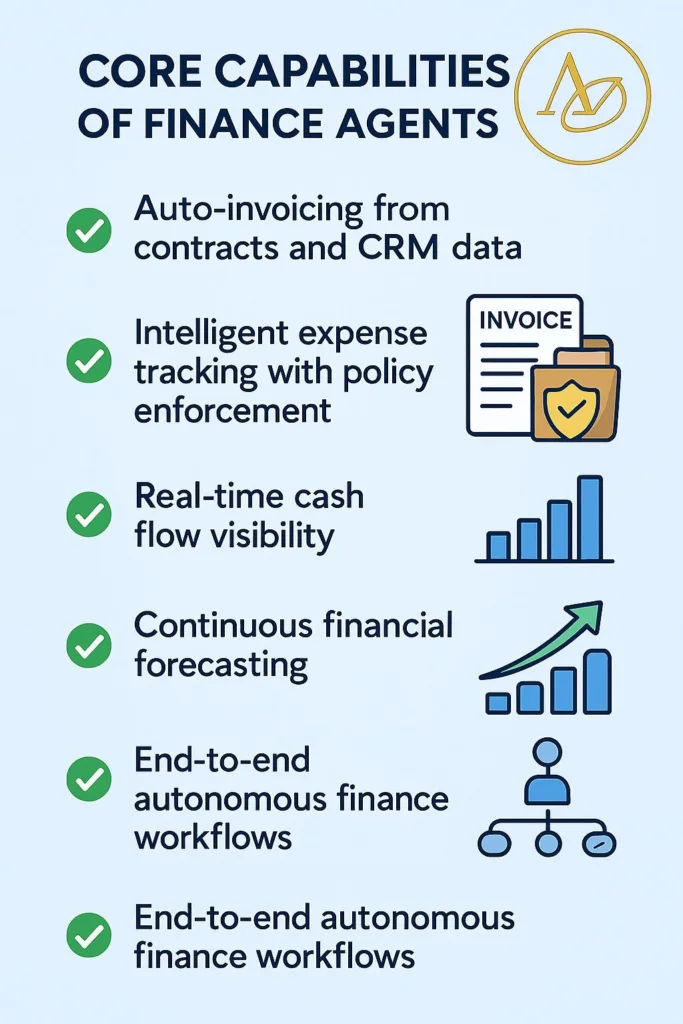
The reason why the of finance perform well in business is their usability in three important aspects which include the following: revenue, expenses and forecasting. A combination of these features is the foundation of AI-based financial processes.
Auto-invoicing ascertains that money circulates at a quicker pace. Smart cost monitoring maintains expenditure at an acceptable level. Constant predicting makes finance a prospective rather than a reporting aspect.
Auto-Invoicing Explained: From Contract to Cash
Auto-invoicing was previously understood as creating PDFs in a schedule. It is something much more powerful with automated invoicing AI. Finance agents withdraw data on contracts, time-tracking applications and CRMs to generate invoices dynamically.
They use tax rationality, approves price, and automatically issues invoices. The agent real-time reconciles payments when they are received. Partial payments? It adjusts balances. Overpayments? It flags credits. It is AI billing agents in action and minimizes revenue leakage and speed up cash flow.
In the case of revenue teams, this streamlines revenue operations automation to a permanent circle rather than a scramble each month.
Intelligent Expense Tracking Beyond Receipt Scanning
It seems to me that expense management is like keeping cats. Receipts are delayed, categories are inaccurate and policy breaches make it through. Changes made to AI expense tracking by continually running in the back.
Receipts, bank feeds and card transactions are digested by finance agents in real time. Based on OCR and machine learning, they will classify expenses immediately and contrast them with company policies. Claims that are non-compliant are not reimbursed but marked, and not after the reimbursement.
This method of automated maintenance of expenses, also enhances the compliance AI within the financial areas, meaning that rules are not ignored by inconsistency with teams slacking in the process.
Continuous Forecasting: The End of Static Budgets
The traditional forecasting can be compared to weather inspection once a month. When the forecast comes it is already too late to change the conditions. The AI financial forecasting inverts this model.
Finance agents have rolling forecasts, which are updated as the flow of data in. Revenue fluctuates, expense upsurge, or market signal happens instantly and updates projections. This facilitates proactive choice based on cash flow prediction AI.
This is the emergence of autonomous FP&A in FP&A, where the forecast is constantly acting as autonomous and not continually being created afresh.
How Finance Agents Work: Agent Architecture
Far back, finance agents are based on a trust and scalable modular AI agent architecture
| Layer | Function |
| Reasoning Engine | Exception handling and decision making |
| Financial Memory | Background and past dealings |
| Workflow Orchestration | Multi-step execution |
| Tool Integrations | ERP, CRM, banks, spreadsheets |
| Governance Layer | Audit logs, approvals, controls |
This architecture allows coordination of finance workflows between systems meaning that agents are actual AI operations agents and not independent tools.
Real-World Use Cases of Finance Agents
Subcription billing, use-based pricing and churn prediction are automated by agents in SaaS businesses. This minimizes the error in manuals and increases predictability of revenue.
In the case of startups and SMBs, lean teams would substitute the manual bookkeeping with monthly end close and forecasting agents that also take care of the month-end close and forecasting on their own. These AI accounting applications enable founders to grow.
Organizations are using agents that are used to consolidate multi-entities, prepare audit and regulatory reporting. It is an enterprise AI of finance.
Benefits of Using Finance Agents
The influence of finance agent is both strategic and operational. There is a reduction in manual workloads, reduction in errors and reduction in cash cycles. More to the point, finance becomes an object of constant visibility.
Decision-making is the true value. Under AI-driven accounting, less time is wasted by the finance teams trying to harmonize figures but rather strategize. That is the real advantage of AI-based accounting and the advantages of AI in the financial sphere.
Risks, Controls, and Governance in Agentic Finance
Lack of control and autonomy are dangerous. AI of agentic finance should be controlled. Risks are errors in data, risks in compliance and AI hallucinations.
This is dealt with by strong AI governance in finance through approval thresholds, audit trails and human-in-the-loop. Compliance of financial AI guarantees that the agents work in stipulated policies, and the autonomy is secure and trusted.
Finance Teams in an Agent-Driven Future
Finance functions change as executives replace an agent. CFOs become the organizers of digital employees, which are directional and efficient. This is an indication of the future of a job in the finance sector when insight takes the place of data entry.
An effective CFO AI strategy does not see agents as threats. Finance is what becomes the heart of the business.
Build vs Buy: Deploying Finance Agents
The decision has to do with building or buying finance agents based on scale and resources.
| Factor | Build In-House | Buy Platform |
| Customization | High | Medium |
| Time to deploy | Slow | Fast |
| Cost | High upfront | Subscription-based |
| Scalability | Engineering-dependent | Platform-native |
| Security | Full Control | Vendor-dependent |
Custom AI agents are appropriate in environments with high levels of regulation, whereas most AI finance platforms accelerate adoption.
The Road Ahead: From Accounting Software to Autonomous Finance
It is the finance agents that signify the transition between the devices that help humans and the mechanisms that perform work. Auto-invoicing, expense tracking and forecasting is a tip of the iceberg.
The future is the AI-native firms established on autonomous finance future principles. With the maturity of AI agent architecture, finance will evolve to become a self-operating mechanism that is being driven by AI-motivated financial processes and AI operations agents

Conclusion
It is the finance agents who are redefining the movement of money within organizations. They automate their invoicing and expenses and forecasting autonomously to transform finance into a real-time engine of intelligence. In the case of businesses that are willing to accelerate, then finance agents are not an option anymore, but rather a necessity.
FAQs
1. What are finance agents in simple terms?
Artificial intelligence finance agents perform invoicing, expenses management, and forecasting with autonomy, among other financial processes.
2. How are finance agents different from accounting software?
Accounting software captures data, whereas finance agents deal with it, make decisions, and solve exceptions independently.
3. Are finance agents safe to use?
Yes, finance agents are safely and compliant with proper governance, audit logs and approval controls.
4. Can startups use finance agents?
Absolutely, The greatest advantage of startups is that it would eliminate the use of manual bookkeeping.
5. Are finance agents part of AI-native companies?
Yes, they are the foundation to the establishment of programs of scaling AI-native companies with autonomous operations.
