


Marketing teams invest in multiple channels, including search engines, social media, email, paid advertising, and content marketing. However, understanding which activities generate meaningful results can be challenging. Marketing attribution AI helps businesses identify the touchpoints that influence customer decisions, while ROI analytics automation simplifies the process of measuring campaign performance. By analyzing Marketing Campaigns, customer interactions, and conversion data, AI agents help marketers understand how their investments contribute to revenue and business growth.
Traditional reporting methods often require marketers to collect data from different platforms, compare results manually, and prepare performance reports. AI agents streamline these tasks through automated data analysis, real-time insights, and predictive recommendations. They also support Lead Nurturing by identifying customer engagement patterns, strengthen B2B Marketing Strategies through account-level insights, and help businesses understand which channels contribute to conversions. With these capabilities, companies can improve decision-making, allocate budgets effectively, and build more measurable marketing strategies.
What Is Marketing Attribution and Why Does It Matter?
Marketing attribution is the process of identifying the marketing channels, campaigns, and customer interactions that contribute to a conversion. A customer might discover a brand through an organic search, visit its website through a social media advertisement, read an email, and eventually make a purchase after clicking a paid search result.
Without an effective attribution system, businesses may credit the wrong channel for the conversion or overlook valuable interactions earlier in the customer journey.
AI agents improve this process by examining large volumes of customer and campaign data. They identify patterns, connect touchpoints, and generate insights that help marketers understand the relationship between marketing activities and business outcomes.
For example, an online retailer may discover that organic search introduces new customers, email campaigns encourage repeat purchases, and paid advertisements support final conversions. Understanding these relationships helps marketing teams evaluate channels more accurately instead of relying only on last-click reporting.
Common Marketing Attribution Models
| Attribution Model | How It Works | Best Use Case |
| First-touch attribution | Credits the first recorded marketing interaction | Understanding customer discovery |
| Last-touch attribution | Credits the final interaction before conversion | Evaluating channels that close sales |
| Linear attribution | Distributes credit equally across recorded touchpoints | Understanding the overall customer journey |
| Time-decay attribution | Assigns more credit to interactions closer to conversion | Analyzing longer buying journeys |
| Data-driven attribution | Uses observed data to estimate each touchpoint’s contribution | Evaluating complex, multi-channel journeys |
AI agents can help compare these models and identify how attribution results change under different assumptions. However, attribution models provide estimates rather than definitive proof that a particular marketing interaction caused a sale.
1. Automating Campaign Data Collection and Analysis
Marketing data often exists across advertising platforms, customer relationship management systems, analytics tools, email software, and eCommerce platforms. Combining these sources manually can consume valuable time and introduce reporting errors.
AI agents simplify the process by collecting accessible data, organizing metrics, identifying inconsistencies, and preparing performance summaries. When connected to suitable campaign tracking systems, they can monitor clicks, impressions, leads, conversions, and revenue across multiple channels.
This process supports Marketing Operations by reducing repetitive reporting tasks and giving teams a more consistent view of campaign performance.
How AI Agents Simplify Campaign Tracking
- Automated data collection: Gather campaign metrics from connected platforms and approved data sources.
- Data quality checks: Flag missing tracking parameters, duplicate records, and unusual reporting differences.
- Cross-channel analysis: Compare performance across search, social media, email, and paid campaigns.
- Automated reporting: Generate summaries that explain important changes in traffic, conversions, and spending.
- Performance alerts: Notify teams when campaigns experience unexpected drops or significant changes.
For instance, an AI agent can identify that a paid social campaign generates many clicks but relatively few qualified leads. It can then compare landing-page performance, audience segments, and conversion events to help marketers investigate the problem.
The result is a more efficient reporting process that allows teams to spend less time compiling spreadsheets and more time improving campaign outcomes.
2. Understanding Customer Journeys With Multi-Touch Attribution AI
Customers rarely make purchasing decisions after a single interaction. They may encounter a brand through an article, watch a product video, receive an email, and later respond to a promotional campaign.
Multi-touch attribution AI helps marketers examine these interactions together. Rather than evaluating each channel independently, AI agents analyze sequences of touchpoints and identify patterns associated with successful conversions.
This approach is especially useful for companies with long sales cycles, multiple marketing channels, or customers who interact with a brand across different devices.
Benefits of Multi-Touch Analysis
AI-driven customer journey analysis can help businesses:
- Identify channels that introduce customers to a brand.
- Understand which interactions support consideration and purchase decisions.
- Compare journeys that result in conversions with those that do not.
- Detect patterns across new and returning customers.
- Evaluate how different campaign combinations relate to sales outcomes.
For example, a B2B software company might find that prospects who attend a webinar and subsequently receive educational emails are more likely to request a product demonstration. This insight can inform future campaign planning and sales follow-up.
However, reliable analysis depends on data quality, consent-based tracking, and the ability to connect customer interactions across systems. AI agents cannot accurately attribute touchpoints that are missing or incorrectly recorded.
3. Improving ROI Analysis Through Predictive Insights
Return on investment (ROI) helps businesses assess whether marketing expenditure generates sufficient financial value.
A basic marketing ROI calculation is:
Marketing ROI = [(Revenue attributable to marketing − Marketing cost) ÷ Marketing cost] × 100
Suppose a campaign generates ₹5,00,000 in attributable revenue and costs ₹1,00,000 to run. Its calculated ROI is 400%, assuming the revenue and cost figures are measured consistently.
Although this calculation is straightforward, accurately determining attributable revenue can be difficult when several campaigns contribute to the same purchase.
AI agents support predictive ROI systems by analyzing historical performance, current campaign results, conversion patterns, and other relevant business data. They can estimate potential outcomes, identify underperforming campaigns, and help teams compare different budget scenarios.
How AI Improves ROI Analysis
| Capability | Traditional Approach | AI-Agent Approach |
| Performance reporting | Periodic manual reports | Automated summaries and alerts |
| ROI forecasting | Historical averages and spreadsheets | Predictive estimates based on available data |
| Budget allocation | Manual comparisons between channels | Data-supported budget recommendations |
| Anomaly detection | Issues found during scheduled reviews | Automated identification of unusual changes |
| Scenario analysis | Manually prepared calculations | Faster comparisons of potential campaign outcomes |
Predictive results should be treated as estimates rather than guaranteed returns. Forecast accuracy depends on the quality of historical data, changing market conditions, and the assumptions used in each model.
Businesses should also distinguish between revenue, gross profit, and contribution margin. A campaign that produces substantial revenue may still be unprofitable after accounting for product costs, fulfilment, discounts, and other expenses.
4. Optimizing Ad Spend Across Marketing Channels
Marketing budgets are often distributed across paid search, social media, display advertising, influencer partnerships, email, and other channels. Without reliable attribution, businesses may continue investing in campaigns that generate engagement but contribute little to profitable growth.
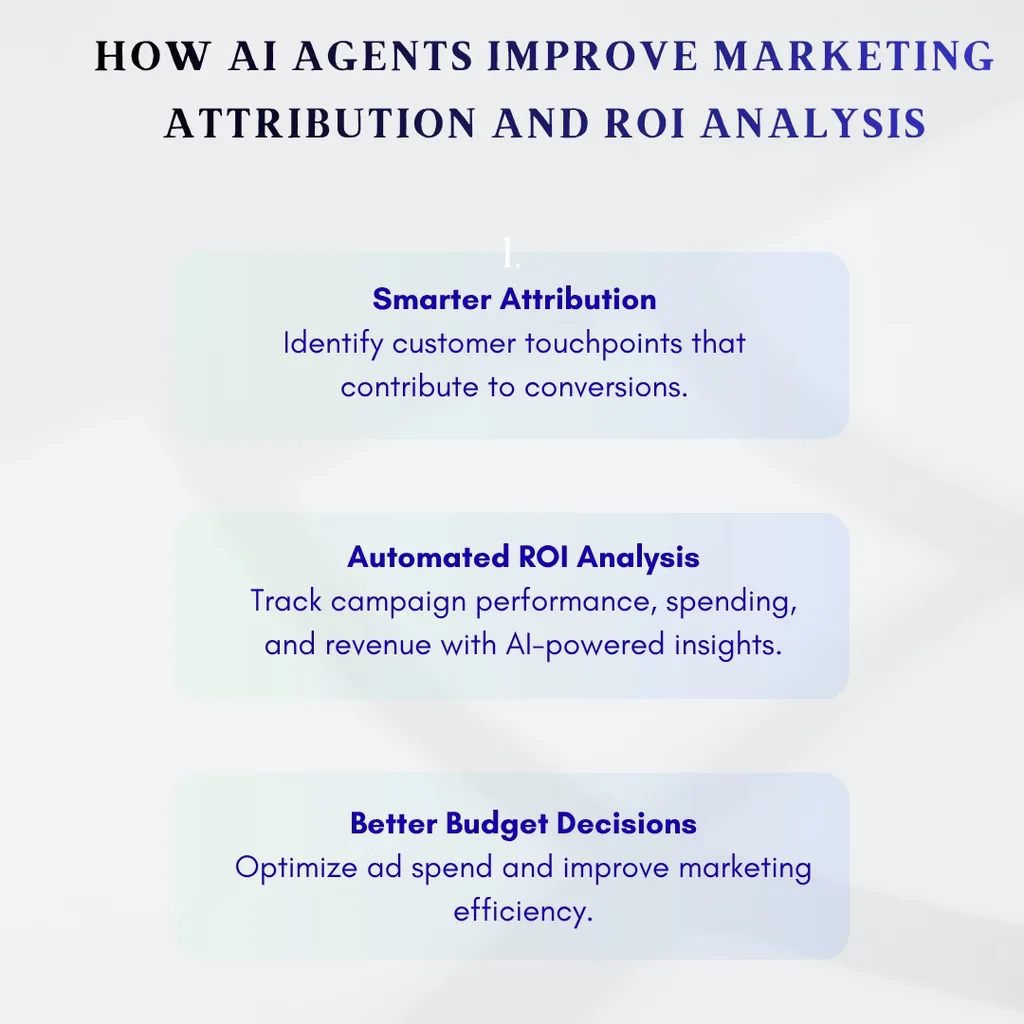
AI agents support ad spend optimization by evaluating campaign costs alongside conversions, customer quality, revenue, and profitability metrics.
Rather than simply identifying the campaign with the most clicks, these systems can help marketers assess which activities contribute to meaningful business outcomes.
Practical Ad Spend Optimization Strategies
Identify inefficient campaigns: Flag campaigns with rising costs, declining conversion rates, or weak lead quality.
Compare channel performance: Evaluate customer acquisition costs, attributed revenue, and conversion efficiency across marketing channels.
Recommend budget adjustments: Suggest reallocating spending based on performance trends, business objectives, and available budget constraints.
Monitor diminishing returns: Identify situations where additional advertising expenditure appears to generate progressively smaller gains.
Evaluate customer value: Consider repeat purchases and customer lifetime value when comparing acquisition channels.
These recommendations are particularly useful when combined with human oversight. Marketing teams should consider seasonality, campaign objectives, brand-building activities, and attribution uncertainty before making substantial budget changes.
5. Connecting Customer Acquisition Analytics With Business Growth
Marketing performance should not be measured only by impressions, clicks, or immediate conversions. Businesses also need to understand the cost of acquiring customers, the quality of leads, retention rates, and the long-term value of customer relationships.
Customer acquisition analytics helps connect marketing activity with these business outcomes. AI agents can compare acquisition costs across channels, segment customers by behavior, and identify patterns associated with repeat purchases or stronger customer retention.
For example, a campaign might generate fewer leads than another campaign but attract customers who spend more, renew subscriptions more frequently, or require less support. An AI-assisted analysis can help businesses recognize this difference.
Metrics That Matter for Marketing ROI
| Metric | Meaning | Why It Matters |
| Customer acquisition cost (CAC) | Cost of acquiring a customer | Measures acquisition efficiency |
| Conversion rate | Percentage of visitors or leads who convert | Indicates how effectively traffic produces results |
| Customer lifetime value (CLV) | Estimated value generated throughout a customer relationship | Supports long-term investment decisions |
| Return on ad spend (ROAS) | Revenue attributed to advertising divided by advertising spend | Measures advertising revenue efficiency |
| Cost per qualified lead | Marketing expenditure divided by qualified leads | Helps evaluate lead quality and acquisition costs |
AI agents can monitor these metrics together and identify situations where improving one metric negatively affects another. For example, reducing cost per lead may increase the number of low-quality enquiries, making overall sales performance worse.
This broader perspective helps businesses connect marketing analytics with business growth analytics and make decisions based on sustainable results rather than isolated campaign metrics.
6. Supporting Enterprise Marketing Intelligence
Large organizations often manage several brands, markets, business units, and advertising accounts. Different teams may use different reporting conventions, making it difficult to compare results and identify organization-wide opportunities.
Enterprise marketing intelligence combines data from relevant marketing and business systems to support a more consistent view of performance. AI agents can summarize trends, compare business units, flag discrepancies, and answer questions about campaign outcomes using connected data.
This can be particularly valuable for businesses operating in multiple regions or managing large advertising budgets.
Enterprise Applications of AI Agents
- Centralized reporting: Consolidate performance insights from approved data sources.
- Cross-team collaboration: Share consistent metrics with marketing, sales, finance, and leadership teams.
- Regional comparisons: Compare campaign performance across locations, markets, and customer segments.
- Strategic planning: Use historical trends and predictive estimates to evaluate upcoming campaigns.
- Brand Monitoring: Identify changes in brand mentions, audience sentiment, and market conversations when connected to suitable monitoring tools.
For organizations investing in B2B Marketing Strategies, AI agents can also connect account engagement data with lead progression and sales outcomes. This makes it easier to evaluate how marketing contributes to pipeline development, although sales-cycle length and attribution limitations must be considered.
Strong governance remains essential. Businesses should define shared metric definitions, control data access, document attribution assumptions, and regularly validate automated outputs.
7. Applying AI Attribution Across eCommerce Marketing
In eCommerce Marketing, customer journeys can include product searches, social media advertisements, product-page visits, abandoned carts, promotional emails, and completed purchases.
AI agents can connect these interactions to help retailers understand which campaigns contribute to product discovery, conversions, and repeat purchases.
For example, a retailer may discover that video advertisements generate initial interest while email reminders encourage customers to complete abandoned purchases. Rather than treating these activities as unrelated, AI-supported analysis can provide a broader view of their combined contribution.
eCommerce Use Cases
- Compare product-category performance across advertising channels.
- Identify customer segments with high purchase intent.
- Analyze abandoned-cart recovery campaigns.
- Evaluate promotional campaigns alongside repeat-purchase behavior.
- Estimate customer acquisition costs by product category.
- Identify potential opportunities for Conversion Rate Optimization through landing-page and checkout analysis.
AI agents can also help retailers monitor changing Consumer Trends Earlier by analyzing permitted search, engagement, sales, and customer feedback data. These signals may highlight shifts in product interest or purchasing behavior before they become obvious in periodic reports.
Such findings are most useful when validated against actual sales, inventory availability, seasonality, and broader market conditions.
8. Extending Attribution to Multi-Location Marketing
Businesses operating across multiple cities, branches, franchises, or service areas face a different measurement challenge. A customer might discover a business online, call a local branch, visit its physical location, and make a purchase offline.
Multi-Location Marketing requires businesses to connect digital interactions with local outcomes wherever reliable tracking is available.
AI agents can compare local advertising performance, analyze Google Business Profile interactions, monitor tracked calls and forms, and summarize differences between locations. When connected to suitable customer relationship management and point-of-sale systems, they can help relate marketing activity to qualified enquiries, bookings, store visits, and sales.
Local Attribution Opportunities
| Business Goal | AI-Agent Application | Measurement Consideration |
| Generate local enquiries | Compare calls, forms, and campaign sources | Use consistent lead-source tracking |
| Improve local visibility | Analyze search visibility and engagement trends | Separate visibility from actual revenue |
| Increase store visits | Connect available location-related campaign data with store outcomes | Account for tracking limitations |
| Compare branch performance | Evaluate spending, lead quality, and sales by location | Consider local demand and operating costs |
| Improve regional budgets | Identify patterns in local acquisition efficiency | Validate recommendations against business conditions |
For example, a service company with branches in Jaipur, Delhi, and Ahmedabad could use AI-assisted reporting to compare cost per qualified enquiry and booked appointment. A branch generating fewer enquiries may still deliver stronger financial results if it converts a larger proportion of those enquiries into paying customers.
The objective is not simply to rank locations but to understand why their performance differs and identify practical improvements.
9. Integrating Attribution With Marketing Automation
Attribution becomes more valuable when insights lead to timely action. AI agents can connect reporting with approved marketing workflows, allowing teams to respond to customer behavior without manually reviewing every campaign.
This creates opportunities to combine attribution analysis with Marketing Automation, customer segmentation, and campaign personalization.
Examples of Automated Marketing Workflows
Lead follow-up: When a qualified prospect submits a form, an agent can trigger an approved CRM workflow or recommend the next sales action.
Budget alerts: If campaign spending increases while qualified conversions decline, an agent can notify the responsible team.
Audience segmentation: Customer behavior and purchase history can inform audience groups for relevant campaigns, subject to consent and data-use policies.
Chatbots in Modern Marketing: Conversational agents can answer common questions, qualify enquiries, and route promising prospects to sales teams. Their interactions can contribute to attribution when properly recorded and linked to the customer journey.
Content Repurposing: AI agents can analyze content performance and recommend adapting successful material into email campaigns, social posts, short videos, or landing-page assets.
These workflows can reduce repetitive tasks and improve response times. However, businesses should maintain clear approval rules for sensitive actions, promotional claims, budget changes, and communications that could affect customer trust.
10. Using AI Agents to Improve Conversion Rate Optimization
Attribution explains how customers interact with marketing channels, while conversion optimization focuses on helping more visitors complete valuable actions.
AI agents can connect these areas by examining landing-page engagement, traffic sources, device types, form completion, checkout behavior, and conversion outcomes.
For example, an agent may identify that a paid search campaign attracts relevant visitors but has a lower conversion rate on mobile devices. This finding can prompt the team to review page speed, form usability, message relevance, and checkout friction.
A Practical Conversion Optimization Process
- Identify the problem: Find pages or campaigns with weaker-than-expected conversion performance.
- Analyze the context: Compare traffic sources, audience segments, devices, and customer journeys.
- Develop hypotheses: Recommend possible changes based on observed patterns.
- Test improvements: Run controlled experiments where practical.
- Measure results: Compare conversion rates and downstream business outcomes.
- Refine the strategy: Apply validated improvements and continue monitoring performance.
AI agents can accelerate analysis and recommend experiments, but controlled testing is generally more reliable than assuming that a correlation proves a change caused an improvement.
11. Measuring the Impact of AI-Powered Performance Measurement
AI-powered performance measurement helps marketing teams move beyond static dashboards toward continuous analysis and decision support.
However, adopting AI agents does not automatically improve ROI. Businesses need to evaluate whether automation reduces reporting effort, improves data reliability, helps identify useful opportunities, and contributes to better commercial decisions.
Companies should begin with a focused use case, such as automated campaign reporting or identifying inefficient advertising spend. Once the workflow demonstrates value, they can expand into predictive analysis and more advanced cross-channel optimization.
Privacy, security, data access, and human review should be built into the implementation from the beginning.
Challenges and Best Practices for AI-Driven Attribution
Despite their advantages, AI agents face several limitations that marketing teams must address.
Common Challenges
- Incomplete tracking: Missing identifiers and disconnected systems can create gaps in customer journeys.
- Data quality problems: Duplicate records or inconsistent campaign naming can distort reports.
- Attribution bias: A selected model may overvalue certain channels or overlook offline interactions.
- Changing customer behavior: Historical patterns may become less reliable when market conditions change.
- Privacy restrictions: Consent requirements and platform limitations can reduce the availability of user-level data.
- Overreliance on automation: Unverified recommendations may lead to ineffective spending decisions.
Best Practices for Reliable Results
- Establish consistent campaign naming conventions and tracking parameters.
- Validate conversion events and revenue data regularly.
- Compare multiple attribution models where appropriate.
- Distinguish attributed revenue from incremental revenue.
- Evaluate profitability alongside revenue and ROAS.
- Use controlled experiments to assess whether marketing changes create additional value.
- Apply access controls and follow relevant privacy requirements.
- Keep humans involved in important budget and strategy decisions.
These practices help businesses use AI agents as decision-support systems rather than treating automated outputs as unquestionable facts.
The Future of Marketing Attribution and ROI Analysis
Marketing measurement is moving toward more connected data, faster reporting, predictive insights, and increasingly automated decision support. AI agents can help businesses identify emerging patterns, compare customer journeys, and evaluate marketing performance across channels.
As systems improve, Marketing Intelligence will increasingly connect campaign data with sales, customer retention, product performance, and financial outcomes. This will support more informed planning across paid advertising, organic search, email, content, and offline channels.
The most effective systems will combine reliable data, suitable attribution methods, business context, and human judgment. AI agents can accelerate the process, but sustainable marketing performance still depends on sound strategy, customer understanding, and continuous validation.
Conclusion
AI agents improve marketing attribution and ROI analysis by automating data collection, connecting customer touchpoints, generating predictive insights, and helping businesses evaluate campaign effectiveness. They make it easier to identify inefficient spending, understand customer acquisition costs, compare marketing channels, and connect performance metrics with business outcomes.
From eCommerce Marketing to Multi-Location Marketing, AI-driven attribution can help organizations build more consistent reporting processes and make better-informed budget decisions. When supported by accurate data, clear measurement rules, privacy safeguards, and human oversight, these systems can strengthen marketing efficiency and support long-term business growth.
Frequently Asked Questions (FAQs)
1. How do AI agents improve marketing attribution?
AI agents analyze data from connected marketing platforms, identify customer touchpoints, compare attribution models, and summarize the interactions associated with conversions. They can also flag tracking issues and help marketers understand how different channels contribute to business outcomes.
2. Can AI agents calculate marketing ROI automatically?
Yes. When connected to reliable campaign cost and revenue data, AI agents can automate ROI calculations, prepare reports, and estimate future performance. Results depend on accurate cost allocation, suitable attribution rules, and consistent revenue measurement.
3. What is the difference between multi-touch attribution and AI-powered attribution?
Multi-touch attribution distributes conversion credit across multiple customer interactions. AI-powered attribution uses data analysis and, in some cases, machine learning to estimate the contribution of those interactions. AI can support multi-touch models, but the two terms are not interchangeable.
4. How can AI agents help reduce advertising costs?
AI agents can identify campaigns with rising acquisition costs, weak conversion performance, or low-quality leads. They can recommend budget adjustments and highlight potential improvements. Marketers should validate these recommendations before making significant spending changes.
5. Are AI agents suitable for small businesses as well as enterprises?
Yes. Small businesses can start with automated reporting, conversion tracking, and campaign alerts, while larger organizations may use AI agents for cross-channel attribution, regional performance analysis, and predictive forecasting. The right approach depends on available data, technical resources, and business goals.
