


Venture capital is becoming increasingly data-driven, and venture capital AI is helping investors process startup information faster and more accurately. Modern startup evaluation systems can organize funding histories, market data, founder backgrounds, competitive positioning, and business metrics in one workflow. For investors, this supports stronger Risk Management by making it easier to identify potential concerns before spending significant time on a deal.
At the same time, VC deal sourcing AI can scan large volumes of startup information and surface companies that match specific investment criteria. Report Analysis powered by AI can summarize financial reports, market studies, pitch decks, and company documents, allowing investors to spend more time on strategic Financial Decision-Making rather than manual research.
How AI Agents Are Changing Venture Capital Research
Traditional venture capital research often requires analysts to collect information from multiple databases, company websites, news sources, financial reports, and founder profiles. AI agents can coordinate these activities and create structured research outputs.
With startup market research AI, investors can analyze industries, competitors, customer segments, market trends, and emerging opportunities more efficiently. These systems can continuously monitor new information instead of relying only on one-time research.
Key Applications of AI Agents in VC
| Application | How AI Agents Help | Investor Benefit |
| Deal sourcing | Identify startups matching investment criteria | Faster opportunity discovery |
| Market research | Analyze industries and competitors | Better market understanding |
| Founder analysis | Organize founder backgrounds and experience | More structured evaluation |
| Financial research | Review financial and business metrics | Faster financial assessment |
| Portfolio monitoring | Track company performance and market changes | Proactive portfolio management |
AI-Powered Startup Evaluation
Evaluating a startup involves much more than looking at revenue or funding. Investors need to assess the founding team, market size, product differentiation, customer traction, business model, competition, and scalability.
Modern founder analysis tools can organize information about founders, including professional backgrounds, previous ventures, domain expertise, and relevant experience. AI can help analysts compare this information against the requirements of a particular investment thesis.
Investment opportunity intelligence can also combine multiple data points to identify startups that may have strong growth potential. Instead of manually reviewing hundreds of companies, investment teams can prioritize opportunities based on predefined criteria.
AI Agents for Deal Sourcing
Finding promising startups at the right stage is one of the biggest challenges for venture capital firms. AI agents can continuously monitor startup databases, funding announcements, industry publications, company websites, and other sources.
VC deal sourcing AI can filter opportunities according to factors such as:
- Industry and sector
- Geographic market
- Funding stage
- Revenue growth
- Business model
- Technology
- Founder experience
- Market size
- Investment thesis
This allows analysts to create more focused deal pipelines while reducing repetitive research work.
Startup Market and Competitive Research
Understanding a startup’s market position is essential before making an investment. AI agents can analyze competitors, customer trends, market reports, product offerings, pricing models, and industry developments.
Financial Market Intelligence can provide additional context by connecting startup performance with broader market conditions. For startups operating in financial services, Fintech Companies can benefit from AI-powered research that evaluates market trends, regulatory developments, competitors, and emerging technologies.
Startup Research Areas
| Research Area | Data AI Can Analyze | Potential Output |
| Market size | Industry reports and market data | TAM, SAM, SOM insights |
| Competition | Competitor websites and offerings | Competitive comparison |
| Customers | Reviews and customer signals | Customer sentiment |
| Funding | Funding rounds and investors | Funding history |
| Product | Features and positioning | Product differentiation |
| Industry | News and market trends | Emerging opportunity signals |
Venture Workflow Automation
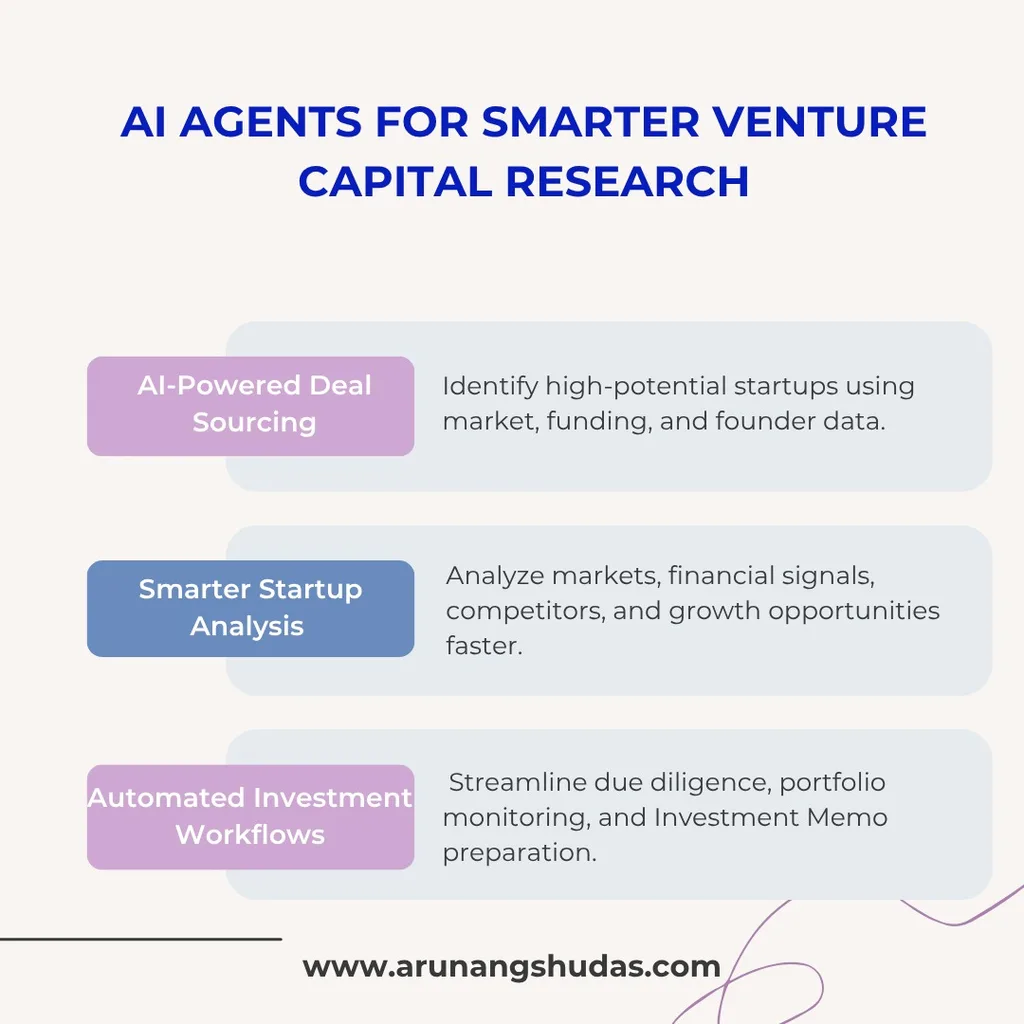
VC analysts often spend significant time performing repetitive tasks such as collecting company information, updating spreadsheets, preparing summaries, and monitoring portfolio companies.
Venture workflow automation can connect these activities into a more efficient process. An AI agent can gather information, classify opportunities, summarize findings, and prepare research documents based on predefined instructions.
This can be particularly useful for Finance Teams and investment teams managing multiple opportunities simultaneously.
From Research to Investment Memo
Once the research stage is complete, AI can help organize findings into structured Investment Memos. An AI-generated memo can include:
- Company overview
- Founder background
- Market opportunity
- Competitive landscape
- Business model
- Financial performance
- Growth indicators
- Key risks
- Investment thesis
- Due diligence questions
Human investors should still review and validate important information before using an AI-generated memo for an investment decision.
Portfolio Analysis with AI
AI is also useful after an investment has been made. Investors need to monitor revenue growth, customer acquisition, cash flow, hiring, market conditions, and competitive changes across portfolio companies.
Portfolio analysis AI can consolidate these signals and help investment teams identify companies that may require additional attention.
For example, an AI system could flag a portfolio company experiencing slower revenue growth, increased customer churn, or changing competitive pressure. This enables investors to investigate potential issues earlier.
AI for Growth Analysis
Startup growth can be measured through multiple indicators rather than a single metric. Growth analysis systems can help investors track changes in revenue, users, customers, retention, acquisition costs, hiring, and other business indicators.
AI can compare current performance with historical data and highlight unusual changes.
Growth Metrics AI Can Monitor
| Metric | What It Indicates | AI Application |
| Revenue growth | Business expansion | Trend analysis |
| Customer growth | Market adoption | Growth monitoring |
| Customer retention | Product-market fit | Retention analysis |
| CAC | Acquisition efficiency | Cost monitoring |
| LTV | Customer value | Unit economics analysis |
| Burn rate | Capital usage | Financial monitoring |
| Runway | Time until additional funding | Risk alerts |
Financial Automation for Investment Teams
Investment teams increasingly use technology to streamline financial workflows. Financial Automation Tools can support data collection, financial reporting, document processing, and recurring analysis.
For organizations working with regulated financial information, Financial Compliance Automation can also help organize compliance-related workflows, identify missing documentation, and create review trails. However, compliance decisions should remain subject to appropriate human and regulatory oversight.
Fintech investment tools can further support investors evaluating financial technology businesses by combining market information, financial indicators, company data, and sector trends.
AI Agents and Fund Research
AI can also assist with Fund Research and Trading by organizing market information and monitoring relevant financial signals. For venture investors, this can provide useful context when assessing how broader financial conditions may influence startup valuations, funding availability, and exit opportunities.
AI should not replace professional investment judgment. Instead, it can function as a research assistant that reduces manual information processing and helps teams focus on higher-value analysis.
How AI Supports Corporate Finance Teams
Although venture capital is a primary use case, AI research agents can also support Corporate Finance Teams. These teams frequently handle financial reporting, forecasting, market research, business analysis, and strategic planning.
AI agents can help summarize financial information, compare business performance, monitor market changes, and organize data for management discussions.
AI Agent Workflow for Startup Analysis
| Stage | AI Agent Activity | Result |
| 1. Sourcing | Scan startup and market data | Potential opportunities |
| 2. Screening | Apply investment criteria | Shortlisted companies |
| 3. Research | Analyze company and market information | Research profile |
| 4. Evaluation | Compare business and financial signals | Investment assessment |
| 5. Due diligence | Organize documents and questions | Due diligence workspace |
| 6. Memo creation | Structure research findings | Investment Memo |
| 7. Monitoring | Track company and market changes | Portfolio intelligence |
Benefits of AI Agents for VC Firms
AI agents can provide several advantages when implemented carefully:
Faster Research
AI can process large amounts of structured and unstructured information much faster than manual workflows.
Better Information Organization
Instead of keeping research across multiple documents and spreadsheets, AI can structure findings into consistent formats.
Improved Deal Prioritization
Investment teams can use predefined criteria to rank opportunities and focus analyst time on the most relevant companies.
Continuous Monitoring
AI agents can monitor new developments after the initial investment, helping investors maintain current company and market information.
Reduced Administrative Work
Automating repetitive activities gives analysts more time for conversations with founders, due diligence, strategic analysis, and investment decisions.
Challenges of AI in Venture Capital
Despite its benefits, AI adoption in VC requires careful implementation. Data quality is one major concern. AI systems can produce incomplete or inaccurate conclusions when the underlying information is outdated or unreliable.
Privacy and confidentiality are also important when processing pitch decks, financial statements, customer information, and other sensitive documents.
Investment teams should establish clear processes for data validation, access control, human review, and model governance.

The Future of AI-Powered Venture Capital
The future of venture capital research is likely to involve increasingly connected AI agents that can move information between sourcing, research, due diligence, memo preparation, and portfolio monitoring.
Rather than replacing investment professionals, AI agents can act as research and workflow assistants. They can collect evidence, identify patterns, summarize complex information, and highlight areas that require deeper investigation.
As venture capital AI becomes more sophisticated, firms that combine AI capabilities with strong investment frameworks and human judgment may be better positioned to manage growing volumes of startup and market information.
Frequently Asked Questions
1. What is AI in venture capital?
AI in venture capital refers to using artificial intelligence to support activities such as startup sourcing, market research, founder analysis, due diligence, financial analysis, investment memo preparation, and portfolio monitoring.
2. How does AI help with startup evaluation?
AI can organize company information, analyze market and financial data, compare competitors, review founder backgrounds, and identify important signals that investors can consider during startup evaluation.
3. Can AI agents automate VC deal sourcing?
Yes. AI agents can monitor relevant data sources and identify startups that match predefined criteria such as industry, location, funding stage, business model, or growth indicators. Human review remains important before advancing an opportunity.
4. Can AI create investment memos?
Yes. AI can organize research findings into structured Investment Memos containing company information, market analysis, financial indicators, competitive insights, risks, and investment considerations. Investors should verify the underlying information before relying on the memo.
5. What are the main benefits of AI agents for VC firms?
The main benefits include faster research, more structured startup evaluation, improved deal prioritization, automated workflows, continuous portfolio monitoring, and reduced repetitive administrative work.
