


Financial institutions are handling growing volumes of regulations, transactions, reports, and operational data. Risk Management, Report Analysis, Fintech Companies, and Financial Decision-Making all require accurate compliance processes that can keep pace with changing requirements. This is where compliance automation AI can support organizations by monitoring financial activities, identifying potential issues, and organizing compliance-related information for faster review.
Modern Fintech Companies are also using AI-driven systems to strengthen governance while reducing repetitive manual work. Financial Decision-Making increasingly depends on timely and reliable compliance data, while Report Analysis can help teams identify inconsistencies across financial documents. With AI agents handling routine checks and escalation workflows, Corporate Finance Teams can spend more time on strategic activities while maintaining structured compliance processes.
What Are AI Agent Systems for Financial Compliance?
AI agent systems are software systems that can perform specific tasks with a degree of autonomy. In financial compliance, these agents can collect information, evaluate predefined rules, monitor transactions, analyze documents, and flag exceptions for human review.
Unlike traditional automation, AI agents can coordinate multiple steps in a workflow. For example, an agent can review a financial report, compare relevant information against internal policies, identify a potential compliance concern, and route the issue to the appropriate team.
Organizations can use regulatory technology systems to connect these capabilities with existing financial platforms, reporting systems, document repositories, and governance processes.
Why Financial Compliance Needs Intelligent Automation
Financial compliance involves large amounts of structured and unstructured information. Teams may need to review policies, transaction records, regulatory updates, financial statements, audit evidence, and internal reports.
Manual processes can make it difficult to maintain consistency across these activities. AI-based workflows can help standardize repetitive checks while maintaining human oversight for complex decisions.
Key areas where AI agents can contribute include:
- Regulatory document analysis
- Transaction monitoring
- Policy compliance checks
- Audit evidence collection
- Exception identification
- Risk reporting
- Internal control monitoring
- Compliance documentation
- Management reporting
Finance Teams can use these capabilities to create repeatable workflows that support daily compliance operations.
Core Components of an AI Compliance Architecture
A financial compliance AI system generally includes several interconnected components.
| Component | Purpose | Example |
| Data ingestion | Collects relevant financial and regulatory information | Reports, transactions, policies |
| AI agents | Performs defined compliance tasks | Document review agent |
| Rules engine | Applies organizational and regulatory rules | Threshold validation |
| Monitoring layer | Tracks activities and exceptions | Transaction monitoring |
| Human review | Handles complex or high-risk cases | Compliance officer approval |
| Reporting layer | Produces compliance outputs | Audit and management reports |
A well-designed architecture should also include access controls, audit trails, validation mechanisms, and clear escalation procedures.
How Autonomous Compliance Agents Work
Autonomous compliance agents can be designed to complete individual compliance tasks while operating within predefined boundaries.
A typical workflow may look like this:
- Collect data from approved financial and regulatory sources.
- Classify information according to the relevant compliance process.
- Apply rules and policies to the collected information.
- Identify exceptions or potentially unusual activity.
- Generate supporting evidence for the review process.
- Escalate issues requiring human intervention.
- Document outcomes for future audits and reporting.
The goal is not to remove human responsibility from compliance. Instead, AI agents can support professionals by handling repetitive analysis and organizing information before human review.
AI for Risk and Compliance Monitoring
Risk compliance monitoring can become more efficient when AI systems continuously evaluate relevant data rather than relying only on periodic manual reviews.
For example, an AI agent can monitor transaction-related information against predefined thresholds and policies. If an exception appears, the system can create an alert and provide supporting context to the compliance team.
This approach can help organizations establish consistent monitoring processes while reducing unnecessary manual checks.
Common Monitoring Activities
- Policy adherence checks
- Transaction pattern monitoring
- Regulatory requirement tracking
- Exception management
- Control testing
- Documentation verification
- Risk indicator monitoring
Intelligent governance tools can bring these activities into centralized workflows, helping teams maintain visibility across different compliance functions.
AI Audit Workflows and Evidence Management
Audits often require organizations to collect documents, transaction records, approvals, policy evidence, and explanations for specific decisions.
AI audit workflows can organize this information and help identify missing documentation. An AI agent can also classify documents, match evidence to control requirements, and prepare review packages.
For example, an audit agent could:
- Identify required evidence
- Search approved repositories
- Classify supporting documents
- Match evidence to controls
- Flag missing information
- Prepare an audit summary
- Maintain an activity trail
Audit analytics systems can further analyze historical compliance information to identify recurring issues and control gaps.
Enterprise Reporting and Compliance Intelligence
Financial organizations generate numerous internal and external reports. Enterprise reporting AI can help standardize how compliance-related information is collected and presented.
An AI reporting workflow may combine data from financial systems, risk platforms, compliance databases, and internal documents. The system can then organize the information into structured reports for review.
This can support areas such as:
- Regulatory reporting
- Internal compliance reports
- Risk dashboards
- Audit summaries
- Management reports
- Control-performance reporting
For organizations involved in Financial Market Intelligence, automated reporting can also help connect market information with internal governance requirements.
AI and Financial Regulation Automation
Regulations frequently change, creating a need for ongoing monitoring and policy updates. Financial regulation automation can help teams track regulatory information and identify areas that may require internal review.
A regulatory AI workflow could:
- Monitor approved regulatory sources.
- Identify relevant changes.
- Classify changes by business function.
- Map requirements to internal policies.
- Notify responsible teams.
- Track review and implementation status.
Human compliance professionals should remain responsible for interpreting regulatory requirements and approving consequential policy changes.
Connecting Compliance Automation With Finance Operations
AI compliance systems can also support broader financial workflows. Financial Automation Tools may connect compliance monitoring with reporting, research, documentation, and financial operations.
For example, organizations involved in Fund Research and Trading may require controls around data usage, documentation, reporting, and transaction processes. AI agents can support these workflows by checking predefined requirements and creating exception reports.
Similarly, Investment Memos can benefit from structured compliance checks before information is included in investment-related documentation.
AI Governance for Corporate Finance Teams
Finance governance AI can provide a structured layer between financial operations and governance requirements. It can help monitor policies, document approvals, and identify exceptions.
For Corporate Finance Teams, useful applications may include:
- Financial policy monitoring
- Approval workflow verification
- Internal control checks
- Reporting validation
- Documentation management
- Compliance alerts
- Audit preparation
Governance systems should clearly define which actions AI can perform independently and which actions require approval from authorized employees.
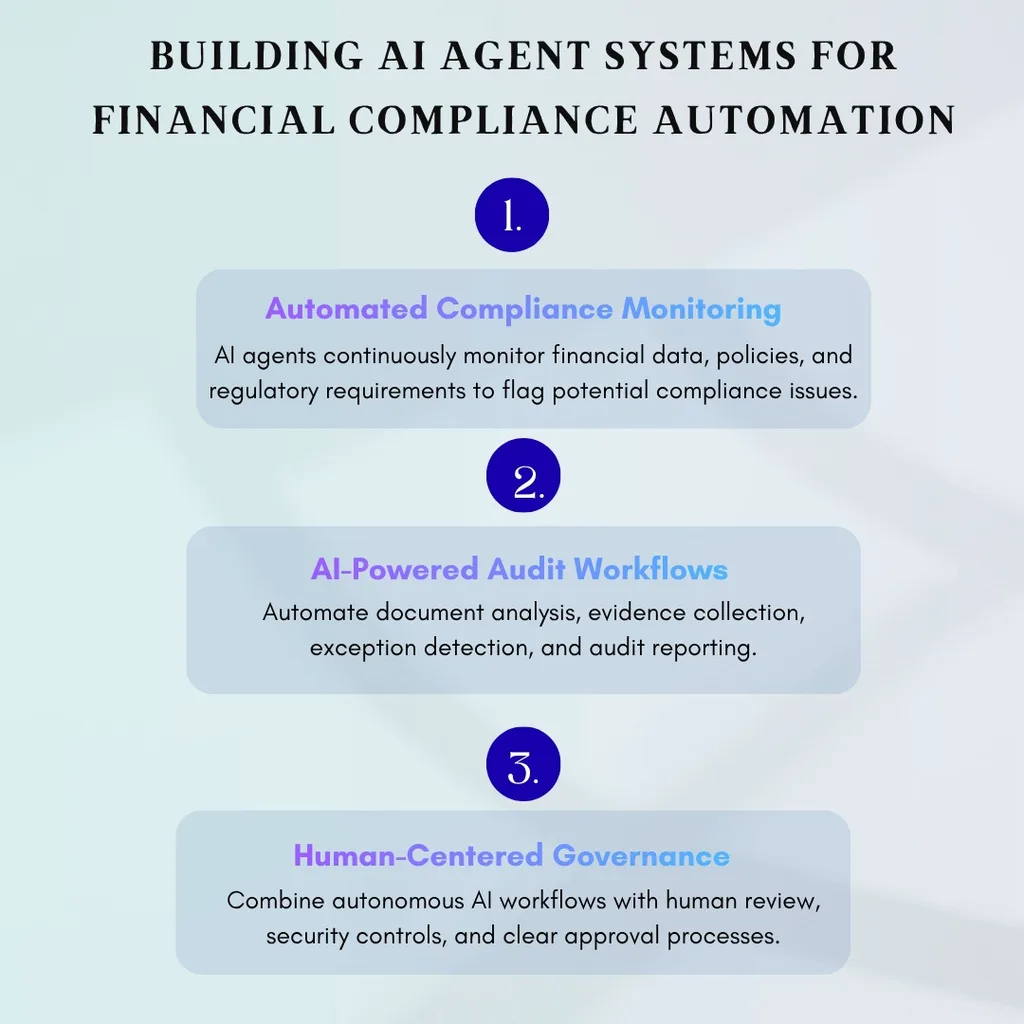
Compliance Automation Workflow
The following table shows how an AI-enabled compliance process can be structured.
| Workflow Stage | AI Agent Activity | Human Role |
| Data collection | Gather approved information | Verify data sources |
| Initial analysis | Classify and analyze information | Review important cases |
| Compliance check | Compare against rules | Validate complex interpretations |
| Exception detection | Flag potential issues | Investigate exceptions |
| Reporting | Prepare structured reports | Approve final outputs |
| Documentation | Maintain evidence and records | Confirm completeness |
This human-in-the-loop structure is particularly important for high-impact financial decisions.
Benefits of AI Agent Systems for Financial Compliance
Organizations may use AI agents to improve several operational areas.
1. Faster Compliance Reviews
AI can process large amounts of information quickly, allowing teams to focus on exceptions and higher-value reviews.
2. Consistent Rule Application
Automated workflows can apply predefined policies consistently across large datasets.
3. Better Documentation
AI systems can organize supporting evidence and create structured records for compliance activities.
4. Continuous Monitoring
Instead of relying only on periodic checks, organizations can implement ongoing monitoring for selected compliance activities.
5. Improved Reporting
AI can bring information from multiple systems into standardized compliance reports.
6. Reduced Repetitive Work
Routine classification, document review, and data validation can be automated within controlled workflows.
Use Cases Across Financial Organizations
AI compliance systems can support multiple types of financial organizations and departments.
| Organization/Team | Potential AI Compliance Use Case | Expected Workflow Support |
| Banks | Transaction and policy monitoring | Exception identification |
| Fintech Companies | Regulatory reporting | Data validation |
| Investment firms | Research and documentation controls | Evidence tracking |
| Corporate finance | Internal governance | Policy monitoring |
| Audit teams | Evidence management | Document classification |
| Risk teams | Continuous monitoring | Alert generation |
The exact implementation depends on regulatory obligations, organizational policies, data availability, and risk tolerance.
Challenges in Building Compliance AI Agents
Despite their potential, AI compliance systems require careful design.
Data Quality
Incorrect or incomplete data can produce unreliable outputs. Organizations need validation processes before AI agents use financial information.
Explainability
Compliance teams may need to understand why an AI system flagged an issue. Systems should therefore provide relevant evidence, rules, and reasoning traces where appropriate.
Security and Access Control
Financial information can be highly sensitive. AI systems need appropriate authentication, authorization, encryption, and data-access controls.
Regulatory Accountability
AI can assist with compliance activities, but organizations remain responsible for their regulatory obligations. Human oversight is essential for significant compliance decisions.
Model Reliability
AI models can produce incorrect outputs. Critical workflows should include validation, monitoring, testing, and escalation mechanisms.
Measuring AI Compliance System Performance
Organizations should define measurable indicators before deploying AI agents.
| Metric | What It Measures | Why It Matters |
| Exception detection rate | Identified compliance exceptions | Monitoring effectiveness |
| False-positive rate | Incorrect alerts | Review workload |
| Review time | Time required per case | Operational efficiency |
| Evidence completeness | Availability of required documentation | Audit readiness |
| Escalation accuracy | Cases routed to appropriate reviewers | Workflow quality |
| Human approval rate | Cases requiring human decisions | Automation boundaries |
These metrics should be monitored continuously rather than treated as one-time implementation targets.
Future of Compliance Automation AI
The future of compliance automation AI is likely to involve interconnected agents that perform specialized tasks across finance, risk, audit, and governance functions.
A compliance agent could communicate with a reporting agent, while a separate audit agent verifies supporting evidence. Governance systems could then track approvals and maintain a centralized record of activities.
This model could create more connected regulatory technology systems, where compliance becomes part of everyday financial workflows rather than a separate manual process.
As AI adoption grows, organizations will need to balance automation with governance, transparency, security, and human accountability. The strongest implementations will focus not only on automation but also on creating reliable controls around how AI systems operate.

Conclusion
Building AI agent systems for financial compliance automation requires more than connecting an AI model to financial data. Organizations need structured workflows, reliable data, clearly defined rules, access controls, audit trails, monitoring, and human oversight.
From risk compliance monitoring and AI audit workflows to enterprise reporting AI and financial regulation automation, AI agents can support multiple compliance activities. When implemented within appropriate governance frameworks, these systems can help financial organizations manage repetitive processes while giving professionals more time to review complex issues and make informed decisions.
Frequently Asked Questions
1. What is compliance automation AI?
Compliance automation AI uses artificial intelligence to support activities such as regulatory monitoring, document analysis, policy checks, exception detection, reporting, and audit preparation.
2. How do autonomous compliance agents work?
Autonomous compliance agents perform predefined tasks such as collecting data, checking rules, identifying exceptions, organizing evidence, and routing cases for human review. Their level of autonomy should be limited according to the risk of the task.
3. Can AI replace financial compliance teams?
AI can automate or assist with repetitive compliance activities, but it does not remove the need for qualified compliance professionals. Human oversight remains important for interpretation, investigation, approvals, and significant decisions.
4. What are the main benefits of AI audit workflows?
AI audit workflows can help organize evidence, classify documents, identify missing information, match evidence with controls, and prepare structured audit materials.
5. What should companies consider before implementing AI compliance systems?
Companies should evaluate data quality, regulatory requirements, security, access controls, explainability, model reliability, human oversight, auditability, and clear boundaries for autonomous actions before deploying AI agents.
