


Preparing for a Java Backend Developer role often requires candidates to understand both application development and modern software delivery practices. Along with java spring boot interview questions, recruiters may ask java developer interview questions and core java questions asked in interview to evaluate programming fundamentals, object-oriented concepts, exception handling, collections, multithreading, and backend development knowledge. A strong understanding of these areas can help candidates confidently handle technical discussions during interviews.
For professionals targeting backend and DevOps-oriented positions, preparing Java Backend Developer concepts alongside java spring boot interview questions, java developer interview questions, and core java questions asked in interview can provide an advantage. Interviewers may also expect candidates to understand how applications move from development to testing and production, making knowledge of deployment practices and automation increasingly valuable.
What Is DevOps?
DevOps is a software development and operations approach that combines collaboration, automation, monitoring, testing, and deployment practices. It aims to shorten development cycles while improving software quality, reliability, and delivery speed.
A typical DevOps lifecycle includes planning, development, continuous integration, testing, release, continuous deployment, operations, monitoring, and feedback. Organizations use automation and collaboration to reduce manual work and deliver software more frequently.
For freshers, understanding the basic terminology is important. Experienced professionals should additionally understand architecture, automation strategies, cloud platforms, security, scalability, monitoring, and troubleshooting.
Top DevOps Interview Questions and Answers
1. What is DevOps?
DevOps is a set of practices and cultural principles that bring development and operations teams closer together. It emphasizes automation, collaboration, monitoring, rapid feedback, and reliable software delivery.
The primary goal is not simply to automate deployments but to create a streamlined process where teams can develop, test, release, and maintain applications efficiently.
2. What are the main benefits of DevOps?
Some important benefits include:
- Faster software delivery
- Improved collaboration between teams
- Automated testing and deployment
- Faster identification of defects
- More reliable releases
- Better infrastructure management
- Improved scalability
- Continuous feedback from production systems
DevOps also helps organizations reduce repetitive manual tasks through automation.
3. What is continuous integration?
Continuous integration is the practice of frequently integrating code changes into a shared repository. Automated builds and tests are generally executed whenever developers submit changes.
The purpose is to identify integration problems early instead of discovering them shortly before a release.
4. What is CI/CD?
CI/CD refers to practices that automate and streamline software development, testing, and delivery.
In a typical pipeline:
- Developers commit code.
- The application is built.
- Automated tests are executed.
- Artifacts are created.
- The application is deployed to an environment.
- Monitoring and feedback help validate the release.
5. What are CI/CD interview questions generally focused on?
Common CI/CD interview questions cover pipeline architecture, build automation, automated testing, artifact management, deployment strategies, rollback procedures, environment management, and security.
Candidates may also be asked to design a pipeline for a web application and explain how failures should be handled.
6. What is continuous deployment?
Continuous deployment automatically releases successfully validated changes to production. It goes one step further than simply building and testing code because successful changes can reach end users without requiring a separate manual production deployment step.
Organizations generally use automated testing, monitoring, approvals where appropriate, and rollback mechanisms to reduce deployment risk.
7. What are popular DevOps tools?
There are many DevOps tools, and organizations select them based on their technology stack and requirements.
| Category | Examples | Primary Purpose |
| Version Control | Git, GitHub, GitLab | Source-code management |
| CI/CD | Jenkins, GitHub Actions, GitLab CI/CD | Pipeline automation |
| Containers | Docker | Application packaging |
| Orchestration | Kubernetes | Container orchestration |
| Cloud | AWS, Azure, Google Cloud | Infrastructure and cloud services |
| Monitoring | Prometheus, Grafana | Metrics and visualization |
| Infrastructure as Code | Terraform, CloudFormation | Infrastructure automation |
The ability to explain why a particular tool is used is generally more valuable than simply memorizing tool names.
Git Interview Questions
8. What is Git?
Git is a distributed version-control system used to track source-code changes. It allows multiple developers to work on the same project while maintaining a history of modifications.
Git is widely used in development and automation pipelines because CI/CD systems can trigger builds and tests based on repository changes.
9. What are some commonly used Git commands?
Candidates should be comfortable explaining common Git commands and their use cases.
| Git Command | Purpose |
| git init | Initializes a Git repository |
| git clone | Copies a remote repository |
| git status | Displays working-tree status |
| git add | Stages changes |
| git commit | Saves staged changes |
| git pull | Fetches and integrates remote changes |
| git push | Sends local commits to a remote repository |
| git branch | Manages branches |
| git merge | Combines branches |
| git log | Displays commit history |
10. What is the difference between git pull and git fetch?
git fetch downloads changes from a remote repository without automatically merging them into the current branch.
git pull generally performs a fetch followed by an integration operation such as merge or rebase, depending on configuration and command usage.
11. What is a Git branch?
A branch is an independent line of development. Teams can use branches for features, bug fixes, releases, or experiments without directly modifying the main development branch.
Branching strategies should be selected according to team size, release process, and deployment requirements.
Docker Interview Questions
12. What is Docker?
Docker is a containerization platform that packages an application together with its dependencies into a portable container image.
Docker containers provide process-level isolation and help create consistent application environments across development, testing, and deployment systems.
13. What is a Docker image?
A Docker image is a packaged, immutable template used to create containers. It contains the application and the dependencies required to run it.
Images are commonly built using a Dockerfile and can be stored in container registries.
14. What is the difference between a Docker image and a container?
An image is the package or template, while a container is a running instance created from that image.
For example, an application team can build one image and use it to create multiple containers across different environments.
Kubernetes Interview Questions
15. What is Kubernetes?
Kubernetes is a container orchestration platform used to deploy, manage, scale, and maintain containerized workloads.
It can automate scheduling, service discovery, scaling, rolling updates, and recovery of workloads.
16. What are Kubernetes pods?
Kubernetes pods are the smallest deployable units in Kubernetes. A pod can contain one or more containers that share networking and storage resources.
In many common architectures, one primary application container runs inside a pod, although multi-container pods can be useful for tightly coupled supporting processes.
17. What happens when a Kubernetes pod fails?
Kubernetes continuously works toward the desired state defined for an application. Depending on the workload configuration, a failed container may be restarted, or a replacement pod may be created.
Controllers such as Deployments help maintain the required number of application replicas.
AWS and Cloud Interview Questions
18. What should you know for an AWS interview?
An AWS cloud interview may cover compute, storage, networking, databases, identity management, monitoring, security, and deployment architecture.
Common services candidates should understand include:
- EC2
- S3
- IAM
- VPC
- CloudWatch
- RDS
- Elastic Load Balancing
- Auto Scaling
- Lambda
Interviewers may also present an architecture scenario and ask how you would design a highly available or scalable application.
19. What is Infrastructure as Code?
Infrastructure as Code, or IaC, is the practice of managing infrastructure through machine-readable configuration files rather than manually configuring resources.
IaC improves repeatability, version control, automation, and environment consistency.
Programming and Full-Stack Questions You May Encounter
DevOps professionals often work closely with developers, so interviews may include application-development questions depending on the role.
20. What is important in Node.js backend development?
For candidates working with JavaScript-based backend systems, Node.js API development can include questions about asynchronous programming, event-driven architecture, middleware, REST APIs, authentication, error handling, routing, and database integration.
An interviewer may ask you to explain how you would design an API that handles high traffic while maintaining reliability.
21. What are SQL joins?
SQL joins combine records from multiple database tables using related columns.
| Join Type | Description | Common Use |
| INNER JOIN | Returns matching records from both tables | Matching related records |
| LEFT JOIN | Returns all records from the left table and matches from the right | Finding optional relationships |
| RIGHT JOIN | Returns all records from the right table and matches from the left | Reverse relationship analysis |
| FULL OUTER JOIN | Returns matching and non-matching records from both sides | Complete comparison |
Candidates should understand not only the syntax but also when each join is appropriate.
22. What React topics can appear in an interview?
For frontend or full-stack positions, React interview questions may cover components, props, state, hooks, lifecycle behavior, event handling, conditional rendering, API calls, and performance optimization.
Interviewers may also ask candidates to identify unnecessary renders or explain how component state should be managed.
23. What type of Python questions are asked in technical interviews?
Python coding problems commonly test data structures, loops, functions, strings, lists, dictionaries, recursion, sorting, searching, exception handling, and object-oriented programming.
For experienced candidates, interviewers may additionally explore Python performance, concurrency, testing, packaging, and application architecture.
24. What topics are covered in ASP.NET Core interviews?
asp net core interview questions can include middleware, dependency injection, routing, controllers, configuration, authentication, authorization, Entity Framework Core, logging, REST APIs, and application deployment.
Candidates should be able to explain how an ASP.NET Core application processes an incoming HTTP request.
25. What are common C# interview topics?
c sharp interview questions and answers frequently cover object-oriented programming, interfaces, inheritance, delegates, events, generics, LINQ, exception handling, asynchronous programming, memory management, and collections.
For experienced developers, interviewers may also explore design patterns, dependency injection, performance, and concurrency.
Scenario-Based DevOps Interview Questions
26. How would you design a CI/CD pipeline?
A basic pipeline could contain the following stages:
Code Commit → Build → Unit Tests → Static Analysis → Package → Integration Tests → Deploy to Staging → Validation → Production Deployment → Monitoring
The pipeline should include failure handling and clear feedback. Production deployments can use strategies such as blue-green deployment, canary deployment, or rolling deployment.
27. How would you troubleshoot a failed deployment?
A structured troubleshooting approach is important:
- Check pipeline logs.
- Identify the stage where the failure occurred.
- Review recent code or configuration changes.
- Check application and infrastructure logs.
- Validate environment variables and secrets.
- Check resource availability.
- Reproduce the problem where possible.
- Roll back if production availability is affected.
- Document the root cause and preventive action.
28. What is blue-green deployment?
Blue-green deployment maintains two production environments. One environment serves the current production version, while the other contains the new version.
After validation, traffic can be switched to the new environment. If problems occur, traffic can be redirected to the previous version.
29. What is canary deployment?
Canary deployment gradually releases a new application version to a small percentage of users or infrastructure.
Teams monitor metrics and application behavior before increasing the rollout percentage. This approach can reduce the impact of a faulty release.
30. How can DevOps improve application reliability?
Reliability can be improved through:
- Automated testing
- Infrastructure automation
- Monitoring and alerting
- Centralized logging
- Health checks
- Automated recovery
- Version-controlled configuration
- Deployment automation
- Rollback strategies
- Regular incident analysis
Fresher vs Experienced DevOps Interview Preparation
| Area | Freshers | Experienced Professionals |
| Git | Basic commands and branching | Advanced workflows and branching strategies |
| CI/CD | Understand pipeline stages | Design and optimize production pipelines |
| Docker | Images and containers | Multi-stage builds and optimization |
| Kubernetes | Pods, services, deployments | Production clusters, scaling and troubleshooting |
| Cloud | Basic AWS services | Architecture, security, scalability and cost |
| Monitoring | Basic metrics and logs | Observability strategy and incident response |
| Security | Basic concepts | DevSecOps, secrets and compliance |
| Troubleshooting | Follow documented procedures | Diagnose complex production failures |
Tips to Prepare for a DevOps Interview
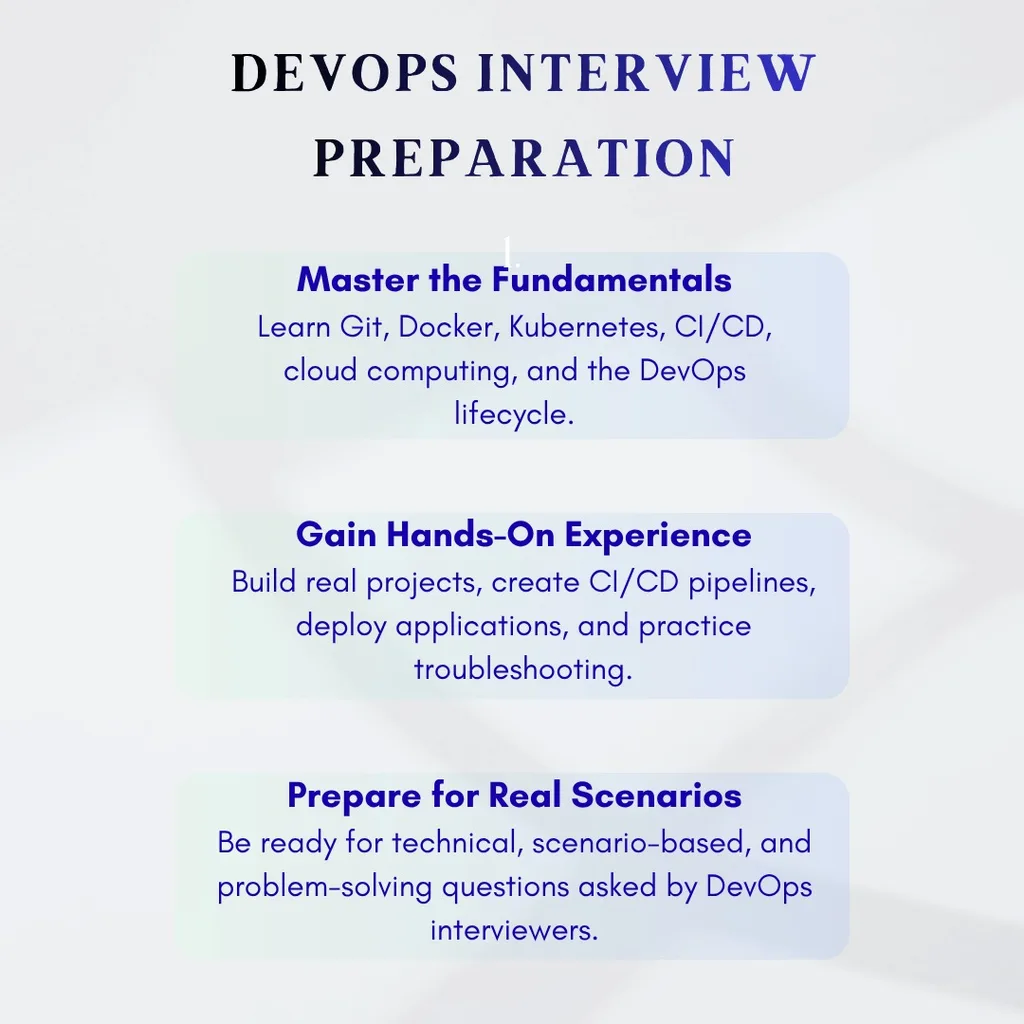
1. Learn the fundamentals
Do not begin by memorizing advanced Kubernetes commands. First understand Linux, networking, Git, HTTP, containers, cloud concepts, and software development workflows.
2. Build a practical project
Create a small application and take it through a complete workflow:
Source Code → Git → Automated Build → Tests → Docker Image → Container Registry → Kubernetes/AWS Deployment → Monitoring
A practical project gives you real examples to discuss during interviews.
3. Understand why tools are used
Interviewers may ask, “Why did you choose Docker?” or “Why use Kubernetes?” Be prepared to explain the problem each technology solves rather than simply listing features.
4. Practice troubleshooting
Experienced DevOps interviews frequently involve real-world scenarios. Practice investigating failed builds, unhealthy containers, high CPU usage, unavailable services, deployment failures, and connectivity issues.
5. Prepare project-based answers
When describing your experience, use a simple structure:
Problem → Approach → Tools → Implementation → Result → Lessons Learned
This makes technical answers easier for interviewers to understand.
Conclusion
DevOps interviews evaluate much more than knowledge of individual tools. Candidates should understand how development, testing, infrastructure, deployment, monitoring, and collaboration work together to deliver reliable software.
Freshers should build strong fundamentals and complete practical projects, while experienced professionals should prepare for architecture and troubleshooting scenarios. Whether the interview focuses on Git, Docker, Kubernetes, AWS, CI/CD, programming, or application development, the best answers explain both what a technology does and why it is appropriate for a particular problem.
With consistent practice and hands-on experience, candidates can approach DevOps interviews with greater confidence and demonstrate the practical skills employers expect from modern software professionals.
Frequently Asked Questions
FAQ 1: Is DevOps difficult for freshers?
DevOps can seem broad because it combines development, infrastructure, automation, cloud, networking, and monitoring. However, freshers can start with Linux, Git, scripting, Docker, CI/CD, and basic cloud concepts before progressing to Kubernetes and advanced infrastructure.
FAQ 2: Which DevOps tools should I learn first?
Start with Git, Linux, Docker, a CI/CD platform, and one major cloud platform. After building a foundation, learn Kubernetes, Infrastructure as Code, monitoring, and security practices.
FAQ 3: Do DevOps interviews require coding?
Coding requirements depend on the position. Some roles emphasize scripting and automation, while others expect stronger programming skills. Python, Bash, Java, or another language can be useful for automation and development-related responsibilities.
FAQ 4: What projects are good for DevOps interview preparation?
A strong beginner project can involve building a web application, storing its code in Git, creating a CI/CD pipeline, containerizing it with Docker, deploying it to Kubernetes or a cloud platform, and adding monitoring and logging.
FAQ 5: How should experienced professionals prepare for DevOps interviews?
Experienced candidates should focus on real production scenarios, architecture, scalability, security, observability, incident management, deployment strategies, infrastructure automation, and explaining measurable outcomes from previous projects.
