


SQL remains one of the most important skills for developers working with applications, APIs, backend systems, and data-driven products. Whether you are preparing for a SQL database interview, revising SQL queries interview questions, or looking for practical SQL queries for interview preparation, understanding how databases work is essential. Developers should also be comfortable with front developer interview questions, interview questions on machine learning, restful api interview questions, and java full stack developer interview questions, because modern development roles increasingly require knowledge across multiple technologies.
In this guide, we cover commonly asked SQL questions, practical query examples, database concepts, SQL joins, and SQL functions that developers should know before an interview. The questions are useful for candidates preparing for backend, full-stack, and software engineering positions, alongside topics such as React interview questions, Python technical interview, asp net core interview questions, and other technology-specific assessments.
Why SQL Is Important for Developers
SQL, or Structured Query Language, is used to communicate with relational databases. Developers use SQL to create tables, insert and update records, retrieve information, establish relationships between entities, and analyze application data.
Even when a development role focuses primarily on programming languages or frameworks, interviewers often test SQL because database interaction is fundamental to most modern applications. A developer who understands SQL can write efficient queries, identify performance problems, design better schemas, and troubleshoot data-related issues.
For developers preparing for interviews, SQL knowledge becomes particularly valuable when applying for backend and full-stack positions. For example, candidates preparing for a Java Backend Developer position may be asked to optimize database queries, while those preparing for java spring boot interview questions may need to explain how Spring applications interact with relational databases.
1. What Is SQL?
SQL stands for Structured Query Language. It is a standard language used to communicate with relational database management systems such as MySQL, PostgreSQL, SQL Server, and Oracle Database.
SQL allows developers to perform operations such as:
- Creating databases and tables
- Inserting records
- Retrieving data
- Updating existing records
- Deleting records
- Joining multiple tables
- Grouping and aggregating data
- Managing database permissions
- Creating indexes and constraints
Example
SELECT name, email

FROM employees

WHERE department = 'IT';
This query retrieves the name and email of employees who belong to the IT department.
2. What Is the Difference Between SQL and a Database?
SQL is a language, while a database is a structured collection of data.
For example, MySQL is a database management system that understands SQL commands. PostgreSQL and Microsoft SQL Server are also database systems that allow developers to store and manage relational data using SQL.
3. What Are the Main Types of SQL Commands?
SQL commands are generally divided into several categories.
| Category | Purpose | Examples |
| DDL | Defines database structure | CREATE, ALTER, DROP |
| DML | Modifies data | INSERT, UPDATE, DELETE |
| DQL | Retrieves data | SELECT |
| DCL | Controls permissions | GRANT, REVOKE |
| TCL | Manages transactions | COMMIT, ROLLBACK |
Understanding these categories helps developers explain database operations clearly during interviews.
4. What Is a Primary Key?
A primary key uniquely identifies each record in a table. It cannot contain duplicate values and generally cannot contain NULL values.
Example:
CREATE TABLE Employees (

    EmployeeID INT PRIMARY KEY,

    Name VARCHAR(100),

    Department VARCHAR(100)

);
Here, EmployeeID uniquely identifies every employee.
5. What Is a Foreign Key?
A foreign key creates a relationship between two tables. It references a primary key or another unique key in a related table.
CREATE TABLE Orders (

    OrderID INT PRIMARY KEY,

    CustomerID INT,

    FOREIGN KEY (CustomerID) REFERENCES Customers(CustomerID)

);
Foreign keys help maintain referential integrity between related records.
6. What Are SQL Joins?
SQL joins are used to retrieve related data from multiple tables. They are among the most frequently tested concepts in developer interviews.
The most common joins are:
- INNER JOIN
- LEFT JOIN
- RIGHT JOIN
- FULL OUTER JOIN
- CROSS JOIN
- SELF JOIN
For example:
SELECT Customers.Name, Orders.OrderID
FROM Customers
INNER JOIN Orders
ON Customers.CustomerID = Orders.CustomerID;
This query returns customers who have corresponding orders.
SQL Join Comparison
| Join | Returns | Common Use |
| INNER JOIN | Matching records from both tables | Finding related records |
| LEFT JOIN | All records from left table + matches | Finding missing relationships |
| RIGHT JOIN | All records from right table + matches | Reverse relationship analysis |
| FULL OUTER JOIN | All records from both tables | Comparing complete datasets |
7. What Is the Difference Between WHERE and HAVING?
WHERE filters individual rows before grouping, while HAVING filters groups after aggregation.
Example:
SELECT Department, COUNT(*) AS EmployeeCount

FROM Employees

WHERE Status = 'Active'

GROUP BY Department

HAVING COUNT(*) > 5;
Here, WHERE filters active employees, while HAVING selects departments with more than five active employees.
8. What Is the Difference Between DELETE, TRUNCATE, and DROP?
These commands have different purposes.
| Command | Purpose | Table Structure | Typical Use |
| DELETE | Removes selected rows | Preserved | Removing specific records |
| TRUNCATE | Removes all rows | Preserved | Quickly clearing a table |
| DROP | Removes table/database object | Removed | Permanently removing an object |
A developer should understand the consequences of each command before executing it in a production environment.
9. What Are SQL Functions?
SQL functions perform calculations or transformations on data. They can be broadly divided into aggregate and scalar functions.
Common aggregate functions include:
COUNT()

SUM()

AVG()

MIN()

MAX()
Common scalar functions vary between database systems but can include string, date, mathematical, and conversion functions.
Example:
SELECT

    COUNT(*) AS TotalEmployees,

    AVG(Salary) AS AverageSalary,

    MAX(Salary) AS HighestSalary

FROM Employees;
10. How Do You Find Duplicate Records?
A common interview question is to identify duplicate values.
SELECT Email, COUNT(*) AS DuplicateCount

FROM Employees

GROUP BY Email

HAVING COUNT(*) > 1;
This groups employees by email address and returns email values appearing more than once.
11. How Do You Find the Second-Highest Salary?
One possible approach is:
SELECT MAX(Salary) AS SecondHighestSalary

FROM Employees

WHERE Salary < (

    SELECT MAX(Salary)

    FROM Employees

);
Another approach using a window function is:
SELECT Salary

FROM (

    SELECT Salary,

           DENSE_RANK() OVER (ORDER BY Salary DESC) AS SalaryRank

    FROM Employees

) AS RankedEmployees

WHERE SalaryRank = 2;
The second approach is especially useful when duplicate salary values need to be handled correctly.
12. What Is a Subquery?
A subquery is a query nested inside another SQL statement.
Example:
SELECT Name, Salary

FROM Employees

WHERE Salary > (

    SELECT AVG(Salary)

    FROM Employees

);
This returns employees whose salary is greater than the average salary.
13. What Is a CTE?
A Common Table Expression, or CTE, temporarily defines a named result set that can be referenced by a subsequent query.
WITH HighEarners AS (

    SELECT *

    FROM Employees

    WHERE Salary > 80000

)
SELECT Name, Salary
FROM HighEarners;
CTEs can make complex queries easier to read and maintain.
14. What Are Window Functions?
Window functions calculate values across related rows without collapsing those rows into a single result.
Popular window functions include:
ROW_NUMBER()

RANK()

DENSE_RANK()

LAG()

LEAD()

SUM() OVER()
Example:
SELECT
Name,

    Department,

    Salary,

    RANK() OVER (

        PARTITION BY Department

        ORDER BY Salary DESC

    ) AS SalaryRank
    FROM Employees;
This ranks employees according to salary within each department.
15. What Is an Index?
An index is a database structure that can improve the speed of data retrieval. Instead of scanning every row, the database can use an appropriate index to locate relevant records more efficiently. Understanding indexing is also useful when preparing for core java questions asked in interviews, as Java backend developers often work with databases and need to understand how queries can be optimized for better application performance.
Example:
CREATE INDEX idx_employee_email

ON Employees(Email);
However, indexes are not free. They require storage and can increase the cost of insert, update, and delete operations. Developers therefore need to balance query performance against write performance.
16. What Is Database Normalization?
Normalization is the process of organizing data to reduce redundancy and improve data integrity.
Common normal forms include:
First Normal Form (1NF)

Second Normal Form (2NF)

Third Normal Form (3NF)

Boyce-Codd Normal Form (BCNF)
For example, instead of storing repeated customer information in every order record, a normalized design can store customers and orders in separate tables connected through a foreign key.
17. What Is a Transaction?
A transaction is a sequence of database operations treated as a single logical unit.
Transactions are commonly discussed using the ACID properties:
- Atomicity – all operations succeed or fail as a unit.
- Consistency – data remains valid according to defined rules.
- Isolation – concurrent transactions are controlled appropriately.
- Durability – committed changes survive system failures.
Example:
BEGIN TRANSACTION;

UPDATE Accounts

SET Balance = Balance - 500

WHERE AccountID = 101;

UPDATE Accounts

SET Balance = Balance + 500

WHERE AccountID = 202;

COMMIT;
If an error occurs, the transaction can potentially be rolled back.
18. Advanced SQL Questions Developers Should Prepare For
For experienced developers, interviewers may move beyond basic SELECT statements and ask advanced SQL questions involving performance, transactions, indexing, execution plans, concurrency, window functions, CTEs, and database design. Depending on the role, candidates may also face interview questions on html css, along with questions covering frontend development, backend programming, and database management.
Some examples include:
- How would you optimize a slow SQL query?
- What is the difference between clustered and non-clustered indexes?
- How do execution plans help diagnose performance issues?
- What are isolation levels?
- What causes deadlocks?
- When would you use a CTE instead of a subquery?
- What is the difference between RANK() and DENSE_RANK()?
- How would you find gaps in sequential data?
- How do composite indexes work?
- When should database denormalization be considered?
These questions help interviewers determine whether a developer understands not only how to write SQL but also how databases behave in real-world applications.
19. Practical SQL Queries for Interview Preparation
Candidates should practice writing queries rather than memorizing definitions. The following examples cover common scenarios.
Find employees earning more than 50,000
SELECT *

FROM Employees

WHERE Salary > 50000;
Find employees in a particular department
SELECT Name

FROM Employees

WHERE Department = 'Engineering';
Count employees by department
SELECT Department, COUNT(*) AS EmployeeCount

FROM Employees

GROUP BY Department;
Find the highest salary in each department
SELECT Department, MAX(Salary) AS HighestSalary
FROM Employees
GROUP BY Department;
Sort employees by salary
SELECT Name, Salary
FROM Employees
ORDER BY Salary DESC;
These are representative SQL queries for interview practice and can be adapted to many business scenarios.
20. How SQL Fits Into Full-Stack Development Interviews
SQL is rarely tested in isolation for modern development roles. Interviewers may combine database questions with programming, API, frontend, and architecture topics.
Candidates preparing for c sharp interview questions and answers may be asked how .NET applications interact with SQL databases. Similarly, developers preparing for asp net core interview questions may encounter questions about Entity Framework, database migrations, connection management, and query optimization.
Java candidates should also understand how SQL fits into application development. Along with java developer interview questions, interviewers may ask core java questions asked in interview, database connectivity questions, transactions, JPA, Hibernate, and SQL optimization. Candidates preparing for java spring boot interview questions should be ready to explain repository patterns, ORM behavior, transactions, and database queries.
Frontend and full-stack candidates may also face interview questions on html css, JavaScript, React, API integration, and database fundamentals. This makes SQL especially important for candidates targeting full stack interview questions and roles where frontend and backend responsibilities overlap.
SQL Interview Preparation Checklist
| Topic | What to Know | Difficulty |
| SELECT | Filtering and retrieving records | Beginner |
| JOINs | Combining related tables | Intermediate |
| GROUP BY | Aggregating records | Intermediate |
| Subqueries | Nested queries | Intermediate |
| CTEs | Structuring complex queries | Intermediate |
| Window Functions | Ranking and analytical operations | Advanced |
| Indexes | Query performance | Advanced |
| Transactions | ACID and concurrency | Advanced |
Common Mistakes to Avoid in an SQL Interview
Candidates often lose points not because they lack SQL knowledge but because they overlook important details.
1. Writing a query without understanding the data
Before writing SQL, identify the tables, relationships, required columns, and expected output.
2. Using SELECT *
Although convenient during practice, selecting every column can be inefficient in production queries. Select only the fields you actually need.
3. Ignoring NULL values
NULL represents an unknown or missing value. It should not be compared using =.
Use:

WHERE ManagerID IS NULL;

instead of:

WHERE ManagerID = NULL;
4. Forgetting duplicate values
When solving ranking and salary problems, always consider whether duplicate values are possible. This is one reason DENSE_RANK() can be preferable to ROW_NUMBER() in certain interview problems.
5. Not considering performance
For senior positions, simply producing a correct query may not be enough. Be prepared to discuss indexes, query plans, joins, data volume, and optimization strategies.
How to Prepare for SQL Database Interview Questions
A strong preparation strategy should combine theory with hands-on practice. Start with basic commands such as SELECT, INSERT, UPDATE, and DELETE. Then move to filtering, sorting, grouping, joins, subqueries, and aggregate functions.
Once those concepts are comfortable, practice CTEs, window functions, indexes, transactions, and query optimization. Finally, solve scenario-based questions where you need to design a query from a business requirement.
It is also useful to connect SQL preparation with the technology stack used in your target role. For example, a Java developer should understand SQL alongside JPA and Hibernate, while a .NET developer should understand SQL alongside Entity Framework and ASP.NET Core. Full-stack candidates should be comfortable explaining how frontend applications communicate with APIs and how APIs retrieve and manipulate database records. This preparation is especially helpful when practicing full stack interview questions, where interviewers may assess frontend, backend, API, and database knowledge together.

Conclusion
SQL is a foundational skill for developers, regardless of whether they specialize in backend, frontend, or full-stack development. Strong knowledge of queries, joins, functions, database design, transactions, indexing, and optimization can significantly improve interview performance.
Instead of memorizing answers, focus on understanding why each query works and how it would behave with different datasets. Practice writing queries from real business requirements, explain your reasoning clearly, and be prepared to discuss performance and edge cases.
Whether you are preparing for a SQL-focused position or combining SQL preparation with React interview questions, Python technical interview topics, c sharp interview questions and answers, Java Backend Developer roles, or full stack interview questions, strong database fundamentals will give you an important advantage in technical interviews.
Frequently Asked Questions
1. What SQL topics are most important for developer interviews?
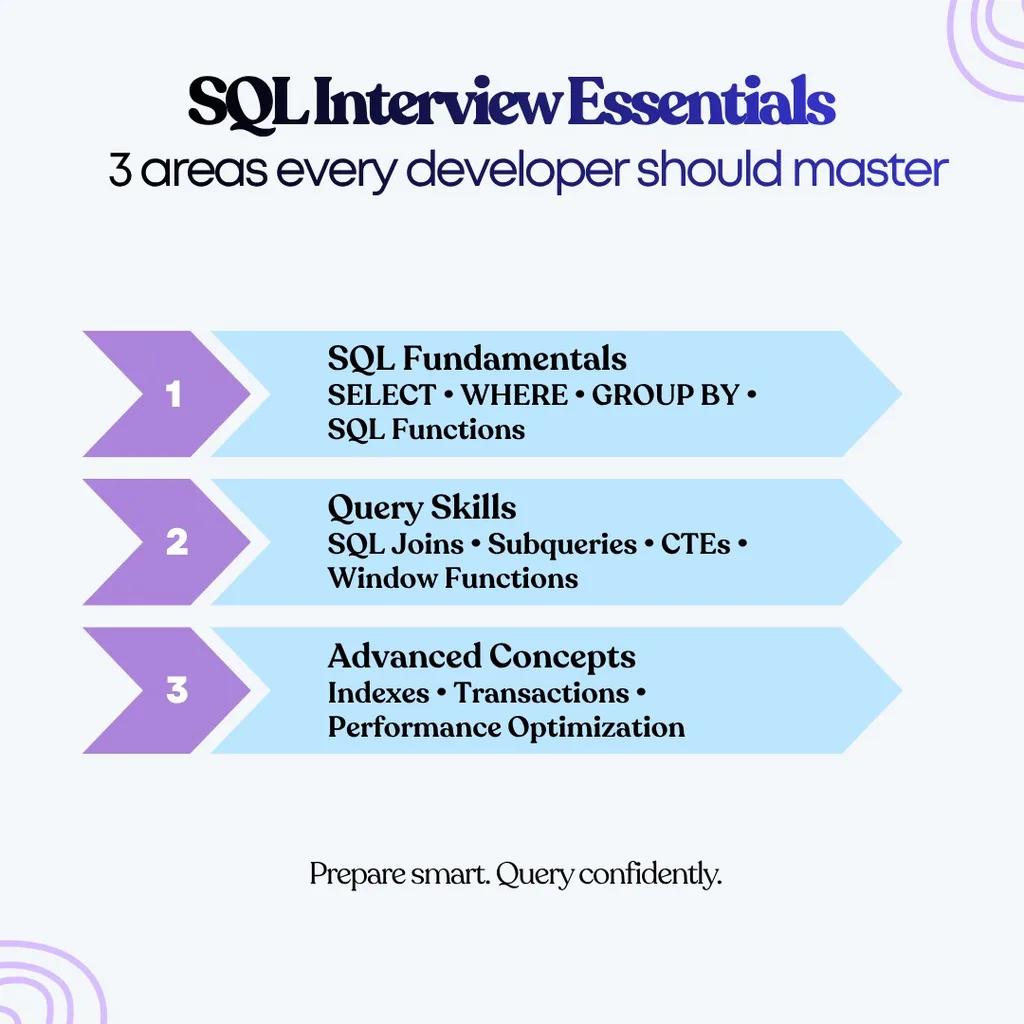
The most important topics include SELECT statements, filtering, GROUP BY, aggregate functions, joins, subqueries, CTEs, window functions, indexes, transactions, normalization, and query optimization.
2. Are SQL joins commonly asked in interviews?
Yes. Joins are among the most frequently tested SQL concepts because they demonstrate whether a developer understands relationships between database tables.
3. How can I practice SQL interview questions?
Practice by creating sample databases and solving real-world problems such as finding duplicate records, calculating department averages, identifying top salaries, joining customers with orders, and ranking records.
4. Are advanced SQL questions important for experienced developers?
Yes. Senior candidates are often asked about indexes, execution plans, transactions, isolation levels, concurrency, window functions, CTEs, database design, and query optimization.
5. Is SQL required for full-stack developer roles?
SQL is highly useful for full-stack development because many applications depend on relational databases. Even when a developer primarily works on frontend technologies, understanding how backend services retrieve and modify database data can be valuable.
