


The financial industry is experiencing a rapid transformation as organizations increasingly adopt fraud detection AI to combat sophisticated cyber threats and fraudulent transactions. Modern financial institutions are leveraging Autonomous AI Agents to monitor millions of transactions in real time, identify suspicious behaviors, and reduce operational risks. Businesses are also using AI Systems in Financial Services to improve customer protection, streamline regulatory processes, and strengthen security across digital banking platforms. Combined with Financial Research Workflows, intelligent automation enables organizations to detect fraud faster while improving decision-making and operational efficiency.
As digital payments continue to grow, banks and financial organizations require advanced technologies that go beyond traditional rule-based systems. Solutions powered by AI Agents in Wealth Management are helping institutions secure investment portfolios while reducing exposure to financial risks. Organizations can also Automate Financial Modeling to forecast risks, optimize lending decisions, and identify unusual financial patterns before they become costly incidents. By integrating fraud detection AI, banking security AI, and advanced analytics into daily operations, financial institutions can build more resilient and intelligent risk management frameworks.
Why AI Agents Are Revolutionizing Financial Risk Monitoring
Traditional fraud detection methods rely heavily on predefined rules and manual investigations. However, cybercriminals continuously develop new attack strategies that bypass static security measures.
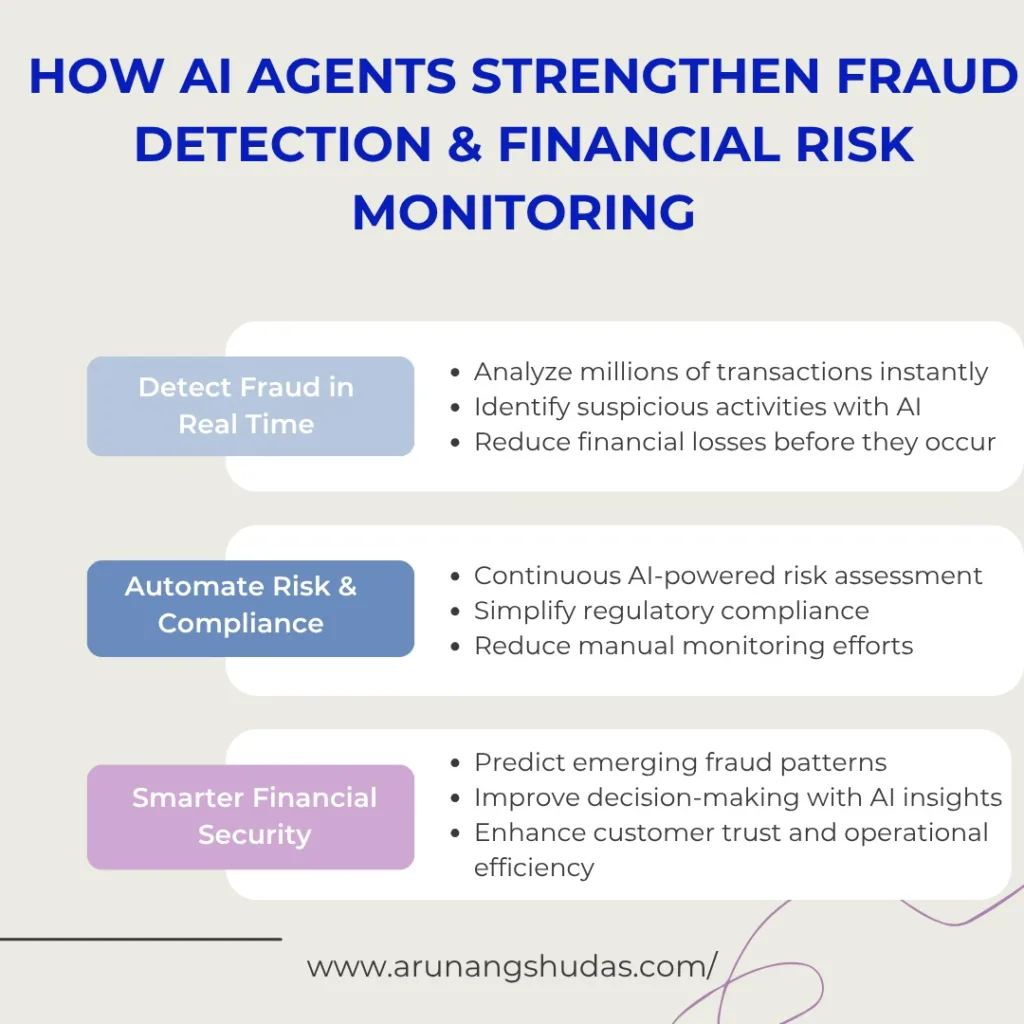
Modern Autonomous AI Agents continuously monitor transaction streams, customer behaviors, device information, and account activities. Instead of waiting for human intervention, these intelligent systems analyze data in real time, identify suspicious activities, and automatically trigger alerts or preventive actions.
Key advantages include:
- Real-time fraud identification
- Continuous learning from new fraud patterns
- Reduced manual investigations
- Improved regulatory compliance
- Enhanced customer trust
- Faster incident response
How Fraud Detection AI Works
Modern fraud detection AI solutions combine machine learning, behavioral analytics, predictive modeling, and automation.
The AI process typically includes:
- Collecting transaction data
- Monitoring customer behavior
- Comparing current activity with historical patterns
- Detecting unusual behaviors
- Assigning fraud risk scores
- Alerting investigators
- Blocking suspicious transactions automatically
These intelligent systems continuously improve their detection capabilities by learning from both legitimate and fraudulent activities.
Applications of AI Agents in Financial Institutions
Financial organizations use AI across multiple departments to strengthen security and reduce financial risks.
| Financial Area | AI Application | Business Benefit |
| Retail Banking | Transaction Monitoring AI | Detects suspicious transactions instantly |
| Credit Card Services | Anomaly Detection Systems | Prevents unauthorized purchases |
| Investment Banking | Private Equity Due Diligence | Identifies hidden financial risks |
| Insurance | Fraud claim detection | Reduces fraudulent payouts |
| Digital Payments | Behavioral analytics | Improves payment security |
Fraud Detection Across Banking Operations
Banks process millions of transactions every day, making manual monitoring nearly impossible.
With banking security AI, institutions can:
- Monitor account activity continuously
- Detect account takeover attempts
- Identify identity theft
- Prevent payment fraud
- Flag unusual spending behaviors
- Analyze login locations
- Stop suspicious fund transfers
These intelligent solutions dramatically reduce false positives while improving fraud detection accuracy.
Types of Financial Fraud AI Can Detect
| Fraud Type | AI Detection Method | Result |
| Credit Card Fraud | Behavioral analysis | Immediate alerts |
| Identity Theft | Customer profile verification | Faster prevention |
| Money Laundering | Pattern recognition | Regulatory compliance |
| Insider Fraud | Employee behavior monitoring | Internal risk reduction |
| Loan Fraud | Predictive risk scoring | Better lending decisions |
AI-Powered Risk Management Automation
Modern organizations rely on risk management automation to reduce manual workloads while improving decision accuracy.
AI agents automate:
- Risk assessments
- Fraud investigations
- Compliance reporting
- Transaction approvals
- Customer verification
- Suspicious activity reporting
- Credit scoring
This automation reduces operational costs while increasing efficiency.
AI Compliance Monitoring for Financial Institutions
Regulatory requirements continue to become more complex.
With AI compliance monitoring, financial organizations automatically:
- Track regulatory changes
- Monitor suspicious transactions
- Generate compliance reports
- Detect AML violations
- Support KYC verification
- Reduce human error
Automated compliance significantly improves operational transparency.
The Role of Anomaly Detection Systems
One of the most valuable capabilities of AI is identifying unusual behavior.
Advanced anomaly detection systems analyze:
- Customer transaction history
- Login locations
- Device fingerprints
- Payment frequency
- Merchant categories
- Spending limits
- Network activity
Whenever abnormal behavior occurs, AI immediately generates alerts for investigators.
Cybersecurity Finance AI Protects Digital Banking
Growing cyber threats require advanced protection.
cybersecurity finance AI strengthens security by:
- Monitoring user sessions
- Detecting phishing attempts
- Preventing ransomware attacks
- Blocking suspicious access
- Identifying malware activity
- Protecting customer information
These intelligent systems continuously adapt to evolving cyber threats.
Transaction Monitoring AI in Action
Modern transaction monitoring AI evaluates thousands of variables simultaneously.
Examples include:
- Transaction amount
- Time of purchase
- Customer location
- Device information
- Merchant category
- Historical spending
- Payment frequency
The AI instantly identifies suspicious activities and assigns fraud risk scores.
Fraud Analytics Tools Improve Decision-Making
Organizations increasingly rely on fraud analytics tools for data-driven investigations.
These solutions help teams:
- Visualize fraud patterns
- Analyze historical fraud cases
- Predict emerging fraud risks
- Improve investigation efficiency
- Reduce false alarms
- Optimize fraud detection strategies
Better analytics lead to faster and more accurate decisions.
Intelligent Risk Systems for Financial Growth
Financial organizations use intelligent risk systems to balance security with customer experience.
These systems support:
- Credit risk management
- Investment risk analysis
- Fraud prevention
- Operational risk reduction
- Regulatory compliance
- Enterprise risk management
AI ensures that organizations can scale securely while maintaining customer trust.
Financial Research Workflows Enhanced by AI
AI is transforming Financial Research Workflows by automating data collection, financial analysis, market monitoring, and investment research.
Benefits include:
- Faster research
- Higher data accuracy
- Better forecasting
- Reduced manual effort
- Real-time market insights
- Improved investment strategies
Researchers can focus on strategic analysis rather than repetitive tasks.
Private Equity Due Diligence with AI
Investment firms increasingly use AI during Private Equity Due Diligence.
AI helps evaluate:
- Financial statements
- Regulatory risks
- Market trends
- Legal documentation
- Operational performance
- Revenue forecasts
This reduces due diligence time while improving investment confidence.
Benefits of Autonomous AI Agents
Modern Autonomous AI Agents provide continuous monitoring without human intervention.
Major benefits include:
- 24/7 fraud detection
- Faster investigations
- Reduced financial losses
- Better customer experience
- Improved compliance
- Lower operational costs
- Continuous learning
- Scalable risk management
AI Technologies Used in Fraud Detection
| AI Technology | Primary Function | Business Value |
| Machine Learning | Pattern recognition | Improved fraud detection |
| Natural Language Processing | Document analysis | Faster compliance reviews |
| Predictive Analytics | Risk forecasting | Better decision-making |
| Behavioral Analytics | User activity monitoring | Reduced fraud losses |
| Robotic Process Automation | Workflow automation | Increased operational efficiency |
Business Benefits of AI Fraud Detection
| Business Challenge | AI Solution | Outcome |
| High fraud losses | fraud detection AI | Lower financial losses |
| Manual compliance | AI compliance monitoring | Faster reporting |
| Cyber attacks | cybersecurity finance AI | Stronger protection |
| Transaction monitoring | transaction monitoring AI | Real-time alerts |
| Investment risk | intelligent risk systems | Better portfolio management |
Future of AI in Financial Risk Monitoring
The future of financial security will increasingly depend on intelligent automation. As AI technologies continue to evolve, organizations will deploy more advanced Autonomous AI Agents capable of making complex decisions, predicting fraud before it occurs, and continuously adapting to emerging cyber threats. Financial institutions that invest in AI today will gain stronger security, improved compliance, greater operational efficiency, and enhanced customer trust.

Conclusion
AI has become an essential component of modern financial security. From fraud detection AI and risk management automation to AI compliance monitoring, transaction monitoring AI, and cybersecurity finance AI, intelligent systems are transforming how organizations detect fraud and manage financial risks. By combining fraud analytics tools, anomaly detection systems, Financial Research Workflows, Private Equity Due Diligence, and Autonomous AI Agents, businesses can build smarter, faster, and more secure financial ecosystems prepared for the future.
Frequently Asked Questions (FAQs)
1. What is fraud detection AI?
Fraud detection AI uses artificial intelligence, machine learning, and predictive analytics to identify suspicious financial activities and prevent fraudulent transactions in real time.
2. How do Autonomous AI Agents improve financial security?
Autonomous AI Agents continuously monitor financial activities, detect unusual behaviors, automate investigations, and respond to threats without requiring constant human intervention.
3. What is transaction monitoring AI?
Transaction monitoring AI analyzes banking transactions in real time, detects suspicious payment patterns, assigns risk scores, and alerts investigators before fraud causes financial damage.
4. How does AI compliance monitoring help financial institutions?
AI compliance monitoring automates regulatory reporting, monitors anti-money laundering (AML) activities, supports Know Your Customer (KYC) verification, and reduces compliance risks.
5. Why are anomaly detection systems important in banking?
Anomaly detection systems identify unusual customer behavior, unauthorized transactions, account takeovers, and emerging fraud patterns, allowing financial institutions to prevent losses before fraud escalates.
