


Neural networks are the backbone of modern artificial intelligence, powering everything from image recognition to self-driving cars. But not all neural networks are the same. Depending on the task, different types of neural networks are used to optimize performance and accuracy.
Understanding the unique architectures, strengths, and primary use cases of these networks is essential for building effective machine learning models. Below is a detailed guide to the six fundamental types of neural networks driving the AI landscape.
1. Feedforward Neural Networks (FNN) / Multilayer Perceptrons (MLP)
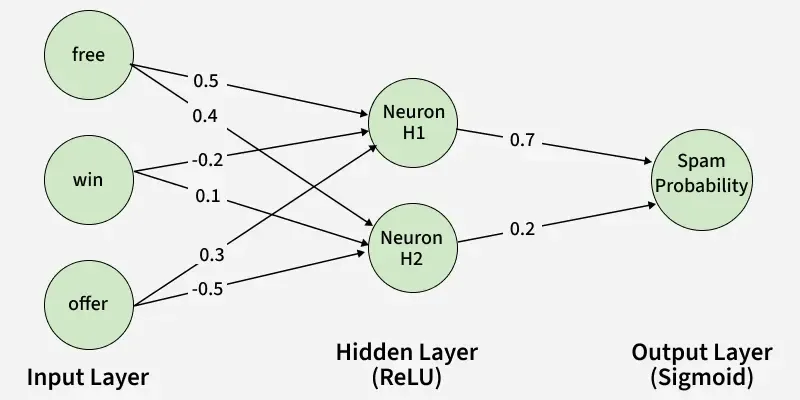
Feedforward Neural Networks (FNNs)—often implemented as Multilayer Perceptrons (MLPs)—are the simplest and foundational form of artificial neural networks. In an FNN, information moves in only one direction: forward from the input nodes, through hidden layers, to the output nodes. There are no loops, feedback cycles, or memory states.
[Input Layer] ──> [Hidden Layer 1] ──> [Hidden Layer 2] ──> [Output Layer]
How It Works
- Architecture: Composed of an input layer, one or more hidden layers, and an output layer. Every neuron in one layer is typically connected to every neuron in the subsequent layer (fully connected).
- Mathematical Flow: Inputs are multiplied by weights, added to biases, and passed through non-linear activation functions (e.g., ReLU, Sigmoid, or Tanh) to learn non-linear decision boundaries.
- Training: Uses backpropagation paired with gradient descent to minimize loss and adjust network weights.
Primary Use Cases
- Tabular Data Classification: Predicting customer churn, credit scoring, or spam detection.
- Simple Regression Tasks: House price estimation or sales forecasting based on static feature sets.
- Basic Pattern Recognition: Identifying simple categorizations when temporal or spatial relationships are not present.
2. Convolutional Neural Networks (CNN)
Convolutional Neural Networks are specialized architectures designed explicitly to process grid-like structured data, such as 2D images or spatial feature maps. Unlike fully connected networks, CNNs preserve spatial relationships between pixels while dramatically reducing the total parameter count.
[Input Image] ──> [Convolution Layer] ──> [Pooling Layer] ──> [Fully Connected] ──> [Output]
How It Works
- Convolutional Layers: Slide small feature-detector filters (kernels) across the input matrix to extract spatial features such as edges, textures, and shapes.
- Pooling Layers: Perform downsampling (e.g., Max Pooling or Average Pooling) to reduce dimensionality, control overfitting, and grant translation invariance.
- Fully Connected Layers: Flatten spatial features into a 1D vector at the end of the network to output class probabilities via Softmax activation.
Primary Use Cases
- Computer Vision & Object Detection: Identifying objects in autonomous driving (e.g., pedestrian and lane detection).
- Medical Image Diagnostics: Detecting tumors or fractures in X-rays, MRIs, and CT scans.
- Facial Recognition: Biometric authentication systems on mobile devices and security checkpoints.
3. Recurrent Neural Networks (RNN) & LSTMs
While FNNs assume inputs are independent of each other, Recurrent Neural Networks (RNNs) are designed specifically for sequential or time-series data where temporal context matters. RNNs maintain an internal memory state, allowing previous outputs to serve as inputs for current predictions.
         ┌──┐ (Internal Memory Loop)
         ▼  │
[Input Sequence] ──> [Recurrent Cell] ──> [Output Sequence]
How It Works
- Hidden States: The network processes inputs step-by-step, passing information from step $t-1$ to step $t$ through hidden states.
- LSTM & GRU Variants: Standard RNNs suffer from the vanishing/exploding gradient problem over long sequences. Modern implementations rely on Long Short-Term Memory (LSTM) units or Gated Recurrent Units (GRU), which utilize gating mechanisms (forget gate, input gate, output gate) to selectively retain or discard long-term information.
Primary Use Cases
- Time-Series Forecasting: Predicting stock market movements, weather patterns, or energy grid loads.
- Speech Recognition: Converting audio signals into text transcriptions over continuous time.
- Sensor Analytics: Monitoring IoT equipment data streams to predict machine failure.
4. Autoencoders
Autoencoders are unsupervised neural networks designed to compress input data into a lower-dimensional representation (encoding) and then reconstruct the original input from that representation (decoding).
[Input Data] ──> [Encoder] ──> [Bottleneck / Latent Space] ──> [Decoder] ──> [Reconstructed Output]
How It Works
- Encoder: Compresses the high-dimensional input into a compact, low-dimensional latent space representation (bottleneck).
- Bottleneck Layer: Forces the network to ignore noise and prioritize learning only the most important features.
- Decoder: Reconstructs the original input data using only the compressed representation from the bottleneck, minimizing reconstruction error (e.g., Mean Squared Error).
Primary Use Cases
- Data Denoising: Removing grain, blur, or background noise from images and audio files.
- Anomaly Detection: Identifying fraudulent transactions or manufacturing defects by flagging high reconstruction error on unseen data.
- Dimensionality Reduction: Serving as a non-linear alternative to Principal Component Analysis (PCA).
5. Generative Adversarial Networks (GAN)
Generative Adversarial Networks consist of two distinct neural networks trained simultaneously in a zero-sum, competitive framework: a Generator and a Discriminator.
[Noise Input] ──> [Generator] ──> [Synthetic Sample] ──┐
                                                      ├──> [Discriminator] ──> Real or Fake?
                  [Real Data] ────────────────────────┘
How It Works
- The Generator: Takes random noise as input and creates synthetic data samples (e.g., images) aiming to pass as real data.
- The Discriminator: Evaluates samples and attempts to distinguish between authentic data from the training set and synthetic data produced by the Generator.
- Adversarial Training: The two networks compete in a minimax game: the Generator continually improves its ability to trick the Discriminator, while the Discriminator gets better at detecting fakes.
Primary Use Cases
- Synthetic Data Generation: Creating high-resolution synthetic images, video frames, or audio for training edge models without privacy issues.
- Image-to-Image Translation: Converting sketches into photorealistic images or transforming daytime photos to night scenes.
- Data Augmentation: Expanding training datasets in fields with limited real data, such as rare disease medical imaging.
6. Transformer Networks (Self-Attention Models)
Transformers are state-of-the-art architectures designed to process sequence data without relying on sequential recurrence. By processing entire sequences simultaneously through parallelization and using self-attention mechanisms, Transformers power modern Large Language Models (LLMs) and advanced AI systems.
[Input Tokens] ──> [Positional Encoding] ──> [Multi-Head Self-Attention] ──> [Feedforward Layer] ──> [Outputs]
How It Works
- Self-Attention Mechanism: Computes context weights dynamically across every token in a sequence simultaneously, allowing the network to understand relationships regardless of distance (e.g., linking a pronoun to a noun 50 words prior).
- Positional Encoding: Adds spatial or sequence order vectors directly to input embeddings to preserve sequence structure without needing loop structures.
- Parallel Processing: Unlike RNNs, Transformers process entire text blocks at once, enabling massive GPU parallelization and enabling large-scale model pre-training.
Primary Use Cases
- Large Language Models (LLMs): Powering models like GPT-4, Claude, Gemini, and Llama for text generation, reasoning, and coding.
- Machine Translation: Translating full documents instantly with high contextual accuracy (e.g., Google Translate).
- Vision Transformers (ViT): Applying self-attention directly to image patches for visual recognition tasks.
Summary Comparison Table
| Neural Network Type | Core Mechanism | Key Advantage | Best Application |
| Feedforward (FNN/MLP) | Unidirectional, fully connected layers | Simple, fast training on structured data | Tabular classification & regression |
| Convolutional (CNN) | Sliding spatial kernels & pooling | Preserves spatial structure with low parameters | Computer vision & image classification |
| Recurrent (RNN/LSTM) | Internal memory feedback loops | Captures temporal order & sequential dependency | Time-series forecasting & audio processing |
| Autoencoder | Compression bottleneck (Encoder/Decoder) | Unsupervised feature extraction & filtering | Data denoising & anomaly detection |
| Generative Adversarial (GAN) | Two networks competing (Generator vs. Discriminator) | Creates hyper-realistic synthetic data | Synthetic image & media generation |
| Transformer | Multi-head self-attention & parallelization | Captures long-range context without recurrence | Natural Language Processing & LLMs |
Conclusion: Choosing the Right Neural Network for Your AI Vision
Neural networks are far from a one-size-fits-all technology. From the straightforward classification capabilities of Feedforward Networks to the context-aware spatial intelligence of CNNs and the massive language understanding of Transformers, each architecture is engineered to solve specific challenges.
Selecting the right network depends on your data type, computational budget, and operational goals:
- Choose FNNs for structured, tabular predictions.
- Rely on CNNs for spatial, visual, and image-based tasks.
- Deploy RNNs or LSTMs for time-series forecasting and sequential data.
- Use Autoencoders for compression, anomaly detection, and noise reduction.
- Leverage GANs to generate high-fidelity synthetic data.
- Implement Transformers for complex natural language processing, context modeling, and generative AI.
As artificial intelligence continues to evolve, multi-modal systems—combining several of these architectures into unified models—are fast becoming the new standard. By mastering how these six core neural networks function individually, you gain the foundational knowledge required to design, deploy, and scale intelligent AI applications effectively.
You may also like:
1) How AI is Transforming the Software Development Industry
2) 8 Key Concepts in Neural Networks Explained
3) Top 5 Essential Deep Learning Tools You Might Not Know
4) 10 Common Mistakes in AI Model Development
5) 6 Types of Neural Networks You Should Know
6) The Science Behind Fine-Tuning AI Models: How Machines Learn to Adapt
7) 7 Essential Tips for Fine-Tuning AI Models
Read more blogs from Here
Share your experiences in the comments, and let’s discuss how to tackle them!
Follow me on Linkedin
Frequently Ask Question:
1. How do I choose the right type of neural network for my project?
The right choice depends primarily on your input data structure:
Use CNNs for spatial grid data (images, video frames, medical scans).
Use RNNs or LSTMs for sequential time-series or streaming data (sensor readings, audio waves).
Use Transformers for large text sequences, document processing, and modern natural language tasks.
Use FNNs / MLPs for traditional tabular dataset predictions (spreadsheets, user metrics).
2. Why are Transformers replacing Recurrent Neural Networks (RNNs) for NLP?
Transformers process entire sequences simultaneously using self-attention, whereas RNNs must process data sequentially token-by-token. This parallel processing allows Transformers to train significantly faster on GPUs while capturing long-range context across thousands of words without forgetting earlier information.
3. What is the difference between supervised and unsupervised neural networks?
Supervised neural networks (like FNNs and CNNs) learn by comparing their predictions against labeled target outputs to calculate loss. Unsupervised neural networks (like Autoencoders) process unlabeled data to uncover hidden patterns, compress representations, or remove noise without explicit target labels.
4. Are Convolutional Neural Networks (CNNs) only used for images?
While CNNs are most famous for computer vision, they can also process non-image data structured in 1D grids—such as raw audio signals, time-series data, or text sequences—by applying 1D convolution filters across the data stream.
