


Investment teams are under increasing pressure to produce accurate, well-structured investment memos while reviewing large volumes of financial information. Investment memo automation can streamline this process by helping professionals organize research, summarize findings, and prepare decision-ready documents. At the same time, Report Analysis can help teams identify important trends across financial statements, market data, and company performance. These capabilities are particularly relevant to Fintech Companies, where fast-moving markets require efficient documentation and analysis.
Modern investment workflows also depend on timely information and consistent evaluation. PE documentation AI can support private equity professionals by organizing company research, transaction information, and supporting documents. In Financial Decision-Making, AI agents can assist with structuring complex information and highlighting relevant factors for review. Meanwhile, Investment Banking Operations can benefit from automated workflows that reduce repetitive research and documentation tasks.
The Role of AI Agents in Investment Memo Creation
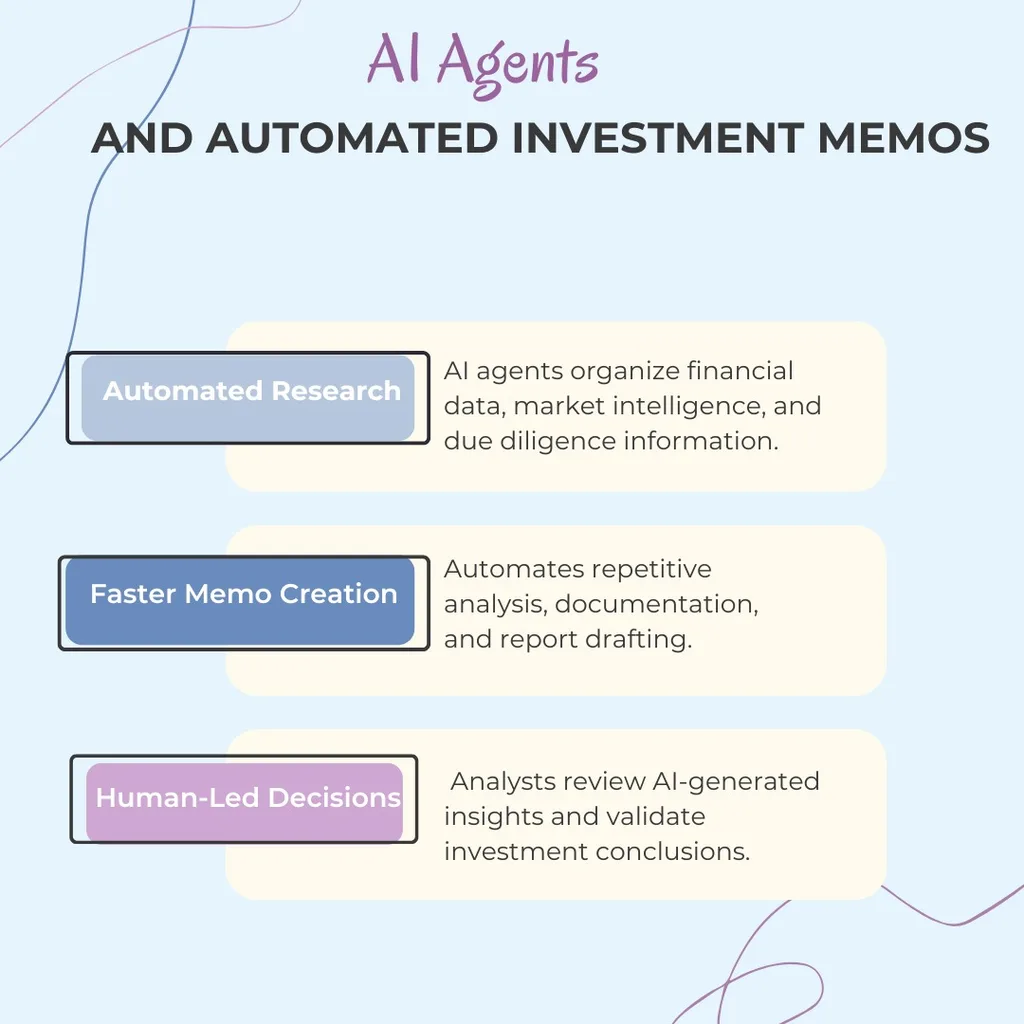
Traditional investment memo preparation often involves collecting information from multiple sources, reviewing spreadsheets, analyzing reports, and manually writing conclusions. AI agents can connect these activities into a more coordinated workflow. Rather than simply generating text, an AI agent can help gather information, organize evidence, identify relevant metrics, and prepare sections of a memo for human review.
This makes investment analysis automation an important development for financial professionals. Agents can process financial information at scale while maintaining structured workflows for analysts and investment teams. Human professionals can then focus on interpreting results, challenging assumptions, and making decisions.
From Research to Structured Investment Documentation
Investment memos usually contain several components, including company background, market analysis, financial performance, investment rationale, risks, and potential returns. AI-powered documentation can help organize these sections into consistent formats while reducing repetitive administrative work.
For private equity professionals, deal presentation systems can also connect research with presentations, investment committee materials, and supporting documentation. This creates a more unified workflow from initial research through final presentation.
Key Components of AI-Assisted Investment Memos
| Component | Traditional Approach | AI-Assisted Approach |
| Research | Manual source collection | Automated information gathering |
| Financial analysis | Spreadsheet-heavy review | AI-assisted analysis and summaries |
| Documentation | Manual drafting | Structured document generation |
| Updates | Repeated manual edits | Automated content updates |
| Review | Manual cross-checking | AI-assisted consistency checks |
Financial Storytelling and Investment Communication
Numbers alone rarely provide enough context for an investment decision. Analysts need to explain what the numbers mean, how market conditions affect performance, and why a particular opportunity may require further consideration. Financial storytelling AI can assist in converting complex financial information into structured narratives.
This approach does not replace professional judgment. Instead, it can help transform financial metrics, research findings, and operational information into a coherent story that analysts can review and refine.
Business intelligence writing can also support investment teams by turning structured business data into readable summaries. This can be useful when preparing management summaries, market assessments, or investment committee documentation.
Autonomous Report Generation for Investment Workflows
Investment professionals frequently create recurring reports based on similar information. Autonomous report generation can reduce the amount of repetitive writing involved in these workflows. AI agents can use predefined structures to prepare drafts based on updated financial and market information.
The resulting documents can then pass through human review, fact-checking, and approval processes before being used for investment decisions. This combination of automation and oversight can provide greater consistency without removing accountability from financial professionals.
Supporting Due Diligence With AI Agents
Due diligence requires the review of financial records, market conditions, competitors, legal information, operational metrics, and other relevant material. Due diligence reporting can become more efficient when AI agents help organize large volumes of documentation and identify information relevant to specific investment questions.
AI systems can also help categorize documents and create summaries that allow analysts to move through large information sets more efficiently. However, important findings should still be verified against original documentation.
AI Agents Across the Investment Research Process
| Investment Stage | AI Agent Support | Human Responsibility |
| Company research | Information collection and organization | Validate sources |
| Market research | Trend and data summarization | Interpret market conditions |
| Financial analysis | Metric extraction and comparison | Assess assumptions |
| Due diligence | Document classification and summaries | Verify material findings |
| Memo preparation | Drafting and formatting | Review conclusions |
| Investment committee | Presentation support | Make investment decisions |
AI and Corporate Finance Teams
Corporate Finance Teams increasingly manage large volumes of financial reports, forecasts, budgets, and management information. AI agents can help structure this information and produce recurring documentation more efficiently.
For broader Finance Teams, AI-assisted workflows can support reporting, research, forecasting documentation, and internal communication. The value comes from reducing repetitive work while allowing finance professionals to spend more time on analysis and strategic activities.
Financial Market Intelligence and Research
Investment decisions depend heavily on current market information. Financial Market Intelligence can include company announcements, industry developments, economic indicators, competitor activity, and market trends.
AI agents can organize these inputs into structured research workflows. For teams involved in Fund Research and Trading, automated information processing may help analysts monitor multiple information streams and prepare research summaries more efficiently.
Finance Communication Tools and Investment Committees
Investment committees require information that is concise, structured, and supported by evidence. Finance communication tools can help teams share financial findings across analysts, executives, investment committees, and other stakeholders.
AI-generated drafts can provide a starting point for investment memos, but the final document should reflect verified data, approved assumptions, and the responsible team’s interpretation.
Benefits of AI-Driven Investment Memo Workflows
| Benefit | How AI Agents Help |
| Speed | Automate repetitive research and drafting |
| Consistency | Follow standardized memo structures |
| Scalability | Process larger volumes of information |
| Organization | Structure data and supporting documents |
| Collaboration | Create standardized outputs for teams |
| Review | Highlight missing or inconsistent information |
Financial Automation Tools and Risk Management
The adoption of Financial Automation Tools is expanding beyond basic reporting. AI agents can connect research, analysis, documentation, and monitoring activities into broader financial workflows.
Risk Management is another area where structured AI workflows can support professionals. Agents may help organize risk indicators, summarize changes, and prepare monitoring reports. These outputs should remain subject to appropriate controls because automated systems can produce incomplete or inaccurate information.
The Future of Automated Investment Memos
The future of investment memo creation is likely to involve increasingly connected workflows rather than isolated AI writing tools. An AI agent could potentially collect research, organize financial data, summarize due diligence findings, draft an investment memo, and prepare supporting presentation materials within one workflow.
The emphasis will remain on combining automation with human oversight. Investment professionals will continue to be responsible for validating information, challenging assumptions, interpreting uncertainty, and approving the final analysis.
Future Investment Memo Workflow
| Workflow Area | Current Process | Emerging AI-Agent Model |
| Data collection | Manual research | Agent-assisted research |
| Analysis | Analyst-led spreadsheets | AI-assisted analysis |
| Writing | Manual drafting | Automated first drafts |
| Presentation | Separate preparation | Connected memo-to-presentation workflow |
| Monitoring | Periodic manual review | Continuous AI-assisted monitoring |
| Approval | Human review | Human approval with AI support |
Challenges and Considerations
Despite its potential, AI-driven investment documentation has several limitations. Financial information can be incomplete, outdated, or incorrectly interpreted. AI systems can also produce unsupported statements if they are not connected to reliable data sources and appropriate validation processes.
Organizations should therefore establish clear review procedures, source verification requirements, access controls, and approval responsibilities. Sensitive financial information also requires appropriate security and governance measures.

Conclusion
AI agents are changing how investment teams approach research, analysis, and documentation. Investment memo automation, structured research workflows, automated reporting, and AI-assisted financial storytelling can reduce repetitive work while improving the consistency of investment materials.
The strongest approach is not to remove analysts from the process but to give them better tools for handling information-intensive tasks. As AI agents become more capable, investment memos can evolve from manually assembled documents into connected, continuously updated workflows that support research, due diligence, communication, and informed human decision-making.
FAQs
1. What are AI agents in investment memo creation?
AI agents are software systems that can perform multiple connected tasks such as gathering information, organizing financial data, summarizing research, and preparing draft investment documentation. Human professionals remain responsible for reviewing and approving the final material.
2. How does investment memo automation help finance teams?
Investment memo automation can reduce repetitive research, writing, formatting, and information-organizing tasks. This can allow finance professionals to spend more time reviewing evidence, analyzing assumptions, and developing investment conclusions.
3. Can AI agents replace investment analysts?
AI agents can automate portions of research and documentation, but they do not eliminate the need for professional judgment. Analysts are still needed to validate information, assess assumptions, interpret uncertainty, and make investment decisions.
4. How can AI support due diligence reporting?
AI can help classify documents, extract relevant information, summarize large collections of material, and organize findings into structured reports. Important findings should be checked against original sources before being included in final investment materials.
5. What should companies consider before adopting AI for investment memos?
Companies should consider data quality, source verification, information security, privacy, governance, human review, access controls, and integration with existing financial systems. A clear approval process is important when AI-generated content is used in investment documentation.
