


Finance teams are under increasing pressure to analyze large volumes of financial data, automate repetitive processes, and support faster business decisions. Modern Financial Research Workflows are being transformed by Private Equity Due Diligence, Autonomous AI Agents, and advanced Financial Modeling for Analysts. Instead of relying entirely on spreadsheets, manual research, and disconnected software, startups are building intelligent platforms that can coordinate finance tasks from research to reporting.
The rise of AI finance startups is accelerating this transformation. These companies are developing SaaS AI agents that can collect information, analyze documents, monitor financial metrics, generate reports, and support decision-making with limited human intervention. As these systems mature, finance teams are moving toward automated workflows that combine specialized agents, financial data, and business applications into a single operating environment.
What Are AI Agent Platforms for Finance Teams?
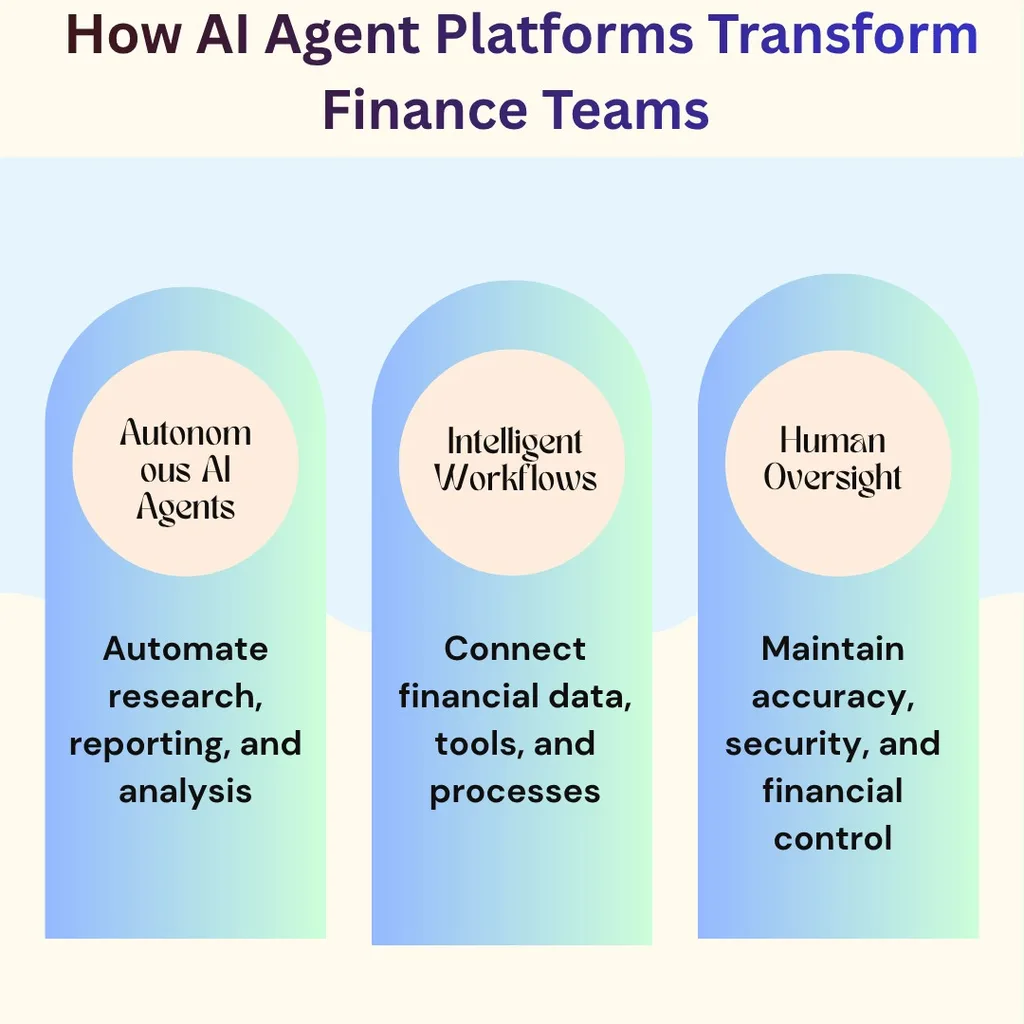
AI agent platforms are software systems designed to perform finance-related tasks using AI agents that can reason through workflows, access approved data sources, use connected tools, and complete multiple steps toward a defined objective.
Unlike traditional automation, which generally follows fixed rules, AI agents can adapt their actions based on the information they encounter.
For example, a finance team may ask an AI agent to:
- Collect quarterly financial statements.
- Extract revenue, expenses, debt, and cash-flow information.
- Compare results with previous periods.
- Identify unusual changes.
- Summarize findings.
- Prepare a report for an analyst or investment committee.
This combination of automation and reasoning is making startup automation platforms increasingly valuable for financial organizations.
Why Startups Are Building Finance-Specific AI Agents
Generic AI tools can answer questions and generate content, but finance teams require much more than text generation. They need accurate calculations, traceable sources, structured data, permissions, security, and integration with existing systems.
Startups are therefore building specialized finance workflow software that understands financial terminology, documents, metrics, and processes.
The major drivers include:
- Increasing financial data volumes
- Demand for faster analysis
- Pressure to reduce operational costs
- Repetitive reporting requirements
- Complex compliance processes
- Growing demand for real-time insights
- Need for better financial controls
- Expansion of AI across enterprise functions
The result is a new generation of AI-powered enterprise tools designed specifically for finance professionals.
Key Components of an AI Agent Finance Platform
A successful finance AI platform typically combines several layers of technology.
| Platform Layer | Primary Function | Example Use |
| Data Layer | Collects and organizes financial information | Statements, market data, CRM records |
| AI Agent Layer | Performs reasoning and task execution | Research, analysis, monitoring |
| Workflow Layer | Coordinates multiple tasks | Due diligence or reporting |
| Integration Layer | Connects external applications | ERP, CRM, spreadsheets |
| Security Layer | Controls access and protects data | Permissions and audit trails |
| Reporting Layer | Presents outputs to users | Dashboards and investment reports |
This architecture allows startups to build flexible systems instead of isolated AI features.
1. Automating Financial Research
One of the strongest use cases for AI agents is financial research.
Analysts often spend hours searching through company websites, earnings releases, investor presentations, filings, news reports, and industry research. AI agents can reduce this manual workload by gathering relevant information and organizing it into structured research.
For example, an agent could receive a company name and automatically:
- Find relevant financial documents
- Extract key financial metrics
- Summarize management commentary
- Identify major business risks
- Compare competitors
- Track historical performance
- Create an analyst-ready research brief
This is particularly useful for Financial Market Intelligence, where timely information can influence investment decisions.
2. Supporting Private Equity and Investment Research
Private equity professionals perform extensive research before evaluating potential investments.
AI agents can assist with repetitive parts of the process by organizing documents, extracting financial information, identifying inconsistencies, and preparing preliminary summaries.
A platform supporting Fund Research and Trading could use multiple agents for different responsibilities. One agent might research the target company, another could analyze financial statements, and another could monitor industry developments.
Human professionals remain responsible for investment judgment, but AI can significantly reduce the time spent preparing information.
3. Automating Financial Modeling
Financial models frequently require data collection, spreadsheet updates, scenario analysis, and assumption management.
AI platforms are beginning to support Financial Modeling for Analysts by helping users gather financial inputs and identify relationships between business assumptions and model outputs.
An AI agent could assist with:
- Revenue projections
- Expense assumptions
- Cash-flow analysis
- Scenario modeling
- Sensitivity analysis
- Historical financial comparisons
- Variance analysis
The objective is not necessarily to remove analysts from the process. Instead, AI can reduce manual preparation and allow analysts to spend more time evaluating assumptions and business implications.
4. Building Autonomous Finance Operations
The concept of autonomous finance operations is becoming an important direction for startups.
Rather than automating a single task, startups are creating systems where multiple AI agents work together across an entire workflow.
For example:
Invoice received → Data extracted → Expense categorized → Policy checked → Exception identified → Manager notified → Accounting system updated
A traditional automation tool may handle several predetermined steps. An agent-based system can potentially interpret exceptions and determine what action should happen next based on predefined policies.
However, financial organizations still need approval controls for high-impact decisions.
5. AI for Financial Reporting and Analysis
Financial reporting is another major opportunity.
Finance teams regularly prepare management reports, board materials, variance reports, forecasts, and performance summaries. These activities involve collecting information from multiple systems and converting it into understandable insights.
Modern Report Analysis agents can help identify:
- Revenue fluctuations
- Cost increases
- Margin changes
- Cash-flow problems
- Budget variances
- Unusual transactions
- Performance trends
Instead of simply producing a report, an AI system can potentially explain why a particular metric changed and identify the supporting data.
How AI Agents Work Together
The next stage of finance automation involves multi-agent architectures.
Consider a platform supporting an investment research workflow.
| AI Agent | Responsibility | Output |
| Research Agent | Collects company and industry information | Research dataset |
| Financial Agent | Analyzes statements and metrics | Financial summary |
| Risk Agent | Identifies potential risks | Risk assessment |
| Monitoring Agent | Tracks new developments | Alerts |
| Reporting Agent | Combines findings | Final report |
Each agent specializes in a particular function while the platform coordinates the overall workflow.
This architecture can make intelligent workflow platforms more scalable because new agents can be added without rebuilding the entire system.
6. Startup AI Infrastructure for Finance
Building finance AI requires more than adding a chatbot to existing software.
Startups need robust startup AI infrastructure that can support data ingestion, model orchestration, secure integrations, agent memory, workflow management, monitoring, and access controls.
A simplified architecture may look like:
Financial Data → Data Processing → AI Models → Agent Orchestration → Workflow Engine → Finance Applications
Important infrastructure components include:
- Large language models
- Financial databases
- Retrieval systems
- API integrations
- Workflow engines
- Vector databases
- Authentication systems
- Audit logging
- Human approval layers
- Monitoring systems
The infrastructure must also be designed for reliability because financial workflows can have significant business consequences.
7. Creating Scalable Finance AI
A major challenge for startups is building scalable finance AI.
A prototype might successfully analyze one financial statement. An enterprise platform, however, may need to process thousands of documents across hundreds of companies while maintaining accuracy, security, and performance.
Scalability requires:
- Efficient data pipelines
- Model routing
- Caching
- Asynchronous processing
- API management
- Role-based access
- Cost monitoring
- Automated testing
- Human review mechanisms
Startups that solve these infrastructure challenges can build platforms capable of supporting larger finance teams.
8. AI in Fintech and Financial Services
The growth of fintech SaaS systems is creating new opportunities for AI agent platforms.
Fintech Companies can integrate agents into banking, lending, payments, insurance, investment, accounting, and wealth management workflows.
Examples include:
- Automated financial analysis
- Customer financial insights
- Fraud monitoring
- Investment research
- Compliance support
- Credit analysis
- Portfolio monitoring
- Financial reporting
At the enterprise level, AI Systems in Financial Services must balance automation with governance, security, explainability, and regulatory requirements.
9. Improving Risk Management
Financial decisions involve uncertainty, making Risk Management a natural application for AI agents.
An AI risk-monitoring system could continuously evaluate financial information and alert teams when predefined risk indicators change.
For example:
Market Data → Risk Agent → Threshold Analysis → Risk Alert → Human Review
Applications can include:
- Credit risk monitoring
- Market risk analysis
- Liquidity monitoring
- Counterparty risk
- Portfolio exposure
- Operational risk
- Financial anomaly detection
AI should support risk professionals rather than independently make high-impact decisions without appropriate controls.
10. Financial Risk Monitoring in Real Time
Traditional risk reviews may happen periodically, while AI-powered systems can continuously process incoming information.
Financial Risk Monitoring agents can track changes across financial statements, market data, company announcements, economic indicators, and internal business metrics.
A platform might notify an analyst when:
- A company’s leverage increases significantly
- Cash reserves decline
- Revenue falls below expectations
- A major customer relationship changes
- Market conditions affect portfolio exposure
- A new regulatory development creates potential risk
This can help finance teams move from periodic analysis toward continuous monitoring.
11. AI Agents in Wealth Management
Another emerging application is AI Agents in Wealth Management.
Wealth management firms handle large amounts of client, portfolio, market, and research information. AI agents can help professionals organize this information and prepare client-facing insights.
Potential use cases include:
- Portfolio research
- Market summaries
- Investment reporting
- Client meeting preparation
- Portfolio monitoring
- Risk analysis
- Research aggregation
Human advisors can then review AI-generated outputs before using them in client communications or investment decisions.
Business Benefits of AI Agent Platforms
Startups are building these platforms because they can address several operational challenges simultaneously.
| Business Challenge | AI Agent Solution | Potential Benefit |
| Manual research | Research agents | Faster information gathering |
| Repetitive reporting | Reporting agents | Reduced preparation time |
| Data fragmentation | Integrated workflows | Centralized information |
| Risk monitoring | Monitoring agents | Faster alerts |
| Document-heavy processes | Extraction agents | Structured data |
| Multiple approval steps | Workflow orchestration | Better process coordination |
The value is not simply faster task completion. The larger opportunity is redesigning how finance teams operate.
AI Agents vs Traditional Financial Automation
Traditional automation and AI agents serve different purposes.
| Feature | Traditional Automation | AI Agent Platform |
| Workflow | Rule-based | Goal-oriented |
| Adaptability | Limited | Higher |
| Data handling | Structured data preferred | Structured and unstructured data |
| Decision logic | Predefined rules | AI-assisted reasoning |
| Exceptions | Often require manual intervention | Can analyze predefined exception types |
| Complexity | Best for predictable tasks | Useful for multi-step workflows |
| Human oversight | Usually workflow-based | Can be integrated at critical checkpoints |
The best finance platforms will likely combine both approaches rather than completely replace traditional automation.
Challenges Startups Must Solve
Despite the opportunity, finance AI has significant challenges.
Accuracy
Financial information must be accurate. Incorrect calculations or unsupported conclusions can create serious business risks.
Data Security
Finance platforms handle sensitive company and customer information. Strong encryption, authentication, permissions, and data governance are essential.
Hallucinations
AI models can generate incorrect information. Systems should use trusted data sources, retrieval mechanisms, validation, and human review.
Regulatory Requirements
Financial organizations operate in highly regulated environments. AI platforms need appropriate governance and auditability.
Explainability
Finance professionals often need to understand how an AI system reached a conclusion, particularly when the output affects financial decisions.
Integration
AI platforms must connect with existing ERP, CRM, accounting, data warehouse, spreadsheet, and reporting systems.
The Role of Human-in-the-Loop Finance AI
Fully autonomous financial decision-making is not always appropriate.
A better approach is often human-in-the-loop automation, where AI handles research and operational tasks while humans approve important decisions.
For example:
AI Agent → Analysis → Risk Check → Human Approval → Action
This structure allows organizations to benefit from automation while maintaining accountability.
It is particularly important for Financial Decision-Making, investment recommendations, compliance processes, and other high-impact financial activities.
What the Future of Finance AI Could Look Like
The future is moving from isolated AI assistants toward interconnected agent ecosystems.
Instead of asking a chatbot individual questions, finance professionals may interact with a platform that understands ongoing workflows.
For example:
“Prepare the monthly performance review, identify unusual changes, compare our results with the sector, update the forecast assumptions, and flag any risks that require management attention.”
The platform could coordinate several specialized agents to complete different parts of the request.
This could create a new generation of Financial Automation Tools where research, analysis, reporting, monitoring, and workflow execution happen within a connected environment.
AI Agent Platforms Across Investment Banking
Investment Banking Operations involve extensive research, document review, financial modeling, presentations, transaction analysis, and communication.
AI agents can support these workflows by helping professionals:
- Organize transaction documents
- Extract financial information
- Compare company performance
- Prepare preliminary analyses
- Summarize market research
- Monitor transaction-related information
- Assist with repetitive reporting
The most effective systems will likely focus on augmenting bankers rather than replacing professional judgment.
How Startups Can Build a Finance AI Platform
A startup planning to enter this market can follow a structured development strategy.
| Stage | Focus | Key Objective |
| Stage 1 | Identify workflow | Find repetitive finance processes |
| Stage 2 | Build data layer | Connect trusted financial data |
| Stage 3 | Develop agents | Automate specific tasks |
| Stage 4 | Add orchestration | Connect agents into workflows |
| Stage 5 | Add governance | Introduce security and approvals |
| Stage 6 | Measure performance | Track accuracy, time, and ROI |
Starting with a narrow workflow can help startups validate the product before expanding into broader finance operations.
Measuring ROI From Finance AI
Startups and finance leaders should measure more than the number of AI tasks completed.
Useful metrics include:
- Analyst hours saved
- Research turnaround time
- Reporting preparation time
- Error rates
- Cost per workflow
- Number of automated processes
- Human intervention rate
- Data accuracy
- Risk alerts identified
- User adoption
- Revenue impact
A successful AI platform should demonstrate measurable improvements in productivity, accuracy, or decision support.

Final Thoughts
Startups are transforming finance software by moving beyond simple chatbots and rule-based automation toward intelligent agent-based platforms. These systems combine financial data, AI models, workflow orchestration, integrations, and human oversight to automate complex processes.
From Financial Market Intelligence and Fund Research and Trading to Risk Management, Report Analysis, and Financial Risk Monitoring, AI agents can support finance teams across multiple functions. As AI finance startups continue developing specialized solutions, finance organizations may increasingly operate through connected agent ecosystems rather than isolated applications.
The long-term opportunity is not simply to automate individual finance tasks. It is to create secure, scalable, and intelligent financial operating systems where AI agents handle repetitive work while finance professionals focus on strategy, judgment, and high-value Financial Decision-Making.
Frequently Asked Questions
1. What are AI agent platforms for finance teams?
AI agent platforms are software systems that use AI agents to perform, coordinate, and automate finance-related tasks such as research, reporting, document analysis, monitoring, and workflow management.
2. How are startups using AI agents in finance?
Startups are using AI agents for financial research, reporting, financial modeling support, risk monitoring, due diligence, document analysis, investment research, and workflow automation.
3. What is the difference between AI agents and traditional automation?
Traditional automation generally follows predefined rules, while AI agents can interpret information, reason through multiple steps, and adapt their actions within defined goals and permissions.
4. Are AI agents capable of replacing finance professionals?
AI agents are primarily being developed to augment finance professionals. They can automate repetitive tasks and support analysis, but important financial decisions generally require human judgment, oversight, and accountability.
5. What should startups consider when building finance AI platforms?
Startups should prioritize data accuracy, security, regulatory compliance, explainability, system integration, scalability, human oversight, and reliable performance measurement when developing AI platforms for finance teams.
