


Financial markets move faster than traditional research processes can keep up. Autonomous AI Agents are transforming Financial Research Workflows by continuously collecting market data, analyzing financial reports, monitoring news, and identifying changes that may influence investment outcomes. Instead of relying entirely on manual research, firms can deploy AI Systems in Financial Services to process large volumes of information and support faster Financial Decision-Making. These systems can also strengthen Report Analysis, Risk Management, and the use of Financial Automation Tools across research and investment teams.
Modern AI agents can operate across multiple financial functions, from Private Equity Due Diligence and Financial Modeling for Analysts to Investment Banking Operations and AI Agents in Wealth Management. They can monitor portfolios, compare company performance, detect market signals, and support Fund Research and Trading without requiring analysts to manually review every information source. For Fintech Companies, this creates an opportunity to build intelligent platforms that deliver timely insights while improving scalability and operational efficiency.
How AI Agents Transform Financial Market Intelligence
AI agents combine data retrieval, reasoning, automation, and continuous monitoring. Unlike conventional software that follows a fixed workflow, autonomous agents can interpret changing information and determine which actions are appropriate within predefined rules.
| Financial Intelligence Area | AI Agent Capability | Business Benefit |
| Market Research | Monitors market data, news, filings, and economic indicators | Faster research cycles |
| Company Analysis | Extracts financial metrics and compares companies | More efficient analysis |
| Portfolio Monitoring | Tracks positions and relevant market developments | Earlier identification of risks |
| Competitive Intelligence | Monitors competitors and sector movements | Better strategic awareness |
| Investment Research | Connects multiple sources of financial information | More comprehensive insights |
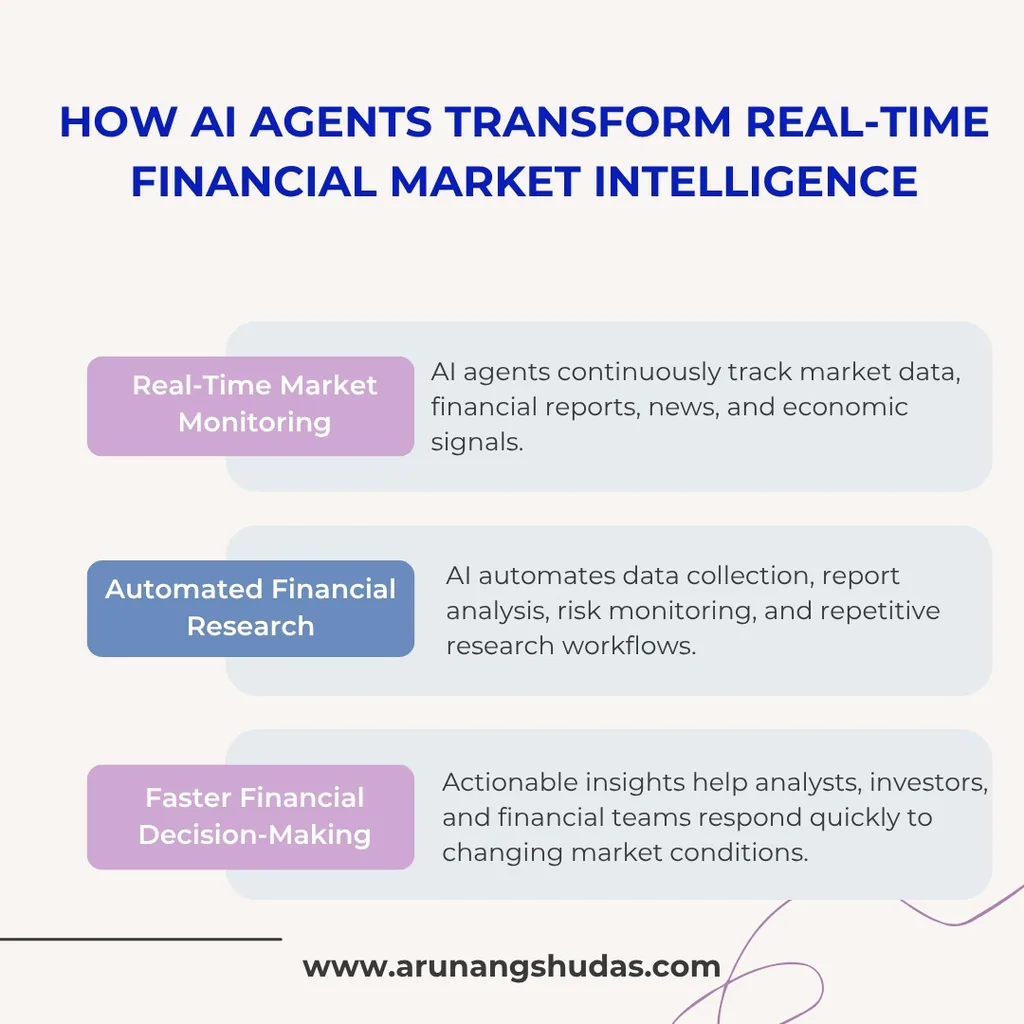
Real-Time Data Monitoring
A major advantage of AI agents is their ability to monitor information continuously. An agent can track earnings announcements, regulatory filings, market movements, analyst commentary, economic releases, and company news. When a significant event occurs, the system can summarize the development and highlight its potential relevance.
For investment teams, this reduces the time spent searching across disconnected information sources. Instead of waiting for a scheduled research report, analysts can receive structured intelligence as market conditions evolve.
Automated Financial Research
Traditional research often involves gathering data from multiple sources, cleaning it, organizing it, and then preparing analysis. AI agents can automate many of these repetitive tasks.
An agent might identify a company’s latest financial results, compare them with previous periods, calculate changes in key metrics, and prepare a concise briefing for an analyst. This supports Financial Research Workflows while allowing professionals to focus more heavily on interpretation and strategy.
AI Agents in Investment and Private Markets
AI agents are particularly valuable where financial professionals must evaluate large amounts of qualitative and quantitative information.
For Private Equity Due Diligence, agents can review company documents, identify relevant financial trends, organize competitive information, and flag potential issues for further investigation. They can support—not replace—the judgment of investment professionals.
In investment banking, AI agents can assist with repetitive Investment Banking Operations, including information gathering, document review, market monitoring, and preparation of preliminary analysis. This can reduce administrative workloads and give banking teams more time for client-facing and strategic activities.
| Use Case | What the AI Agent Can Do | Human Role |
| Private Equity Due Diligence | Review documents and identify relevant findings | Validate findings and investment thesis |
| Investment Banking | Monitor transactions and market information | Make strategic and client decisions |
| Equity Research | Track companies and financial developments | Interpret business implications |
| Corporate Finance | Monitor financial indicators | Determine financial strategy |
| Wealth Management | Track portfolios and market events | Advise clients and approve actions |
Financial Modeling and Analyst Productivity
Financial Modeling for Analysts can involve extensive data preparation before a model is even constructed. AI agents can help collect historical financial information, structure datasets, identify inconsistencies, and update selected model inputs.
For example, an agent could monitor quarterly earnings and identify changes in revenue, margins, operating expenses, or guidance. The analyst can then review the extracted information before incorporating it into a financial model.
This creates a collaborative model in which AI handles repetitive information processing while analysts remain responsible for assumptions, valuation methodologies, scenario analysis, and final conclusions.
Supporting Financial Decision-Making
The purpose of AI-driven market intelligence is not simply to generate more information. The real objective is to make relevant information easier to understand and act upon.
An effective AI agent can transform thousands of data points into a prioritized set of insights:
- What changed?
- Why did it change?
- Which companies or portfolios are affected?
- How significant is the development?
- What additional information should an analyst investigate?
- Does the event require immediate attention?
This approach can make Financial Decision-Making more timely while reducing information overload.
Financial Risk Monitoring With AI Agents
Financial Risk Monitoring is another area where continuous AI-driven analysis can provide significant value. Markets can change rapidly, and risk teams need visibility into developments that may affect credit, liquidity, market exposure, operational performance, or portfolio concentration.
AI agents can monitor predefined risk indicators and notify teams when thresholds or patterns change. They can also combine structured financial data with unstructured information such as news and corporate announcements.
| Risk Category | AI Monitoring Activity | Potential Alert |
| Market Risk | Tracks price and volatility changes | Unusual market movement |
| Credit Risk | Monitors company and borrower indicators | Deteriorating credit profile |
| Liquidity Risk | Tracks liquidity-related metrics | Emerging liquidity pressure |
| Operational Risk | Reviews incidents and operational signals | Repeated operational issues |
| Portfolio Risk | Monitors concentration and exposure | Excessive sector or asset exposure |
AI should be used as an early-warning and analytical support layer rather than as an unquestioned source of truth. Human oversight remains essential, especially when decisions involve material financial consequences.
AI Agents in Wealth Management
AI Agents in Wealth Management can help advisors and investment teams monitor portfolios, research securities, summarize market developments, and prepare client-oriented insights.
For example, an agent can track whether a portfolio company has released earnings, whether a major economic event could affect an asset allocation strategy, or whether a security has experienced an unusual movement.
The value comes from personalization and speed. Instead of producing identical market summaries for every investor, AI systems can organize information according to portfolio holdings, investment objectives, risk parameters, and predefined preferences.
AI Systems in Financial Services
The broader adoption of AI Systems in Financial Services is creating an ecosystem in which multiple specialized agents can work together.
One agent may monitor markets, another may analyze financial statements, another may conduct risk checks, and another may prepare a management summary. These agents can operate as coordinated components within a larger financial intelligence platform.
For Fintech Companies, this architecture can support new products such as automated research platforms, intelligent portfolio monitoring systems, financial data copilots, and AI-powered institutional research solutions.
Key Advantages
The strongest benefits of AI agents in financial intelligence include:
- Speed: Information can be processed continuously rather than only during scheduled research cycles.
- Scale: Agents can monitor thousands of companies, securities, documents, and data points.
- Consistency: Standardized workflows can reduce repetitive manual processing.
- Context: Multiple information sources can be combined to create richer insights.
- Automation: Routine research and monitoring tasks can be handled automatically.
- Prioritization: Significant developments can be surfaced for human review.
Building an Effective AI Agent Strategy
Organizations should begin with clearly defined use cases rather than attempting to automate every financial workflow at once. High-volume, repetitive, information-intensive activities are often strong starting points.
A practical implementation can include:
- Defining the financial question the agent must answer.
- Connecting trusted market and company data sources.
- Establishing rules for data validation.
- Creating human approval checkpoints.
- Setting permissions for sensitive information.
- Monitoring agent accuracy and performance.
- Maintaining audit trails for important outputs.
- Regularly testing the system for errors and unexpected behavior.
AI agents become significantly more useful when they are integrated into existing financial workflows rather than deployed as isolated tools.

The Future of Real-Time Financial Intelligence
The next generation of financial technology will increasingly combine human expertise with autonomous systems. Rather than replacing financial professionals, AI agents are likely to become intelligent research and monitoring partners that help professionals work faster and evaluate more information.
As these systems become more capable, financial organizations will need to focus equally on data quality, governance, explainability, cybersecurity, and human oversight. The firms that successfully balance automation with professional judgment will be better positioned to use real-time intelligence as a competitive advantage.
Frequently Asked Questions
1. What are AI agents for financial market intelligence?
AI agents are software systems that can autonomously collect, analyze, organize, and monitor financial information. They can track market data, company announcements, financial reports, and other signals to provide timely insights for financial professionals.
2. How can AI agents support financial research?
AI agents can automate information gathering, Report Analysis, company comparisons, market monitoring, and research summaries. This allows analysts to spend more time interpreting information and developing investment conclusions.
3. Can AI agents be used for private equity due diligence?
Yes. AI agents can assist with Private Equity Due Diligence by reviewing large document collections, extracting financial information, identifying trends, organizing findings, and highlighting areas that require additional human investigation.
4. Are AI agents suitable for financial risk monitoring?
Yes. AI agents can continuously monitor financial and market indicators and identify changes that may require attention. However, important risk decisions should retain appropriate human oversight, validation, and governance.
5. How can fintech companies benefit from AI agents?
Fintech Companies can use AI agents to create automated research platforms, portfolio monitoring solutions, financial copilots, risk intelligence systems, and other services that deliver faster and more personalized financial insights.
