


Java full stack developer roadmap is a useful starting point for anyone who wants to build complete web applications using Java for backend development and modern frontend technologies. A structured learning path can help beginners avoid jumping between programming languages, frameworks, databases, and tools without understanding how they fit together.
Full stack development requires knowledge of both frontend and backend technologies. On the frontend, developers work with HTML, CSS, JavaScript, and frameworks such as React or Angular. On the backend, Java and Spring Boot are commonly used to build application logic and APIs. Databases, Git, testing, and deployment are also important parts of the stack.
This guide explains a practical Java full stack developer roadmap that takes you from programming fundamentals to building complete projects and preparing for a professional development career.
Table of Contents
What Is a Java Full Stack Developer?
A Java full stack developer works on both the frontend and backend of a web application, with Java commonly used for backend development.
For example, an ecommerce website may have a frontend where customers browse products and place orders. The backend handles authentication, business logic, payments, and communication with the database.
A full stack developer understands how these different layers communicate and can contribute to multiple parts of the application.
You do not need to become an expert in every technology immediately. The goal is to develop a strong foundation and gradually expand your knowledge.
Java Full Stack Developer Roadmap: Step-by-Step Learning Path
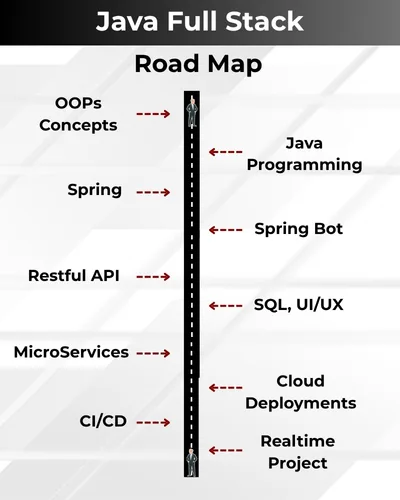
Following the right order can make full stack development easier to learn. The following steps provide a practical progression for beginners.
Step 1: Learn Programming Fundamentals
Before learning frameworks, start with programming fundamentals.
If Java is your primary backend language, begin with Core Java. Learn how programs work and practice writing small applications.
Important concepts include:
- Variables and data types
- Operators
- Conditional statements
- Loops
- Methods
- Arrays
- Classes and objects
- Exception handling
- Collections
- File handling
Do not rush through these topics. A strong understanding of programming fundamentals will make advanced Java concepts much easier.
Step 2: Master Object-Oriented Programming in Java
Object-oriented programming, or OOP, is central to Java development.
Learn the four major OOP principles:
- Encapsulation
- Inheritance
- Polymorphism
- Abstraction
You should also understand interfaces, constructors, access modifiers, static members, and method overloading and overriding.
Try building small applications while learning these concepts. For example, create a library management system with classes for books, members, and transactions.
Step 3: Learn Advanced Java Concepts
Once you are comfortable with the fundamentals, move into more advanced Java concepts.
Focus on:
- Generics
- Collections Framework
- Lambda expressions
- Stream API
- Multithreading
- Functional interfaces
- Exception handling
- JDBC
- Java I/O
Modern Java development also requires familiarity with newer Java features, so avoid learning only older versions of the language.
At this stage of the Java full stack developer roadmap, your goal should be writing clean, reusable, and maintainable Java code.
Step 4: Learn HTML and CSS
After establishing your Java foundation, begin learning frontend development.
HTML provides the structure of a webpage, while CSS controls its appearance.
Learn:
- Semantic HTML
- Forms
- Tables
- Links
- Images
- CSS selectors
- Box model
- Flexbox
- CSS Grid
- Responsive design
Build simple webpages rather than learning only through tutorials.
You could create a personal portfolio, product page, or basic company website.
Step 5: Learn JavaScript
JavaScript is essential for modern frontend development.
Start with the basics:
- Variables
- Functions
- Arrays
- Objects
- Loops
- Events
- DOM manipulation
- Modules
- Promises
- Async/await
- Fetch API
- JSON
Understanding asynchronous JavaScript is particularly important because frontend applications frequently communicate with backend APIs.
Build small projects such as a calculator, weather application, task manager, or shopping cart.
Step 6: Learn a Frontend Framework
Once you understand HTML, CSS, and JavaScript, choose a modern frontend framework or library.
Two common choices are React and Angular.
If your goal is to work specifically with enterprise Java applications, Angular can be a useful technology to study. React is also widely used and provides a strong ecosystem for building modern interfaces.
Learn concepts such as:
- Components
- Routing
- Forms
- State management
- API requests
- Reusable components
- Authentication
- Error handling
Do not try to learn multiple frontend frameworks simultaneously. Choose one and become comfortable with it before exploring alternatives.
Step 7: Learn SQL and Databases
A backend application needs somewhere to store data.
Start with relational databases such as MySQL or PostgreSQL.
Learn SQL concepts including:
- SELECT
- INSERT
- UPDATE
- DELETE
- JOIN
- GROUP BY
- ORDER BY
- Primary keys
- Foreign keys
- Indexes
- Transactions
You should understand how applications create, retrieve, update, and delete database records.
Later, you can explore NoSQL databases such as MongoDB to understand alternative approaches to data storage.
Step 8: Learn Spring Framework
Spring is one of the most important technologies in the Java full stack developer roadmap.
Start by understanding Spring fundamentals, including dependency injection and inversion of control.
Then move toward Spring Boot, which simplifies the development of Java applications.
Important Spring Boot concepts include:
- Controllers
- Services
- Repositories
- Dependency injection
- Configuration
- Validation
- Exception handling
- Profiles
- Application properties
Understanding how these layers work together will help you create structured backend applications.
Step 9: Learn REST APIs
REST APIs connect your frontend application with the Java backend.
For example, when a user opens a product page, the frontend may send a GET request to a backend API. The Java application retrieves the product information from the database and returns it to the frontend in JSON format.
Learn HTTP methods such as:
- GET
- POST
- PUT
- PATCH
- DELETE
You should also understand HTTP status codes, request parameters, headers, JSON, authentication, and API testing.
Postman or similar API-testing tools can help you test your endpoints.
Step 10: Learn Git and GitHub
Version control is an essential professional skill.
Git allows developers to track changes, create branches, collaborate with teammates, and manage different versions of their code.
Learn commands such as:
git clonegit addgit commitgit pushgit pullgit branchgit merge
Create GitHub repositories for your projects so potential employers can see your code and development experience.
Step 11: Learn Testing
Testing helps ensure that your application behaves as expected.
For Java applications, learn tools and concepts such as JUnit and Mockito.
Understand the difference between unit testing and integration testing.
You do not need to become a testing specialist, but you should know how to write basic tests for services, controllers, and important business logic.
Testing should become part of your development process rather than something you only do at the end of a project.
Step 12: Learn Deployment and Basic DevOps
Once you can build applications locally, learn how to deploy them.
Start with basic concepts such as:
- Servers
- Environment variables
- Build processes
- Docker
- CI/CD
- Cloud platforms
- Application logs
You do not need to become a DevOps engineer. However, understanding how applications move from development to production will make you a more complete developer.
Step 13: Build Real-World Projects
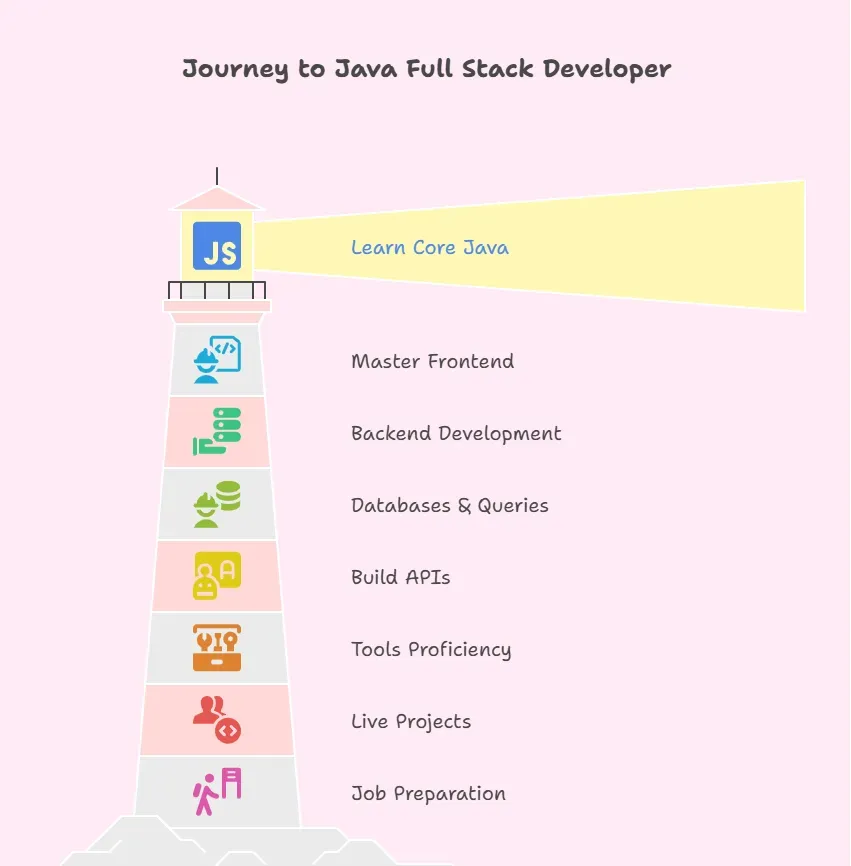
Projects are one of the most important stages of the Java full stack developer roadmap.
Instead of creating only small practice applications, build complete projects that combine frontend, backend, databases, and APIs.
Good project ideas include:
Ecommerce Application
Build product listings, user registration, login, shopping carts, orders, and an admin dashboard.
Employee Management System
Create features for adding employees, updating records, searching employees, and managing departments.
Online Booking System
Build a platform where users can browse available services, select dates, and make bookings.
Task Management Application
Allow users to create, update, delete, and organize tasks. Add authentication and database integration.
Your projects should demonstrate that you understand how the different technologies in the Java full stack developer roadmap work together.
Step 14: Build a Professional Portfolio
Once you have completed several projects, create a portfolio.
Include:
- About section
- Technical skills
- Project descriptions
- GitHub links
- Live project links
- Resume
- Contact information
For every project, explain the problem it solves, technologies used, major features, and challenges you encountered.
A portfolio gives employers evidence of your practical skills rather than just a list of technologies on your resume.
Step 15: Prepare for Java Full Stack Developer Jobs
The final stage is preparing for interviews and applications.
Review Java fundamentals, OOP, collections, SQL, Spring Boot, REST APIs, frontend concepts, databases, and Git.
Practice coding problems and common technical interview questions.
You should also be able to explain your projects clearly. Interviewers may ask why you selected a particular technology, how authentication works, how your database is structured, or how your API communicates with the frontend.
Java Full Stack Developer Roadmap Timeline
There is no fixed amount of time required to become a full stack developer because learning speed depends on your background and study schedule.
A possible progression could be:
| Stage | Main Focus |
|---|---|
| Month 1–2 | Core Java and OOP |
| Month 3 | Advanced Java |
| Month 4 | HTML, CSS and JavaScript |
| Month 5 | React or Angular |
| Month 6 | SQL and databases |
| Month 7–8 | Spring Boot and REST APIs |
| Month 9 | Git, testing and deployment |
| Month 10–12 | Projects, portfolio and interview preparation |
This is only an example. Some learners may progress faster, while others may need additional time.
Common Mistakes to Avoid

One common mistake is trying to learn too many technologies simultaneously. Focus on one technology at a time and understand how it works before moving forward.
Another mistake is watching tutorials without building projects. Passive learning will not give you the same experience as writing and debugging your own code.
You should also avoid ignoring frontend development simply because Java is your main programming language. A full stack developer needs to understand how the frontend and backend communicate.
Finally, do not wait until you know everything before building projects. Start small and gradually increase project complexity.
Final Thoughts
A Java full stack developer roadmap gives you a structured path for learning the technologies required to build complete web applications.
Start with Core Java and OOP, then learn HTML, CSS, JavaScript, a frontend framework, databases, Spring Boot, REST APIs, Git, testing, and deployment. Most importantly, combine these skills through real-world projects.
You do not need to master every technology before applying for jobs. Focus on strong fundamentals, practical experience, and continuous learning.
With consistent practice and a portfolio of meaningful projects, you can gradually develop the skills needed to pursue a career as a Java full stack developer.
Frequently Asked Questions
1. What should I learn first in a Java full stack developer roadmap?
Start with Core Java and object-oriented programming. Once you understand Java fundamentals, move to HTML, CSS, JavaScript, databases, Spring Boot, REST APIs, and a frontend framework.
2. Is Java enough to become a full stack developer?
No. Java is primarily used for backend development. You also need frontend technologies such as HTML, CSS, JavaScript, and React or Angular, along with databases, APIs, Git, testing, and basic deployment knowledge.
3. Which frontend framework should I learn with Java?
React and Angular are both useful choices. If you want to work in enterprise environments, Angular can be particularly relevant, while React is also widely used across different types of web applications.
4. How long does it take to become a Java full stack developer?
The timeline varies based on your previous experience and study time. A beginner following a structured learning plan may need several months to build foundational skills and additional time to become comfortable with real-world development.
