


In today’s competitive digital landscape, businesses are turning to AI Marketing Agents to create highly personalized experiences across every customer touchpoint. From lead generation to retention, AI-driven technologies help brands understand user behavior, predict future actions, and deliver relevant content at the right time. Organizations leveraging Customer Support Agents, AI Tools, and advanced automation solutions are seeing significant improvements in customer satisfaction, engagement, and conversion rates.
The growing adoption of Digital Health Tech and intelligent business platforms has accelerated the demand for personalization. Modern enterprises use customer journey AI systems to analyze interactions, identify customer intent, and optimize engagement strategies. Combined with AI Marketing Agents, these solutions help brands build meaningful relationships, increase loyalty, and streamline marketing operations across multiple channels.
What Are AI Agents for Customer Journey Optimization?
AI agents are intelligent software systems designed to analyze customer behavior, automate marketing decisions, and personalize interactions throughout the customer lifecycle. These systems leverage machine learning, predictive analytics, and automation technologies to deliver customized experiences.
Businesses use AI customer engagement solutions to understand customer preferences, automate communication, and improve overall customer satisfaction. By integrating customer experience AI into business operations, organizations can create data-driven experiences that adapt in real time.
Core Functions of AI Agents in Customer Journey Optimization
| Function | Description | Business Benefit |
| Behavioral Analysis | Tracks customer interactions | Better personalization |
| Audience Segmentation | Groups users by behavior | Targeted campaigns |
| Predictive Modeling | Forecasts customer actions | Improved decision-making |
| Content Personalization | Delivers customized content | Higher engagement |
| Automation | Handles repetitive tasks | Increased efficiency |
The Role of AI Marketing Agents in Modern Marketing
Today’s marketing teams are increasingly relying on AI Marketing Agents to automate and optimize campaigns. These agents collect customer data, evaluate behavior patterns, and recommend personalized marketing actions.
By integrating Digital Marketing Workflows, businesses can automate lead nurturing, customer onboarding, email campaigns, and retention strategies. This reduces manual effort while improving marketing effectiveness.
Additionally, Content Marketing at Scale becomes achievable when AI systems automatically generate, distribute, and optimize content based on audience preferences.
How Customer Journey AI Enhances Personalization
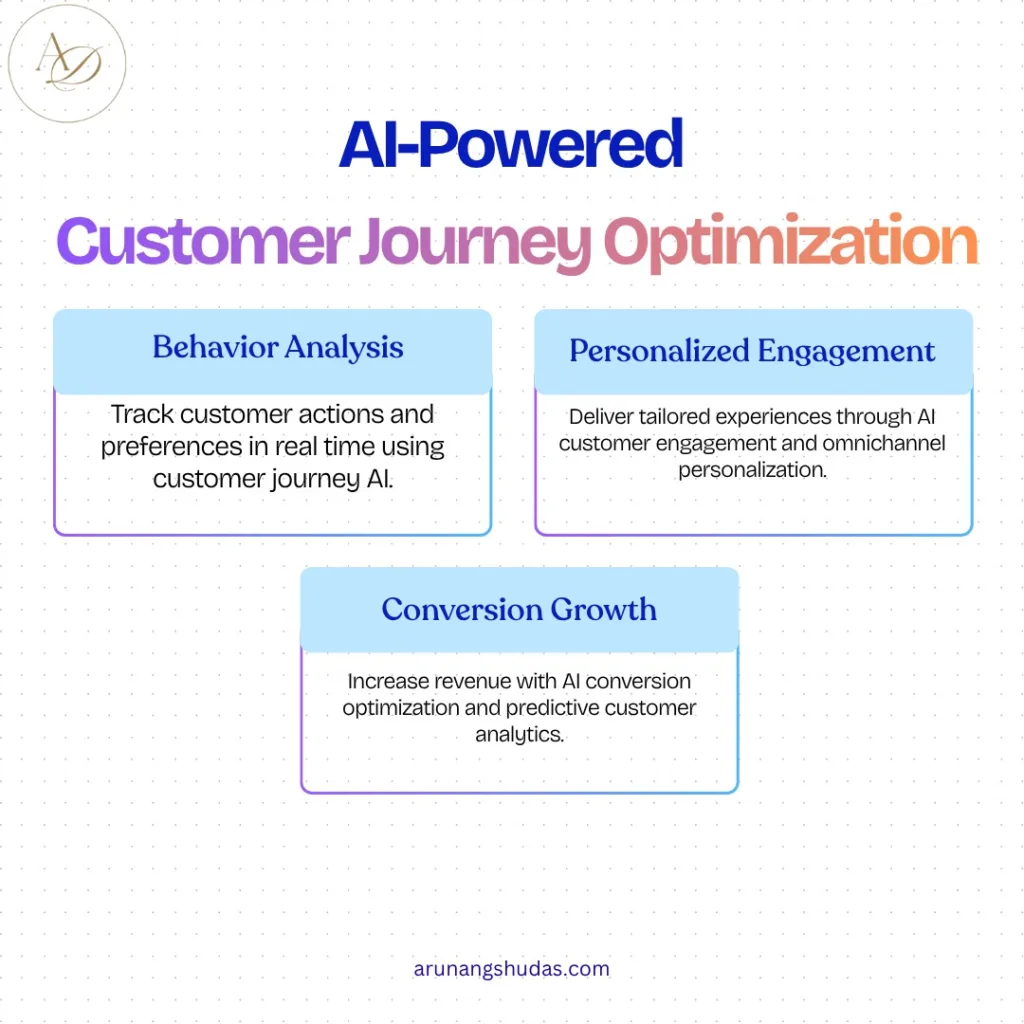
The strength of customer journey AI lies in its ability to understand customers at every stage of the buying process. AI continuously gathers data from websites, mobile apps, social media, and customer interactions to build detailed user profiles.
Key personalization capabilities include:
- Real-time content recommendations
- Dynamic website experiences
- Personalized email marketing
- Automated customer support
- Predictive product suggestions
These capabilities contribute significantly to personalization automation, allowing businesses to deliver relevant experiences without manual intervention.
Personalization Techniques Powered by AI
| Personalization Method | AI Capability | Outcome |
| Product Recommendations | Machine Learning | Increased sales |
| Dynamic Website Content | Real-Time Analysis | Better engagement |
| Personalized Emails | Behavioral Tracking | Higher open rates |
| Chatbots | Natural Language Processing | Faster support |
| Customer Retargeting | Predictive Analytics | Improved conversions |
AI Agents for SEO and Content Optimization
Search engine optimization has evolved significantly with the rise of AI Agents for SEO. These intelligent systems analyze search trends, competitor performance, and user intent to optimize content strategies.
Organizations leveraging AI Agents for SEO benefit from:
- Automated keyword research
- Content gap analysis
- Search intent mapping
- Internal linking recommendations
- Performance tracking
When combined with Content Marketing at Scale, businesses can produce optimized content more efficiently while maintaining quality and relevance.
AI-powered content strategies ensure that customer needs align with search engine requirements, improving both rankings and engagement.
Behavioral Marketing AI for Smarter Decision-Making
One of the most powerful applications of AI is behavioral marketing AI. These systems analyze customer actions, browsing habits, purchase history, and engagement patterns to predict future behavior.
Businesses use behavioral marketing AI to:
- Anticipate customer needs
- Identify high-value prospects
- Improve campaign targeting
- Increase customer retention
- Optimize advertising spend
This data-driven approach enables marketers to make smarter decisions while reducing wasted marketing resources.
Benefits of Behavioral Marketing AI
| Area | Traditional Marketing | Behavioral Marketing AI |
| Targeting | Broad Segments | Precise Audience Groups |
| Personalization | Limited | Highly Customized |
| Decision Making | Historical Data | Predictive Insights |
| Engagement | Generic Messaging | Relevant Experiences |
| ROI | Moderate | Higher Efficiency |
Intelligent Audience Targeting for Better Results
Modern consumers expect brands to understand their preferences. Intelligent audience targeting enables businesses to segment customers based on behavior, demographics, interests, and purchasing patterns.
Using predictive customer analytics, AI agents identify the most promising prospects and deliver tailored messaging. This improves campaign relevance and boosts customer acquisition efforts.
Benefits of intelligent audience targeting include:
- Higher conversion rates
- Improved lead quality
- Reduced acquisition costs
- Better customer retention
- Enhanced customer experiences
Omnichannel Personalization Across Customer Touchpoints
Customers interact with brands through websites, mobile apps, email, social media, and messaging platforms. Maintaining consistency across these channels can be challenging.
This is where omnichannel personalization becomes essential.
AI-powered systems synchronize customer data across channels, ensuring that users receive consistent experiences regardless of where they engage.
Examples include:
- Personalized website recommendations
- Customized email campaigns
- Tailored mobile notifications
- AI-powered chat interactions
- Social media personalization
By implementing omnichannel personalization, businesses create seamless customer journeys that improve satisfaction and loyalty.
Omnichannel Personalization Channels
| Channel | Personalization Example |
| Website | Dynamic content recommendations |
| Behavior-based messaging | |
| Mobile App | Personalized notifications |
| Social Media | Targeted advertisements |
| Customer Support | Context-aware assistance |
AI Conversion Optimization for Higher Revenue
Increasing conversions is a primary objective for every business. AI conversion optimization helps organizations identify barriers in the customer journey and implement improvements automatically.
AI systems analyze:
- Landing page performance
- User navigation patterns
- Cart abandonment behavior
- Click-through rates
- Purchase journeys
These insights enable businesses to continuously improve customer experiences and maximize revenue opportunities.
Organizations implementing AI conversion optimization often experience significant gains in sales and customer retention.
Predictive Customer Analytics and Future Insights
Understanding what customers will do next is one of AI’s most valuable capabilities. Through predictive customer analytics, businesses can forecast future actions based on historical and real-time data.
Applications include:
- Churn prediction
- Purchase forecasting
- Lifetime value estimation
- Lead scoring
- Demand forecasting
These insights allow organizations to proactively engage customers and improve decision-making processes.
Digital Engagement Systems and Customer Experience AI
Modern digital engagement systems leverage AI to automate customer interactions while maintaining personalization. These platforms integrate communication channels, customer data, and automation tools into a unified ecosystem.
By combining customer experience AI with advanced engagement technologies, businesses can:
- Improve customer satisfaction
- Deliver personalized experiences
- Reduce response times
- Increase customer loyalty
- Enhance operational efficiency
AI-Driven Customer Journey Optimization Metrics
| Metric | Before AI | After AI Implementation |
| Customer Engagement | Moderate | High |
| Conversion Rate | Average | Improved |
| Customer Retention | Standard | Enhanced |
| Marketing Efficiency | Manual | Automated |
| Customer Satisfaction | Good | Excellent |

Conclusion
The future of marketing is increasingly powered by AI Marketing Agents, customer journey AI, and advanced personalization technologies. Businesses that embrace personalization automation, AI customer engagement, behavioral marketing AI, intelligent audience targeting, and omnichannel personalization are better positioned to meet evolving customer expectations.
By integrating AI Agents for SEO, Content Marketing at Scale, Digital Marketing Workflows, AI conversion optimization, predictive customer analytics, customer experience AI, and digital engagement systems, organizations can create smarter, more efficient customer journeys that drive long-term growth and profitability.
FAQs
1. What are AI Marketing Agents?
AI Marketing Agents are intelligent software systems that automate marketing tasks, analyze customer behavior, and personalize interactions across the customer journey.
2. How does customer journey AI improve personalization?
Customer journey AI tracks user behavior, predicts preferences, and delivers tailored experiences that increase engagement and customer satisfaction.
3. What are the benefits of AI Agents for SEO?
AI Agents for SEO help automate keyword research, optimize content, analyze search intent, and improve website visibility in search engines.
4. Why is omnichannel personalization important?
Omnichannel personalization ensures customers receive consistent and relevant experiences across websites, apps, email, social media, and support channels.
5. How does predictive customer analytics support business growth?
Predictive customer analytics helps businesses forecast customer behavior, reduce churn, improve targeting, and make data-driven decisions that increase revenue.
