


Preparing for REST API interview questions is essential for developers aiming to secure roles in modern software development. Whether you are an associate software engineer, preparing for a basic technical interview, or an experienced professional in software engineering, understanding REST APIs can significantly improve your chances of success. Employers frequently ask api interview questions to evaluate a candidate’s understanding of web services, API architecture, HTTP protocols, authentication mechanisms, and system design principles.
For candidates applying as a java full stack developer, backend engineer, or software architect, mastering rest interview questions, restful api interview questions, and interview questions rest api topics is crucial. Interviewers often combine API concepts with backend questions for interview, coding interview questions with solutions, and data structures and algorithms to assess overall technical competency. If you’re preparing for a senior developer interview, this guide covers the most important rest api interview questions and answers along with practical examples and API testing concepts.
Why REST APIs Are Important for Backend Developers
REST (Representational State Transfer) is the most widely used architectural style for building scalable web services. Most modern applications, including mobile apps, SaaS platforms, e-commerce systems, and enterprise software, rely on RESTful APIs for communication between services.
Key benefits include:
- Stateless communication
- Scalability
- Platform independence
- Faster development
- Easy integration with frontend applications
- Better maintainability
Basic REST API Interview Questions
1. What is REST API?
REST API is an architectural style that allows communication between client and server using HTTP protocols.
Key Characteristics:
- Stateless
- Client-Server Architecture
- Cacheable
- Uniform Interface
- Layered System
2. What are the REST Constraints?
REST follows six architectural constraints:
- Client-Server
- Stateless
- Cacheable
- Uniform Interface
- Layered System
- Code on Demand (Optional)
3. What is the Difference Between REST and RESTful API?
A REST API follows REST principles, while a RESTful API fully adheres to all REST architectural constraints.
4. Which HTTP Methods Are Commonly Used in REST APIs?
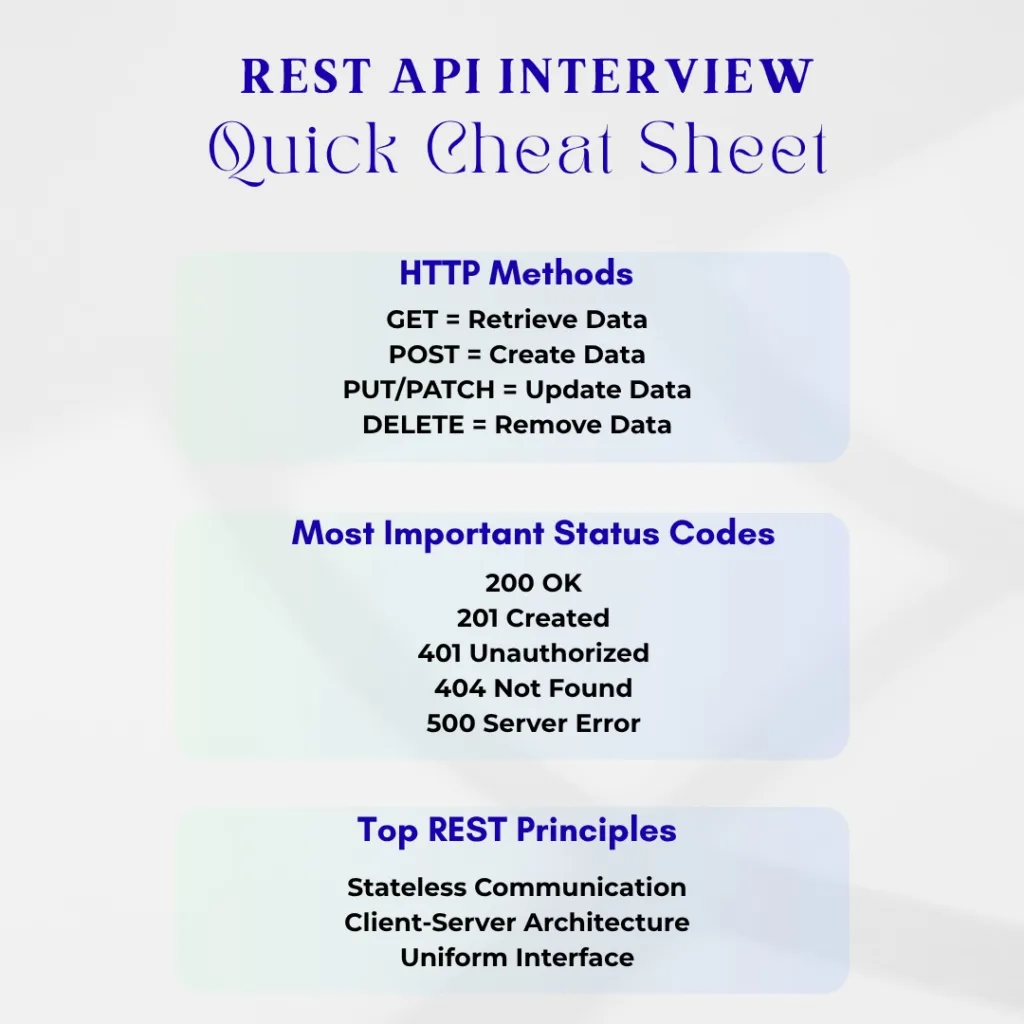
| HTTP Method | Purpose | Example |
| GET | Retrieve Data | GET /users |
| POST | Create Data | POST /users |
| PUT | Update Entire Resource | PUT /users/1 |
| PATCH | Partial Update | PATCH /users/1 |
| DELETE | Remove Resource | DELETE /users/1 |
5. What is Statelessness in REST?
Statelessness means every request contains all information needed by the server to process it.
Benefits:
- Better scalability
- Improved reliability
- Easier load balancing
Intermediate RESTful API Interview Questions
6. Explain Idempotency in REST APIs.
An operation is idempotent if multiple identical requests produce the same result.
Idempotent Methods
- GET
- PUT
- DELETE
- HEAD
- OPTIONS
Non-Idempotent Methods
- POST
7. What Are HTTP Status Codes?
HTTP status codes indicate the outcome of a request.
Important HTTP Status Codes
| Status Code | Meaning | Usage |
| 200 | Ok | Successful request |
| 201 | Created | Resource created |
| 204 | No Content | Successful deletion |
| 400 | Bad Request | Invalid request |
| 401 | Unauthorized | Authentication required |
| 403 | Forbidden | Access denied |
| 404 | Not Found | Resource missing |
| 500 | Internal Server Error | Server issue |
8. Difference Between PUT and PATCH?
| Feature | PUT | PATCH |
| Update Type | Complete Resource | Partial Resource |
| Idempotent | Yes | Usually |
| Payload Size | Larger | Smaller |
| Usage | Full Replacement | Specific Updates |
9. What is Content Negotiation?
Content negotiation allows clients to request specific response formats using headers.
Example:
Accept: application/json
or
Accept: application/xml
10. What is API Versioning?
API versioning ensures backward compatibility while introducing new features.
Common Approaches:
- URI Versioning (/v1/users)
- Header Versioning
- Query Parameter Versioning
Advanced REST API Interview Questions and Answers
11. What is JWT Authentication?
JWT (JSON Web Token) is a secure mechanism used for authentication and authorization.
Structure:
- Header
- Payload
- Signature
Benefits:
- Stateless authentication
- Scalable architecture
- Secure token-based access
12. What is Rate Limiting?
Rate limiting controls how many requests a user can make within a specific timeframe.
Benefits:
- Prevents abuse
- Protects server resources
- Improves availability
13. What is CORS?
Cross-Origin Resource Sharing (CORS) allows secure communication between different domains.
Common Headers:
Access-Control-Allow-Origin
Access-Control-Allow-Methods
Access-Control-Allow-Headers
14. Explain API Pagination.
Pagination helps manage large datasets.
Methods:
Pagination Strategies
| Strategy | Example | Advantages |
| Offset-Based | ?offset=20&limit=10 | Easy implementation |
| Page-Based | ?page=2 | User friendly |
| Cursor-Based | ?cursor=abc123 | Better performance |
| Keyset Pagination | ?last_id=100 | Fast querying |
15. What Is HATEOAS?
HATEOAS (Hypermedia as the Engine of Application State) allows clients to dynamically discover actions through links included in responses.
Example:
{
 "id": 1,
 "name": "John",
 "links": {
   "self": "/users/1",
   "orders": "/users/1/orders"
 }
}
API Testing Interview Questions
These api testing interview questions are commonly asked in QA and backend interviews.
What tools are used for API testing?
Popular tools include:
- Postman
- Swagger
- SoapUI
- Insomnia
- JMeter
What should be tested in an API?
- Functionality
- Response Codes
- Authentication
- Security
- Performance
- Error Handling
What is Contract Testing?
Contract testing ensures APIs meet the agreed interface between consumers and providers.
Backend Questions for Interview
If you’re preparing for backend questions for interview, expect topics such as:
- REST API Design
- Authentication & Authorization
- Database Optimization
- Caching Strategies
- Message Queues
- Microservices
- Load Balancing
- API Security
For a java full stack developer role, REST API concepts are often combined with:
- Spring Boot
- Hibernate
- SQL
- Java Collections
- Design Patterns
Senior Developer Interview REST API Topics
During a senior developer interview, interviewers focus on:
- Distributed Systems
- API Scalability
- Rate Limiting
- Event-Driven Architecture
- API Gateway Design
- Security Best Practices
- Microservices Communication
Senior candidates are also expected to demonstrate knowledge of data structures and algorithms and solve coding interview questions with solutions alongside REST API discussions.
Best Practices for REST API Design
- Use nouns instead of verbs in URLs.
- Follow consistent naming conventions.
- Implement proper authentication.
- Use meaningful HTTP status codes.
- Support pagination.
- Version APIs properly.
- Secure endpoints using HTTPS.
- Document APIs using OpenAPI/Swagger.

Conclusion
Mastering rest api interview questions and answers is crucial for anyone pursuing a career in backend development. Whether you’re preparing for an associate software engineer role, a basic technical interview, a java full stack developer position, or a senior developer interview, understanding REST API concepts will significantly improve your interview performance. Combine REST API knowledge with strong foundations in data structures and algorithms, system design, and practical development skills to stand out in today’s competitive job market.
FAQs
1. What are the most common REST API interview questions?
The most common rest api interview questions include HTTP methods, status codes, authentication, API versioning, caching, pagination, and REST principles.
2. What REST API topics are asked in a Java full stack developer interview?
A java full stack developer interview typically covers REST architecture, Spring Boot APIs, JWT authentication, CRUD operations, and API security.
3. How do I prepare for API testing interview questions?
Practice using Postman, understand status codes, learn authentication methods, and focus on request validation and response verification.
4. Why are RESTful APIs important in software engineering?
RESTful APIs enable scalable communication between systems, making them essential in modern software engineering projects and cloud-based applications.
5. What additional topics should backend developers study for interviews?
Besides restful api interview questions, candidates should prepare data structures and algorithms, system design, databases, caching, microservices, and coding interview questions with solutions.
