



Starting a business in India is a thrilling task- however, before you so much as concentrate on your product, marketing, or staff, you must select the appropriate business legal structure in India. Such a choice has consequences on all aspects including taxes and compliance as well as funding and scalability. The misguided decision may not only stop your progress, but may as well put you into unrelated dangers.
We will now dissect the key formations- Private Limited Company, Limited Liability Partnership (LLP) and Proprietorship and assist you in identifying the type of formation that suits the vision of the startup you have.
Understanding the Business Legal Structure in India
Indian legal structure of a business defines your legal business structure. It identifies liability, ownership, taxation and levels of compliance. Any startup, be it SaaS or AI or a conventional retail company, has to decide its legal identity prior to becoming operational.
The three most common types are:
- Proprietorship– It applies to individual owners who are running small businesses
- LLP (Limited Liability Partnership) – This is a type of partnership with a division of risk but with limited risk.
- PLC Company- Perfect fit to growth-orientated start-ups that seek VC Funding to SaaS Startups.
Proprietorship: Simple but Risky
The simplest and the oldest type of business ownership in India is a proprietorship. It is a private property belonging to a single owner. Although it is easy to establish it has no independent legal entity, that is, the business and the owner are one and the same.
Advantages
- Low price & quick installation: Minimal documentation and quick registration.
- Complete control: The owner makes all the decisions on his own.
- Tax simplicity: The taxation is based on income as the personal income of the proprietor.
Disadvantages
- Unlimited liability: The owner himself is liable to all debts.
- Poor growth: Hard to get investors or partners.
- Nonexistent legal entity: When the business owner stops operating, the business stops.
The structure is effective to use with freelancers, shops locally or single service providers, but not to those who intend to scale.
Limited Liability Partnership (LLP): The Balanced Middle Ground
A LLP is a mix between limited liability and traditional partnership. It is registered under the LLP act, 2008 and is best suited when professionals or small teams are starting up together.
Advantages
- Limited liability: This secures the personal categories of partners.
- Separate legal entity- The LLP is capable of owning property and making contracts.
- Less compliance: It has less audits and filings than a Private Limited Company.
- Loose organization: Simple to control internal activities.
Disadvantages
- Poor investor attractiveness: VCs would attract investing in Private Limited Companies.
- Limitation on FDI: FDI is more complicated in LLPs.
- Difficulties of conversion: It can be hard to create a bigger entity in future.
LPP would make a great tradeoff between ease and defense in case you are launching a consulting firm or professional services business.
Private Limited Company: The Investor’s Choice
The most popular startup structure in India, particularly in the tech and AI Cybersecurity Startups sector is the Private Limited Company. It is regulated by the Companies Act, 2013 and it is said to be the gold-standard of scalability and investor confidence.
Advantages
- Limited liability coverage: The business is an independent legal entity.
- Funding availability: Best option of VC Funding of SaaS Start ups and angel investors.
- Endless life: The change of ownership does not have an impact on the operations of the company.
- Increased credibility: Establishes a brand value among customers and partners.
Disadvantages
- Increased compliance: Frequent ROC filings, board meetings, and annual audits to be done.
- Installation: A bit increased registration and maintenance fee.
- Double taxation: The profit of corporations and dividends are taxed differently.
The Private Limited structure is the most appropriate in case you want to establish a scalable business where the chances of investing are available.
Difference Between LLP and Private Limited Company
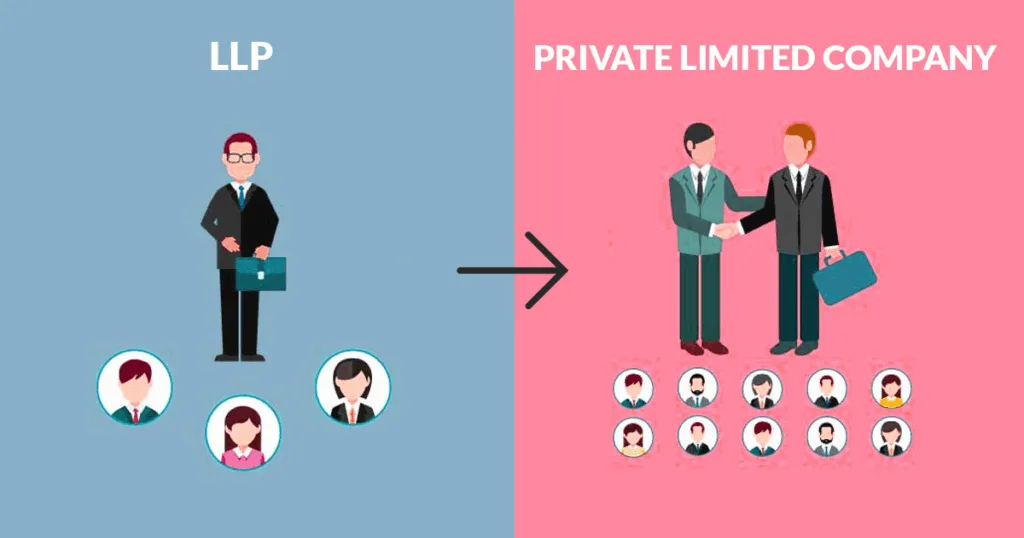
The following is a comparison in some details as to a choice between LLP and Private Limited Company:
| Aspect | Limited Liability Partnership (LLP) | Private Limited Company |
| Governing Law | LLP Act, 2008 | Companies Act, 2013 |
| Legal Entity | Separate legal entity | Separate legal entity |
| Ownership | Partners | Shareholders |
| Minimum Members | 2 partners | 2 directors and 2 shareholders |
| Liability | Restricted to contribution of capital | Limited to shareholding |
| Compliance Level | Moderate | High |
| Taxation | Flat 30% income tax | 22%-25% corporate tax + dividend tax |
| Fundraising Options | Limited | Perfect VC Funding of SaaS Startups |
| Foreign Investment (FDI) | Restricted | Admitted on automatic route. |
| Ideal For | Small startups, service oriented | Investor-supported startups that are growth-oriented |
Verdict: A Private Limited Company is more advantageous in case you need to raise funds and scale fast or in the case of entering into tech industries such as Artificial Intelligence in the case of Small Businesses. LLP works more effectively with small and low-risk operations.
Proprietorship vs Private Limited Company

In the comparison of proprietorship and private limited company, the former is simple to establish with high risks whereas the latter is safe and has access to funding opportunities. Proprietorships are ideal whereby the trader is small and in case you have the vision of expanding long-term, it is prudent to incorporate a Private Limited Company in the process itself.
How to Register a Company in India
Thinking of establishing a business in India? The following are just a few steps that can be followed:
- Get DSC (Digital Signature Certificate)- This is mandatory to directors.
- Get DIN (Director Identification Number) –Special ID of directors.
- Name Approval- Applicant must submit through MCA portal in SPICe+ form.
- Make Documents Memorandum (MOA) and Articles of Association (AOA).
- File Incorporation – upload all the documents on MCA portal.
- Obtain PAN & TAN Issued automatically upon registration.
- Bank Account Opening- Open a current account.
It will take an average of 7-10 working days when the documentation is correct.
Best Legal Entity for Startups in India
The question of the most suitable legal structure of start-up business in India depends upon your vision:
- Solo Entrepreneurs: Proprietorship- low cost and control.
- Partnerships Small Partnerships: LLP Flexible with liability protection.
- Scalable Startups: Private Limited — best suited to external financing.
In case of high growth tech companies or AI Cybersecurity Startups, the Private Limited route will allow optimum flexibility in the capital raising, issuing ESOPs, and internationalization.
Product-Market Fit is Hard: Legal Readiness Matters

Finding the right audience and product-market fit are not easy, and it is more complex with legal preparation when an individual does not consider it. A lot of founders do not pay much attention to the role of legal clarity in attracting investors. Even promising startups do not even get funding without the right structure. Then, prior to pursuing growth, make sure your legal base is strong enough to support your company – Product-Market Fit is Hard without investor confidence.

How Arunangshu Das Guides Us to This
Arunangshu Das has counseled several Indian start-ups on how to integrate the legal, financial and operations structures. His advice is based on the fact that the correct business structure can assist the founders to raise capital, cope with the compliance issues, and grow effectively. Through his assistance, several entrepreneurs have easily switched to LLP to the models of the Private Limited Company to maximize their chances of receiving VC Funding to SaaS Startups and expand into the international market.
Conclusion
Selecting the appropriate legal organization, i.e. Proprietorship, LLP or a Private Limited Company, can or break a startup. Proprietorships are good in small businesses, LLPs have a degree of flexibility and share control and the PLCs enable growth with investor confidence.
Think long-term. A Private Limited Company is the most appropriate next step to your startup should you expect to become scalable, attract investor confidence, and brand value.
1. What’s the easiest business legal structure in India to start?
A Proprietorship- least compliance and easy to establish, suitable in single businesses.
2. Is LLP or Private Limited Company better for startups?
A Private Limited Company is preferable in case of scalability of the venture and also when there is investor funding. LLPs are applicable to small businesses with low risks.
3. How long does it take to register a Private Limited Company in India?
Normally 7-10 working days based on the verification of documents and MCA approval.
4. Can foreign investors invest in an LLP in India?
Foreign Direct Investment (FDI) in LLPs is limited and the government must approve this but in the case of the Private Limited Companies it is not so.
5. What is the best legal entity for AI or SaaS startups in India?
A Private Limited Company is the best fit because of its scalability and the possibility of raising VC Funding towards SaaS Startups and tech-based ventures.
