



When you visit a website or use an app, you interact with buttons, forms, and images—the “frontend.” But behind the scenes, there’s a whole system making everything work smoothly. That’s where backend development comes in.
The Backbone of the Web
Backend development is like the engine of a car—you don’t see it, but without it, nothing moves. It involves writing code that handles data, processes requests, and communicates with databases and other services. When you log in to a website, post a comment, or make a purchase, the backend is doing all the heavy lifting.
Key Components of Backend Development
1. Servers
A server is a high-powered computer or cloud environment dedicated to processing incoming network requests and delivering data back to the client. Think of it as the backend’s primary engine: when a user clicks a button or submits a form on the frontend, the server processes that action, executes the underlying business logic, and returns the appropriate payload. Modern backend development focuses on building highly responsive architecture capable of handling millions of concurrent operations without latency.
2. Databases
Databases serve as the structured storage layer of an application, responsible for securely organizing, retrieving, and updating persistent data—such as user profiles, transactional records, and product inventories. Backend engineers implement and optimize these storage layers using two main archetypes depending on the data structure:
- Relational (SQL): Systems like MySQL and PostgreSQL for highly structured, tabular data.
- Non-Relational (NoSQL/Cloud): Distributed systems like MongoDB or real-time cloud solutions like Firebase for flexible, unstructured, or document-based data.
3. APIs (Application Programming Interfaces)
APIs act as the standardized communication pathways that allow completely independent software applications to exchange data seamlessly. For instance, when a mobile application displays live weather updates, financial metrics, or payment confirmation, it uses the backend to fetch that data from an external or internal API. Today’s backend architectures rely primarily on RESTful APIs for predictable, stateless routing, and GraphQL for flexible, client-driven data querying.
4. Authentication & Security
The backend is an application’s primary line of defense, responsible for verifying user identities and enforcing strict data privacy protocols. Rather than just relying on basic passwords, robust backend security implements cutting-edge framework protocols, including:
- Token-Based Authentication: Utilizing JWTs (JSON Web Tokens) for stateless, secure user sessions.
- Third-Party Integration: Deploying OAuth protocols to allow secure, single-sign-on (SSO) capabilities through verified providers.
- Data Protection: Implementing end-to-end encryption to safeguard sensitive information both at rest in the database and in transit across the network.
Popular Backend Programming Languages & Frameworks
Backend developers select their development stack based on specific execution speeds, architecture scale, and project requirements. The most prominent ecosystem options include:
1. Node.js (JavaScript / TypeScript)
Node.js allows developers to use JavaScript for server-side scripting, unifying frontend and backend development under a single language. Built on Google’s V8 engine, its asynchronous, event-driven architecture makes it exceptionally fast and efficient.
- Best For: Real-time applications (such as chat apps, streaming platforms, and collaborative tools) and microservices.
2. Python (Django, Flask, FastAPI)
Python is celebrated for its clean, highly readable syntax, making it a top choice for rapid prototyping. Its robust ecosystem of libraries allows developers to implement intricate backend workflows with minimal code.
- Best For: Data-heavy applications, machine learning integrations, AI automation services, and algorithmic web platforms.
3. Java (Spring Boot)
Java remains a foundational powerhouse in backend engineering due to its strict object-oriented structure, cross-platform portability, and excellent long-term stability. Using frameworks like Spring Boot, it easily handles massive transactional loads.
- Best For: Enterprise-level software, secure banking applications, and large-scale legacy system migrations.
4. PHP (Laravel)
Powering a massive percentage of the web, PHP remains a highly resilient server-side language. The modern PHP landscape is dominated by Laravel, an elegant framework that streamlines routine development tasks like routing, authentication, and caching.
- Best For: Robust content management systems, traditional web applications, and fast-to-market business portals.
5. Ruby (Ruby on Rails)
Ruby on Rails operates on the principle of “Convention over Configuration,” drastically reducing the time spent setting up boilerplate code. It allows engineering teams to ship fully functional database-backed applications rapidly.
- Best For: Startups, MVP (Minimum Viable Product) development, and fast-paced agile projects.
How Frontend and Backend Work Together
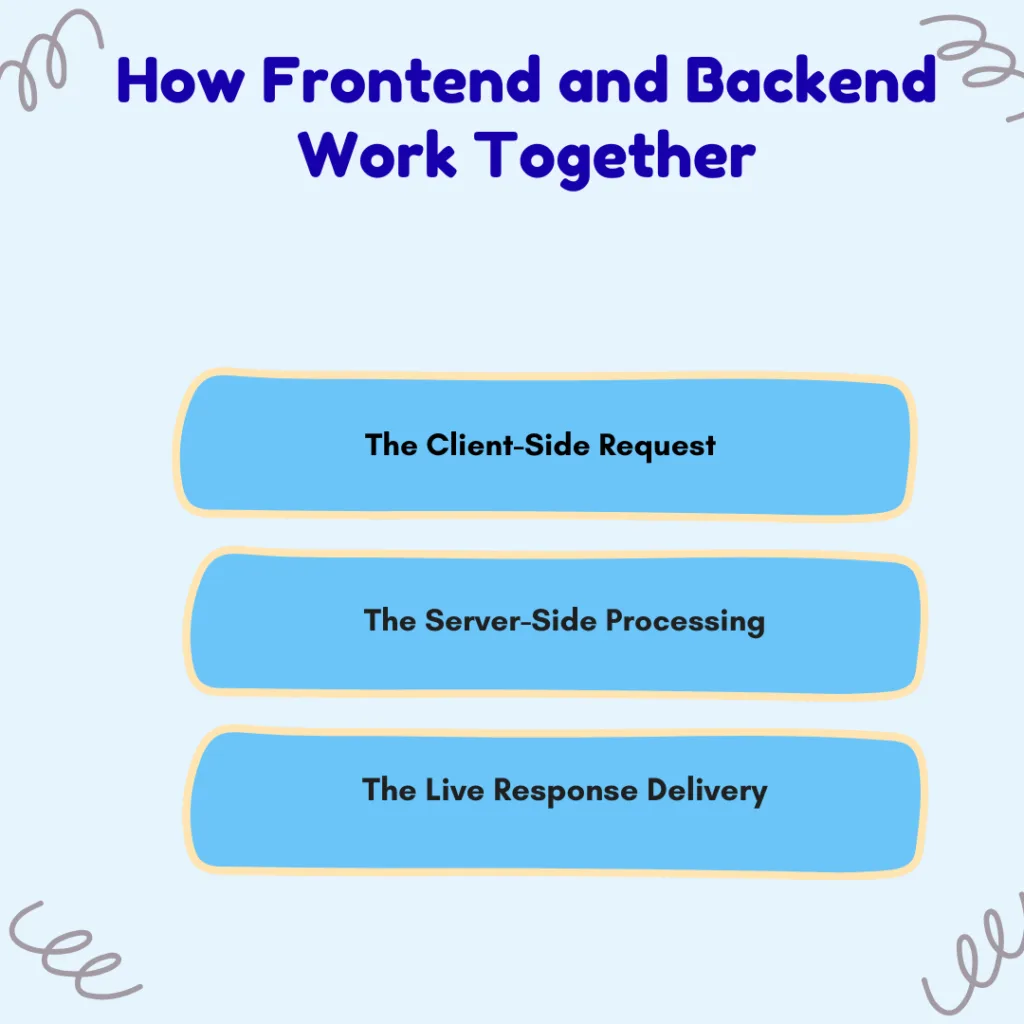
To build a seamless user experience, the client-side (frontend) and the server-side (backend) must work in continuous, synchronized harmony.
Here is exactly how they communicate in real time, using a food delivery application as an example:
1. The Client-Side Request (Frontend)
The user opens the app, browses through restaurants, and taps “Place Order.” The frontend captures this user interaction and instantly packages the data—such as the user’s ID, the restaurant choice, and the items selected—into a structured secure request (usually via an API call).
2. The Server-Side Processing (Backend)
The backend server receives the incoming request, validates the user’s payment session, and processes the transaction. Once approved, the backend executes the core business logic: it writes the new transaction to the database, updates the order history, and triggers a real-time notification to the restaurant’s tablet or terminal to start preparing the meal.
3. The Live Response Delivery (Frontend)
Once the backend successfully commits these updates to the database, it sends a successful status response code back to the application. The frontend receives this response and instantly translates the raw data into visual UI elements—displaying a “Confirmation” screen and rendering a live map so the user can track their delivery driver in real time.
Without the backend, the order wouldn’t reach the restaurant, and users wouldn’t get real-time updates.
Backend Development Overview
| Core Category | Key Technologies / Concepts | Primary Responsibility | Analogy / Real-World Example |
| Servers | Node.js, Apache, Nginx, AWS, Linux | Processes incoming requests, runs application logic, and serves responses. | The engine room of a ship, converting fuel into movement behind the scenes. |
| Databases | PostgreSQL, MySQL, MongoDB, Redis | Securely organizes, stores, updates, and retrieves application data. | A highly organized digital filing cabinet for all user accounts and logs. |
| APIs | REST, GraphQL, WebSockets | Standardizes communication so separate software applications can exchange data. | A waiter taking your order to the kitchen and bringing back your food. |
| Security | JWT, OAuth 2.0, SSL/TLS, Bcrypt | Encrypts traffic, checks user permissions, and blocks malicious cyber threats. | A secure bank vault with automated identity verification at the entrance. |
| Deployment | AWS, Vercel, Docker, Kubernetes | Hosts the codebase in a stable, live cloud environment capable of scaling. | Moving a physical storefront into a premium, infinitely expandable skyscraper. |
Why Backend Development is Vital for Digital Success
While a captivating frontend design attracts users, it is the backend architecture that keeps them there. Without a powerful backend, a website is just an empty shell. Investing in robust backend engineering is critical for four foundational reasons:
- Executes Core Business Logic: The backend acts as the brain of your application. It ensures complex workflows—such as checkout algorithms, mathematical calculations, and automated data processing—happen flawlessly and predictably behind the scenes.
- Enables Seamless Data Management: Modern applications generate massive amounts of information. The backend organizes, optimizes, and serves this data instantly, allowing users to retrieve past orders, personal settings, and transaction histories in milliseconds.
- Enables Enterprise-Grade Scalability: As your business grows, your traffic multiplies. A well-architected backend utilizes cloud infrastructure, load balancing, and efficient caching to ensure your application scales smoothly to handle millions of concurrent users without crashing.
- Safeguards Data & Enhances Security: The backend is your primary security firewall. By implementing end-to-end data encryption, secure token authentication, and strict access controls, it protects sensitive customer data from malicious cyber threats and data breaches.
Roadmap: How to Get Started with Backend Development
If you are looking to build or expand your technical stack, mastering backend development requires a structured approach. Focus on these four sequential pillars:
1. Master a Core Programming Language
Begin by selecting a versatile language that aligns with your development goals. JavaScript (via Node.js) is highly recommended if you want to use a single language across the entire stack. Alternatively, Python is excellent for its readable syntax and its deep integration with modern AI and data workflows.
2. Understand Database Management
Data is the lifeblood of backend engineering. Learn how to store and query data by working with both major database models:
- Relational (SQL): Start with PostgreSQL to learn structured data tables and relationships.
- Non-Relational (NoSQL): Explore MongoDB to understand flexible, document-based data storing.
3. Build and Document Functional APIs
Learn how to connect the dots by building server-side applications that handle API requests. Practice creating standard CRUD (Create, Read, Update, Delete) routes using minimalist frameworks like Express.js (for Node.js) or Flask/FastAPI (for Python).
4. Deploy and Scale Your Projects
A backend application isn’t complete until it lives in the cloud. Transition from running code on your local computer to deploying live applications using scalable hosting environments. Start with developer-friendly platforms like Vercel or Render, then gradually progress to enterprise cloud giants like AWS (Amazon Web Services) or Google Cloud Platform.

Final Thoughts: The Backbone of the Digital World
Backend development is the unsung hero of the digital age. While frontend design captures the user’s attention, it is the backend architecture that earns their trust by delivering speed, stability, and flawless security. Every seamless transaction, instant search result, and secure login is a direct result of a well-engineered server-side foundation.
If you enjoy breaking down complex problems, building scalable logic, and orchestrating how things work behind the scenes, backend development is an incredibly rewarding and future-proof career path. The digital landscape will only continue to grow more complex—and backend engineers will always be the ones driving it forward.
You may also like:
1) 5 Common Mistakes in Backend Optimization
2) 7 Tips for Boosting Your API Performance
3) How to Identify Bottlenecks in Your Backend
4) 8 Tools for Developing Scalable Backend Solutions
5) 5 Key Components of a Scalable Backend System
6) 6 Common Mistakes in Backend Architecture Design
7) 7 Essential Tips for Scalable Backend Architecture
8) Token-Based Authentication: Choosing Between JWT and Paseto for Modern Applications
9) API Rate Limiting and Abuse Prevention Strategies in Node.js for High-Traffic APIs
10) Can You Answer This Senior-Level JavaScript Promise Interview Question?
11) 5 Reasons JWT May Not Be the Best Choice
12) 7 Productivity Hacks I Stole From a Principal Software Engineer
13) 7 Common Mistakes in package.json Configuration
Read more blogs from Here
Share your experiences in the comments, and let’s discuss how to tackle them!
Follow me on Linkedin
Frequently Asked Questions (FAQs)
1. What is the difference between frontend and backend development?
Frontend development focuses on the client-side of an application—everything users see, click, and interact with visually on their screens. Backend development focuses on the server-side—the hidden data storage, security firewalls, and server logic that power the frontend and process user data.
2. Can I learn backend development without knowing frontend?
Yes, you can specialize purely in backend development. While having a basic understanding of how the frontend requests data (like HTML and basic JavaScript) is incredibly helpful, your day-to-day focus will be on server configurations, databases, database management, and building APIs.
3. Which backend language is best for beginners?
Python and JavaScript (Node.js) are widely considered the best entry points for beginners. Python is favored for its incredibly readable, human-like syntax, while JavaScript allows you to use a single programming language to write both frontend and backend code.
4. What is an API, and why is it crucial in backend web development?
An API (Application Programming Interface) is a bridge that allows different software systems to talk to one another. In backend development, APIs are crucial because they serve as the delivery system that safely fetches data from your database and securely delivers it to the user’s frontend interface.
