


Large Language Models (LLMs) have transformed the artificial intelligence landscape, delivering unprecedented capabilities in natural language understanding, code generation, and complex problem-solving. However, these massive architectures—often boasting billions of parameters—come with significant operational hurdles. Deploying them in real-world production environments is notoriously slow, demanding immense computational power, specialized hardware accelerators, and high memory bandwidth, which ultimately translates to staggering financial costs and high inference latency.
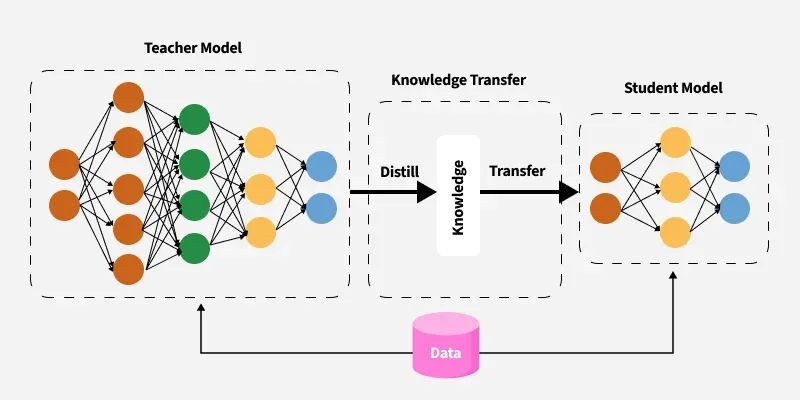
To bridge this critical gap between capability and feasibility, LLM distillation has emerged as an essential technique in modern machine learning engineering. Distillation functions as a knowledge-transfer process where a compact, resource-efficient “student” model is trained to mimic the behavior, outputs, and internal representations of a massive, highly accurate “teacher” model. By distilling a large model down to a fraction of its original size, developers can dramatically reduce memory footprints, accelerate inference speeds, and cut hosting expenses without drastically sacrificing performance. This makes advanced AI capabilities practical and cost-effective for everyday applications, edge devices, and high-throughput enterprise systems.
1. Focus on Task-Specific Knowledge Retention
Not all knowledge in an LLM is equally useful for your application. If you’re distilling an LLM for code generation, for example, you don’t need to retain its general knowledge about history or cooking.
- Tip: Use task-specific datasets for distillation. Fine-tune the teacher model before distillation to emphasize important patterns. This targeted approach ensures your student model is lean and smart rather than bloated with unnecessary information.
2. Leverage Multi-Stage Distillation
Instead of trying to shrink an LLM in one big step, consider using a multi-stage approach. This means gradually distilling the model in phases, fine-tuning at each stage to maintain quality.
- Why? A drastic reduction in model size often leads to performance collapse. A gradual, step-by-step distillation process prevents catastrophic loss of knowledge. Think of it like weight loss—losing weight slowly with a healthy diet and exercise is better than crash dieting.
3. Use Intermediate Layer Matching
Most naive distillation techniques focus on just the model’s final outputs. However, LLMs store a lot of useful knowledge in intermediate layers. By aligning these layers between the teacher and student models, you retain more depth of understanding.
- How to do it? Use hidden-state loss functions to align feature representations in different layers, and match activations of early, middle, and later layers for a balanced transfer of knowledge. This technique leads to a student model that thinks more like the teacher rather than just mimicking its answers.
4. Optimize Loss Functions for Distillation
Standard cross-entropy loss is not enough for LLM distillation. A better approach is to use a combination of loss functions that encourage knowledge retention.
Read more blog : Which Techniques Are Best for AI Model Customization?
- Recommended loss functions:
- KL Divergence Loss: Ensures soft probabilities from the teacher are transferred well.
- MSE Loss (Mean Squared Error): Helps align the hidden state representations.
- Perplexity-based Loss: Helps the student model achieve a similar level of confidence in its predictions.
5. Take Advantage of Knowledge Transfer Techniques
Sometimes, instead of pure distillation, it’s useful to apply additional techniques that help in knowledge transfer.
- Some methods include:
- Self-distillation: A model learns from its own predictions, refining itself over time.
- Contrastive learning: Helps the student model learn nuanced differences between similar responses.
- Feature-based transfer: Extracts useful features from the teacher model instead of just output logits.
6. Train with a Mixture of Hard and Soft Labels
When distilling an LLM, you can use hard labels (actual correct answers) alongside soft labels (probabilistic outputs from the teacher model). While hard labels help in traditional supervised learning, soft labels capture richer relationships between outputs and help the student understand degrees of correctness.
7. Evaluate with Real-World Benchmarks
After distilling your model, don’t just rely on accuracy scores—test it in real-world scenarios. Use human evaluations alongside automated metrics, check for hallucinations, and measure performance on domain-specific benchmarks and inference speed.
At-a-Glance: Summary of Distillation Techniques
| Strategy | Core Focus | Key Benefit |
| 1. Task-Specific Retention | Curated datasets & targeted fine-tuning | Eliminates bloated, irrelevant knowledge |
| 2. Multi-Stage Distillation | Gradual, phased compression | Prevents catastrophic performance collapse |
| 3. Intermediate Layer Matching | Hidden-state & activation alignment | Deepens the student model’s reasoning process |
| 4. Optimized Loss Functions | KL Divergence, MSE, & Perplexity | Captures rich probabilistic nuances |
| 5. Advanced Transfer Methods | Self-distillation & contrastive learning | Enhances the overall learning process |
| 6. Hard & Soft Labels | Combining exact answers with probabilities | Teaches degrees of correctness |
| 7. Real-World Benchmarking | Domain metrics, latency, & human review | Ensures production-readiness |

Final Thoughts
Effective LLM distillation is a fine balance between reducing size and retaining intelligence. By carefully choosing task-specific data, optimizing loss functions, and evaluating real-world performance, you can create a highly efficient, practical LLM that delivers strong results without the heavy computational cost.
You may also like:
1) 5 Common Mistakes in Backend Optimization
2) 7 Tips for Boosting Your API Performance
3) How to Identify Bottlenecks in Your Backend
4) 8 Tools for Developing Scalable Backend Solutions
5) 5 Key Components of a Scalable Backend System
6) 6 Common Mistakes in Backend Architecture Design
7) 7 Essential Tips for Scalable Backend Architecture
8) Token-Based Authentication: Choosing Between JWT and Paseto for Modern Applications
9) API Rate Limiting and Abuse Prevention Strategies in Node.js for High-Traffic APIs
10) Can You Answer This Senior-Level JavaScript Promise Interview Question?
11) 5 Reasons JWT May Not Be the Best Choice
12) 7 Productivity Hacks I Stole From a Principal Software Engineer
13) 7 Common Mistakes in package.json Configuration
Read more blogs from Here
Share your experiences in the comments, and let’s discuss how to tackle them!
Follow me on Linkedin
Frequently Ask Question
What is the main goal of LLM distillation?
The primary goal is to compress a massive, resource-heavy teacher model into a smaller, faster student model while retaining as much of the original model’s accuracy and performance as possible for production use.
Why can’t I just use standard cross-entropy loss?
: Standard cross-entropy only trains the model on binary right/wrong (hard) labels. Distillation benefits greatly from “soft labels” (probabilities generated by the teacher) and intermediate layer matching, which convey richer context about how the teacher arrived at an answer.
How do I choose between multi-stage distillation and single-step compression?
If you are drastically reducing the model size (e.g., shrinking a 70B parameter model down to 7B), a multi-stage approach is strongly recommended to prevent performance collapse. For smaller compression gaps, a single stage may suffice.
What is the difference between hard labels and soft labels?
Hard labels are the traditional, exact correct answers (e.g., 0 or 1, or the exact right token). Soft labels are the probabilistic outputs from the teacher model (e.g., showing confidence scores across multiple options), which teach the student model about degrees of correctness and relationships between concepts.
How can I prevent the student model from hallucinating after distillation?
To minimize hallucinations, combine domain-specific datasets during training, use intermediate layer matching to retain the teacher’s reasoning depth, and rigorously evaluate the model using real-world benchmarks alongside human reviews rather than relying solely on automated accuracy scores.
