



In today’s fast-paced software development world, the need for scalable and resilient applications has never been greater. Microservices architecture has emerged as a popular solution for building highly scalable systems that can evolve and adapt to business requirements.
Understanding Microservices Architecture
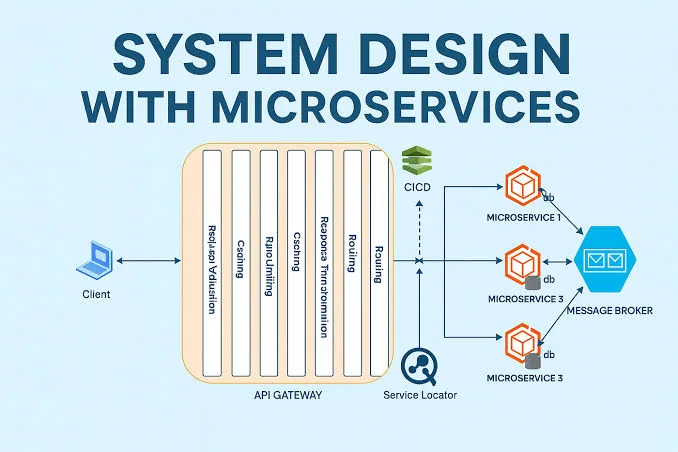
Microservices are an architectural style where an application is composed of loosely coupled, independently deployable services. Each service is a self-contained unit that performs a specific business function and communicates with other services through APIs.
Microservices bring benefits such as improved scalability, faster deployments, and fault isolation. Unlike monolithic architectures, where a single failure can affect the entire system, microservices provide a more resilient structure.
Key Components of Microservices Architecture
- Service Registry and Discovery: To scale microservices effectively, a dynamic service registry (like Consul or Eureka) is critical for maintaining information about each service instance and enabling them to discover each other.
- API Gateway: This is an entry point for managing communication, handling routing, and providing scalability. It also deals with cross-cutting concerns such as rate limiting, security, and logging.
- Load Balancer: Distributing requests among multiple service instances helps scale microservices horizontally. Tools like AWS Elastic Load Balancer or NGINX help balance traffic loads efficiently.
- Containerization: Docker and Kubernetes provide the foundation for deploying and managing microservices independently, which is crucial for scalability. Containers also make scaling faster as services can be replicated seamlessly.
Microservices Architecture: Pattern & Tooling Matrix
| Architecture Domain | Core Pattern / Strategy | Recommended Industry Tools | Scalability & Resilience Benefit |
| Infrastructure & Deployment | Containerization & Orchestration | Docker, Kubernetes | Enables independent service replication and automated horizontal auto-scaling based on resource usage. |
| Traffic & Routing Management | Edge Gateway & Distribution | AWS ELB, NGINX | Centralizes rate limiting, security, and routes incoming traffic efficiently across multiple service instances. |
| Service Discovery | Dynamic Service Registry | Consul, Eureka | Automatically tracks active service instances, allowing fluid, decoupled communication as instances scale up or down. |
| Inter-Service Communication | Asynchronous / Event-Driven Messaging | Apache Kafka, RabbitMQ | Decouples services so they can process tasks at their own pace without waiting for synchronous API responses. |
| Data Architecture | Polyglot Persistence & Partitioning | Database-per-Service, CQRS, Sharding | Eliminates database contention and single points of failure by tailoring the database type to the specific service workload. |
| System Resilience | Fault Isolation | Circuit Breaker Pattern | Prevents a single failing service from triggering cascading failures across the entire ecosystem. |
| Observability & Health | Centralized Telemetry & Tracing | ELK Stack, Prometheus, Jaeger, Grafana | Identifies distributed performance bottlenecks and latency spikes across multiple network hops. |
Breaking Down Monoliths into Microservices
When transforming a monolith to a microservices architecture, consider the following:
- Identify Bounded Contexts: Divide the application by focusing on different bounded contexts within the domain. Each microservice should represent a specific business capability.
- Database Partitioning: Microservices should have their own dedicated databases to maintain isolation. Techniques like Database per Service and CQRS (Command Query Responsibility Segregation) can help manage data dependencies and improve scalability.
- Define Clear API Contracts: Each microservice must have a well-defined API. REST or GraphQL can be used for communication between services, providing flexibility in scaling individual services.
Asynchronous Communication for Maximum Scalability
- Message Brokers: Using asynchronous messaging is vital for scalability, particularly when there is a high volume of inter-service communication. Apache Kafka or RabbitMQ are excellent tools for decoupling services and ensuring that each can scale independently without waiting for synchronous responses.
- Event-Driven Architecture: Event-driven microservices can independently react to changes, reducing the load on synchronous APIs and improving overall system scalability.
Scalability Patterns in Microservices
- Auto-scaling with Containers: Utilize orchestration platforms like Kubernetes to automatically scale your services based on CPU or memory usage.
- Circuit Breaker Pattern: This is essential for scaling as it prevents cascading failures by stopping the flow to failing services, allowing other services to handle more requests without being overwhelmed.
- Database Sharding: For services with high data requirements, sharding the database ensures that each shard handles a subset of data, making read and write operations faster, which is crucial for scalability.
Monitoring and Observability
Scalability demands continuous monitoring. Without proper visibility into each microservice’s performance, it’s challenging to identify bottlenecks:
- Centralized Logging: Use ELK Stack (Elasticsearch, Logstash, and Kibana) or Splunk to aggregate and analyze logs across all microservices.
- Distributed Tracing: Tools like Jaeger or Zipkin provide tracing capabilities that help track the flow of requests across microservices, identifying latency issues.
- Metrics and Alerts: Collect metrics for each service using tools like Prometheus and set up alerts via Grafana to take proactive actions before a failure impacts scalability.
Best Practices for Achieving Maximum Scalability
- Decentralized Data Management: Allow each microservice to own and manage its data, avoiding single points of failure and data contention issues.
- Polyglot Persistence: Select databases that fit the purpose of each microservice. For instance, use a NoSQL database for services handling large unstructured data and a relational database for services needing transactional consistency.
- Immutable Infrastructure: Use Infrastructure as Code (IaC) tools like Terraform to ensure that scaling environments are identical and repeatable, minimizing downtime during scaling operations.
Security Considerations for Scalable Microservices
As microservices scale, ensuring security across the distributed system becomes increasingly important:
- Authentication and Authorization: Implement centralized authentication using OAuth 2.0 with a solution like Keycloak. Each microservice should handle authorization independently, scaling securely.
- Service-to-Service Security: Enable mTLS (Mutual TLS) or use service mesh technologies like Istio to enforce security between services while maintaining scalability.
Real-World Example of Scaling Microservices
Consider Netflix, which successfully scaled its system by adopting microservices to handle over 200 million active users. Netflix uses Kubernetes for auto-scaling, Apache Kafka for messaging, and Spring Cloud for managing service discovery and configurations—each component optimized for scalability.
Challenges and Solutions
- Network Latency: Increased network hops can introduce latency. Solutions like Edge Computing or content delivery networks (CDNs) can help minimize the impact of latency on scalability.
- Data Consistency: Managing consistency is challenging with distributed microservices. Implement sagas or two-phase commits to ensure data consistency without compromising scalability.

Conclusion
Implementing microservices for maximum scalability requires a combination of smart architecture decisions, robust infrastructure tools, and best practices tailored to your application’s needs. From efficient load balancing to database partitioning and automated container orchestration, scalability lies in optimizing every ecosystem element.
Suggested Further Reading
- Scaling Databases for High Traffic Applications
- Optimizing Service-to-Service Communication in Microservices
Frequently Ask Question:
1. What is the main reason microservices are more resilient than monolithic architectures?
In a traditional monolithic architecture, all business functions run within a single process; if one component experiences a critical error or crashes, the entire application goes down. Microservices prevent this by utilizing fault isolation. Because each service is a self-contained, loosely coupled unit running independently, a failure in one service (like the recommendation engine) won’t take down other critical services (like user authentication or payment processing).
2. Why is asynchronous communication preferred over synchronous communication for scaling?
Synchronous communication (like traditional REST APIs) requires a service to wait for a direct, real-time response from another service before completing its task. This creates dependencies and can slow down the entire system if one service lags. Asynchronous communication uses message brokers like Apache Kafka or RabbitMQ to decouple services. A service can simply emit an event or message and move on to the next request, allowing each microservice to scale and process data at its own optimal pace.
3. How do you handle data consistency when every microservice has its own database?
Maintaining data consistency across distributed databases is one of the biggest challenges in a microservices setup. The blog highlights using strategies like Sagas or Two-Phase Commits (2PC). For example, a Saga breaks down a business transaction into a series of local transactions across individual services. If one step fails, the Saga executes “compensating transactions” to undo the changes made by the previous steps, ensuring data consistency without hurting overall scalability.
4. What role does a Circuit Breaker pattern play in a scalable system?
When a microservice becomes overwhelmed or fails, continuing to flood it with traffic will only worsen the issue and cause a pile-up of delayed requests that can bring down neighboring services. The Circuit Breaker pattern monitors for these failures. When a failure threshold is crossed, the circuit “trips,” immediately blocking traffic to the broken service and returning a fallback response. This stops cascading failures in their tracks and gives the struggling service room to recover.
5. How do tools like Jaeger or Zipkin help solve the “Network Latency” challenge?
Because microservices communicate over a network, tracking down where a delay is happening can be incredibly difficult as requests hop from service to service. Tools like Jaeger or Zipkin provide Distributed Tracing. They assign a unique ID to an incoming user request and track it visually as it moves through every single microservice. This allows development teams to see exactly which network hop or database query is causing latency, making it easy to eliminate bottlenecks.
