


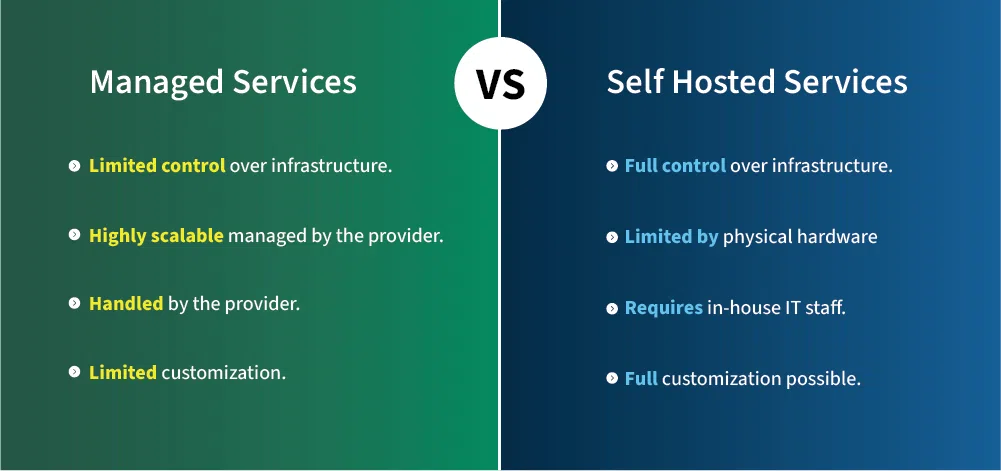
Managed database hosting vs self-hosting is an important comparison for businesses, startups, and developers deciding how to store and manage application data. Both approaches offer different advantages in terms of cost, performance, security, flexibility, and maintenance.
Managed database hosting allows businesses to use database infrastructure maintained by a hosting provider. Self-hosting, on the other hand, gives organizations direct control over their database servers, configurations, and administration.
Choosing between these options depends on your technical expertise, available budget, application requirements, and long-term business goals. While managed services simplify database administration, self-hosting provides greater control over infrastructure and customization.
In this guide, we compare managed database hosting and self-hosting to help you understand their differences and determine which option is better for your requirements.
Table of Contents
What Is Managed Database Hosting?
Managed database hosting is a service in which a hosting provider handles much of the infrastructure and administrative work required to operate a database.
Instead of maintaining physical or virtual database servers independently, businesses use a provider’s managed infrastructure. Depending on the service, the provider may handle software updates, automated backups, monitoring, security patches, and database maintenance.
Popular examples include Amazon RDS, Google Cloud SQL, DigitalOcean Managed Databases, and Azure SQL Database.
Key Features of Managed Database Hosting:
- Automated database backups and recovery options.
- Routine software updates and maintenance.
- Monitoring and performance management tools.
- High-availability and replication options.
- Flexible storage and computing resources.
- Infrastructure management handled by the provider.
Managed services are particularly useful for businesses that want reliable database infrastructure without hiring dedicated database administrators.
What Is Self-Hosting?

Self-hosting means installing and managing database software on infrastructure that you control. This can include a physical server, virtual private server (VPS), dedicated server, or private cloud environment.
Unlike managed database services, self-hosting requires users to handle most database administration responsibilities themselves.
For example, a developer can install MySQL or PostgreSQL on a VPS and configure the database according to specific application requirements.
Key Features of Self-Hosting:
- Complete control over database configurations.
- Freedom to choose server hardware and software.
- Custom security and networking configurations.
- Flexible database architecture.
- Direct control over maintenance schedules.
- Greater responsibility for backups and recovery.
Self-hosting is suitable for organizations with experienced technical teams that need more control over their database infrastructure.
Managed Database Hosting vs Self-Hosting: Key Differences
Both approaches can support websites, applications, and enterprise workloads. However, their operational requirements are different.
Here is a comparison of their major differences.
| Factor | Managed Database Hosting | Self-Hosting |
|---|---|---|
| Setup | Usually simpler | Requires manual configuration |
| Maintenance | Mostly provider-managed | User-managed |
| Backups | Often automated | Must be configured |
| Security | Provider tools plus user configuration | Mostly user-managed |
| Scalability | Often simplified | Requires manual planning |
| Customization | Limited by service options | Greater flexibility |
| Technical skills | Lower administration requirements | Advanced technical skills |
| Cost structure | Service and resource-based pricing | Infrastructure and administration costs |
1. Cost and Pricing
Cost is one of the most important factors when comparing these hosting approaches.
Managed database hosting typically involves monthly subscription charges or usage-based billing. The provider includes infrastructure and certain management services in the price.
Self-hosting may appear cheaper initially because affordable VPS plans can provide sufficient resources for smaller applications. However, the total cost also includes server maintenance, backup storage, monitoring tools, security management, and technical support.
For example, a small business may spend less on a basic self-hosted VPS than on a managed database service. However, if it needs to hire an administrator to maintain the server, the overall cost can increase significantly.
Winner: Self-hosting may be cheaper for technically experienced users with simple workloads. Managed hosting can offer better overall value when administration costs are considered.
2. Security and Data Protection

Security is essential for applications that store customer details, financial records, and business information.
Managed database hosting providers typically offer encryption, access controls, network security, automated updates, and monitoring tools. However, customers are still responsible for configuring permissions, credentials, and application-level security correctly.
With self-hosting, organizations have greater control over security configurations. They can implement custom firewalls, access policies, network restrictions, and monitoring systems.
However, this flexibility also creates additional responsibilities. Missing security patches or incorrectly configured databases can expose sensitive information.
Winner: Managed hosting is often easier to secure for teams without dedicated database security expertise. Self-hosting is suitable for organizations with experienced security administrators and specific infrastructure requirements.
3. Performance and Scalability
Database performance depends on several factors, including processing power, memory, storage speed, database configuration, and application queries.
Managed providers offer infrastructure options designed to support different workloads. Many also provide read replicas, automated scaling options, and high-availability configurations.
Self-hosting allows administrators to optimize server configurations, select specific hardware, and control database resources directly. This can be useful for specialized workloads that require customized performance tuning.
However, scaling a self-hosted database may require manual server upgrades, replication configuration, or infrastructure migration.
Winner: Managed hosting is generally more convenient for businesses expecting changing workloads. Self-hosting offers more customization for teams with advanced infrastructure knowledge.
4. Maintenance and Technical Support
Database maintenance includes software updates, security patches, performance monitoring, backups, and troubleshooting.
With managed database hosting, providers handle many routine maintenance tasks. This allows development teams to focus on application features and business operations.
Self-hosting requires administrators to manage database software, monitor server health, configure backups, and troubleshoot infrastructure problems.
Businesses without dedicated technical staff may find these responsibilities difficult to manage consistently.
Winner: Managed hosting is better for teams that want to reduce administrative work. Self-hosting is more suitable for organizations with dedicated system administrators.
5. Flexibility and Customization
Self-hosting provides greater control over database configurations, operating systems, networking, software versions, and server-level settings.
This flexibility is useful when applications require specialized database extensions, custom configurations, or infrastructure restrictions.
Managed services offer convenience but may limit access to certain system-level settings. Users must work within the provider’s supported database engines, configurations, and service features.
Winner: Self-hosting is better for advanced customization, while managed hosting is more convenient for standard database requirements.
When Should You Choose Managed Database Hosting?

Managed database hosting is a practical choice for businesses that want to minimize infrastructure administration.
Consider managed hosting if:
- You operate a startup or small business without dedicated database administrators.
- Your application requires automated backups and recovery options.
- You want to reduce server maintenance responsibilities.
- Your database workload may increase over time.
- You prefer provider-managed infrastructure and monitoring.
Platforms such as AWS RDS, Google Cloud SQL, DigitalOcean, and Azure SQL Database offer managed solutions for different business requirements.
When Should You Choose Self-Hosting?
Self-hosting can be a better option when you have the technical expertise and resources to manage database infrastructure independently.
Consider self-hosting if:
- You need complete control over database configurations.
- Your application requires specialized software or extensions.
- You have experienced system administrators.
- You want to manage server resources directly.
- You have specific networking, compliance, or infrastructure requirements.
VPS and dedicated server providers can provide the infrastructure needed to host databases such as MySQL, PostgreSQL, and MariaDB.
Managed Database Hosting vs Self-Hosting: Final Verdict
There is no universal winner because both approaches serve different requirements.
Managed database hosting is generally better for startups, small businesses, and development teams that want to reduce maintenance responsibilities. It offers convenient backups, monitoring, infrastructure management, and scaling options.
Self-hosting is more suitable for technically experienced organizations that need greater control over their infrastructure and database configurations.
When evaluating managed database hosting, consider the value of automated administration, support, and reliability rather than comparing subscription prices alone.
Similarly, self-hosted database solutions should be evaluated based on server costs, maintenance requirements, security responsibilities, and the availability of technical expertise.
For most small businesses and growing applications, managed database hosting is a convenient starting point. Organizations with specialized requirements and experienced technical teams may benefit more from self-hosting.
Frequently Asked Questions (FAQs)
1. Is managed database hosting better than self-hosting?
Managed database hosting is generally better for businesses that want simplified maintenance, automated backups, and less infrastructure administration. Self-hosting is better for organizations requiring greater customization and direct control.
2. Is self-hosting a database cheaper?
Self-hosting can be cheaper when the database workload is small and the organization already has the technical expertise to manage it. However, server maintenance, backups, monitoring, and administration can increase the total cost.
3. Which database is best for self-hosting?
MySQL, PostgreSQL, and MariaDB are popular choices for self-hosted database environments. The best option depends on application requirements, database structure, and technical expertise.
4. Can I migrate from self-hosting to managed database hosting?
Yes. Most managed database providers support migration from existing database environments. Depending on the database engine and application architecture, migration may involve exporting data, importing it into the new platform, configuring connections, and testing application functionality.
Conclusion
Managed database hosting and self-hosting both provide effective ways to operate databases, but they differ significantly in administration, flexibility, security responsibilities, and overall costs.
Managed services simplify database operations and reduce maintenance work, making them suitable for businesses that want convenience and scalability. Self-hosting offers greater control and customization but requires more technical knowledge.
Evaluate your budget, application requirements, infrastructure needs, and available technical resources before making a decision. The right approach is the one that delivers reliable database performance without creating unnecessary operational complexity.
