


Video has become one of the most effective formats for attracting attention, educating audiences, and driving conversions. Yet creating videos consistently can require significant time, creative resources, editing skills, and coordination. AI agents are changing this process by helping marketers plan, create, edit, distribute, and repurpose video content through connected automated workflows.
Modern Digital Marketing Workflows increasingly combine artificial intelligence with automated research, scripting, editing, publishing, and analytics. Instead of treating every video as a separate production project, businesses can build systems that turn one piece of source content into multiple marketing assets. This approach makes it easier to Automate Content Marketing at Scale while maintaining consistency across channels.
What Are AI Agents for Video Marketing?
AI agents are software systems that can perform multi-step tasks based on goals, instructions, data, and predefined workflows. In video marketing, an agent can identify content opportunities, develop a script, generate visual assets, create captions, edit footage, produce different formats, and prepare content for distribution.
Unlike basic automation, which usually follows a fixed trigger-and-action sequence, AI agents can make decisions within a workflow. For example, an agent could analyze a long webinar, identify the most valuable sections, create several short clips, generate different hooks for each audience, and prepare platform-specific captions.
This makes AI particularly useful for AI video marketing, where speed and personalization are becoming increasingly important.
Why Video Marketing Is Moving Toward Automation
Traditional video production often involves multiple stages:
- Topic research
- Content planning
- Scriptwriting
- Recording or asset creation
- Editing
- Captioning
- Thumbnail creation
- Distribution
- Performance analysis
- Repurposing
Each stage can create bottlenecks. AI-powered systems can connect these activities into a repeatable workflow.
For example, video automation tools can automatically transform a webinar into educational clips, social posts, video summaries, email content, and blog sections. This reduces repetitive manual work and gives marketing teams more time to focus on strategy and creative direction.
How AI Agents Automate Video Content Creation
A sophisticated video marketing agent can operate across the entire content lifecycle.
1. Content Research and Topic Discovery
The process can begin with research. AI can analyze search behavior, customer questions, competitor content, social conversations, and historical campaign data to identify promising topics.
This is where Consumer Trends Earlier can become valuable. Rather than waiting for a trend to become mainstream, marketers can use AI-powered research systems to detect emerging interests and create relevant content earlier.
2. Automated Script Development
Once a topic is selected, an AI agent can create a script based on the target audience, funnel stage, platform, and desired outcome.
For example:
- A YouTube video may use a detailed educational structure.
- An Instagram Reel may require a strong hook within the first few seconds.
- A LinkedIn video may emphasize professional insights.
- A product video may focus on objections and benefits.
This enables AI-powered storytelling that can be adapted to different audiences without starting from scratch.
3. AI-Assisted Video Production
After scripting, AI can assist with voiceovers, visual selection, captions, scene suggestions, transitions, background music, and other production elements.
Video editing AI can accelerate tasks such as removing pauses, generating subtitles, identifying important moments, resizing footage, and preparing multiple versions of the same video.
4. Creating Short-Form Content
Long-form videos contain numerous opportunities for short-form content. Short-form video AI can identify compelling moments and turn them into clips for platforms such as Instagram, TikTok, YouTube Shorts, and LinkedIn.
This turns one recording into a content library rather than a single asset.
Content Repurposing AI: Turning One Video Into Many Assets
One of the biggest advantages of content repurposing AI is its ability to multiply the value of existing content.
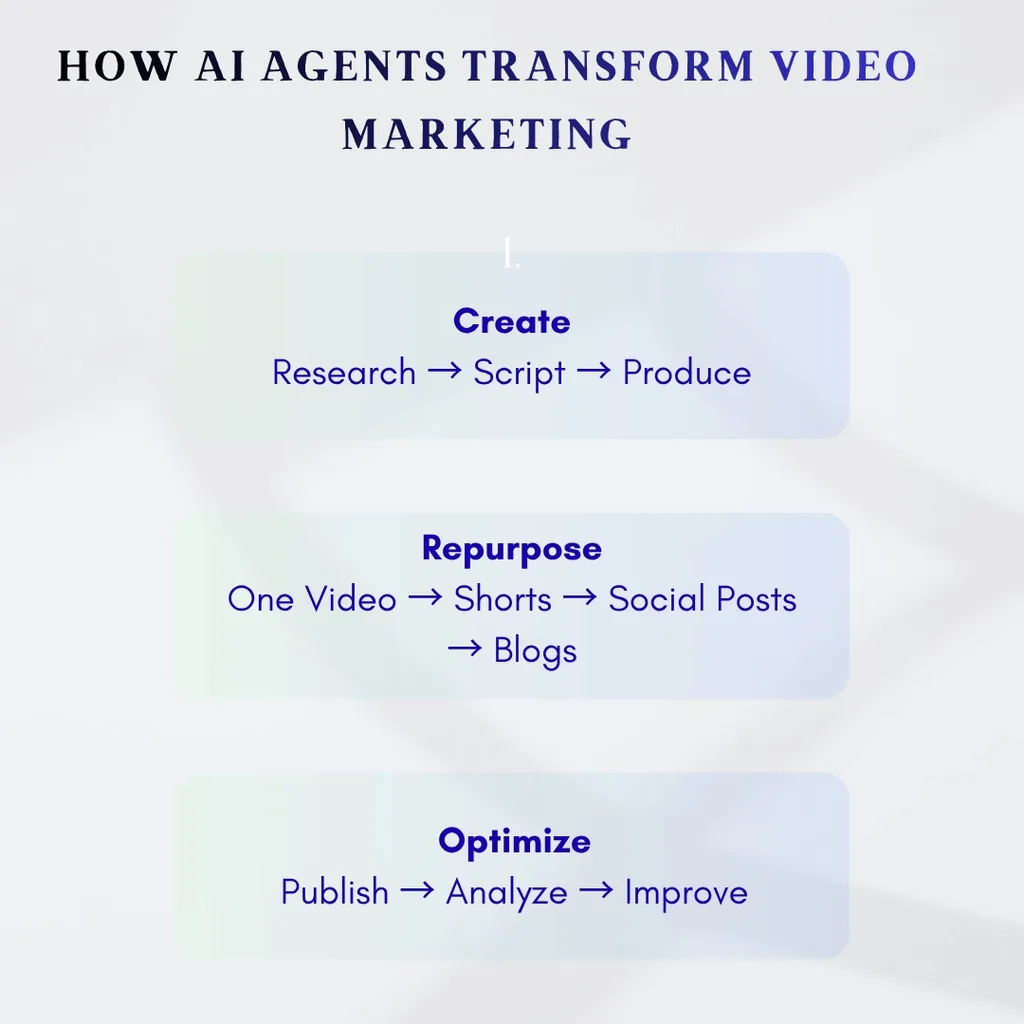
Imagine a company publishes a 45-minute webinar. An AI agent could transform that webinar into:
| Original Asset | Repurposed Output | Primary Channel |
| 45-minute webinar | 8–12 short clips | YouTube Shorts, Instagram |
| Webinar transcript | Blog article | Website |
| Expert insights | LinkedIn posts | |
| Key questions | FAQ content | Website |
| Major statistics | Social graphics | Social media |
| Customer pain points | Email content | Email marketing |
Instead of producing six independent campaigns, the marketing team creates one core asset and lets AI extend its reach.
This is the foundation of modern content scaling systems.
YouTube Automation and Long-Form Content
YouTube automation does not necessarily mean removing humans from the creative process. Instead, it can mean automating repetitive activities around research, scripting, editing, optimization, publishing, and repurposing.
An AI agent can support a YouTube workflow by:
- Researching potential topics
- Analyzing audience questions
- Creating video outlines
- Developing multiple titles
- Drafting descriptions
- Generating chapters
- Creating captions
- Identifying clips for Shorts
- Preparing social posts
- Reviewing campaign analytics
Human marketers can then review the content, add brand expertise, and approve publication.
Social Video Automation Across Multiple Platforms
Different platforms reward different formats. A single horizontal video may not perform equally well everywhere.
Social video automation allows marketers to create platform-specific versions from a common source.
| Platform | Recommended Adaptation | AI Automation Opportunity |
| YouTube | Long-form educational video | Script, chapters, captions |
| YouTube Shorts | Vertical short clip | Highlight detection |
| Reels and Stories | Resizing, captions, hooks | |
| Expert-led short video | Professional copy generation | |
| TikTok | Fast-paced short video | Clip selection and formatting |
The goal is not simply to publish the same video everywhere. The goal is to adapt the central idea to the expectations of each platform.
Building Automated Marketing Video Workflows
The most effective systems connect video production with broader marketing operations.
Marketing video workflows can be designed around the customer journey. For example:
Awareness → Education → Consideration → Conversion → Retention
At the awareness stage, AI may produce short educational videos. During consideration, it can create product explainers, comparisons, and demonstrations. At the conversion stage, AI can help develop testimonials, case studies, and objection-handling videos.
This approach connects video production with Conversion Rate Optimization, because content is created around specific customer actions rather than views alone.
AI Agents and Marketing Automation
The next stage of marketing automation is moving beyond individual tools toward interconnected AI agents.
An automated workflow might look like:
Trend Detection → Topic Selection → Script → Video Creation → Editing → Repurposing → Distribution → Analytics → Optimization
This differs from Traditional Automation, where marketers often have to manually move information between disconnected applications.
AI agents can coordinate several steps and use performance data to influence future content decisions.
Supporting Influencer Marketing Campaigns
AI video systems can also support Influencer Marketing Campaigns by helping marketing teams manage large quantities of creator-generated content.
For example, an AI agent can organize influencer videos, identify strong clips, generate variations for paid campaigns, create captions, and categorize content according to product, audience, or campaign objective.
This can make influencer content easier to reuse throughout the marketing funnel.
Lead Nurturing With Automated Video
Video can play an important role in Lead Nurturing. Prospects often need multiple interactions before becoming customers.
AI can help marketers create sequences such as:
- Introductory educational video
- Problem-awareness video
- Product demonstration
- Customer case study
- FAQ video
- Objection-handling video
- Conversion-focused video
These assets can be connected to email campaigns, landing pages, CRM workflows, and advertising campaigns.
The result is a more personalized content experience without requiring marketers to manually create every variation.
B2B Marketing Strategies and AI Video
For organizations using B2B Marketing Strategies, video can simplify complex products and services.
AI agents can turn technical information into:
- Product explainers
- Executive thought leadership
- Customer testimonials
- Case studies
- Sales enablement videos
- Webinar clips
- Frequently asked question videos
This can help sales and marketing teams use the same core content across different stages of the buying process.
Brand Monitoring and Video Content
AI can also support Brand Monitoring by analyzing mentions, comments, audience reactions, and recurring questions.
For example, if customers repeatedly ask about a particular product feature, an AI agent can identify that pattern and recommend a video explaining the feature.
This creates a feedback loop:
Audience Feedback → Content Opportunity → Video Creation → Distribution → Performance Data → New Content Opportunity
Instead of relying exclusively on an editorial calendar, businesses can allow customer conversations to influence content production.
Measuring Campaign Performance
Automated video marketing should not focus exclusively on views. Campaign Performance needs to be evaluated against meaningful business outcomes.
| Metric | What It Shows | Possible Optimization |
| View-through rate | How much of the video people watch | Improve opening and pacing |
| Engagement rate | Audience interaction | Strengthen relevance and CTA |
| Click-through rate | Traffic generated | Improve CTA and messaging |
| Conversion rate | Business action | Align video with landing page |
| Cost per lead | Acquisition efficiency | Optimize targeting and creative |
| Revenue influenced | Commercial impact | Connect video to CRM data |
AI can analyze these signals and identify patterns that humans might overlook.
Customer Journey Optimization Through Video
Customer Journey Optimization becomes more powerful when video content is mapped to specific customer needs.
For example, someone discovering a brand may need educational content, while a returning visitor may need proof, product comparisons, or a demonstration.
An AI agent can help classify content according to the funnel stage and recommend which asset should appear at each stage.
| Customer Stage | Content Objective | Example Video |
| Awareness | Build attention | Industry trend video |
| Interest | Educate | How-to video |
| Consideration | Build trust | Product comparison |
| Decision | Remove objections | Customer testimonial |
| Retention | Increase value | Product tutorial |
This makes automated video a strategic component of the customer experience rather than simply a production shortcut.
Four Ways Businesses Can Scale With AI Video Agents
1. Create Once, Repurpose Everywhere
Start with high-quality long-form content and systematically transform it into smaller assets.
2. Build Reusable Content Templates
Create templates for different video categories, such as tutorials, product announcements, testimonials, and educational clips.
3. Connect Video With Marketing Data
Integrate content performance with CRM, analytics, email, and campaign platforms where possible.
4. Keep Humans in the Approval Loop
Automation should accelerate production without removing brand oversight. Human review remains important for accuracy, brand voice, sensitive claims, and strategic decisions.
AI Video Marketing vs. Manual Production
| Factor | Manual Workflow | AI-Agent Workflow |
| Research | Mostly manual | AI-assisted |
| Scripting | Human-led | AI-assisted and templated |
| Editing | Time-intensive | Automated assistance |
| Repurposing | Often manual | Multi-format automation |
| Distribution | Channel-by-channel | Workflow-based |
| Optimization | Periodic | Continuous data analysis |
| Scaling | Requires more resources | More scalable |
The biggest advantage is not that AI eliminates marketing teams. It allows teams to spend more time on high-value strategic and creative work.
The Future of Automated Video Marketing
The future of video marketing is likely to involve increasingly intelligent systems that understand content, audiences, platforms, and campaign objectives simultaneously.
Instead of asking a marketer to manually produce every asset, businesses will increasingly use AI agents to coordinate complete content operations. A single source asset could become a complete campaign spanning YouTube, social media, email, blogs, sales enablement, and paid advertising.
The strongest organizations will not necessarily be those that generate the most videos. They will be the ones that build efficient systems for creating the right video, for the right audience, at the right stage of the customer journey.
AI video marketing therefore represents more than a production trend. It is becoming a new operating model for scalable content creation.
Frequently Asked Questions
1. What are AI agents in video marketing?
AI agents are software systems that can perform and coordinate multiple video marketing tasks, including research, scripting, editing, repurposing, publishing, and performance analysis.
2. How does AI help with content repurposing?
AI can analyze long-form videos, identify important moments, generate short clips, create captions, summarize discussions, and adapt content for different platforms.
3. Can AI completely automate video marketing?
AI can automate many repetitive activities, but human oversight remains valuable for strategy, brand voice, factual accuracy, creative direction, and final approval.
4. How can businesses use AI video automation to generate leads?
Businesses can connect educational videos, product demonstrations, testimonials, and other assets to landing pages, email sequences, advertising campaigns, and CRM workflows to support lead generation and nurturing.
5. Is AI video marketing useful for small businesses?
Yes. Small teams can use AI to reduce repetitive production work, repurpose existing content, maintain a consistent publishing schedule, and create multiple content formats without building a large production team.
