


In Natural Language Processing (NLP), Named Entity Recognition (NER) stands as a fundamental technique with remarkable potential. It’s the key that unlocks the treasure trove of information concealed within textual data. From extracting entities like names of people, organizations, locations, dates, and more, NER revolutionizes how we comprehend, analyze, and interact with language.
Understanding Named Entity Recognition
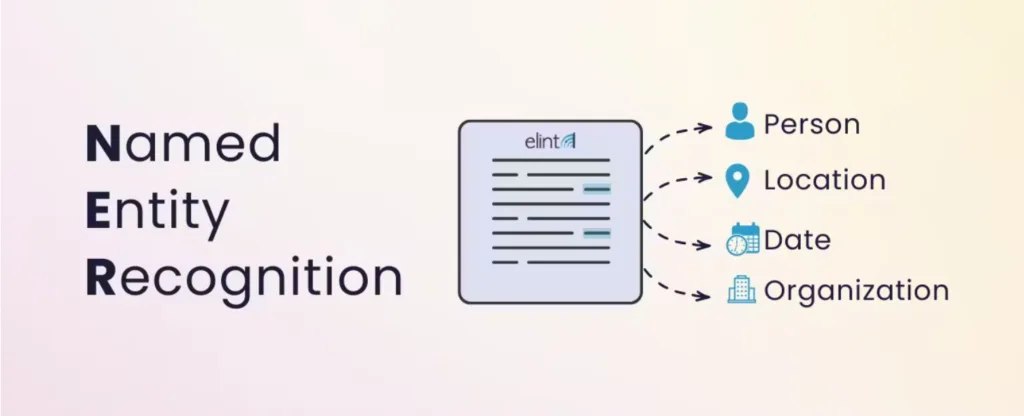
Named Entity Recognition, in its essence, is the process of identifying and categorizing named entities within a body of text. These named entities could range from proper nouns like names of people, organizations, and locations to temporal expressions like dates and times. By recognizing these entities, NER helps machines grasp the semantics of text, facilitating various downstream NLP tasks like information retrieval, question answering, sentiment analysis, and more.
The Anatomy of Named Entity Recognition
NER typically involves a sequence labeling task where each word or token in a sentence is tagged with its corresponding entity label. This is often approached as a machine learning problem, with techniques ranging from rule-based systems to sophisticated deep learning architectures like Recurrent Neural Networks (RNNs), Long Short-Term Memory networks (LSTMs), and Transformers.
Code
import spacy

# Load the English language model
nlp = spacy.load("en_core_web_sm")

# Sample text
text = "Apple is headquartered in Cupertino, California. Steve Jobs founded Apple Inc. in 1976."

# Process the text with spaCy
doc = nlp(text)

# Extract named entities
for ent in doc.ents:
    print(ent.text, "-", ent.label_)
This code does the following:
- Imports the spaCy library.
- Loads the English language model
"en_core_web_sm". - Defines a sample text.
- Processes the text using spaCy, which tokenizes, tags parts of speech, and performs NER.
- Iterates over the named entities (
doc.ents) and prints each entity along with its label.
Applications of Named Entity Recognition
The applications of NER are diverse and far-reaching:
- Information Extraction: NER aids in extracting structured information from unstructured text, facilitating tasks like resume parsing, document summarization, and knowledge graph construction.
- Entity Linking: By disambiguating named entities and linking them to a knowledge base like Wikipedia, NER enables machines to comprehend the context and significance of these entities.
- Question Answering: NER plays a pivotal role in identifying relevant entities within a question and locating corresponding answers within a corpus of text.
- Sentiment Analysis: Recognizing named entities in sentiment analysis helps in understanding the sentiment towards specific entities mentioned in the text, providing deeper insights into public opinion and brand sentiment.
- Language Translation: NER assists in preserving the integrity of named entities during machine translation, ensuring accurate and contextually relevant translations.
NER Architecture Comparison
| Feature | Rule-Based NER | Deep Learning (Bi-LSTM/CRF) | Transformer (BERT/GPT) |
| Logic | “If word is capitalized…” | Learns patterns from sequences. | Uses context from the whole sentence. |
| Flexibility | Rigid; fails on new words. | High; generalizes well. | Extremely high; handles nuance. |
| Speed | Very Fast | Moderate | Slower (requires more compute). |
| Best Use Case | Highly specific, static lists. | General purpose tasks. | Complex, ambiguous text. |
Challenges and Advances in Named Entity Recognition
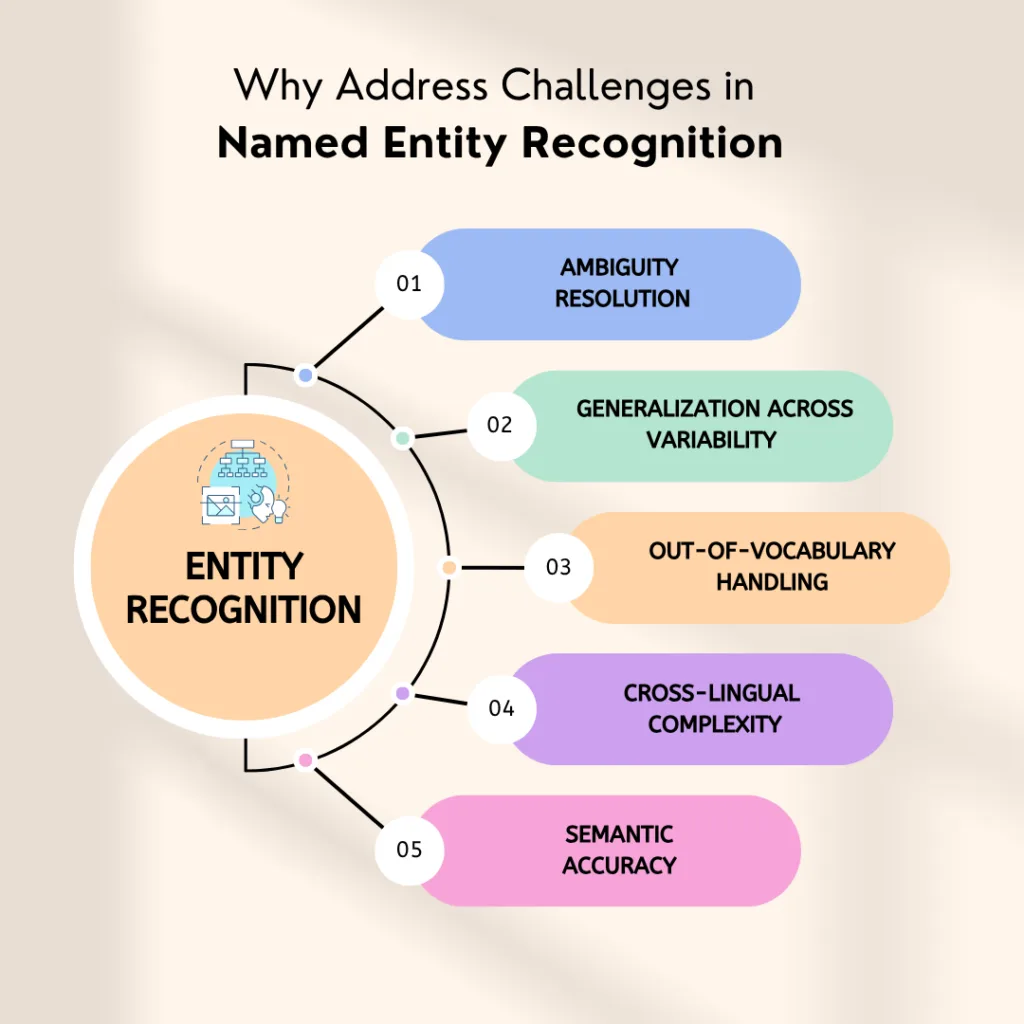
Despite its transformative potential, NER encounters several challenges:
- Ambiguity: Named entities may exhibit ambiguity, making it challenging to accurately categorize them. For instance, “Apple” could refer to the technology company or the fruit.
- Variability: Entities may vary in form and structure, posing difficulties in generalization across different domains and languages.
- Out-of-Vocabulary Entities: NER systems often struggle with recognizing entities not present in their training data, necessitating robust strategies for handling out-of-vocabulary entities.
- Cross-lingual NER: Extending NER to multiple languages presents additional complexities due to linguistic variations and differences in named entity conventions.
The Evolution & Impact of Named Entity Recognition (NER)
Modern NLP, catalyzed by deep learning, has transformed NER from a simple pattern-matching exercise into a sophisticated semantic engine. By leveraging contextual embeddings and pre-trained language models (like BERT or RoBERTa), NER systems now understand nuance, resolving ambiguities that previously baffled older models.
The “Superpower” of Contextual Understanding
NER acts as a cognitive filter for unstructured data. While a human might take minutes to scan a corporate filing, an NER-powered system instantly extracts and structures critical entities:
- Identities: Organizations, Founders, and Stakeholders.
- Geospatial Data: Headquarters and regional market locations.
- Temporal Data: Founding dates, fiscal quarters, and project deadlines.
Strategic Applications Across Industries
| Industry | NER Application | Value Proposition |
| HR & Recruitment | Automated Resume Parsing | Reduces manual screening time by 75%. |
| Market Intelligence | Brand Sentiment Analysis | Tracks public opinion toward specific products. |
| Legal & Finance | Contract Analysis | Rapidly identifies parties, jurisdictions, and dates. |
| Translation | Entity-Preserving MT | Ensures names and places remain accurate across languages. |
The Future of Intelligent Data Synthesis
The convergence of Deep Learning and Named Entity Recognition represents a fundamental shift in how we bridge the gap between raw information and actionable knowledge. As models transition from simple pattern recognition to deep contextual understanding, the ability to extract structure from the chaos of unstructured text becomes a critical competitive advantage. We are moving toward a future where machines do not just “process” language, but actively interpret the world through it—enabling more intuitive human-computer interaction, precise medical breakthroughs, and highly efficient global communication. As these technologies continue to evolve, the focus will shift toward making them more efficient and ethically sound, ensuring that our digital landscape remains as informed as it is interconnected.
Frequently Asked Questions
1. What is the difference between Tokenization and NER?
Tokenization is the first step in text processing where a sentence is broken down into smaller units like words or punctuation. NER is a secondary, high-level task that analyzes those tokens to see if they belong to a predefined category like “Person” or “Location.” Tokenization identifies the pieces, while NER identifies the meaning of those pieces.
2. What is “BIO” tagging in the context of NER?
Most NER models use the BIO format to handle multi-word entities (like “New York City”):
B (Beginning): The first word of an entity.
I (Inside): Subsequent words belonging to the same entity.
O (Outside): Words that are not part of any named entity. This allows the model to distinguish between two separate entities that appear next to each other.
3. Can NER be used for domain-specific tasks, like legal or medical text?
Absolutely. While standard models (like spaCy’s en_core_web_sm) are trained on general news, specialized models exist. For example, SciSpacy is used for biomedical text to identify “Chemicals” or “Proteins,” and legal NER models can identify “Case Citations” or “Statutes.”
4. How do Transformer models (like BERT) improve NER?
Traditional models often looked at words in isolation or in a fixed sequence. Transformers use self-attention to look at the entire sentence at once. This helps solve ambiguity—for example, the model can tell “Apple” is a company in the sentence “Apple released a new phone” by looking at the context word “phone.”
5. Why is NER critical for Chatbots and Virtual Assistants?
When you say “Book a flight to Paris for tomorrow,” the chatbot uses NER to extract the Destination (Paris) and the Date (tomorrow). Without NER, the bot would understand the intent to “book a flight” but wouldn’t know the specific parameters needed to execute the request.
