


Artificial intelligence is rapidly transforming financial technology, but the next major shift goes beyond chatbots and predictive analytics. AI agents are becoming intelligent digital workers capable of managing tasks, making decisions, and continuously improving financial operations. Instead of simply assisting teams, these agents can monitor transactions, analyze financial data, automate workflows, and collaborate across multiple business systems.
Today, companies are investing heavily in fintech AI infrastructure because speed, compliance, and customer expectations continue to rise. Modern AI Systems in Financial Services are enabling organizations to process massive datasets, improve customer experiences, and reduce operational costs. As Financial Risk Monitoring becomes more complex and Investment Banking Operations require faster insights, AI agents provide an intelligent layer that helps businesses operate efficiently while maintaining accuracy.
The rapid growth of autonomous finance platforms is also changing how fintech startups and established institutions build products. From AI-driven fintech systems to financial workflow automation, organizations are adopting intelligent solutions that work around the clock with minimal human intervention.
In this guide, we’ll explain why AI agents are becoming the foundation of modern fintech, their real-world applications, benefits, challenges, and how businesses can prepare for an AI-first financial future.
What Are AI Agents in Fintech?
AI agents are software systems that can perceive information, make decisions, execute tasks, and continuously improve based on outcomes. Unlike traditional automation tools that follow fixed rules, AI agents can analyze changing financial situations and adjust their actions accordingly.
These agents combine technologies such as:
- Machine Learning
- Large Language Models (LLMs)
- Predictive Analytics
- Natural Language Processing
- Intelligent Automation
- Cloud Computing
Together, they create AI-driven fintech systems capable of handling complex financial operations without constant human supervision.
Why Fintech Needs AI Agents
The fintech industry operates in an environment where milliseconds matter. Customer expectations, regulatory compliance, fraud detection, and personalized financial services all require continuous monitoring.
AI agents solve these challenges by acting as intelligent operational systems rather than simple software tools.
Key Reasons Include
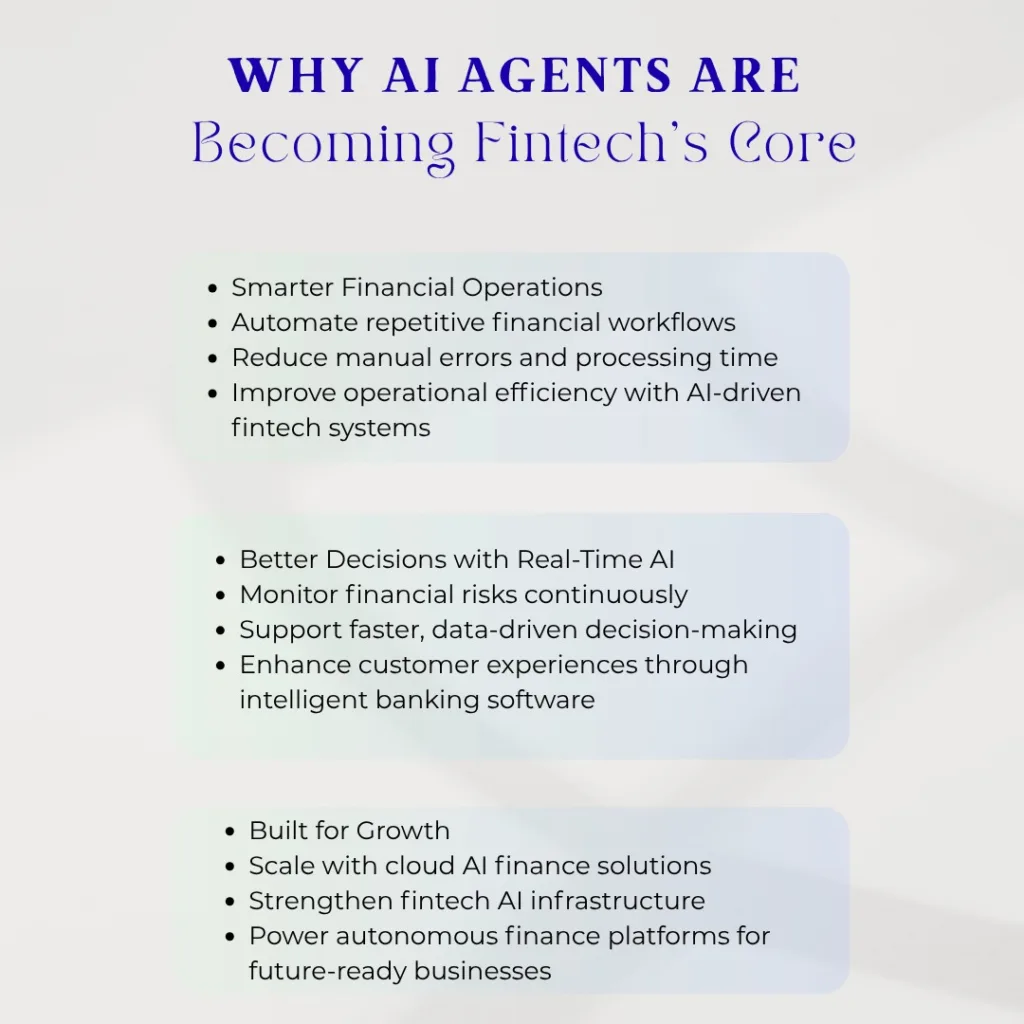
- Faster financial processing
- Continuous fraud detection
- Real-time compliance monitoring
- Better customer experiences
- Improved investment decisions
- Reduced operational costs
Organizations adopting fintech innovation AI are gaining a competitive advantage by automating repetitive tasks while allowing human experts to focus on strategic work.
Evolution from Automation to Autonomous Finance
| Traditional Automation | AI Agents |
| Rule-based workflows | Learns from data |
| Fixed decision paths | Dynamic decision-making |
| Requires manual updates | Continuously improves |
| Limited adaptability | Handles changing financial conditions |
| Performs repetitive tasks | Manages end-to-end financial processes |
The transition toward autonomous finance platforms represents one of the biggest technological shifts in financial services.
How AI Agents Become Core Infrastructure
Instead of being an optional feature, AI agents now sit at the center of fintech operations.
They connect with:
- Banking systems
- Payment gateways
- CRM platforms
- ERP software
- Fraud detection engines
- Compliance platforms
- Investment management tools
This creates a powerful fintech AI infrastructure capable of supporting every financial process.
Major Applications of AI Agents in Fintech
1. Financial Workflow Automation
Routine tasks consume thousands of employee hours every month.
AI agents automate:
- Invoice processing
- Expense verification
- Loan approvals
- Account reconciliation
- Customer onboarding
- Compliance documentation
Modern financial workflow automation improves efficiency while reducing human errors.
2. Intelligent Banking Software
Banks are replacing traditional software with intelligent banking software capable of making operational decisions.
Examples include:
- Smart customer support
- Loan eligibility analysis
- Personalized financial recommendations
- Automated fraud alerts
- Real-time transaction monitoring
3. Financial Research Workflows
Investment professionals spend significant time collecting market data.
AI agents accelerate Financial Research Workflows by:
- Summarizing reports
- Tracking market trends
- Comparing financial statements
- Identifying emerging opportunities
- Monitoring macroeconomic indicators
Analysts receive actionable insights in minutes rather than hours.
4. Private Equity Due Diligence
Private equity firms process thousands of financial documents during acquisitions.
AI agents assist with Private Equity Due Diligence by:
- Reviewing balance sheets
- Detecting financial anomalies
- Comparing historical performance
- Identifying operational risks
- Creating investment summaries
This significantly reduces due diligence timelines.
5. Financial Modeling for Analysts
Building financial models manually requires extensive effort.
AI agents simplify Financial Modeling for Analysts by automatically:
- Forecasting revenue
- Creating valuation models
- Running sensitivity analysis
- Updating assumptions
- Producing scenario comparisons
6. AI Agents in Wealth Management
Modern investment firms increasingly depend on AI Agents in Wealth Management for:
- Portfolio monitoring
- Risk analysis
- Client communication
- Tax optimization
- Investment recommendations
These intelligent systems help advisors serve more clients efficiently.
Benefits of AI Agents in Fintech
| Benefit | Business Impact |
| Faster Processing | Reduces transaction time |
| Better Accuracy | Minimizes operational errors |
| Cost Savings | Lowers staffing expenses |
| Improved Compliance | Supports regulatory requirements |
| Continuous Monitoring | Detects fraud in real time |
| Better Customer Service | Faster responses and personalization |
Organizations implementing digital finance automation consistently report higher operational efficiency.
Building Startup AI Infrastructure
For startups, AI agents provide enterprise-level capabilities without massive teams.
Essential components include:
| Infrastructure Component | Purpose |
| Cloud AI Platforms | Model deployment |
| APIs | Banking integrations |
| Data Pipelines | Financial data processing |
| Vector Databases | Context retrieval |
| Monitoring Systems | AI performance tracking |
| Security Layer | Compliance and privacy |
A well-designed startup AI infrastructure enables rapid product development while supporting long-term growth.
Cloud AI Finance Is Powering Modern Fintech
Cloud computing has made AI adoption significantly easier.
Benefits of cloud AI finance include:
- Elastic computing resources
- Lower infrastructure costs
- Faster deployment
- High availability
- Enhanced security
- Global scalability
Cloud-native AI agents can process millions of financial events daily.
Scalable AI Finance Systems
As fintech businesses grow, their AI infrastructure must scale alongside them.
Characteristics of scalable AI finance systems include:
- Distributed computing
- Real-time analytics
- Automated model updates
- Multi-region deployment
- API-first architecture
- Continuous monitoring
These systems support increasing transaction volumes without compromising performance.
AI Agents and Financial Decision-Making
One of the biggest advantages of AI agents is improving Financial Decision-Making.
They analyze:
- Customer behavior
- Credit history
- Market volatility
- Investment opportunities
- Cash flow trends
- Operational performance
Executives receive faster recommendations supported by real-time data rather than manual reports.
Challenges of AI Agent Adoption
Despite their advantages, organizations should address several challenges.
| Challenge | Solution |
| Data Privacy | Strong encryption and governance |
| Regulatory Compliance | Continuous compliance monitoring |
| AI Bias | High-quality training data |
| Integration Complexity | API-based architecture |
| Security Risks | Zero-trust security framework |
| Model Accuracy | Continuous evaluation and retraining |
Careful planning ensures AI delivers reliable outcomes while maintaining regulatory standards.
The Future of Fintech AI Infrastructure
Over the next decade, AI agents will become standard infrastructure across financial organizations.
Future developments include:
- Fully autonomous lending
- AI-managed investment portfolios
- Intelligent payment ecosystems
- Predictive compliance
- Hyper-personalized banking
- Autonomous accounting systems
- Self-optimizing financial operations
Companies investing early in fintech AI infrastructure will be better positioned to innovate, improve customer experiences, and respond to changing market conditions.
Best Practices for Implementing AI Agents
- Start with high-impact financial workflows.
- Build secure and compliant data pipelines.
- Integrate AI with existing banking systems.
- Monitor model performance continuously.
- Maintain human oversight for critical decisions.
- Use cloud-native architecture for scalability.
- Prioritize transparency and explainable AI.
Following these practices helps organizations maximize the value of AI-driven fintech systems while minimizing operational risks.

Conclusion
AI agents are no longer experimental technologies—they are becoming the backbone of modern financial technology. By combining autonomous finance platforms, financial workflow automation, intelligent banking software, cloud AI finance, and scalable AI finance systems, fintech companies can improve operational efficiency, enhance customer experiences, and strengthen compliance.
As fintech innovation AI continues to evolve, businesses that invest in robust startup AI infrastructure and intelligent automation today will be better prepared for tomorrow’s financial landscape. From Financial Research Workflows and Private Equity Due Diligence to AI Agents in Wealth Management and smarter Financial Decision-Making, AI agents are set to redefine how financial services are built, delivered, and scaled.
Frequently Asked Questions
1. What is fintech AI infrastructure?
Fintech AI infrastructure refers to the combination of AI technologies, cloud platforms, data systems, APIs, and automation tools that power intelligent financial applications and business operations.
2. How do AI agents improve financial workflow automation?
AI agents automate repetitive financial tasks such as invoice processing, compliance checks, customer onboarding, fraud detection, and reporting, reducing manual effort and improving accuracy.
3. Why are autonomous finance platforms important?
Autonomous finance platforms continuously analyze financial data, make informed decisions, and automate processes, helping organizations operate more efficiently while responding quickly to changing conditions.
4. Can startups benefit from AI-driven fintech systems?
Yes. Modern startup AI infrastructure enables startups to build intelligent financial products, automate operations, reduce costs, and scale efficiently without large operational teams.
5. What is the future of AI agents in fintech?
AI agents will increasingly support intelligent banking, automated compliance, investment analysis, wealth management, financial modeling, and enterprise-wide digital finance automation, making them a core component of future financial services.
