


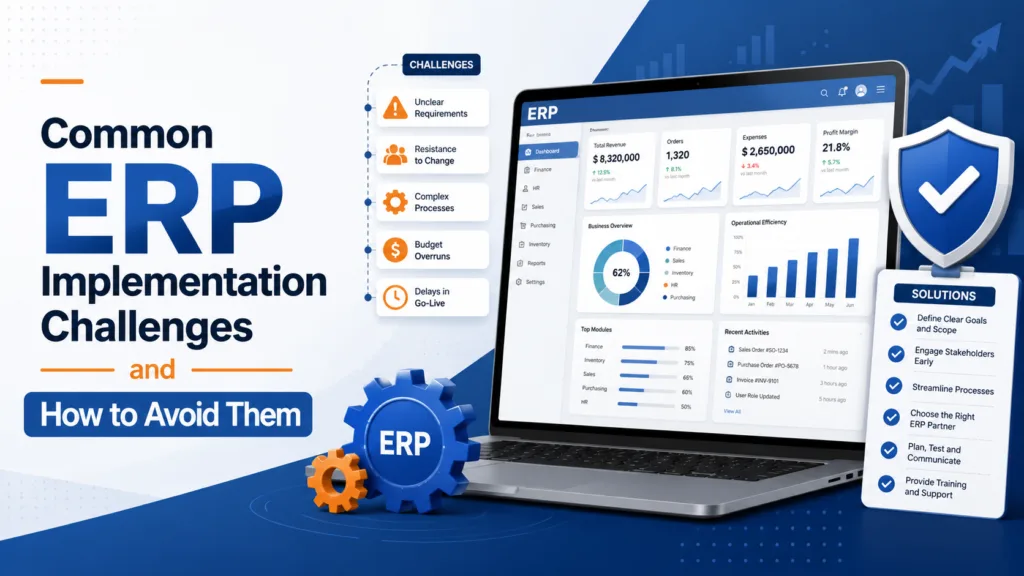
ERP implementation challenges can determine whether a business transformation project succeeds or becomes an expensive setback. In 2026, organizations are adopting enterprise resource planning (ERP) systems to automate workflows, improve reporting, centralize business data, and support growth. However, ERP projects often involve complex processes, data migration, employee training, system integration, and organizational change.
An ERP system can improve finance, inventory, procurement, manufacturing, human resources, and customer service. But without careful planning, businesses may experience delays, budget overruns, poor user adoption, and operational disruptions.
According to Microsoft, successful ERP implementation requires clearly defined business processes, executive support, governance, and structured project planning rather than simply installing software. This is why understanding ERP implementation challenges before starting a project is essential.
Table of Contents
Why ERP Implementations Are Challenging?
ERP systems affect multiple departments at the same time. Finance, purchasing, warehouse operations, manufacturing, sales, HR, and management often depend on the same database and workflows.
Unlike installing a simple application, ERP implementation changes how employees perform daily work. Existing processes may be redesigned, approvals automated, reports standardized, and legacy software replaced.
Because of this broad impact, businesses should view ERP implementation as a business transformation project rather than an IT project.
Understanding ERP Implementation Challenges
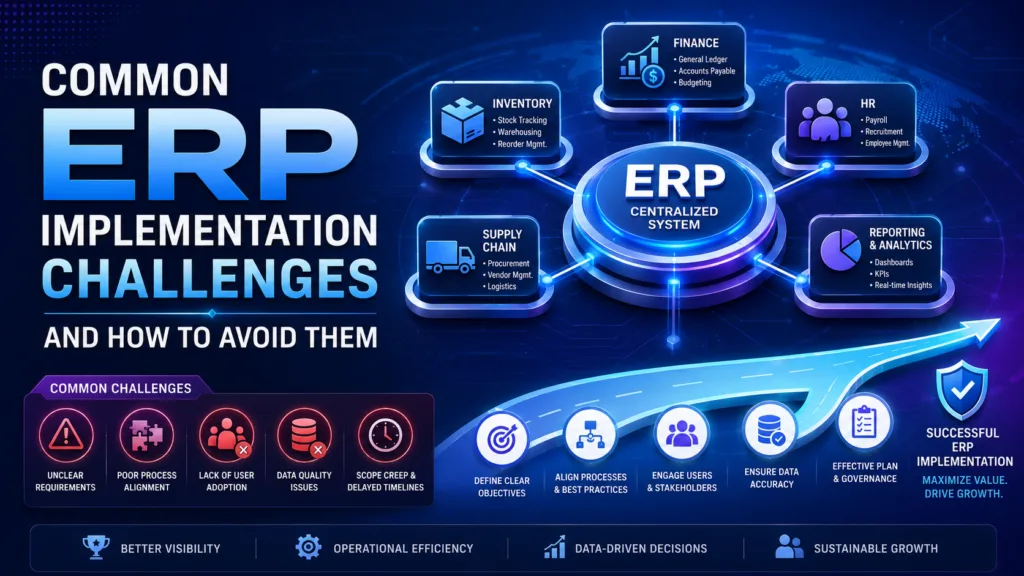
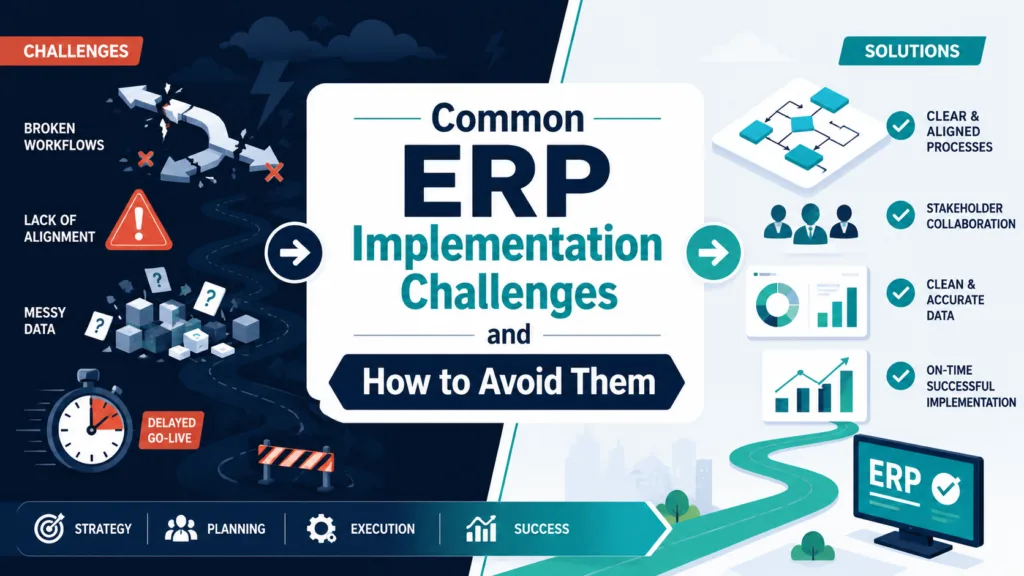
Every organization faces different obstacles, but most projects encounter similar risks. Knowing these common problems allows businesses to prepare practical solutions before implementation begins.
1. Unclear Business Requirements
One of the biggest reasons ERP projects struggle is unclear or incomplete requirements.
Some companies begin evaluating vendors before documenting their business processes. Others focus only on software features instead of identifying operational problems.
For example, a company may request advanced manufacturing features even though its main challenge is inaccurate inventory reporting.
To avoid this problem:
- Map existing workflows.
- Identify process bottlenecks.
- Define measurable business objectives.
- Separate essential requirements from optional features.
Microsoft recommends designing ERP solutions around business processes instead of software functions because process-focused planning reduces implementation risks.
2. Poor Project Planning
ERP implementation requires structured planning from beginning to end.
Without realistic timelines, responsibilities, milestones, and governance, projects often experience delays and confusion.
A successful implementation plan should include:
- Project scope
- Budget
- Timeline
- Resource allocation
- Risk management
- Communication plan
- Testing schedule
- Go-live strategy
Businesses should also create contingency plans for unexpected delays.
Strong ERP project management keeps departments aligned throughout implementation and reduces misunderstandings between business teams and technical consultants.
3. Inaccurate Data Migration
Many organizations underestimate the complexity of moving historical information into a new ERP platform.
Common problems include:
- Duplicate records
- Missing customer information
- Incorrect inventory balances
- Outdated supplier details
- Invalid product codes
- Inconsistent accounting data
Migrating poor-quality data simply transfers existing problems into the new system.
Before migration:
- Remove duplicate records.
- Standardize naming conventions.
- Archive obsolete information.
- Validate financial balances.
- Test migration repeatedly.
Oracle recommends cleansing and validating business data before migration to improve ERP quality and reduce implementation risk.
4. Weak Executive Support
ERP implementation requires leadership involvement throughout the project.
Without executive sponsorship, departments may follow conflicting priorities, delay important decisions, or resist organizational changes.
Senior management should:
- Approve project goals.
- Resolve cross-department issues.
- Monitor progress.
- Support employee adoption.
- Allocate sufficient resources.
Visible leadership encourages employees to treat the ERP project as an organizational priority instead of another temporary IT initiative.
5. Employee Resistance to Change
Employees often worry that a new ERP system will increase workload or replace familiar processes.
Resistance commonly occurs when users:
- Are not informed early.
- Receive limited training.
- Feel excluded from decisions.
- Do not understand project benefits.
Businesses should involve employees during process design, testing, and training.
Clear communication helps staff understand how the ERP system will simplify daily work rather than create additional complexity.
Employee adoption is one of the most important ERP implementation best practices because even excellent software delivers limited value if people refuse to use it correctly.
6. Excessive Customization
Modern ERP platforms include extensive standard functionality.
However, some businesses attempt to recreate every legacy process through customization.
Although customization can solve specific operational requirements, excessive modifications increase:
- Implementation time
- Development costs
- Upgrade complexity
- Testing requirements
- Maintenance expenses
SAP advises organizations adopting cloud ERP to evaluate whether older customized processes remain necessary or whether standard workflows can improve efficiency.
Whenever possible, businesses should adapt processes to supported ERP functionality rather than heavily modifying the software.
7. Integration Problems
ERP systems rarely operate independently.
They often exchange information with:
- CRM platforms
- Ecommerce websites
- Banking software
- Payroll systems
- Shipping providers
- Manufacturing equipment
- Business intelligence tools
Integration failures may create duplicate entries, delayed updates, and reporting errors.
Before implementation:
- Document every required integration.
- Define data ownership.
- Test information flows.
- Monitor synchronization performance.
Proper ERP project management includes integration testing long before the production launch.
8. Inadequate Employee Training
Training should begin before go-live—not after employees start using the system.
Different departments require different training programs.
For example:
Finance teams need accounting workflows.
Warehouse employees require inventory procedures.
Sales representatives need customer and order management.
Managers need dashboards and reporting.
Role-based training improves employee confidence and reduces operational errors.
Businesses should also provide written documentation, video tutorials, and post-launch support.
9. Unrealistic Budgets
ERP software licences represent only one portion of total project costs.
Additional expenses include:
- Consulting services
- Implementation partners
- Data migration
- Employee training
- Integrations
- Testing
- Infrastructure
- Support
- Future upgrades
Organizations should estimate total ownership costs rather than software pricing alone.
Unexpected customization and delayed timelines are common reasons budgets increase during implementation.
10. Insufficient Testing
Some businesses reduce testing because they want to meet aggressive launch deadlines.
This often creates operational problems after go-live.
Testing should include:
- Financial transactions
- Inventory updates
- Purchase orders
- Sales orders
- Manufacturing processes
- Reporting
- Security permissions
- Integrations
- User acceptance testing
Businesses should encourage employees to test realistic daily scenarios instead of only technical functions.
ERP Implementation Best Practices
Following proven implementation methods significantly improves project success.
Some important ERP implementation best practices include:
- Define measurable project objectives.
- Assign executive sponsors.
- Create realistic timelines.
- Clean business data before migration.
- Minimize unnecessary customization.
- Test every workflow thoroughly.
- Train users before launch.
- Monitor performance after go-live.
- Continue improving processes after implementation.
ERP implementation should not end on launch day. Continuous optimization helps businesses gain greater value from the system over time.
How AI Is Improving ERP Implementations in 2026?
Artificial intelligence is reducing several traditional ERP implementation challenges.
Modern ERP platforms increasingly offer:
- Automated invoice processing
- Predictive analytics
- Intelligent forecasting
- Data quality monitoring
- AI-generated reports
- Workflow recommendations
- Natural-language search
- Exception detection
Oracle and Microsoft continue expanding AI capabilities across cloud ERP platforms to automate repetitive work and improve decision-making.
However, AI cannot replace proper planning, employee training, governance, or business process design.
Organizations should treat AI as a productivity tool rather than a substitute for experienced project management.
Measuring ERP Success
Businesses should evaluate implementation success using measurable outcomes rather than opinions.
Useful performance indicators include:
- Faster financial closing
- Reduced inventory errors
- Improved order accuracy
- Shorter procurement cycles
- Lower manual data entry
- Increased employee productivity
- Better reporting speed
- Higher user adoption rates
Regular performance reviews allow organizations to identify additional improvements after implementation.
Conclusion
Understanding ERP implementation challenges before beginning a project significantly increases the chances of success.
Problems such as poor planning, inaccurate data migration, excessive customization, weak executive support, inadequate training, and integration failures can all be reduced through structured preparation and disciplined ERP project management.
Following established ERP implementation best practices allows businesses to reduce implementation risks, improve employee adoption, and achieve better long-term value from their ERP investment. In 2026, organizations that combine careful planning with modern cloud ERP technologies and AI-powered automation will be better positioned to improve operational efficiency and support future growth.
Frequently Asked Questions
1. What is the biggest ERP implementation challenge?
One of the biggest challenges is unclear business requirements. Without defined objectives and documented processes, businesses may choose unsuitable software or implement unnecessary features.
2. How long does ERP implementation usually take?
Implementation time depends on company size, number of modules, integrations, customization, and data quality. Small projects may take a few months, while large enterprise implementations can take considerably longer.
3. Why do ERP implementations fail?
Common reasons include poor planning, inaccurate data migration, insufficient employee training, weak executive support, unrealistic budgets, excessive customization, and inadequate testing.
4. How can businesses improve ERP implementation success?
Businesses should define clear objectives, involve leadership, clean data before migration, minimize customization, train employees, perform extensive testing, and continue optimizing the ERP system after launch.
