


Artificial Intelligence (AI), Machine Learning (ML), and Deep Learning (DL) are revolutionizing the modern world by transforming how businesses operate and how people interact with technology. Artificial Intelligence (AI) is no longer a futuristic concept—it has become an integral part of our everyday lives. From personalized recommendations on streaming platforms to self-driving cars and intelligent virtual assistants, AI is reshaping the way we live, work, and make decisions. At the heart of this revolution lie Machine Learning (ML) and Deep Learning (DL), two powerful branches of AI that enable computers to learn from data, recognize patterns, and make intelligent decisions with minimal human intervention.
As organizations across industries embrace data-driven solutions, understanding the fundamentals of Artificial Intelligence, Machine Learning, and Deep Learning has become increasingly important. These technologies are driving innovations in healthcare, finance, education, manufacturing, cybersecurity, and countless other sectors, solving complex problems that were once considered impossible. Whether you’re a student, professional, or technology enthusiast, learning the basics of AI, ML, and DL is the first step toward understanding the future of intelligent computing.
What is Artificial Intelligence (AI)?
Artificial Intelligence (AI) refers to the simulation of human intelligence by machines. AI systems are designed to perform tasks that typically require human intelligence, including:
- Learning from experience
- Problem-solving
- Decision-making
- Understanding natural language
- Recognizing images and speech
- Planning and reasoning
AI combines computer science, mathematics, cognitive science, and data analytics to create intelligent systems capable of automating complex processes.
Common Examples of Artificial Intelligence
- ChatGPT and AI chatbots
- Siri, Alexa, and Google Assistant
- Self-driving vehicles
- AI-powered recommendation engines
- Facial recognition systems
- Smart manufacturing
What is Machine Learning (ML)?
Machine Learning (ML) is a subset of Artificial Intelligence that enables computers to learn from data instead of relying on explicit programming.
Rather than following fixed instructions, ML algorithms identify patterns within datasets and continuously improve their predictions as more data becomes available.
Relationship Between AI, ML, and DL
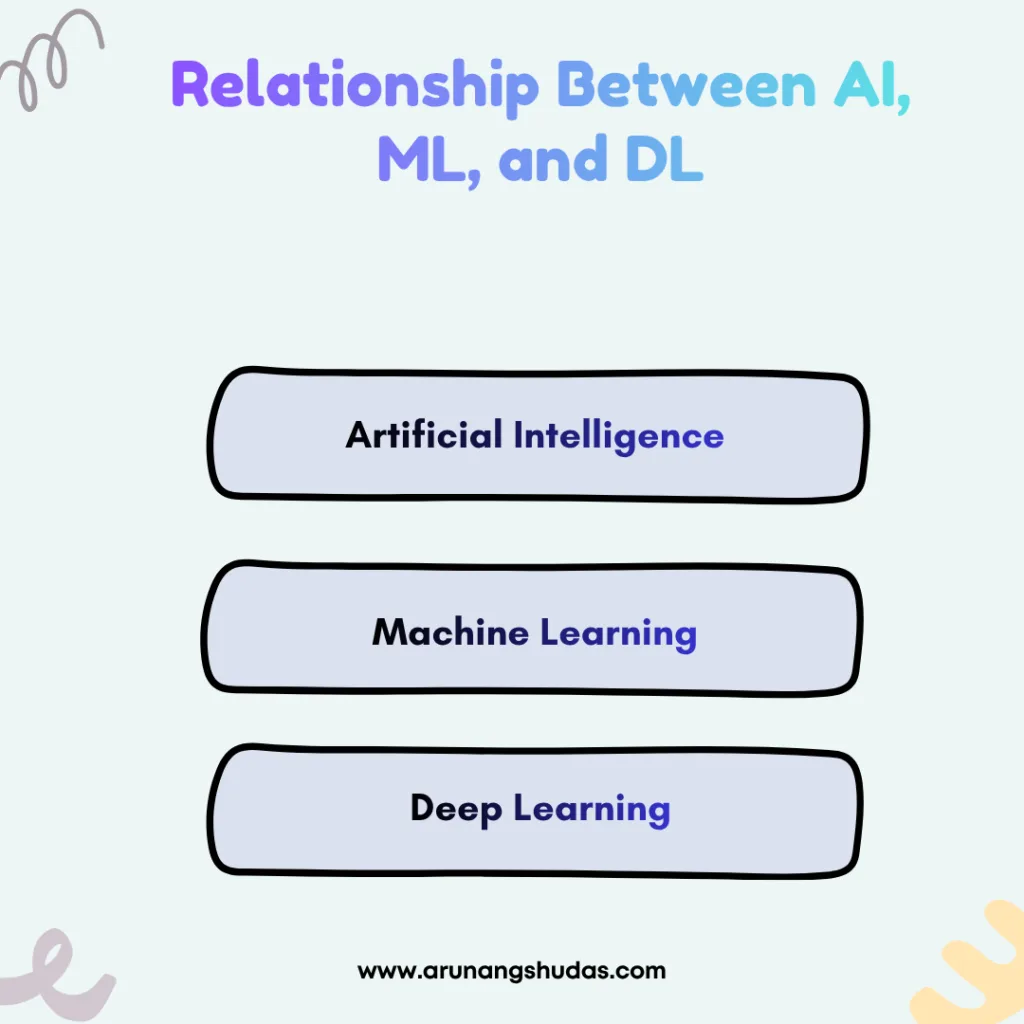
Think of these technologies as three concentric circles:
- Artificial Intelligence is the broad field.
- Machine Learning is a subset of AI.
- Deep Learning is a specialized subset of Machine Learning.
Every Deep Learning model is a Machine Learning model, but not every Machine Learning model uses Deep Learning.
This relationship enables organizati
AI vs ML vs DL: What’s the Difference?
| Feature | Artificial Intelligence (AI) | Machine Learning (ML) | Deep Learning (DL) |
|---|---|---|---|
| Definition | Simulation of human intelligence | AI that learns from data | ML using neural networks |
| Goal | Create intelligent machines | Learn patterns from data | Learn complex representations automatically |
| Human Intervention | High | Moderate | Low |
| Data Requirement | Medium | High | Very High |
| Training Time | Low to Medium | Medium | High |
| Accuracy | Good | Better | Excellent |
| Best For | Automation | Predictions | Image, speech & NLP |
Read More : AI vs Human Creativity Who Wins in the Long Run
Types of Machine Learning
1. Supervised Learning
Uses labeled datasets to predict outcomes.
Examples:
- Email spam detection
- House price prediction
- Customer churn prediction
2. Unsupervised Learning
Finds hidden patterns without labeled data.
Examples:
- Customer segmentation
- Recommendation systems
- Market basket analysis
3. Reinforcement Learning
Allows systems to learn through rewards and penalties.
Examples:
- Robotics
- Game AI
- Autonomous vehicles
What is Deep Learning (DL)?
Deep Learning is an advanced subset of Machine Learning that uses Artificial Neural Networks with multiple hidden layers to process massive datasets.
Unlike traditional ML models, Deep Learning automatically extracts important features without manual intervention, making it highly effective for solving complex problems.
Deep Learning powers today’s most advanced AI applications.
Popular Deep Learning Models
- Convolutional Neural Networks (CNN)
- Recurrent Neural Networks (RNN)
- Long Short-Term Memory (LSTM)
- Transformers
- Generative Adversarial Networks (GANs)
the right technology depending on business requirements, available data, and computational resources.
Real-World Applications of AI, ML, and DL
1. Natural Language Processing (NLP)
Natural Language Processing enables computers to understand, interpret, and generate human language.
Applications include:
- AI chatbots
- Language translation
- Sentiment analysis
- Text summarization
- Voice assistants
2. Computer Vision
Computer Vision allows machines to interpret visual information.
Common applications include:
- Facial recognition
- Medical imaging
- Quality inspection
- Autonomous vehicles
- Object detection
3. Healthcare
Healthcare has become one of the fastest-growing sectors adopting AI.
AI helps with:
- Disease diagnosis
- Medical image analysis
- Drug discovery
- Personalized treatment
- Patient monitoring
4. Finance
Financial institutions leverage AI for:
- Fraud detection
- Credit scoring
- Algorithmic trading
- Risk management
- Customer support automation
5. Retail & E-commerce
Retail companies use AI to improve customer experience through:
- Product recommendations
- Inventory forecasting
- Dynamic pricing
- Customer behavior analysis
- Personalized shopping
6. Manufacturing
Manufacturers implement AI to improve efficiency by using:
- Predictive maintenance
- Smart robotics
- Automated quality control
- Supply chain optimization
7. Cybersecurity
AI strengthens cybersecurity by:
- Detecting malware
- Preventing cyberattacks
- Monitoring network activity
- Identifying suspicious behavior
8. Environmental Sustainability
AI contributes to sustainability through:
- Climate prediction
- Wildlife conservation
- Smart energy management
- Water resource optimization
- Disaster forecasting
Read More : 8 Key Concepts in Neural Networks Explained
Benefits of Artificial Intelligence, Machine Learning, and Deep Learning
Organizations adopt AI because it offers numerous advantages:
- Improves operational efficiency
- Reduces manual work
- Enables data-driven decision-making
- Enhances customer experiences
- Detects fraud and security threats
- Automates repetitive processes
- Increases business productivity
- Supports innovation across industries
Challenges and Ethical Considerations
Despite their enormous potential, AI technologies present several challenges.
Algorithmic Bias
AI systems can inherit biases from training data, leading to unfair outcomes.
Data Privacy
Organizations must protect user data and comply with privacy regulations.
Job Displacement
Automation may replace repetitive tasks while creating demand for new digital skills.
Explainability
Many Deep Learning models function as “black boxes,” making decisions difficult to interpret.
Security Risks
AI systems can become targets for cyberattacks or misuse if not properly secured.
Responsible AI development requires collaboration among businesses, governments, researchers, and policymakers to ensure fairness, transparency, and accountability.
Future of Artificial Intelligence
The future of AI is expected to include:
- Generative AI
- Autonomous robots
- AI-powered healthcare
- Personalized education
- Smart cities
- Human-AI collaboration
- Sustainable AI solutions
As computing power and data availability continue to grow, AI will become even more integrated into our daily lives and business operations.
Artificial Intelligence, Machine Learning, and Deep Learning are transforming industries by enabling machines to learn, adapt, and make intelligent decisions. While AI provides the foundation, ML allows systems to improve through experience, and DL unlocks advanced capabilities through neural networks.
Understanding these technologies is essential for businesses, developers, students, and professionals looking to stay competitive in today’s digital world. As AI continues to evolve, organizations that embrace responsible and innovative AI solutions will be better positioned to drive growth, improve customer experiences, and solve real-world challenges.
Frequently Ask Questions :
What is the difference between Artificial Intelligence, Machine Learning, and Deep Learning?
Artificial Intelligence is the broader concept of creating intelligent machines. Machine Learning is a subset of AI that enables systems to learn from data, while Deep Learning is a specialized branch of ML that uses neural networks to solve complex problems.
Which is better: AI, ML, or Deep Learning?
None is inherently better. Each serves a different purpose. AI is the overall concept, ML is ideal for predictive analytics, and Deep Learning excels in image recognition, speech processing, and large-scale data analysis.
What programming language is best for AI and Machine Learning?
Python is the most popular language due to its simplicity and extensive AI libraries such as TensorFlow, PyTorch, Scikit-learn, and Keras.
Where is Artificial Intelligence used in daily life?
AI is used in virtual assistants, search engines, online shopping recommendations, fraud detection, healthcare, navigation apps, smart homes, social media, and autonomous vehicles.
Is Deep Learning the future of Artificial Intelligence?
Deep Learning is one of the most powerful AI technologies today, but future AI systems will likely combine Deep Learning with symbolic AI, reinforcement learning, and other advanced techniques to build more intelligent and explainable systems.
