


Generative AI is rapidly transforming the digital landscape, fundamentally reshaping how businesses approach software development, workflow automation, and content creation. Unlike traditional artificial intelligence that simply analyzes existing data, advanced Generative AI models and large language models (LLMs) synthesize entirely new, human-like text, code, audio, and visual assets from simple natural language prompts. Powered by breakthroughs in deep learning and multimodal AI architectures, these intelligent systems enable organizations to scale operational efficiency, reduce creative friction, and unlock unprecedented levels of productivity.
1. Understanding and Generating Human-Like Text
One of the most impressive aspects of generative AI is its ability to produce human-like text. Models like GPT-4 (what you’re reading right now) are trained on massive datasets that include books, articles, and conversations. This allows them to grasp context, tone, and even nuanced details like humor or sarcasm.
Why it matters:
- Enables chatbots to have natural conversations
- Helps businesses automate content creation
- Improves accessibility with AI-generated summaries and explanations
Example in Action:
Think about tools like ChatGPT, Jasper, or Copy.ai—these platforms generate marketing copy, blog posts, and even creative fiction that closely resembles human writing.
Core Generative AI Modalities at a Glance
| Modality | Leading Model Architectures | Key Real-World Applications | Business Impact |
| Text Generation (LLMs) | Transformer Decoders (e.g., GPT, Claude, LLaMA) | Technical writing, code generation, summarization, conversational agents | Drastically cuts drafting time; automates routine tier-1 support |
| Visual & Imagery | Diffusion Models (e.g., Stable Diffusion, FLUX, Midjourney) | Concept art, advertising assets, product prototyping, UI wireframes | Reduces design iteration cycles from days to minutes |
| Video & Motion | Video Diffusion, Diffusion Transformers (e.g., Sora, Runway Gen-3) | Marketing reels, storyboard pre-visualization, synthetic training data | Lowers production costs for high-fidelity multimedia assets |
| Audio & Voice | Neural Audio Synthesis (e.g., ElevenLabs, Whisper) | Dynamic voiceovers, real-time speech translation, music composition | Enables instant multilingual localization and accessibility |
| Multi-Modal Reasoning | Unified Vision-Language Transformers (e.g., GPT-4o, Gemini) | Document understanding, visual Q&A, automated video analysis | Bridges sensory data types into a single decision-making engine |
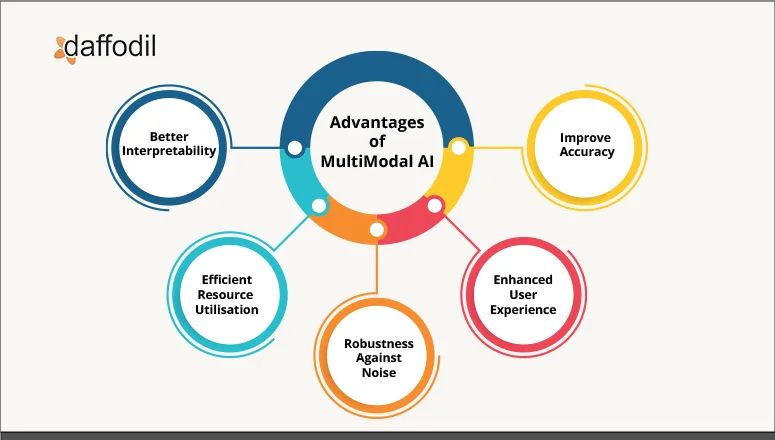
2. Multi-Modal Capabilities: Text, Images, and Beyond
Generative AI isn’t limited to text. Many advanced models can create images, music, and even videos. For instance, OpenAI’s DALL·E generates stunning visuals from text prompts, while tools like Runway ML can transform written descriptions into short films.
Why it matters:
- Enables artists and designers to create unique visuals effortlessly
- Supports industries like gaming and film with AI-generated assets
- Expands AI’s creative potential beyond just words
Example in Action:
You provide a simple text prompt: “A futuristic city skyline at sunset.” Within seconds, an AI like DALL·E generates a stunning, high-resolution image.
3. Context Awareness and Memory (To Some Extent)
Early AI models struggled with context, but modern generative AI has improved dramatically. These models can remember details from earlier in a conversation (within a session) and maintain coherence across longer interactions.
Why it matters:
- Allows for more personalized and meaningful conversations
- Reduces the need for users to repeat information
- Helps businesses enhance customer support with AI-driven chatbots
Read more blog : AI Tools Every Marketer Needs in 2026
Example in Action:
Imagine using a virtual assistant that remembers your preferences—whether it’s your favorite coffee order or your last request for tech support.
4. Creativity and Style Adaptation
Generative AI isn’t just about repeating what it has learned—it can create entirely new ideas, mimicking different styles and tones. Whether it’s writing in Shakespearean English or composing music in the style of Beethoven, AI can adapt to a variety of artistic expressions.
Why it matters:
- Supports creative professionals by generating fresh ideas
- Enables businesses to experiment with different branding styles
- Helps users generate unique content quickly
Example in Action:
A writer struggling with writer’s block can use AI to generate story ideas or rewrite a paragraph in a more dramatic tone.
5. Continuous Learning and Adaptation (With Human Feedback)
While most AI models don’t learn in real time, they improve through iterative training and human feedback. Reinforcement learning techniques help fine-tune AI responses, making them more accurate and contextually relevant over time.
Why it matters:
- AI tools become more reliable and user-friendly over time
- Reduces biases in AI responses through careful training
- Enhances personalization by adapting to user preferences
Example in Action:
Platforms like ChatGPT improve based on user interactions, adjusting for better accuracy and more useful responses based on feedback loops.
Final Thoughts
Generative AI is far more than a passing tech trend—it marks a fundamental paradigm shift in how humans interact with machines, create content, and solve complex problems. By moving from systems that merely analyze data to systems that synthesize entirely new ideas, we are entering an era of unprecedented augmentation.
The true power of Generative AI doesn’t lie in replacing human ingenuity, but in elevating it—automating routine execution so creators, developers, and strategists can focus on higher-level innovation. As these models continue to evolve with multimodal reasoning and tighter contextual grounding, the competitive edge will belong to those who learn to orchestrate and collaborate with AI effectively today.
You may also like:
1) How AI is Transforming the Software Development Industry
2) 8 Key Concepts in Neural Networks Explained
3) Top 5 Essential Deep Learning Tools You Might Not Know
4) 10 Common Mistakes in AI Model Development
5) 6 Types of Neural Networks You Should Know
6) The Science Behind Fine-Tuning AI Models: How Machines Learn to Adapt
7) 7 Essential Tips for Fine-Tuning AI Models
Read more blogs from Here
Share your experiences in the comments, and let’s discuss how to tackle them!
Follow me on Linkedin
Frequently Ask Question :
1. What is the fundamental difference between Generative AI and Traditional (Discriminative) AI?
Traditional (Discriminative) AI focuses on pattern recognition, classification, and prediction based on existing data (e.g., determining whether an email is spam, or predicting customer churn).
Generative AI learns the underlying probability distribution of the training data to synthesize entirely new, original artifacts—such as text, code, audio, or images—that resemble the source material without directly copying it.
2. What role does RLHF (Reinforcement Learning from Human Feedback) play in generative models?
Pre-trained models simply predict the next most probable token (word or pixel), which can result in harmful, biased, or nonsensical outputs. RLHF aligns these raw models with human values and practical intent by using human evaluators and reward models to score responses, steering the AI toward being helpful, honest, and harmless.
3. How do generative AI models retain context during a conversation?
Context awareness is driven by the model’s context window (measured in tokens). During an active session, the entire preceding conversation history (or a summarized version of it) is passed into the prompt with each new query. The model’s self-attention mechanism processes the relationships across all tokens simultaneously to generate coherent, contextually aware responses.
4. What are “hallucinations” in LLMs, and how can they be mitigated?
A hallucination occurs when an AI generates plausible-sounding but factually incorrect or fabricated information with high confidence. This happens because models operate on probabilistic associations rather than absolute truth retrieval. Key mitigation strategies include:
