



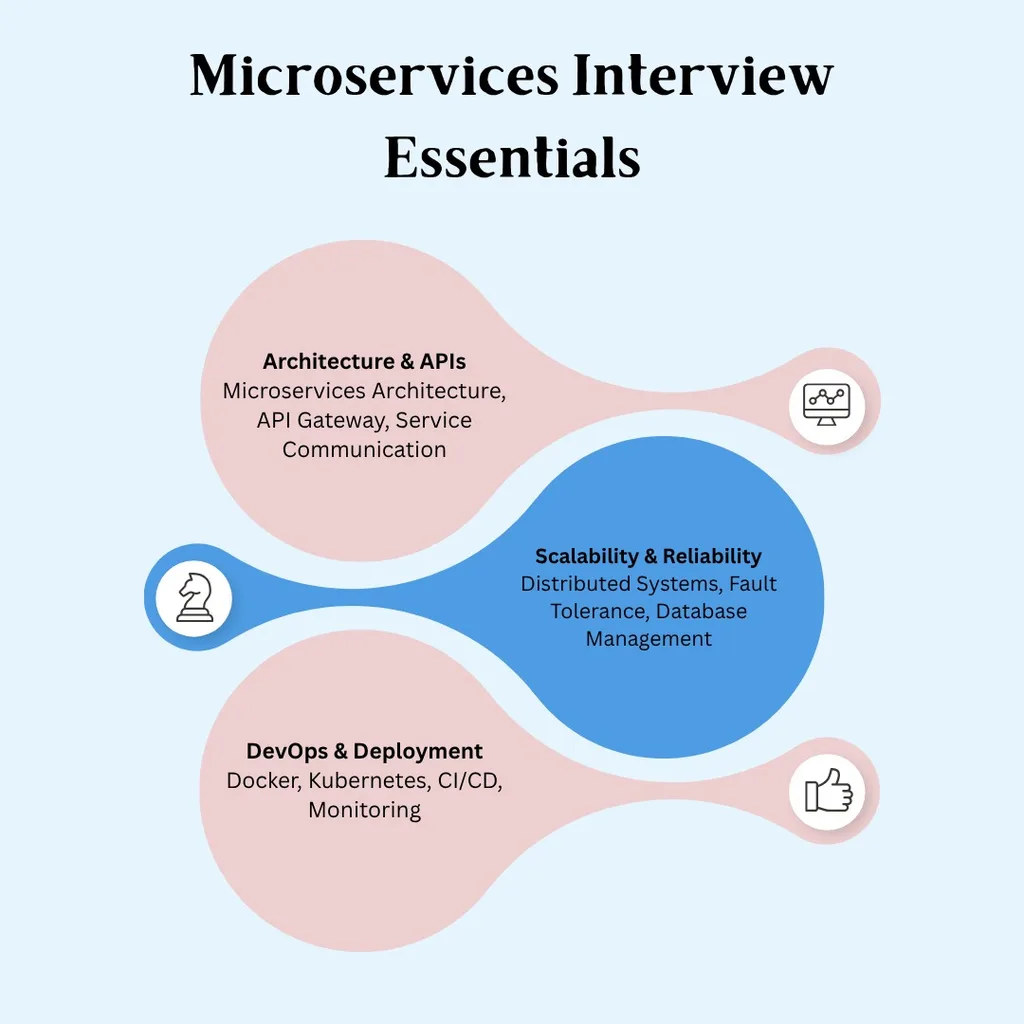
Microservices has become a widely adopted approach for building scalable and resilient software systems. Experienced developers are often expected to understand not only microservices interview questions but also practical microservices architecture, deployment strategies, service dependencies, and troubleshooting. Knowledge of data analysts, security analyst interview topics, DevOps tools, and Git commands can also be valuable when working with cross-functional engineering teams. This guide covers important concepts that can help developers prepare for technical discussions and real-world microservices projects.
For experienced professionals, interviews often go beyond basic definitions and focus on system design, scalability, fault tolerance, and production challenges. Understanding data analysts, security analyst interview expectations, DevOps tools, and Git commands can help developers collaborate effectively across development, operations, security, and analytics teams. The following microservices interview questions cover architecture, communication, databases, containers, APIs, testing, deployment, and modern development practices.
What Is Microservices Architecture?
Microservices architecture is a software development approach where an application is divided into multiple small, independently deployable services. Each service typically focuses on a specific business capability and communicates with other services through well-defined interfaces.
Unlike a traditional monolithic application, microservices allow teams to develop, test, deploy, and scale individual components independently. This architecture is particularly useful for large applications where different modules have different scalability and deployment requirements.
For experienced developers, understanding service boundaries is essential. Poorly designed boundaries can create excessive dependencies and turn a distributed application into a difficult-to-maintain system.
1. What Are Microservices?
Microservices are independently deployable software services that work together to form a larger application. Each service generally owns a specific business function and communicates with other services through APIs or messaging systems.
For example, an e-commerce platform might have separate services for:
- User management
- Product catalog
- Order processing
- Payment
- Inventory
- Notifications
- Shipping
Each service can potentially use its own technology stack and database, depending on business and technical requirements.
2. How Is Microservices Architecture Different From Monolithic Architecture?
A monolithic application generally contains multiple functionalities within one deployable unit. In contrast, a microservices-based application separates functionality into independently deployable services.
| Feature | Monolithic Architecture | Microservices Architecture |
| Deployment | Entire application | Individual services |
| Scaling | Usually application-wide | Service-specific |
| Codebase | Usually centralized | Multiple service codebases |
| Database | Common database is common | Can use separate databases |
| Failure Impact | Potentially wider | Can be isolated |
| Development | Often centralized | Can involve independent teams |
Microservices can improve flexibility, but they also introduce distributed-system challenges such as network failures, data consistency, observability, and service coordination.
3. What Are the Main Advantages of Microservices?
Some important advantages include:
- Independent deployment
- Independent scaling
- Better fault isolation
- Technology flexibility
- Smaller codebases
- Team autonomy
- Faster release cycles
- Easier ownership of business capabilities
However, microservices should not be introduced simply because they are popular. Organizations need to evaluate operational complexity, team maturity, infrastructure requirements, and application boundaries.
4. What Are the Major Challenges of Microservices?
Common challenges include:
- Distributed transactions
- Network latency
- Service discovery
- Data consistency
- Monitoring multiple services
- Debugging distributed failures
- Version management
- Security between services
- Increased infrastructure complexity
Experienced developers are expected to understand these trade-offs rather than treating microservices as an automatic improvement over monolithic systems.
5. What Is an API Gateway?
An API Gateway is a centralized entry point between clients and backend services. It can route incoming requests to appropriate services and perform additional responsibilities.
Typical API Gateway responsibilities include:
- Request routing
- Authentication
- Authorization
- Rate limiting
- Request transformation
- Load balancing
- Logging
- API version management
API Gateway Interview Question
Question: Why use an API Gateway instead of allowing clients to directly communicate with every service?
Answer: An API Gateway provides a controlled entry point for clients. It can hide internal service details, centralize authentication, apply rate limits, aggregate responses, and simplify client interactions. Without a gateway, clients may need to understand the location and API structure of multiple backend services.
6. What Is Service Communication in Microservices?
Service communication describes how individual services exchange data and trigger operations.
Two common approaches are:
- Synchronous communication – A service sends a request and waits for a response.
- Asynchronous communication – A service sends a message or event and continues processing without waiting for an immediate response.
REST and gRPC are commonly used for synchronous communication, while technologies such as Kafka and RabbitMQ can support asynchronous communication.
7. What Is the Difference Between Synchronous and Asynchronous Communication?
| Aspect | Synchronous | Asynchronous |
| Response | Usually immediate | May happen later |
| Coupling | Higher runtime dependency | Lower runtime dependency |
| Complexity | Easier initially | More complex |
| Failure Handling | Request can fail immediately | Requires message/error handling |
| Common Use | REST/gRPC APIs | Events and message queues |
The choice depends on business requirements, latency expectations, reliability needs, and workflow complexity.
8. How Do Microservices Handle Distributed Systems Challenges?
Microservices are essentially applications built across distributed systems, where components may run on different machines, containers, or cloud environments.
Developers should account for:
- Network failures
- Partial failures
- Latency
- Service unavailability
- Duplicate requests
- Message delays
- Data consistency
- Clock differences
- Retry behavior
Techniques such as timeouts, retries, circuit breakers, idempotency, health checks, and distributed tracing help manage these problems.
9. What Is a Circuit Breaker Pattern?
A circuit breaker prevents an application from repeatedly calling a failing service.
It generally operates through states such as:
- Closed: Requests are allowed normally.
- Open: Requests are temporarily blocked because failures have exceeded a threshold.
- Half-open: A limited number of requests are tested to determine whether the service has recovered.
This approach helps prevent cascading failures across services.
10. What Is Service Discovery?
Service discovery allows services to dynamically locate other services within a distributed environment.
There are two common approaches:
- Client-side service discovery
- Server-side service discovery
Service registries or orchestration platforms can maintain information about available service instances.
11. How Do Containers Help Microservices?
Containerized applications package application code along with its runtime dependencies into portable units.
Containers help provide:
- Consistent environments
- Faster deployment
- Process isolation
- Easier scaling
- Better resource utilization
- Simplified CI/CD workflows
Docker is widely used for containerization, while Kubernetes is commonly used for container orchestration.
12. What Is the Role of Docker in Microservices?
Docker allows developers to package services into containers. A service can include its application code, libraries, dependencies, and runtime configuration.
For example, an application might run:
- User service in one container
- Order service in another
- Payment service in another
- Database components separately
This makes local development and deployment more consistent across environments.
13. What Is Kubernetes and Why Is It Used?
Kubernetes is a container orchestration platform used to deploy, manage, scale, and monitor containerized workloads.
It can provide:
- Service discovery
- Automated deployments
- Scaling
- Self-healing
- Load balancing
- Rolling updates
- Configuration management
Experienced developers should understand how Kubernetes concepts such as Pods, Deployments, Services, ConfigMaps, and Secrets relate to microservices deployment.
14. How Should Databases Be Designed for Microservices?
A common principle is database-per-service, where each service owns its data and controls access to its database.
This approach helps maintain service autonomy but introduces challenges around data consistency and cross-service queries.
Database design may also involve concepts such as database normalization, indexing, transactions, replication, and partitioning.
Database Considerations
| Concept | Importance in Microservices |
| Database per service | Improves service ownership |
| Normalization | Reduces unnecessary data duplication |
| Indexing | Improves query performance |
| Replication | Supports availability and read scaling |
| Partitioning | Helps manage large datasets |
| Transactions | Maintains consistency within service boundaries |
15. What Is Database Normalization?
Database normalization is the process of organizing relational data to reduce redundancy and improve data integrity.
Common normal forms include:
- First Normal Form (1NF)
- Second Normal Form (2NF)
- Third Normal Form (3NF)
- Boyce-Codd Normal Form (BCNF)
In microservices, teams must balance normalization with service ownership. Excessive cross-service database dependencies can weaken the independence of services.
16. How Do You Manage Transactions Across Multiple Microservices?
Traditional ACID transactions are difficult to apply across independently owned databases.
Common approaches include:
- Saga pattern
- Event-driven architecture
- Compensating transactions
- Eventual consistency
The Saga pattern breaks a large business transaction into multiple local transactions. If one operation fails, compensating actions can be performed to reverse or correct previous operations.
17. What Is Eventual Consistency?
Eventual consistency means that distributed services may temporarily have different versions of data, but they eventually converge to a consistent state.
For example, after an order is created, the inventory service may receive the update shortly afterward rather than at exactly the same moment.
This approach can improve scalability and availability but requires careful event handling and business rules.
18. What Networking Concepts Are Important for Microservices?
Strong knowledge of networking concepts is useful for troubleshooting distributed applications.
Important areas include:
- HTTP and HTTPS
- TCP/IP
- DNS
- Ports
- Load balancing
- TLS
- Proxies
- Firewalls
- Network latency
- Service discovery
A developer should understand how a request travels from a client through a gateway, load balancer, and multiple services.
19. How Do You Secure Microservices?
Microservices security should be implemented at multiple layers.
Important practices include:
- Authentication
- Authorization
- TLS encryption
- Secure secrets management
- API rate limiting
- Input validation
- Service-to-service authentication
- Audit logging
- Least-privilege access
OAuth 2.0 and OpenID Connect are commonly used for identity and authorization workflows.
20. How Do You Monitor Microservices?
Observability is essential because a request can pass through several services.
Three major observability areas are:
- Logs – Record events and application behavior.
- Metrics – Measure performance and system health.
- Traces – Follow requests across multiple services.
Distributed tracing can help identify where latency or failures occur.
21. What Is the Role of DevOps in Microservices?
Microservices require reliable automation because teams may deploy many services independently.
Common DevOps tools can support:
- Source control
- CI/CD
- Containerization
- Infrastructure automation
- Monitoring
- Testing
- Deployment
Developers should also be comfortable with Git commands for branching, merging, rebasing, conflict resolution, tagging, and release management.
22. How Do SDLC and STLC Apply to Microservices?
SDLC and STLC remain important in microservices projects, although their implementation may be more iterative and automated.
The SDLC covers activities such as:
- Requirement analysis
- Design
- Development
- Testing
- Deployment
- Maintenance
STLC focuses specifically on testing activities, including:
- Requirement analysis
- Test planning
- Test case development
- Environment setup
- Test execution
- Defect reporting
- Test closure
Because services are independently deployable, automated testing becomes especially important.
23. What Testing Strategies Are Used in Microservices?
Testing can occur at several levels:
| Testing Type | Purpose |
| Unit Testing | Tests individual functions/components |
| Integration Testing | Tests service interactions |
| Contract Testing | Validates API expectations |
| End-to-End Testing | Tests complete workflows |
| Performance Testing | Measures scalability and response time |
| Security Testing | Identifies security weaknesses |
Contract testing is particularly useful when multiple services evolve independently.
24. What Is Idempotency in Microservices?
An operation is idempotent when performing it multiple times produces the same intended result as performing it once.
For example, a payment API should prevent duplicate processing if a client retries the same request because of a temporary network failure.
Idempotency keys are commonly used to identify duplicate requests.
25. How Do You Handle Failures in Microservices?
Failure-handling strategies may include:
- Timeouts
- Retries
- Circuit breakers
- Bulkheads
- Fallback responses
- Dead-letter queues
- Health checks
- Graceful degradation
Retries should be implemented carefully because repeated requests can increase load on an already failing service.
26. What Is the Bulkhead Pattern?
The bulkhead pattern isolates resources so that failure in one component does not consume resources needed by other components.
For example, separate thread pools or connection pools can prevent a slow payment service from exhausting resources used by other application features.
27. How Does Caching Improve Microservices Performance?
Caching stores frequently accessed data closer to the application or user.
Caching can reduce:
- Database load
- Network requests
- Response time
- Repeated computation
However, cache invalidation and stale data are important concerns. Developers need to define appropriate expiration and consistency strategies.
28. What Is API Versioning?
API versioning allows a service to introduce changes without immediately breaking existing clients.
Common approaches include:
- URL versioning
- Header versioning
- Query parameter versioning
For example:
/api/v1/orders
and
/api/v2/orders
A well-designed versioning strategy should also define deprecation and migration policies.
29. How Do Git Commands Help in Microservices Development?
Since multiple teams may maintain different services, source-control practices become important.
Useful Git commands include:
- git clone
- git branch
- git checkout
- git switch
- git pull
- git fetch
- git merge
- git rebase
- git cherry-pick
- git revert
- git log
Teams should establish branching and release strategies that match their deployment workflow.
30. How Are Modern AI Concepts Relevant to Experienced Developers?
Modern development environments increasingly include AI-assisted tools. Developers may encounter LLM prompting, generative AI concepts, and predictive modeling while building intelligent applications or integrating AI capabilities into existing microservices.
For example, an AI-powered service could expose an API for document classification while another service handles user authentication, billing, or workflow management.
Understanding AI concepts helps developers design appropriate service boundaries and integration patterns without treating AI functionality as a single monolithic component.
31. What Is LLM Prompting?
LLM prompting involves designing instructions and context for large language models to produce useful outputs.
In a microservices environment, an application might have a dedicated AI service responsible for:
- Prompt management
- Model interaction
- Response validation
- Token usage tracking
- Safety controls
- Model selection
Separating AI functionality into a service can make it easier to modify models without changing unrelated business services.
32. What Are Generative AI Concepts Developers Should Know?
Important generative AI concepts include:
- Large language models
- Embeddings
- Retrieval-augmented generation
- Prompt engineering
- Tokenization
- Model inference
- Fine-tuning
- Context windows
- Vector databases
Developers working on AI-enabled microservices should also consider latency, model costs, security, and data privacy.
33. What Is Predictive Modeling?
Predictive modeling uses historical or existing data to estimate future outcomes.
For example, a business could use a predictive model to estimate:
- Customer churn
- Demand
- Fraud risk
- Sales probability
- Product recommendations
A predictive-modeling service can operate independently and expose predictions through an API to other application services.
34. What Memory Management Concepts Should Developers Know?
Understanding memory management helps developers diagnose performance problems in long-running services.
Important concepts include:
- Heap and stack memory
- Garbage collection
- Memory leaks
- Object allocation
- Memory limits
- Garbage collector behavior
In containerized environments, memory limits should be configured carefully. A service that exceeds its container memory limit may be terminated by the orchestration platform.
35. What Makes a Good Microservices Design?
A strong microservices design generally includes:
- Clear service boundaries
- Loose coupling
- High cohesion
- Independent deployment
- Reliable communication
- Proper observability
- Strong security
- Appropriate data ownership
- Automated testing
- Resilient failure handling
The goal should not be to create as many services as possible. Instead, services should represent meaningful business or technical capabilities.
36. Scenario-Based Microservices Interview Question
Question: One service becomes unavailable and several other services start failing. How would you troubleshoot the problem?
Answer:
I would first identify the affected service using monitoring dashboards, logs, metrics, and distributed traces. Then I would check whether the failure is caused by infrastructure, networking, database connectivity, resource exhaustion, or an application error.
Next, I would examine timeout and retry behavior to determine whether repeated requests are creating additional load. I would verify whether circuit breakers, health checks, and fallback mechanisms are working correctly.
Finally, I would identify the root cause, restore service availability, and review the architecture to prevent similar cascading failures in the future.
37. Scenario-Based Question: How Would You Scale a Microservice?
I would first identify the bottleneck using metrics and performance monitoring. If the service is stateless, I would consider horizontal scaling by running multiple instances behind a load balancer.
I would also review database performance, caching, connection pools, network latency, and downstream service dependencies.
Scaling should be based on measured bottlenecks rather than simply increasing the number of service instances.
38. Scenario-Based Question: How Would You Design a Highly Available Microservices System?
A highly available system could include:
- Multiple service instances
- Load balancing
- Health checks
- Automatic recovery
- Database replication
- Failure isolation
- Circuit breakers
- Retry policies
- Monitoring
- Disaster recovery procedures
The exact design depends on business requirements, acceptable downtime, traffic patterns, and infrastructure capabilities.

Final Thoughts
Preparing for microservices interview questions requires more than memorizing definitions. Experienced developers should be ready to explain architectural decisions, communication patterns, database strategies, scalability approaches, security controls, testing methods, and failure-handling techniques.
A strong candidate should also understand how microservices architecture connects with distributed systems, containerized applications, networking concepts, DevOps practices, testing, and modern AI-enabled services. Scenario-based questions are especially important because they demonstrate whether a developer can apply theoretical knowledge to real production challenges.
By revising architecture patterns, API design, service communication, database ownership, observability, deployment, security, and troubleshooting, experienced developers can approach technical interviews with a stronger understanding of real-world microservices engineering.
Frequently Asked Questions
1. What are the most important microservices interview questions for experienced developers?
Experienced developers should prepare questions covering service boundaries, API Gateway, service communication, distributed systems, database management, event-driven architecture, Kubernetes, Docker, security, observability, testing, scalability, and failure handling.
2. Is microservices architecture better than monolithic architecture?
Neither architecture is universally better. Microservices can provide independent deployment, scaling, and team ownership, while monolithic applications can be simpler to develop and operate. The appropriate choice depends on application requirements and organizational maturity.
3. What should an experienced developer know about API Gateway interviews?
Candidates should understand request routing, authentication, authorization, rate limiting, load balancing, API aggregation, versioning, monitoring, and failure handling. They should also be able to explain when an API Gateway is useful and what problems it can introduce.
4. Why are Docker and Kubernetes important for microservices?
Docker helps package services into consistent containers, while Kubernetes helps deploy, scale, monitor, and manage those containers. Together, they can support automated and scalable microservices deployments.
5. How can I prepare for advanced microservices interviews?
Focus on architecture and scenario-based problems rather than definitions alone. Practice explaining distributed-system failures, database consistency, API design, service communication, observability, security, CI/CD, Kubernetes, testing strategies, and real-world scalability decisions.
