


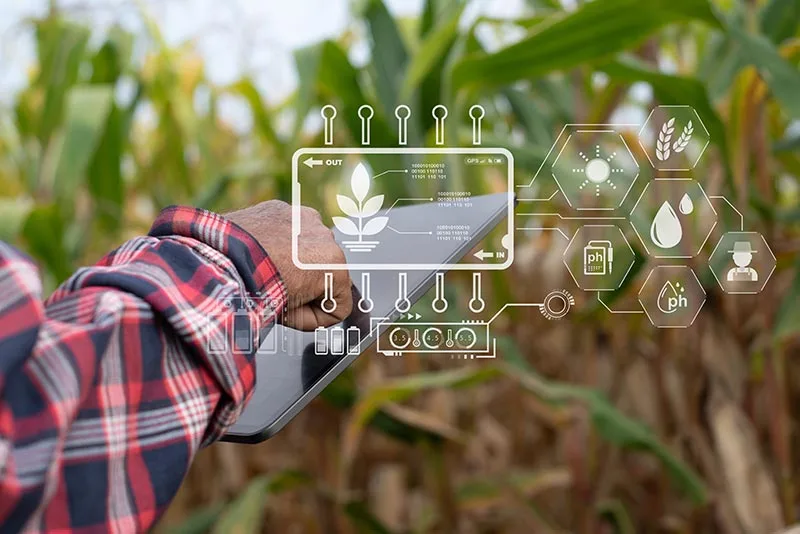
IoT in Precision Agriculture is changing the way modern farmers monitor crops, manage resources, and improve productivity. By connecting sensors, farming equipment, weather stations, drones, and other devices to the internet, farmers can collect real-time information about their fields and make better decisions based on accurate data.
Traditional farming often depends on experience and manual observation. While these methods remain valuable, they may not provide enough information to identify changing soil conditions, water requirements, crop diseases, or weather risks quickly. IoT technology addresses these challenges by bringing real-time data and automation into everyday farming operations.
From smart irrigation to soil monitoring and crop health analysis, IoT in Precision Agriculture is helping farmers use water, fertilizers, energy, and labor more efficiently. This guide explains how the technology works, its major applications, benefits, challenges, and future potential.
Table of Contents
What Is IoT in Precision Agriculture?
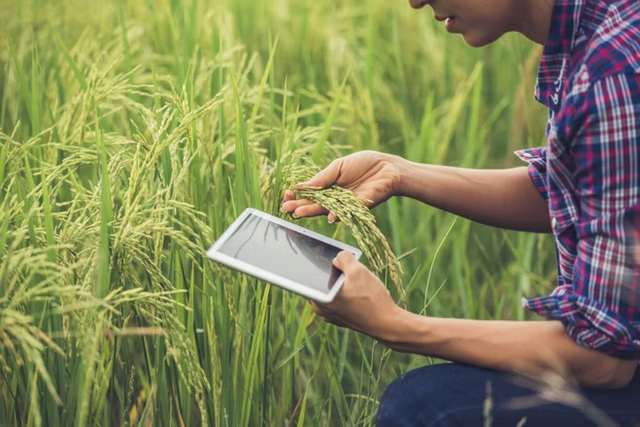
IoT in Precision Agriculture refers to the use of Internet of Things (IoT) devices and connected technologies to collect, transmit, and analyze agricultural data. These devices can monitor conditions such as soil moisture, temperature, humidity, crop health, rainfall, and equipment performance.
The collected information is transmitted through wireless networks to a cloud platform or agricultural management system. Farmers can then access the data through computers, smartphones, or dashboards.
For example, soil sensors can detect when moisture levels fall below a certain threshold. Instead of watering an entire field according to a fixed schedule, an automated irrigation system can deliver water only when and where it is required.
This approach is a major part of precision farming, where agricultural decisions are based on field-specific information rather than assumptions.
How IoT in Precision Agriculture Works
The process generally involves four major components:
1. IoT Sensors
Sensors are installed throughout fields, greenhouses, irrigation systems, and farming equipment. They can measure soil moisture, temperature, humidity, light intensity, nutrient levels, and other environmental conditions.
2. Connectivity
The sensors transmit collected information through technologies such as Wi-Fi, cellular networks, Bluetooth, LoRaWAN, or other wireless communication systems.
3. Data Processing
The collected data is stored and analyzed using cloud platforms or specialized agricultural software. Analytics can identify patterns and provide useful recommendations.
4. Automated Actions
Based on predefined conditions or data-driven recommendations, connected equipment can automatically perform tasks. For example, an irrigation system may activate when soil moisture becomes too low.
Together, these components create a connected smart agriculture ecosystem where farmers can monitor and manage agricultural operations more efficiently.
Key Applications of IoT in Precision Agriculture
There are many ways farmers can use IoT technology to improve agricultural operations.
Smart Irrigation
Water management is one of the most important applications of IoT in farming. Soil moisture sensors can continuously monitor water levels and help determine when irrigation is necessary.
Instead of watering crops on a fixed schedule, farmers can use real-time information to supply the appropriate amount of water. Automated irrigation systems can also control valves remotely.
This can reduce unnecessary water consumption while helping crops receive sufficient moisture.
Soil Monitoring
Healthy soil is essential for productive agriculture. IoT sensors can monitor soil moisture, temperature, pH, and other important conditions.
Farmers can use this information to understand differences between areas of the same field. Some sections may require additional irrigation or nutrients, while others may already have sufficient resources.
This field-level monitoring is an important component of precision farming.
Crop Health Monitoring
IoT devices can help farmers detect potential crop problems at an early stage. Sensors, cameras, drones, and satellite-based systems can collect information about plant growth and environmental conditions.
When unusual changes are detected, farmers can investigate affected areas before problems spread throughout the field.
Early detection can be particularly useful for identifying signs of disease, pest activity, or water stress.
Weather Monitoring
Weather conditions have a major impact on agricultural productivity. Connected weather stations can monitor temperature, humidity, rainfall, wind speed, and other environmental factors.
Farmers can use this information to plan irrigation, spraying, planting, and harvesting activities more effectively.
Real-time weather information can also help farmers prepare for potentially damaging conditions.
Livestock Monitoring
IoT is not limited to crops. Connected devices can also monitor livestock health and behavior.
Wearable sensors can track movement, body temperature, location, and activity patterns. Farmers may receive alerts when unusual behavior indicates that an animal requires attention.
This allows farmers to manage larger herds while maintaining better visibility into individual animal conditions.
Smart Greenhouses
Greenhouses can use IoT devices to automatically control temperature, humidity, lighting, ventilation, and irrigation.
Sensors continuously monitor environmental conditions, while automated systems make adjustments when necessary.
This creates a controlled environment that can support consistent crop growth and reduce the need for constant manual monitoring.
Benefits of IoT in Precision Agriculture
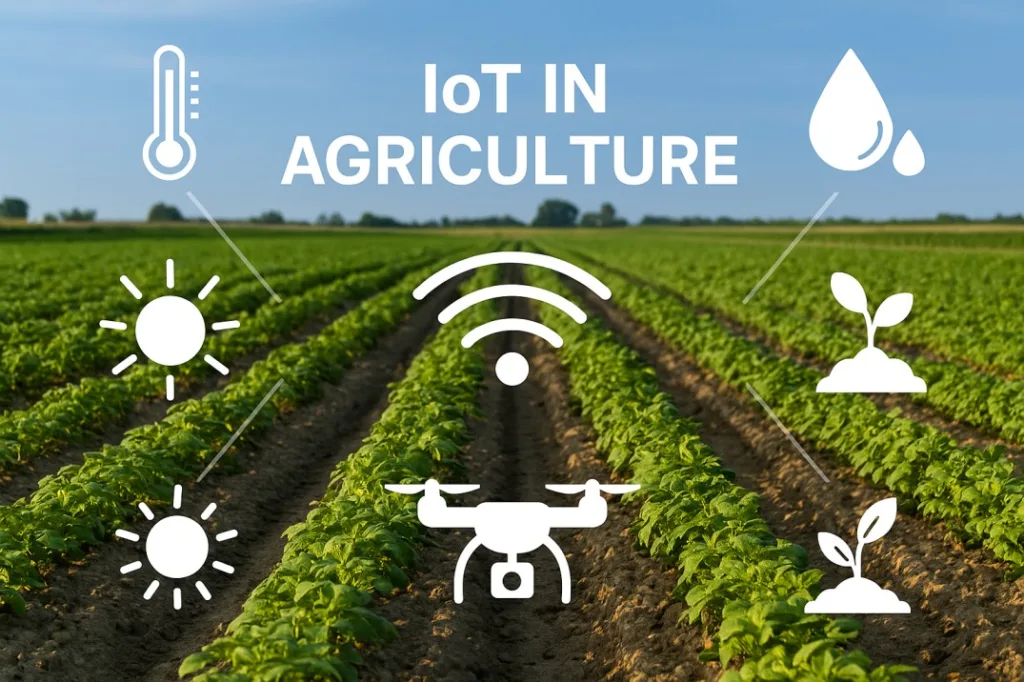
The adoption of IoT in Precision Agriculture can provide several important benefits.
Better Resource Management
Farmers can make more informed decisions about water, fertilizers, pesticides, energy, and labor. Instead of applying the same amount of resources everywhere, they can target specific areas according to actual requirements.
Increased Productivity
Real-time monitoring can help farmers identify problems earlier and respond faster. Better crop management can contribute to improved productivity and more consistent agricultural output.
Reduced Operating Costs
Automation can reduce the amount of manual work required for repetitive tasks. Smart irrigation, automated greenhouse controls, and equipment monitoring can help reduce unnecessary labor and resource consumption.
Data-Driven Decision Making
Farmers can use historical and real-time data to understand field conditions and identify trends. Over time, this information can support better planning and more accurate agricultural decisions.
Improved Sustainability
Efficient resource use is an important part of sustainable agriculture. By applying water, fertilizers, and pesticides more precisely, smart agriculture technologies can help reduce waste and support more responsible farming practices.
IoT and Precision Farming: How They Work Together
Precision farming focuses on managing agricultural resources and activities according to specific field conditions. IoT provides the connected infrastructure needed to make this approach more effective.
For example, a farmer may divide a large field into different zones. Sensors in each zone collect information about soil moisture and temperature. The farmer can then determine which areas need irrigation and which do not.
This combination of real-time data, connected devices, analytics, and automation allows precision farming to become more accurate and responsive.
Instead of treating an entire farm as one uniform area, farmers can manage individual sections according to their specific needs.
Challenges of Using IoT in Agriculture
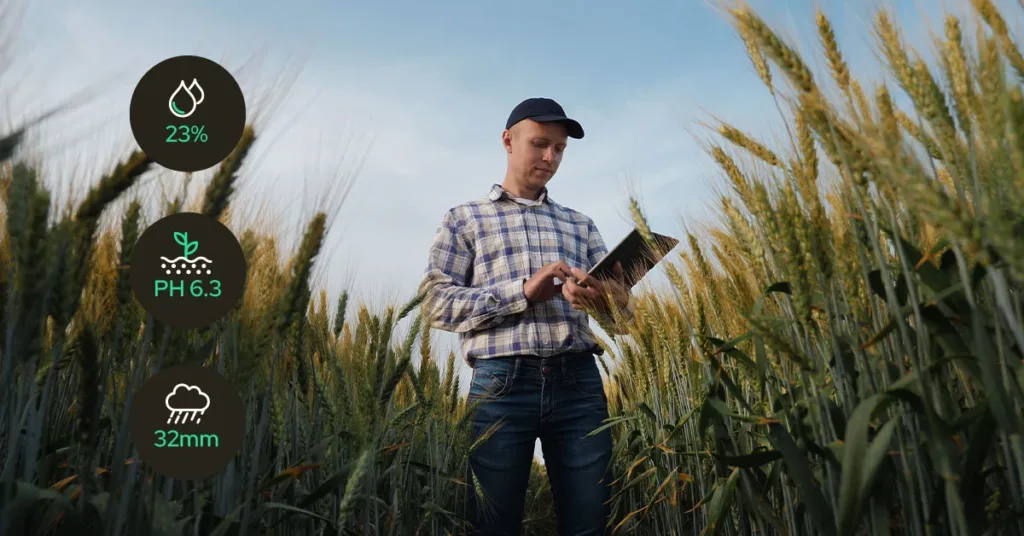
Despite its advantages, IoT adoption can present several challenges.
High Initial Investment
Sensors, connected machinery, network infrastructure, software, and installation can require significant upfront investment. Smaller farms may find these costs difficult to manage.
Internet Connectivity
Many agricultural areas have limited or unreliable internet connectivity. Without stable communication networks, transmitting real-time data can become difficult.
Technical Knowledge
Farmers may need training to install sensors, interpret data, operate software, and maintain connected equipment.
Data Security
Connected farming systems collect and store large amounts of agricultural information. Protecting this data from unauthorized access is an important consideration.
Maintenance
Sensors and other devices require regular maintenance. Damaged equipment, battery failures, or inaccurate sensors can affect the quality of collected data.
The Future of IoT in Precision Agriculture
The future of IoT in Precision Agriculture is closely connected with artificial intelligence, machine learning, robotics, drones, satellite imagery, and advanced analytics.
AI-powered systems can analyze large amounts of agricultural data and identify patterns that may be difficult to detect manually. Autonomous machinery could also perform tasks such as planting, spraying, harvesting, and field monitoring with minimal human intervention.
Drones equipped with advanced cameras can provide detailed information about crop conditions, while connected tractors and agricultural machinery can share operational data with farm management platforms.
As these technologies become more affordable and accessible, smart agriculture could become increasingly common across farms of different sizes.
The long-term goal is not simply to add more technology to farming. It is to create agricultural systems that are more productive, efficient, data-driven, and sustainable.
Conclusion
IoT in Precision Agriculture is transforming traditional farming by connecting physical agricultural operations with real-time data and intelligent technologies. Sensors, connected equipment, cloud platforms, automation, and analytics can help farmers understand their fields more accurately and respond to changing conditions.
From smart irrigation and soil monitoring to crop health analysis and livestock tracking, IoT has applications across almost every part of modern agriculture. While challenges such as cost, connectivity, technical knowledge, and maintenance remain, the potential benefits make IoT an increasingly important technology for the future of farming.
As precision farming and smart agriculture continue to evolve, IoT can play a central role in helping farmers produce more efficiently while making better use of valuable resources.
FAQs
1. What is IoT in Precision Agriculture?
IoT in Precision Agriculture uses connected sensors, devices, machinery, and software to collect and analyze agricultural data. It helps farmers monitor field conditions and make more accurate decisions about irrigation, fertilization, crop management, and other farming activities.
2. How does IoT help precision farming?
IoT provides real-time information about soil, crops, weather, and equipment. Farmers can use this data to apply resources more accurately, automate tasks, detect problems earlier, and improve overall farm management.
3. What are the main applications of IoT in agriculture?
Major applications include smart irrigation, soil monitoring, crop health monitoring, weather tracking, livestock monitoring, smart greenhouses, equipment monitoring, and automated farm management.
4. Is IoT useful for small farms?
Yes. Although some IoT systems can require significant investment, smaller farms can start with individual solutions such as soil moisture sensors, weather monitoring devices, or smart irrigation systems and expand their technology gradually.
