


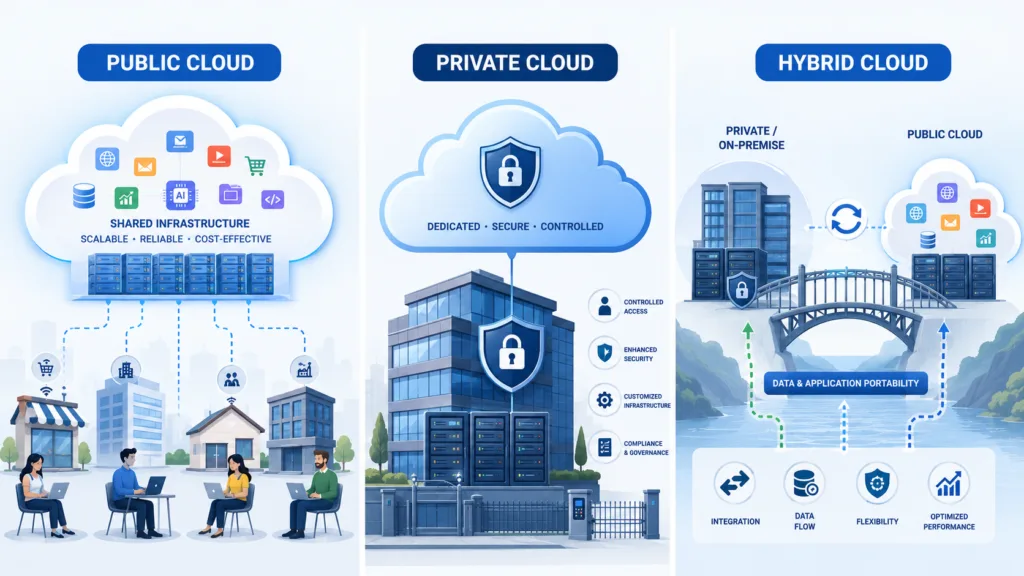
Public Cloud vs Private Cloud vs Hybrid Cloud is an important comparison for businesses deciding where to host applications, store data, and manage digital operations. Each option provides computing resources such as servers, storage, databases, networking, and software, but they differ in ownership, cost, control, security, and scalability.
The public cloud offers shared infrastructure managed by a third-party provider. A private cloud provides dedicated infrastructure for one organization, while a hybrid cloud connects public and private environments.
Understanding these cloud deployment models can help businesses select an infrastructure strategy that matches their workloads, budget, security requirements, and future growth plans. Some companies can operate entirely in the public cloud, while others may need private infrastructure or flexible hybrid cloud solutions.
Table of Contents
What Is Cloud Computing?
Cloud computing allows businesses to access computing resources over a network instead of purchasing and maintaining every server within their own facilities.
Depending on the service, a cloud provider may deliver:
- Virtual servers
- Data storage
- Databases
- Networking
- Backup and recovery
- Software applications
- Analytics tools
- Artificial intelligence services
- Security and monitoring
Cloud resources can often be activated quickly and adjusted according to demand. This helps companies avoid purchasing large amounts of hardware before they know exactly how much computing capacity they will require.
However, cloud computing is not one standard model. Businesses must decide how much infrastructure they want to share, control, and manage.
Public Cloud vs Private Cloud vs Hybrid Cloud: Key Differences
The main difference between these environments is how infrastructure is owned, operated, and accessed.
| Comparison area | Public cloud | Private cloud | Hybrid cloud |
|---|---|---|---|
| Infrastructure | Shared provider environment | Dedicated to one organization | Combination of public and private resources |
| Management | Mainly handled by provider | Managed internally or by a partner | Shared between organization and providers |
| Initial cost | Generally lower | Usually higher | Depends on the architecture |
| Scalability | Highly flexible | Limited by available capacity | Flexible across both environments |
| Control | Less infrastructure control | Greater control | Control varies by workload |
| Maintenance | Provider manages most hardware | Organization manages more infrastructure | Responsibilities are divided |
| Best suited for | Flexible and general workloads | Sensitive or specialized workloads | Businesses with mixed requirements |
These are general differences. Features, responsibilities, and pricing vary between service providers and individual configurations.
What Is a Public Cloud?
A public cloud is an environment where a provider operates computing infrastructure and delivers resources to multiple customers. Each customer receives logically separated services, even though the underlying hardware may be shared.
Businesses usually pay according to subscriptions, usage, reserved capacity, or a combination of these methods.
Common public cloud services include virtual machines, managed databases, file storage, application hosting, serverless computing, and artificial intelligence tools.
Benefits of the Public Cloud
The public cloud usually requires a lower initial investment because businesses do not need to purchase all the supporting hardware.
Other advantages include:
- Rapid deployment
- Flexible scalability
- Access from different locations
- Managed infrastructure
- Global data-centre coverage
- Access to advanced cloud services
- Usage-based pricing options
A startup can launch an application with limited resources and increase capacity as demand grows. This makes the public cloud attractive to growing businesses, software companies, ecommerce websites, and organizations with changing workloads.
Limitations of the Public Cloud
Although customers control their applications and data, they do not have complete control over the provider’s underlying infrastructure.
Costs can also become difficult to predict when companies do not monitor storage, network traffic, premium services, and unused resources.
Businesses operating in heavily regulated industries may need additional controls concerning data location, encryption, access, and compliance.
The public cloud is secure when properly configured, but customers remain responsible for user permissions, application security, data protection, and many service settings.
What Is a Private Cloud?
A private cloud is a cloud environment dedicated to one organization. It may operate inside the company’s own data centre or be hosted by a specialist provider.
Unlike a traditional server environment, a private cloud usually includes cloud-style features such as resource pooling, automation, virtualization, self-service provisioning, and centralized management.
Private clouds are often considered by banks, government organizations, healthcare companies, manufacturers, and businesses with strict security or operational requirements.
Benefits of a Private Cloud
The main benefit is greater control over infrastructure, security policies, data storage, network configuration, and update schedules.
Other advantages include:
- Dedicated computing resources
- Greater customization
- Direct control over data location
- Integration with internal systems
- Consistent performance
- Specialized compliance controls
A private cloud may also support applications that cannot easily move to a shared provider environment because of technical, legal, or operational restrictions.
Limitations of a Private Cloud
Private infrastructure usually requires a larger investment. Businesses may need servers, storage equipment, networking tools, software licences, security systems, and experienced technical employees.
The organization must also plan maintenance, backups, updates, monitoring, and disaster recovery.
Scalability can be slower because the company may need to purchase and install more hardware before adding capacity. For this reason, private cloud is often more suitable for established organizations with predictable workloads and strong internal IT resources.
What Is a Hybrid Cloud?
A hybrid cloud connects public cloud services with private cloud or on-premise infrastructure. Data and applications can move between environments or work together through secure integrations.
For example, a retailer may keep sensitive financial records in a private environment while hosting its customer-facing website in the public cloud. A manufacturer may operate factory systems locally but use cloud analytics to examine production data.
Effective hybrid cloud solutions allow businesses to place each workload in the most suitable environment.
Benefits of a Hybrid Cloud
Hybrid cloud provides greater flexibility than relying entirely on one environment.
Important benefits include:
- Flexible workload placement
- Support for gradual cloud migration
- Better use of existing infrastructure
- Additional capacity during traffic spikes
- Greater control over sensitive data
- Improved disaster-recovery options
A business can continue using important internal systems while adopting cloud services gradually. This can reduce migration risk and prevent the company from replacing every application at once.
Limitations of a Hybrid Cloud
Hybrid environments can be complicated to design and manage.
Businesses must connect identity systems, security policies, networks, monitoring tools, data platforms, and applications across multiple environments.
Poorly planned hybrid cloud solutions may create inconsistent security rules, duplicated data, integration failures, and unexpected costs.
Companies need clear governance explaining where data should be stored, which teams manage each environment, and how workloads can move securely.
Comparing Costs

Public cloud generally has the lowest initial infrastructure cost because the provider supplies and manages the physical resources. However, long-term expenses depend on usage, storage, support, network traffic, and service selection.
Private cloud normally requires higher upfront spending. Costs may include hardware, facilities, electricity, licences, maintenance, security, backups, and technical employees.
Hybrid cloud costs depend on the combination of public and private resources. It may reduce expenses by moving suitable workloads to the public cloud while continuing to use existing private infrastructure.
When comparing cloud deployment models, businesses should calculate the total cost of ownership over several years rather than looking only at monthly service prices.
Comparing Security and Control
Private cloud provides the greatest direct control, but direct control does not automatically guarantee stronger security. The organization must have the expertise and budget to protect the environment effectively.
Public cloud providers may offer advanced encryption, monitoring, identity management, threat detection, and compliance tools. However, customers must configure them correctly.
Hybrid cloud allows sensitive workloads to remain in a controlled environment while other applications use public cloud resources. The challenge is maintaining consistent security across both sides.
Regardless of the chosen model, businesses should review:
- Multi-factor authentication
- Role-based access
- Encryption
- Security monitoring
- Backup protection
- Data residency
- Incident response
- Compliance requirements
Comparing Scalability and Performance
The public cloud usually provides the greatest flexibility for adding or removing resources quickly. It is useful for seasonal traffic, application launches, and unpredictable workloads.
Private cloud performance can be highly consistent because resources are dedicated to one organization. However, capacity is limited by the installed infrastructure.
A hybrid cloud can provide additional public resources when private capacity is insufficient. This approach is sometimes called cloud bursting, although it requires careful application design and network connectivity.
Performance also depends on application architecture, data location, internet connectivity, storage technology, and network latency—not simply the type of cloud selected.
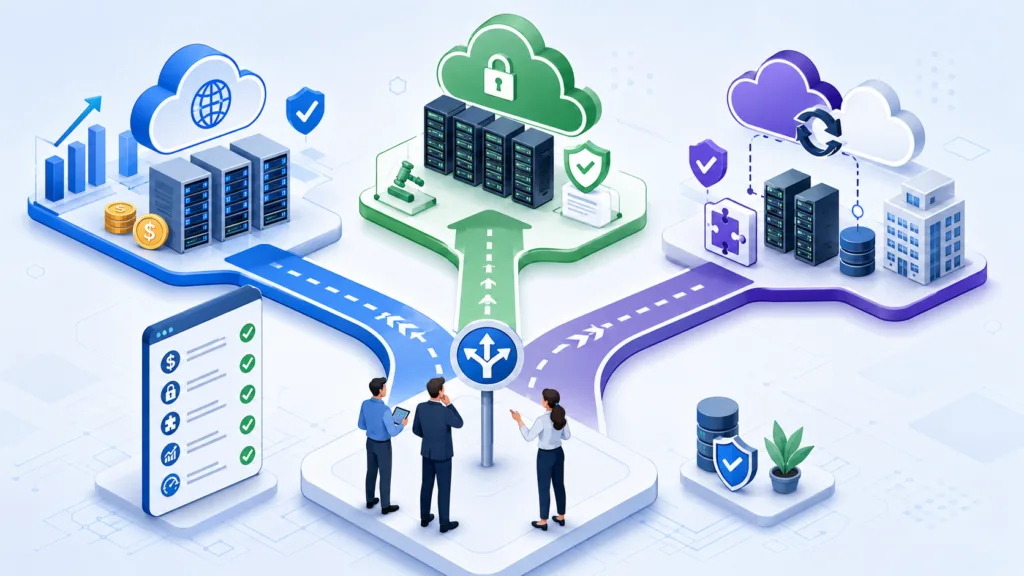
Which Cloud Model Is Right for Your Business?
Public cloud may be suitable when your business:
- Wants a lower initial investment
- Needs fast deployment
- Has changing resource requirements
- Supports remote employees
- Wants access to advanced managed services
- Has limited infrastructure staff
Private cloud may be suitable when your organization:
- Requires dedicated resources
- Needs greater infrastructure control
- Operates specialized legacy systems
- Has strict data-location requirements
- Employs an experienced internal IT team
- Manages predictable workloads
Hybrid cloud may be suitable when your business:
- Has a mixture of sensitive and general workloads
- Wants to migrate gradually
- Must continue using internal systems
- Needs flexible public cloud capacity
- Operates under complex compliance requirements
- Wants different environments for different applications
The right decision should be based on individual workloads rather than applying one approach to the entire business.
Common Cloud Selection Mistakes

One common mistake is choosing an environment based only on price. Businesses should also consider security, performance, integrations, support, compliance, and long-term management.
Another mistake is moving every application to the public cloud without checking whether it is technically suitable. Some older applications may require modification before migration.
Organizations may also adopt multiple cloud deployment models without establishing governance. This can create unused resources, inconsistent permissions, and unexpected spending.
Before choosing a model, classify workloads according to sensitivity, performance, availability, regulatory requirements, and cost.
Conclusion
The Public Cloud vs Private Cloud vs Hybrid Cloud decision depends on the level of flexibility, control, security, and technical responsibility a business requires.
Public cloud is generally suitable for organizations seeking rapid deployment, scalability, and lower initial infrastructure costs. Private cloud provides dedicated resources and greater control but normally requires more investment and internal expertise.
Hybrid cloud combines the strengths of both environments. Well-designed hybrid cloud solutions can help businesses protect sensitive workloads while benefiting from public cloud scalability.
By understanding these options and evaluating each workload separately, companies can select an infrastructure strategy that supports performance, security, compliance, and future growth.
Frequently Asked Questions
1. What is the main difference between public and private cloud?
Public cloud resources are delivered through provider-managed infrastructure shared among multiple customers. Private cloud infrastructure is dedicated to one organization and offers greater control over resources and configurations.
2. Is hybrid cloud more expensive?
Hybrid cloud can be more complex and may require additional integration and management tools. However, it can also reduce costs by allowing businesses to use public cloud resources only where they provide clear value.
3. Which cloud model is the most secure?
No cloud model is automatically the most secure. Private cloud offers greater direct control, while public cloud providers may offer advanced security capabilities. Actual security depends on architecture, configuration, monitoring, and employee practices.
4. Can small businesses use a hybrid cloud?
Yes, but small businesses should adopt hybrid infrastructure only when they have a clear requirement. Managing two connected environments may create unnecessary cost and complexity for companies with simple workloads.
