


The finance industry is experiencing a major transformation through artificial intelligence. Today, analysts are under constant pressure to process large datasets, create accurate forecasts, perform valuations, and deliver insights faster than ever before. This is where Investing in Autonomous AI Agents is becoming increasingly important. Modern AI-powered solutions are reshaping Artificial Intelligence financial modeling by reducing manual effort, increasing accuracy, and improving decision-making. From valuation automation to intelligent forecasting, AI agents are helping finance professionals focus more on strategic analysis rather than repetitive tasks.
Understanding AI-Powered Financial Modeling
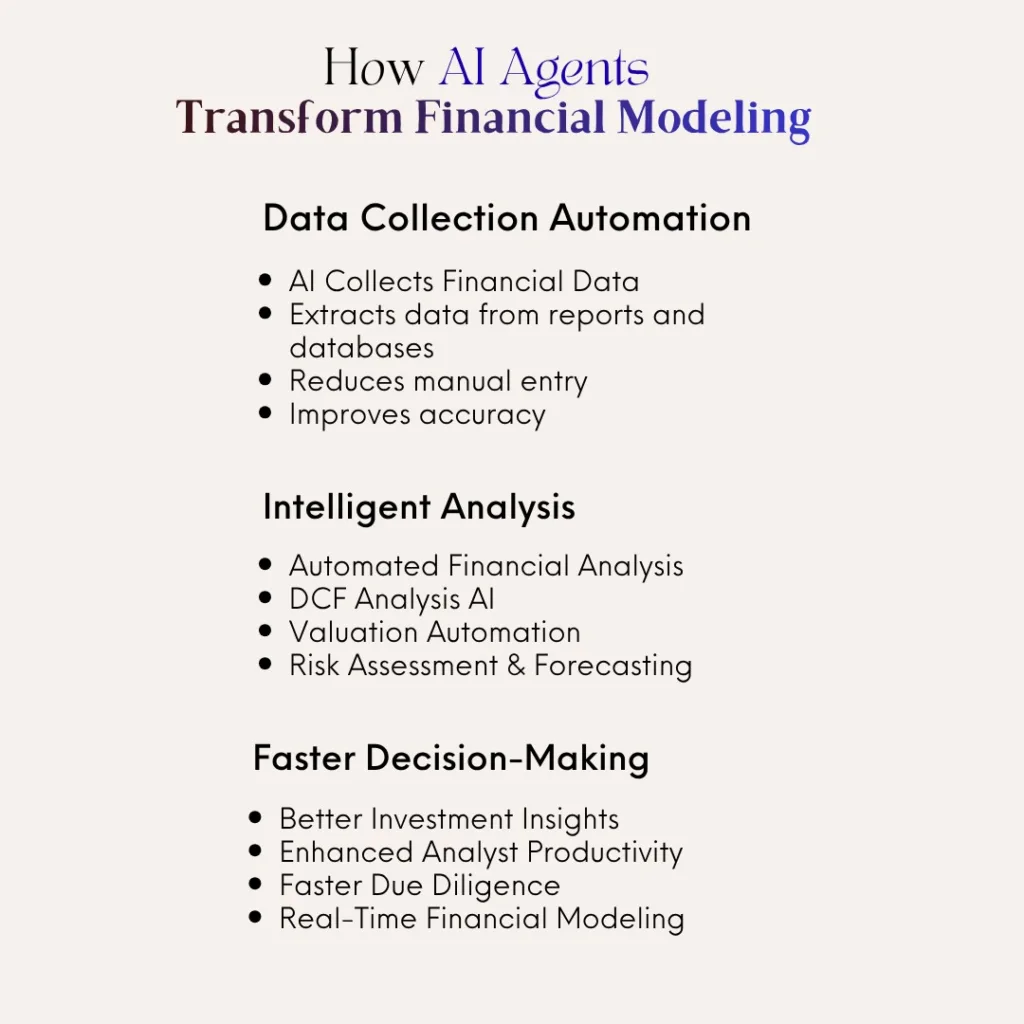
Financial modeling traditionally requires analysts to collect data, build spreadsheets, validate assumptions, and continuously update forecasts. These activities are often time-consuming and prone to human error. Modern finance modeling systems powered by Artificial Intelligence can automate many of these processes while delivering more reliable outputs.
Artificial Intelligence agents can gather financial data from multiple sources, organize information automatically, identify anomalies, and generate financial models with minimal human intervention. This level of automated financial analysis allows organizations to improve efficiency and accelerate business decisions.
Why Financial Analysts Are Adopting AI Agents
The increasing complexity of financial markets has created demand for smarter tools. Artificial Intelligence agents support analysts by automating repetitive activities and providing deeper insights.
| Traditional Financial Modeling | AI-Powered Financial Modeling |
| Manual data collection | Automated data extraction |
| Spreadsheet updates by hand | Real-time model updates |
| High risk of human errors | Improved accuracy and consistency |
| Time-intensive forecasting | Fast forecasting automation |
| Limited scalability | Easily scalable analysis |
By leveraging analyst productivity tools, financial professionals can handle larger workloads without sacrificing quality.
AI Agents and Valuation Automation
One of the most valuable applications of Artificial Intelligence is valuation automation. Valuation models often require extensive calculations, market comparisons, and sensitivity analyses. Artificial Intelligence agents can automate these tasks while continuously incorporating updated market data.
Whether analysts are performing company valuations, merger assessments, or investment evaluations, Artificial Intelligence systems can generate comprehensive reports within minutes. This significantly enhances workflow efficiency while reducing manual effort.
Benefits of Valuation Automation
- Faster company valuation processes
- Improved consistency across models
- Reduced calculation errors
- Enhanced scenario analysis
- Better investment decision support
As a result, organizations are increasingly integrating investment banking Artificial Intelligence solutions into their financial operations.
Enhancing DCF Analysis with Artificial Intelligence
Discounted Cash Flow analysis remains one of the most widely used valuation methods. However, creating and maintaining DCF models can be labor-intensive.
With DCF analysis AI, financial analysts can automate:
- Revenue projections
- Cost forecasting
- Discount rate calculations
- Terminal value estimation
- Sensitivity analysis
Artificial Intelligence systems continuously update assumptions based on market conditions, allowing organizations to maintain more accurate valuation models.
| DCF Analysis Component | Traditional Approach | DCF Analysis AI |
| Revenue Forecasting | Manual estimates | Automated predictive forecasting |
| Cost Modeling | Spreadsheet calculations | AI-generated projections |
| Scenario Analysis | Limited scenarios | Multiple simulations instantly |
| Data Updates | Manual updates | Real-time synchronization |
| Reporting | Time-consuming | Automated reporting |
This capability helps businesses achieve better forecasting accuracy while accelerating decision-making.
Forecasting Automation for Smarter Planning
Financial forecasting is essential for budgeting, investment planning, and risk management. Traditional forecasting methods often rely heavily on historical data and manual assumptions.
Through forecasting automation, Artificial Intelligence agents analyze historical trends, market conditions, economic indicators, and company performance metrics simultaneously. This enables more accurate predictions and proactive financial planning.
Organizations increasingly use predictive finance tools to:
- Forecast revenue growth
- Predict cash flow requirements
- Identify operational risks
- Improve budgeting accuracy
- Support strategic planning
The combination of Artificial Intelligence and predictive analytics creates a significant competitive advantage.
Spreadsheet Automation AI: Eliminating Manual Work
Many finance professionals spend countless hours updating spreadsheets, correcting formulas, and validating data. Spreadsheet automation Artificial Intelligence dramatically reduces these repetitive activities.
Artificial Intelligence -powered systems can:
- Populate spreadsheets automatically
- Detect formula errors
- Reconcile financial statements
- Generate dashboards
- Create financial reports
This automation improves productivity while allowing analysts to focus on higher-value activities such as strategic planning and investment evaluation.
Artificial Intelligence in Investment Banking and Private Equity
The adoption of investment banking AI continues to grow across mergers and acquisitions, equity research, and valuation processes. Artificial Intelligence agents assist bankers by automating data collection, financial analysis, and presentation preparation.
Similarly, Private Equity Due Diligence processes benefit significantly from AI-driven automation. Artificial Intelligence agents can review financial statements, identify risks, compare performance metrics, and accelerate investment assessments.
Key Private Equity Applications
| Process Area | AI Agent Capability | Business Benefit |
| Private Equity Due Diligence | Automated document review | Faster deal evaluation |
| Financial Research Workflows | Data collection and analysis | Increased research speed |
| Clean Financial Audit | Error detection and compliance checks | Improved accuracy |
| Portfolio Monitoring | Continuous performance tracking | Better investment management |
| Risk Assessment | Predictive analytics | Enhanced decision-making |
These capabilities enable private equity firms to process deals more efficiently while improving investment outcomes.
Improving Financial Research Workflows
Research teams often analyze vast amounts of market and company information. Artificial Intelligence agents streamline Financial Research Workflows by collecting data, summarizing reports, and identifying critical trends.
Benefits include:
- Faster research completion
- Improved data accuracy
- Better market intelligence
- Reduced manual workload
- Enhanced reporting capabilities
By integrating Artificial Intelligence into research operations, organizations can generate actionable insights more quickly.
Supporting Clean Financial Audits
Maintaining a Clean Financial Audit is essential for regulatory compliance and stakeholder confidence. Artificial Intelligence agents help identify inconsistencies, detect unusual transactions, and verify financial records automatically.
This reduces audit preparation time while improving transparency and financial governance.
Traditional Automation vs Autonomous Artificial Intelligence Agents
Many organizations already use Traditional Automation tools such as macros and rule-based software. However, autonomous Artificial Intelligence agents provide significantly greater flexibility.
Traditional systems follow predefined rules, whereas Artificial Intelligence agents can learn from data, adapt to changing conditions, and make intelligent recommendations.
As businesses continue investing in digital transformation, Artificial Intelligence-powered financial modeling solutions are becoming a strategic necessity rather than a competitive advantage.

Conclusion
The future of finance is increasingly driven by intelligent automation. Through Artificial Intelligence financial modeling, organizations can streamline valuation processes, improve forecasting accuracy, automate spreadsheets, and enhance decision-making. Technologies such as DCF analysis AI, forecasting automation, predictive finance tools, and advanced finance modeling systems are transforming how analysts work.
From Private Equity Due Diligence and Financial Research Workflows to maintaining a Clean Financial Audit, Artificial Intelligence agents are delivering measurable improvements across the financial ecosystem. As adoption continues to grow, businesses that embrace Artificial Intelligence-driven financial modeling will be better positioned to improve efficiency, reduce risk, and create long-term value.
FAQs
1. What is Artificial Intelligence financial modeling?
Artificial Intelligence financial modeling uses artificial intelligence to automate financial analysis, forecasting, valuation, and reporting processes while improving accuracy and efficiency.
2. How does DCF analysis Artificial Intelligence improve valuation?
DCF analysis AI automates cash flow forecasting, discount rate calculations, sensitivity analysis, and valuation updates, reducing manual work and improving consistency.
3. What are the benefits of forecasting automation?
Forecasting automation improves prediction accuracy, accelerates planning, reduces human error, and supports better financial decision-making.
4. How does spreadsheet automation AI help analysts?
Spreadsheet automation AI automatically updates data, validates formulas, generates reports, and reduces repetitive manual tasks.
5. Can AI assist with Private Equity Due Diligence?
Yes. AI agents can review financial documents, identify risks, compare investment opportunities, and accelerate due diligence processes for private equity firms.
