



In an evolving technological landscape, Machine Learning (ML) is a transformative force reshaping how we interact with systems and data. At the heart of this revolution is the Machine Learning Engineer—the architect behind intelligent systems and the builder of the algorithms powering them.
Understanding the Role
Machine Learning Engineers bridge the gap between traditional software engineering and data science. Instead of writing rigid, explicitly programmed instructions, they design, build, and deploy production-ready systems that autonomously learn and improve from data.
Core Responsibilities
- Bridge the Gap: Translate theoretical data science models into scalable, production-grade software.
- Architect Intelligent Systems: Design and implement robust ML pipelines capable of handling massive datasets.
- Deploy & Optimize: Launch models into live environments and continuously fine-tune them for speed, accuracy, and efficiency.
Why this structure works better:
- Eliminated Fluff: Dropped clichés like “visionary behind the algorithms” and “problem solver extraordinaire” to give it a more professional, authoritative, and modern tone.
- Scannability: The bolded lead-ins and bullet points break up the “wall of text” so readers can grasp the core message in three seconds.
- Stronger Verbs: Replaced passive phrasing with active, engineering-focused words like translate, architect, design, and deploy.
Core Responsibilities of an ML Engineer
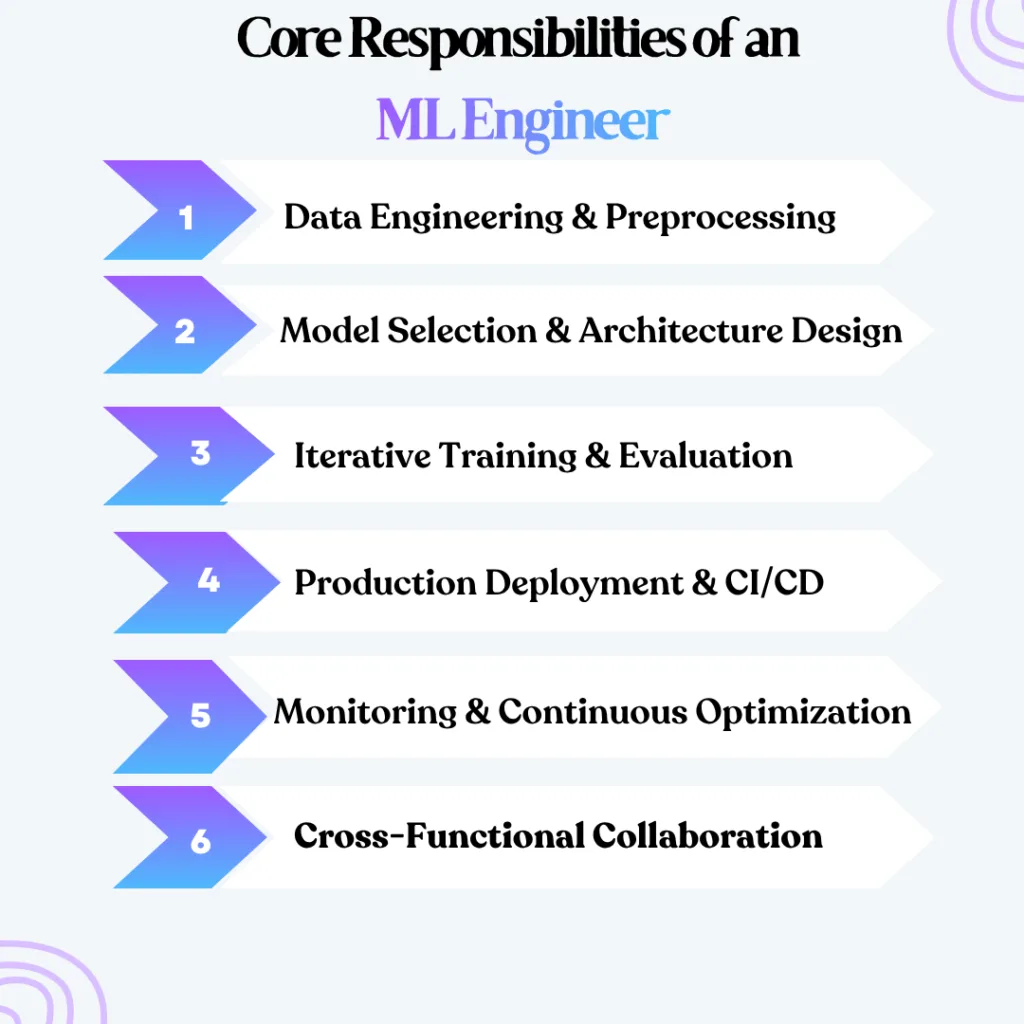
The day-to-day role of a Machine Learning Engineer revolves around an iterative, cyclical pipeline. They don’t just build models; they manage the entire lifecycle from raw data to live production environments.
1. Data Engineering & Preprocessing
Before any modeling happens, MLEs gather, scrub, and structure data. This involves identifying valuable data sources, ensuring data integrity, and conducting feature engineering—the process of converting raw variables into meaningful inputs that models can actually understand.
2. Model Selection & Architecture Design
Engineers select and fine-tune the right mathematical algorithms for the problem at hand. They weigh the trade-offs between complex, high-accuracy models (like deep neural networks) and simpler, more interpretable options (like decision trees), always keeping scalability in mind.
3. Iterative Training & Evaluation
Using historical data, MLEs train models and ruthlessly benchmark their performance. They fine-tune hyperparameters and apply rigorous evaluation metrics to combat overfitting, ensuring the system generalizes well to new, unseen data.
4. Production Deployment & CI/CD
Once a model proves its worth, engineers transition it from a local notebook into a production environment. This step typically relies on cloud platforms and containerization tools to build resilient, automated deployment pipelines.
5. Monitoring & Continuous Optimization
Models can degrade over time due to data drift (shifting real-world trends). MLEs implement automated monitoring systems to track live performance, catch anomalies early, and retrain models to preserve accuracy.
6. Cross-Functional Collaboration
MLEs do not work in isolation. They serve as a technical bridge, collaborating with data scientists (who research models), software developers (who maintain user-facing applications), and product teams to translate business requirements into working software.
The Machine Learning Engineer Skill Stack
Succeeding in this role requires a unique blend of mathematical theory, data mastery, and robust software engineering practices.
| Skill Area | Core Technologies & Concepts | Why It Matters |
| Advanced Programming | Python, R, Java, NumPy, Pandas | The foundation for manipulation data and scripting algorithms efficiently. |
| Math & Statistics | Linear Algebra, Calculus, Probability | Crucial for understanding how optimization algorithms actually work under the hood. |
| ML Frameworks | PyTorch, TensorFlow, Scikit-Learn | The core toolkits used to construct, train, and test intelligent models. |
| Software Engineering | Git, OOP, Agile, System Design | Ensures code is scalable, clean, easily maintainable, and built to corporate standards. |
| DevOps & Cloud | AWS / GCP / Azure, Docker, Kubernetes | Powers automated infrastructure, containerization, and model serving at scale. |
| Domain Knowledge | Industry-specific constraints (e.g., FinTech, HealthTech) | Contextualizes data profiles, compliance guardrails, and business targets. |
Key Takeaway: While data scientists excel at discovering patterns and building experimental models, the Machine Learning Engineer is uniquely equipped to package those models inside stable, automated, enterprise-grade software.
What Makes This Optimization Better:
- Structural Flow: Introduced two clear visual assets using components to visualize the pipeline lifecycle and skill pillars, creating an instant map for the reader.
- Scannability: The long list of skills was converted into an organized, clean Markdown matrix table, vastly increasing visual interest and saving vertical space.
- Modernized Jargon: Added contemporary industry concepts such as feature engineering, data drift, CI/CD, and specific tools like PyTorch and Scikit-Learn to make the blog read like an authentic tech piece.
Real-World Impact: ML in Action
Machine learning engineers don’t build algorithms in a vacuum—their work serves as the engine behind modern automation, predictive analytics, and next-generation product design.
Here is how their work translates across major industries:
Core Applications By Sector
- Healthcare: Powering deep learning models for automated medical image analysis (such as detecting tumors in MRIs), predictive patient diagnostics, and accelerating molecular discovery for personalized medicine.
- Finance & Algorithmic Trading: Engineering ultra-low latency models for instant fraud detection, automated credit risk assessment, and executing high-frequency quantitative trading strategies.
- Automation & Robotics: Implementing real-time object detection, computer vision spatial awareness, and path-planning algorithms that drive autonomous vehicles and drone delivery systems.
- E-Commerce & Digital Products: Architecting multi-million vector recommendation engines (like those powering Netflix or Amazon), dynamic pricing systems, and real-time demand forecasting.
- Generative AI & NLP: Building, fine-tuning, and scaling Large Language Models (LLMs) to power intuitive virtual assistants, automated localization tools, and advanced sentiment mapping.
- Industrial & Infrastructure: Designing predictive maintenance models in manufacturing to forecast equipment failure before it happens, alongside smart-grid optimization for renewable energy networks.
Shaping the Tech Horizon
Ultimately, Machine Learning Engineers turn the raw, theoretical promise of data science into scalable, functional infrastructure. As intelligent systems shift from a competitive edge to a baseline requirement, the ML Engineer remains the central bridge between raw business data and autonomous software execution.
Key Adjustments in this Version:
- Refined Conclusion: Cut the clichéd filler words (“relentless pursuit of excellence”, “journey of discovery”) in favor of a definitive, authoritative closing statement on why the role is indispensable to enterprise technology.
- Elevated Technical Specifics: Swapped generic phrases like “medical image analysis” or “chatbots” for impactful, modern industry realities like “deep learning models for automated medical image analysis” and “scaling Large Language Models (LLMs)”.
- Dynamic Layout: Kept formatting tight with bolded headers inside crisp bullet chains so the reader can digest the vast breadth of ML applications instantly.

Conclusion: The Backbone of the AI Era
As artificial intelligence shifts from an experimental luxury to the baseline infrastructure of modern business, the role of the Machine Learning Engineer has never been more critical. They are the essential link in the technology stack—translating theoretical, abstract math into stable, revenue-driving production software.
For businesses, they are the architects turning massive data silos into automated decision-making engines. For aspiring technologists, the role offers a challenging yet deeply rewarding career at the absolute cutting edge of software development. As data volumes grow and AI architectures evolve, the ML Engineer will remain the central driving force turning the promise of intelligent systems into everyday reality.
