


For senior-level software engineering roles, interviewers expect you to look past basic syntax. They want to see if you understand the deep architectural mechanics of the JavaScript runtime. A favorite way to test this is by combining Promises, setTimeout, and the Event Loop into a single execution-order puzzle.
To ace these interviews, you must master the exact boundary line between the Microtask Queue and the Macrotask Queue.
Let’s dissect a classic senior-level interview puzzle, map out its execution under the hood, and establish a framework to solve any asynchronous priority question.
Read more blog : Best JavaScript Interview Questions for Freshers in 2026
The Interview Puzzle: Predict the Execution Order
Consider the following advanced code snippet. Take a moment to analyze it and predict the exact console output sequence before scrolling down:
console.log("Start");

const myPromise = new Promise((resolve, reject) => {
    console.log("Inside Promise Executor");
    resolve("Promise Resolved Value");
});

setTimeout(() => {
    console.log("Inside Timeout (Macrotask)");
}, 0);

myPromise.then((result) => {
    console.log(result + " (Microtask)");
});

console.log("End");
The Correct Output Sequence
If you guessed that the code runs purely top-to-bottom or that the timer executes first, you fell into a common trap. The actual output is:
Plaintext
Start
Inside Promise Executor
End
Promise Resolved Value (Microtask)
Inside Timeout (Macrotask)
The Architecture: Microtasks vs. Macrotasks
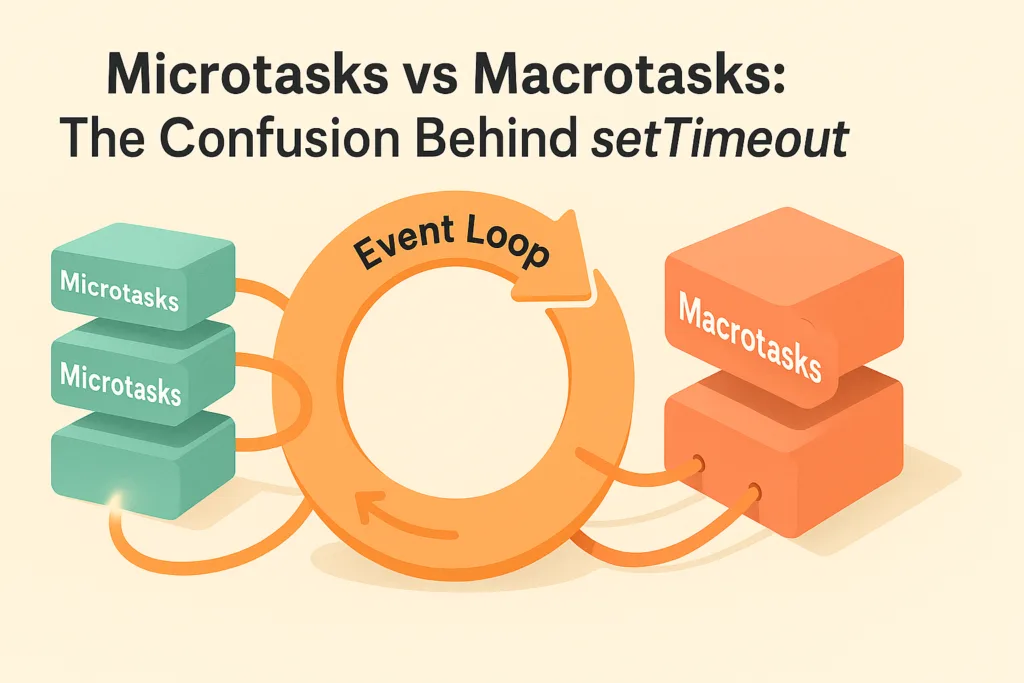
To understand why the code executes in this exact sequence, we must look at how the JavaScript Event Loop prioritizes its queues.
When synchronous execution finishes and the Call Stack is completely empty, the Event Loop manages two distinct channels for asynchronous callbacks:
1. The Microtask Queue (High Priority)
This queue holds callbacks that need to be executed immediately after the current script execution script finishes, before the browser yields control back to the rendering engine or processes any other event.
- Driven by:
Promise.then(),Promise.catch(),Promise.finally(),async/awaitcontinuations, andMutationObserver. - Execution Rule: The Event Loop will completely flush the entire Microtask Queue. If microtasks continuously queue more microtasks, the engine will process them all indefinitely, potentially blocking macrotasks and UI rendering.
2. The Macrotask Queue / Task Queue (Low Priority)
This queue holds callbacks originating from external APIs and environments.
- Driven by:
setTimeout,setInterval,setImmediate(Node.js), I/O operations, and user interaction events (clicks, scrolls). - Execution Rule: The Event Loop processes exactly one macrotask at a time from this queue. Once that single macrotask finishes executing, the Event Loop instantly pivots back to check and flush the Microtask Queue before moving to the next macrotask.
Step-by-Step Execution Breakdown
Let’s trace how the JavaScript engine registers, shifts, and executes each line of our puzzle code under the hood.
| Phase | Code Block / Line | Component | Action Taken & Status | Console Output |
| 1 | console.log("Start"); | Call Stack | Synchronous. Executes immediately. | Start |
| 2 | new Promise((resolve, ...) => { ... }) | Call Stack | Synchronous. The Promise executor function runs immediately upon instantiation. | Inside Promise Executor |
| 3 | resolve("Promise Resolved Value"); | Engine Memory | The Promise state changes from Pending to Fulfilled. The resolved value is saved in memory. | — |
| 4 | setTimeout(..., 0); | Web API | Asynchronous. Offloaded to the browser. Because the delay is 0ms, its callback is instantly pushed into the Macrotask Queue. | — |
| 5 | myPromise.then(...) | Job Queue | Asynchronous. Because the Promise is already fulfilled (from Step 3), the .then() callback is instantly pushed to the Microtask Queue. | — |
| 6 | console.log("End"); | Call Stack | Synchronous. The final line of the main script executes. The Call Stack is now completely empty. | End |
| 7 | Event Loop Tick 1 | Microtask Queue | The Event Loop sees an empty Call Stack and checks the high-priority Microtask Queue. It finds and executes the .then() callback. | Promise Resolved Value (Microtask) |
| 8 | Event Loop Tick 2 | Macrotask Queue | The Microtask Queue is now empty. The Event Loop checks the low-priority Macrotask Queue, finds the setTimeout callback, and executes it. | Inside Timeout (Macrotask) |
💡 Senior Architectural Insight from Arunangshu Das
“A critical mistake developers make in production is confusing the Promise instantiation with its resolution. Writing
new Promise()is an immediate, synchronous operation on the main thread. If you put a heavy computation loop inside that constructor thinking it will run ‘in the background,’ you will lock up the main execution thread. Only the code inside.then(),.catch(), or after anawaitkeyword actually hops into the asynchronous Microtask Queue.”
Practice Interview Questions to Solidify Your Knowledge
Apply the rules of Microtask vs. Macrotask priority to solve these two common senior interview variants. Try to determine the console output order yourself.
Question 1: Mixed Promises and Chaining
console.log("1");

setTimeout(() => console.log("2"), 0);

Promise.resolve()
  .then(() => {
    console.log("3");
  })
  .then(() => {
    console.log("4");
  });

console.log("5");
1
5
3
4
2
Why? 1 and 5 print synchronously. The first .then() prints 3 and queues the second .then(). Because the Microtask queue must be completely empty before checking macrotasks, the second .then() runs next to print 4. Finally, the setTimeout macro-task runs to print 2.
Question 2: The Nested Asynchronous Trap
setTimeout(() => {
  console.log("Timeout 1");
}, 0);

Promise.resolve().then(() => {
  console.log("Promise 1");
  setTimeout(() => {
    console.log("Timeout 2");
  }, 0);
});

Promise.resolve().then(() => {
  console.log("Promise 2");
});
Promise 1
Promise 2
Timeout 1
Timeout 2
Why? There is no initial synchronous console output. The two global Promises run their microtasks first (Promise 1, then Promise 2). During the execution of Promise 1, a new macro-task (Timeout 2) is queued behind Timeout 1. Once the microtask queue is clear, the macrotasks execute sequentially in the order they arrived: Timeout 1, then Timeout 2.
Summary Key Takeaways
- Promise Executors are Synchronous: The code blocks inside a
new Promise(...)block run immediately along the main execution thread. - Microtasks Overrule Macrotasks: The event loop will never look at a
setTimeoutcallback if there is a pending.then()orawaitresolution waiting in the Microtask queue. - Flushing Mechanics: Microtasks flush completely in one sweep cycle, whereas Macrotasks are executed precisely one per event loop cycle.
Conclusion: Mastering Asynchronous Priority
Predicting execution order in complex JavaScript applications comes down to a fundamental mental checklist:
Read more blog : 10 Applications of Code Generators You Should Know
- Execute all synchronous code first (including the immediate evaluation of Promise constructors).
- Completely flush the Microtask Queue (processing all
.then()resolutions,async/awaitcontinuations, and micro-tasks chained along the way). - Execute exactly one Macrotask from the Task Queue (like a
setTimeoutcallback), then instantly pivot back to check if any new microtasks were introduced.
By keeping this structural flow in mind, you can confidently debug race conditions in production code and effortlessly ace asynchronous architecture questions in your next senior-level technical interview.
Frequently Asked Questions (FAQs)
1. Why do Promises execute faster than setTimeout with a 0ms delay?
Promises utilize the Microtask Queue, while setTimeout utilizes the Macrotask Queue. The JavaScript Event Loop prioritizes microtasks over macrotasks. Once the main call stack is cleared, the event loop will completely flush the entire Microtask Queue before it picks up even a single task from the Macrotask Queue. Therefore, a resolved Promise will always outrun a 0ms timer.
2. Is the code inside a Promise constructor synchronous or asynchronous?
The code inside the new Promise((resolve, reject) => { ... }) executor function is strictly synchronous. It executes immediately on the main thread when the Promise instance is created. Only the completion handlers—specifically the code wrapped inside .then(), .catch(), or following an await statement—are sent to the asynchronous Microtask Queue.
3. What happens if a Microtask recursively queues another Microtask?
If a microtask continuously schedules more microtasks (for example, a function that calls itself via Promise.resolve().then()), the Event Loop will remain trapped in the Microtask Queue indefinitely. Because the event loop refuses to move to the next phase until the microtask queue is entirely empty, this will completely block the Macrotask Queue and freeze the browser UI. This is known as starvation.
4. What is the difference between process.nextTick and a Promise microtask?
This is a common Node.js-specific interview question. While both handle asynchronous execution, process.nextTick() belongs to a separate, higher-priority queue managed by Node.js, not the standard Web API event loop. Callbacks registered with process.nextTick() execute immediately after the current operation completes, before the Event Loop moves to the Microtask Queue.
5. Why do senior technical interviews focus so heavily on the Event Loop and queues?
Interviewers use these questions to verify your architectural mastery of JavaScript. It helps them differentiate between developers who simply write syntax and engineers who understand memory allocation, execution thread blocking, and performance optimization. Knowing how the engine prioritizes tasks allows you to write highly responsive applications.
