



Preparing for a QA role requires more than knowing testing definitions. Candidates should understand software development processes, test design, debugging, automation, databases, networking, and practical quality assurance workflows. During a software testing interview, interviewers may also evaluate how well you communicate defects, analyze requirements, and work with development teams. This guide covers essential QA interview questions to help candidates prepare for technical and practical discussions.
QA professionals often work alongside data analysts, developers, and teams preparing for a security analyst interview. Familiarity with DevOps tools and basic Git commands can also strengthen a QA engineer’s profile because modern testing workflows are closely connected with CI/CD, version control, and automated deployments. Whether you are preparing for an entry-level position or an experienced QA role, understanding both manual and automation practices is important.
1. What Is Software Testing?
Software testing is the process of evaluating an application or system to identify defects, verify requirements, and ensure that the software behaves as expected.
Testing helps organizations improve:
- Software quality
- Reliability
- Security
- Performance
- User experience
- Business functionality
A QA engineer may perform testing manually, create automated test scripts, analyze requirements, report bugs, and verify fixes.
2. What Are the Main Types of Software Testing?
Software testing can be broadly divided into several categories:
| Testing Type | Purpose | Example |
| Functional Testing | Checks whether features work according to requirements | Login functionality |
| Performance Testing | Evaluates speed and stability | Testing an application under heavy traffic |
| Security Testing | Identifies security vulnerabilities | Authentication testing |
| Usability Testing | Evaluates user experience | Checking navigation and interface |
| Compatibility Testing | Checks behavior across environments | Testing browsers and devices |
Understanding these categories is important for both manual testing questions and practical QA assessments.
3. What Is the Difference Between Verification and Validation?
Verification checks whether the software is being developed according to specified requirements and standards.
Validation checks whether the final product satisfies user needs and business expectations.
For example:
- Verification: Reviewing requirements and design documents.
- Validation: Testing the actual application.
A QA engineer commonly performs both activities throughout the development lifecycle.
4. What Is SDLC and STLC?
SDLC and STLC are important concepts for QA professionals.
SDLC
Software Development Life Cycle describes the complete process of developing software.
Typical stages include:
- Requirement gathering
- Planning
- Design
- Development
- Testing
- Deployment
- Maintenance
STLC
Software Testing Life Cycle focuses specifically on testing activities.
Common STLC stages include:
- Requirement analysis
- Test planning
- Test case development
- Test environment setup
- Test execution
- Defect reporting
- Test closure
Understanding these stages is frequently tested during a software testing interview.
5. What Is a Test Case?
A test case is a documented set of conditions, inputs, steps, and expected results used to verify a specific application functionality.
A typical test case contains:
| Test Case Component | Description |
| Test Case ID | Unique identifier |
| Test Scenario | Functionality being tested |
| Preconditions | Conditions required before testing |
| Test Steps | Actions performed by tester |
| Test Data | Input values |
| Expected Result | Expected application behavior |
| Actual Result | Observed behavior |
| Status | Pass or Fail |
Good test cases should be clear, repeatable, and traceable to requirements.
6. What Are Common Test Case Interview Questions?
During a test case interview, candidates may be asked to create test cases for everyday functionalities such as:
- Login page
- Registration form
- Password reset
- Shopping cart
- Payment gateway
- Search functionality
- File upload
- Mobile application
For example, for a login page, a QA engineer should consider valid credentials, invalid credentials, blank fields, password masking, account lockout, session behavior, and error messages.
7. What Is the Difference Between Smoke and Sanity Testing?
Smoke testing is a preliminary test performed to determine whether the major functions of a build are working.
Sanity testing is a focused test performed after specific changes or bug fixes to verify that the affected functionality works correctly.
| Factor | Smoke Testing | Sanity Testing |
| Scope | Broad | Narrow |
| Purpose | Build stability | Specific functionality |
| Depth | Basic | More focused |
| Usually performed | On new builds | After changes/fixes |
| Goal | Decide whether further testing is possible | Confirm specific changes |
These concepts frequently appear in QA interview questions.
8. What Is Regression Testing?
Regression testing verifies that new changes have not negatively affected existing functionality.
For example, if developers modify the checkout process, QA engineers may retest:
- Product selection
- Cart functionality
- Discount codes
- Payment
- Order confirmation
- Email notifications
Regression testing can be performed manually or through automation depending on the project.
9. What Is Automation Testing?
Automation testing uses software tools and scripts to execute predefined tests with minimal manual intervention.
Common benefits include:
- Faster execution
- Repeatability
- Reduced manual effort
- Better regression coverage
- Integration with CI/CD pipelines
An automation testing interview may include questions about automation frameworks, scripting languages, locators, waits, assertions, test data, and reporting.
10. Manual Testing vs Automation Testing
| Feature | Manual Testing | Automation Testing |
| Execution | Human tester | Automated scripts |
| Initial setup | Usually simpler | Requires framework/setup |
| Repetitive tests | Time-consuming | Efficient |
| Exploratory testing | Highly suitable | Limited |
| Regression testing | Slower for large suites | Faster |
| Maintenance | Lower script maintenance | Scripts require maintenance |
Automation does not completely replace manual testing. Exploratory testing, usability testing, and scenarios requiring human judgment still benefit significantly from manual QA.
11. What Is a Bug Life Cycle?
The bug life cycle describes the different stages a defect passes through from identification to closure.
A typical workflow is:
New → Assigned → Open → Fixed → Retest → Verified → Closed
A defect may also be:
- Reopened
- Rejected
- Duplicate
- Deferred
- Not a bug
QA engineers should provide clear reproduction steps, expected behavior, actual behavior, environment information, screenshots, and relevant logs when reporting defects.
12. What Is Severity vs Priority?
Severity describes the technical impact of a defect on the application.
Priority describes how urgently the defect should be fixed.
For example, a spelling mistake on a company’s homepage may have low severity but high priority because it is visible to many users.
| Situation | Severity | Priority |
| Application crashes on login | High | High |
| Typo on internal page | Low | Low |
| Minor UI issue on homepage | Low | High |
| Rare backend issue | High | Medium |
13. What Is Database Testing?
Database testing verifies whether data is correctly stored, retrieved, updated, and deleted.
QA engineers may validate:
- Data integrity
- CRUD operations
- Stored procedures
- Constraints
- Data relationships
- Transactions
- Data consistency
Knowledge of SQL can be particularly useful when testing applications with complex backend systems.
14. What Is Database Normalization?
Database normalization is a technique used to organize database tables and reduce data redundancy.
Common normal forms include:
- First Normal Form (1NF)
- Second Normal Form (2NF)
- Third Normal Form (3NF)
- Boyce-Codd Normal Form (BCNF)
A QA engineer does not necessarily need to design databases, but understanding normalization can help when validating database structures and relationships.
15. Why Are Networking Concepts Important for QA Engineers?
Basic networking concepts help QA engineers understand how applications communicate across clients, servers, APIs, and databases.
Important concepts include:
- HTTP and HTTPS
- TCP/IP
- DNS
- IP addresses
- Ports
- Cookies
- Sessions
- REST APIs
- Status codes
For example, understanding HTTP status codes helps testers identify whether an API request returned a successful response, client error, or server error.
16. What Is API Testing?
API testing validates communication between different software components without relying entirely on the user interface.
QA engineers may verify:
- Request methods
- Request parameters
- Headers
- Authentication
- Response status codes
- Response body
- Response time
- Error handling
Common HTTP methods include GET, POST, PUT, PATCH, and DELETE.
17. What Is Memory Management and Why Should QA Engineers Understand It?
Memory management refers to how computer systems allocate, use, and release memory.
For QA engineers, basic knowledge can help when investigating:
- Application crashes
- Memory leaks
- Slow performance
- High resource consumption
- Unexpected application behavior
Performance and system-level testing may require QA engineers to monitor CPU and memory usage during test execution.
18. What Is Exploratory Testing?
Exploratory testing involves simultaneously learning about the application, designing tests, and executing them without relying entirely on predefined test cases.
It is useful for discovering unexpected problems that scripted testing may miss.
A tester may explore:
- Unusual user actions
- Boundary conditions
- Unexpected input
- Navigation behavior
- Error handling
- User experience issues
19. What Are Boundary Value Analysis and Equivalence Partitioning?
Boundary Value Analysis (BVA) focuses on testing values at the boundaries of an input range.
For example, if a field accepts ages from 18 to 60, useful test values include:
- 17
- 18
- 19
- 59
- 60
- 61
Equivalence Partitioning divides input data into groups where the system is expected to behave similarly.
These techniques are common topics in manual testing questions.
20. How Can AI Concepts Support Modern QA?
Modern QA teams are increasingly exposed to AI-based applications and development workflows. Basic knowledge of LLM prompting can help testers create structured prompts for generating test scenarios, edge cases, test data, and defect summaries.
Similarly, understanding generative AI concepts helps QA engineers evaluate AI-generated responses for accuracy, consistency, safety, hallucinations, and relevance.
QA teams working with intelligent applications may also encounter predictive modeling, where models generate predictions based on historical or training data. Testing such systems requires attention to data quality, model outputs, bias, and performance.
21. What Are Common Tools Used by QA Engineers?
QA engineers may use different tools depending on the project.
| Category | Examples | Common Use |
| Test Management | Jira, TestRail | Test and defect tracking |
| Automation | Selenium, Playwright | Browser automation |
| API Testing | Postman | API validation |
| CI/CD | Jenkins, GitHub Actions | Automated pipelines |
| Version Control | Git, GitHub | Code and test management |
Knowledge of these tools can help candidates handle practical technical rounds more confidently.
22. How Do You Prioritize Testing When Time Is Limited?
When testing time is limited, QA engineers should prioritize based on risk and business impact.
A practical approach is:
- Test critical business functionality.
- Test high-risk areas.
- Verify recently changed features.
- Run smoke tests.
- Test integrations and payment-related workflows.
- Perform targeted regression testing.
- Document untested areas and remaining risks.
Risk-based testing helps teams make informed release decisions when complete test coverage is not possible.
23. How Do You Handle a Bug That a Developer Cannot Reproduce?
First, verify the issue again and collect detailed evidence.
The QA engineer should provide:
- Exact reproduction steps
- Test data
- Browser/device information
- Operating system
- Application version
- Screenshots or recordings
- Console logs
- Network logs
- Relevant timestamps
If the issue still cannot be reproduced, QA and development teams can compare environments and investigate logs or backend behavior.
24. What Makes a Good QA Engineer?
A strong QA engineer combines technical knowledge with analytical and communication skills.
Important qualities include:
- Attention to detail
- Logical thinking
- Curiosity
- Understanding of requirements
- Strong documentation
- Communication skills
- Knowledge of testing techniques
- Debugging ability
- Basic programming knowledge
- Risk-based thinking
QA engineers should focus not only on finding defects but also on preventing quality problems throughout the development lifecycle.

Conclusion
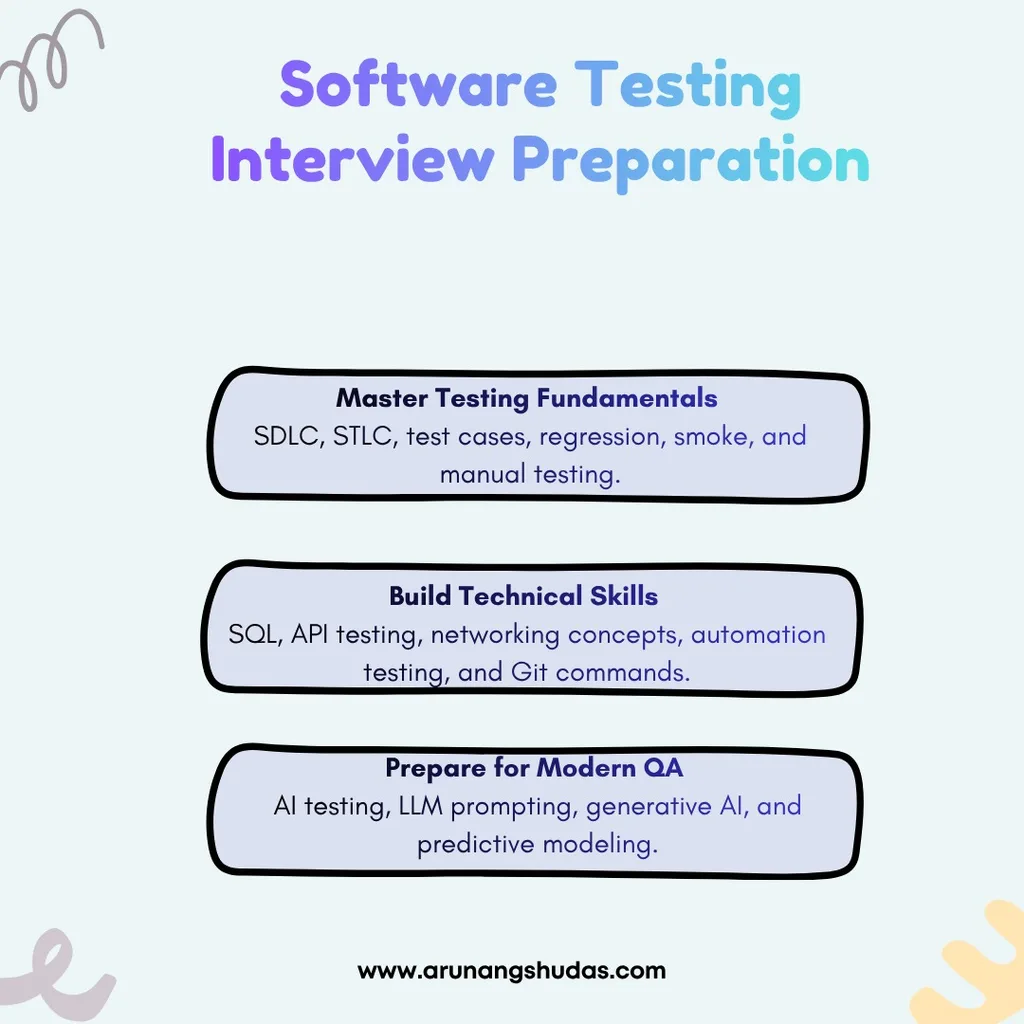
Preparing for QA roles requires a combination of testing fundamentals, technical knowledge, and practical problem-solving. Candidates should be comfortable with manual testing questions, test case design, defect management, databases, APIs, networking, automation, and CI/CD workflows. Understanding emerging areas such as LLM prompting, generative AI concepts, and predictive modeling can also provide an advantage as software quality practices continue to evolve.
Frequently Asked Questions
1. What should I prepare first for a software testing interview?
Start with testing fundamentals, SDLC, STLC, test cases, defect life cycle, severity vs priority, regression testing, smoke testing, and common testing techniques.
2. Are SQL questions asked in QA interviews?
Yes. Many QA roles involve database validation, so candidates may be asked about SQL queries, joins, CRUD operations, constraints, and database concepts.
3. Is coding required for automation testing?
Basic programming knowledge is generally important for automation roles because automation frameworks require writing, maintaining, and debugging test scripts.
4. What should I study for an automation testing interview?
Prepare automation frameworks, locators, waits, assertions, page object models, test data handling, reporting, API testing, version control, and CI/CD concepts.
5. How can I prepare for QA interview questions with practical scenarios?
Practice creating test cases for common applications such as login pages, e-commerce checkouts, payment systems, registration forms, search features, and APIs. Also practice explaining how you would identify, document, prioritize, and retest defects.
