


Local businesses and multi-location brands are managing more digital touchpoints than ever. From Google Business Profile updates and customer reviews to location pages and local search visibility, every activity requires consistent execution. Local SEO AI, Google Business Profile automation, and location-based marketing AI can help marketing teams streamline these processes while keeping location-specific strategies aligned with broader business goals. By combining local search optimization, AI citation management, and hyperlocal marketing systems, businesses can improve how their locations appear across search platforms and connect with customers in specific geographic areas. These technologies also support Marketing Operations, Marketing Intelligence, Chatbots in Modern Marketing, and Content Repurposing, creating a more connected approach to local digital marketing.
For brands operating across several cities, AI agents can coordinate repetitive marketing tasks while adapting activities to individual markets. They can assist with AI reputation management, local ranking automation, and geo-targeted marketing AI, while helping teams monitor changes in consumer behavior and search visibility. Modern Marketing Campaigns can use location-level insights to identify relevant audiences, while Lead Nurturing workflows can respond differently based on a prospect’s location and interaction history. AI can also support B2B Marketing Strategies by organizing location-specific leads and communication workflows. At the same time, Brand Monitoring helps businesses identify mentions, reviews, and local conversations that may require attention.
How AI Agents Are Changing Local SEO
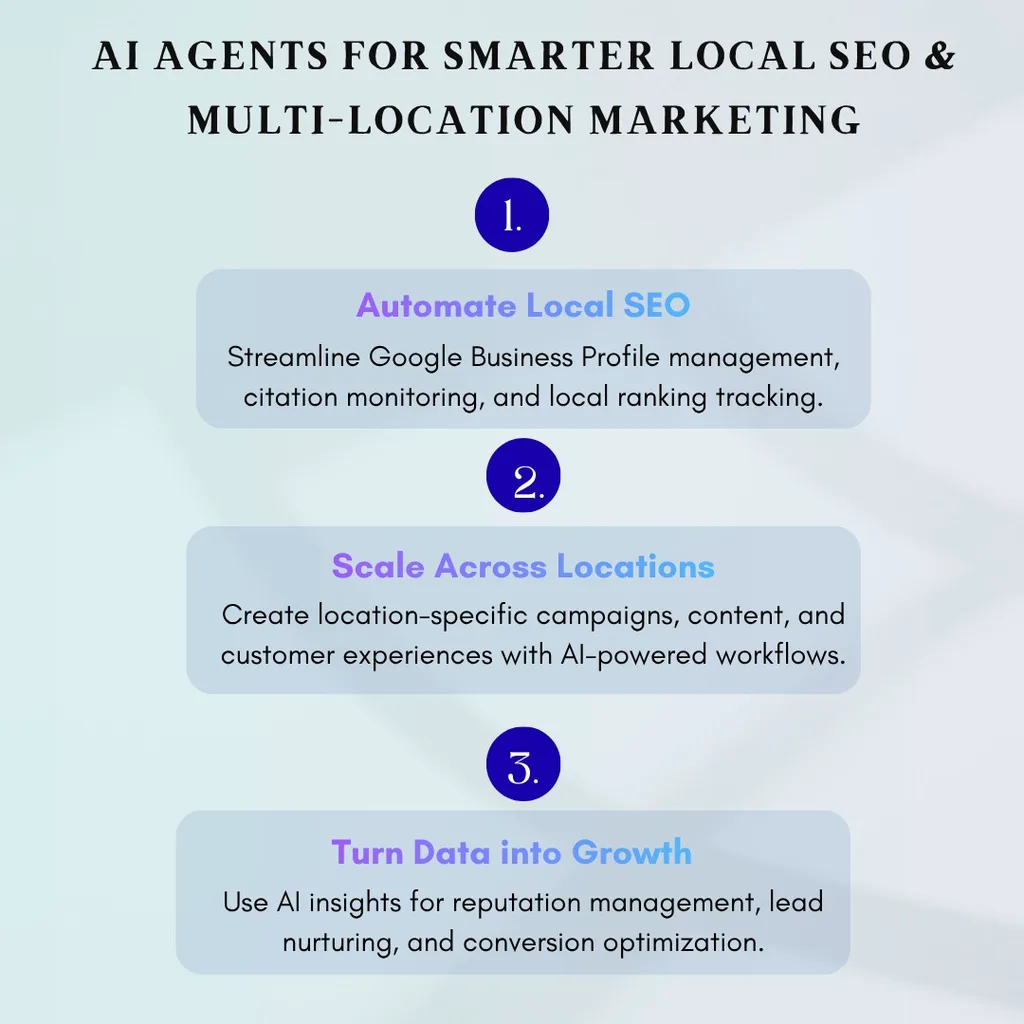
Traditional local SEO involves numerous recurring activities, including updating business profiles, checking rankings, monitoring citations, responding to reviews, and maintaining location-specific content. AI agents can connect several of these activities into automated workflows.
Instead of relying on separate tools for every task, an AI agent can collect information, identify patterns, trigger actions, and provide recommendations based on predefined business rules.
For example, an AI agent supporting a restaurant chain could monitor Google Business Profile activity across multiple cities, identify locations with declining review activity, suggest responses to customer feedback, and flag profiles that need updated information.
Key Local SEO Tasks AI Agents Can Support
| Local SEO Activity | AI Agent Role | Potential Benefit |
| Google Business Profile updates | Schedule and organize profile content | More consistent profile management |
| Local keyword monitoring | Track location-specific search terms | Better visibility tracking |
| Citation management | Identify inconsistent business information | Improved data consistency |
| Review monitoring | Detect and categorize new reviews | Faster reputation response |
| Local content | Generate location-specific content ideas | Scalable content production |
Google Business Profile Automation at Scale
Managing one Google Business Profile can be straightforward. Managing dozens or hundreds across different cities requires a much more structured process.
Google Business Profile automation allows businesses to standardize recurring activities such as post scheduling, content planning, profile monitoring, and performance reporting. AI agents can help organize these tasks while maintaining location-specific information.
For example, a retail company with stores in Jaipur, Delhi, Mumbai, and Bengaluru may use a central workflow while creating different messaging for each location. The system can identify local events, seasonal opportunities, and audience interests without requiring marketers to manually manage every individual profile.
However, automation should not mean publishing identical content everywhere. Location-specific information needs to remain accurate and relevant.
AI Citation Management for Consistent Business Information
Citations are an important part of local search visibility because customers and search engines encounter business information across multiple directories and platforms.
AI citation management can help identify differences in business names, addresses, phone numbers, URLs, and operating information. An AI agent can compare available records and flag inconsistencies for review.
Citation Management Workflow
| Stage | AI Agent Activity | Marketing Team Action |
| Data collection | Gather business information from available sources | Provide approved business details |
| Comparison | Identify conflicting information | Review flagged differences |
| Prioritization | Highlight important inconsistencies | Decide correction priority |
| Updating | Support structured correction workflows | Approve changes where required |
| Monitoring | Recheck information periodically | Review recurring issues |
This approach can be especially useful for franchises, healthcare groups, education networks, hospitality brands, and retail businesses with many locations.
Hyperlocal Marketing Systems and Location-Level Personalization
Customers in different cities may search for different products, services, and experiences. A single national marketing message may not address these differences effectively.
Hyperlocal marketing systems help businesses organize campaigns around specific neighborhoods, cities, regions, or customer segments. AI agents can analyze local signals and recommend content themes, campaign variations, and audience segments.
For instance, a fitness brand could promote different services depending on the local audience. A location near corporate offices might emphasize short weekday programs, while another location in a residential area could focus on family memberships.
Geo-targeted marketing AI can further support this approach by helping marketers organize campaigns according to geographic audience groups.
AI Reputation Management for Local Brands
Online reviews have a direct impact on how customers evaluate local businesses. Managing reviews across many locations can become difficult when handled manually.
AI reputation management can help teams monitor incoming reviews, categorize feedback, identify recurring issues, and prepare response drafts. Human review remains important, particularly when complaints involve sensitive customer experiences.
AI agents can categorize feedback into areas such as:
- Service quality
- Staff experience
- Product availability
- Pricing concerns
- Waiting time
- Facility experience
- Delivery issues
This creates a structured source of Marketing Intelligence that can be used beyond reputation management.
Local Ranking Automation and Performance Monitoring
Tracking local rankings manually for multiple cities can consume significant marketing resources. Local ranking automation can organize keyword and location combinations so marketers can monitor changes over time.
Instead of checking only whether a business ranks for one keyword, AI-powered systems can analyze:
- Location-specific keyword positions
- Search visibility changes
- Competitor movement
- Local landing-page performance
- Google Business Profile activity
- Review trends
- Search intent patterns
The result is a more structured view of local search performance.
Multi-Location SEO Monitoring Framework
| Metric | What to Monitor | Why It Matters |
| Local rankings | Position by keyword and location | Identifies visibility changes |
| Profile activity | Views, actions, posts, interactions | Shows local engagement |
| Reviews | Volume, rating trends, themes | Supports reputation management |
| Citations | Accuracy and consistency | Helps maintain business information |
| Location pages | Traffic and conversions | Measures organic performance |
| Competitors | Local search movement | Provides market context |
Consumer Trends Earlier Through Marketing Intelligence
One advantage of AI agents is their ability to process large amounts of marketing data continuously. Instead of reviewing reports only at the end of a campaign, marketing teams can identify emerging patterns earlier.
For example, an AI system might identify increasing searches around a particular service in one city. The marketing team could then create relevant local content, update a location page, adjust a campaign, or prepare a promotional offer.
This turns local search data into an ongoing source of Marketing Intelligence rather than a simple reporting metric.
Chatbots in Modern Marketing and Local Lead Generation
Chatbots in Modern Marketing can connect local search traffic with customer conversations. When a customer reaches a location page or campaign landing page, a chatbot can answer common questions about services, operating hours, availability, pricing, or appointments.
For multi-location businesses, AI agents can route conversations according to geographic requirements. A customer searching for a service in Jaipur, for example, can be directed toward the relevant branch rather than receiving generic company information.
This can support lead qualification and improve the transition from search visibility to customer interaction.
Content Repurposing for Multi-Location Marketing
Creating unique content for every location can be resource-intensive. Content Repurposing allows businesses to transform one central content asset into multiple location-focused formats.
For example, a national blog about home renovation could be adapted into:
- Jaipur-specific service content
- Delhi-specific location pages
- Instagram posts for individual branches
- Google Business Profile posts
- Local FAQs
- Email campaigns
- Short-form video scripts
AI agents can help generate these variations while marketers review them for accuracy, originality, and local relevance.
Marketing Automation and Conversion Rate Optimization
Local SEO becomes more valuable when it connects directly with business outcomes. Marketing Automation can help connect search interactions with lead management, email communication, CRM workflows, and follow-up activities.
At the same time, Conversion Rate Optimization can identify where users drop off after reaching a location page.
For example, if a location receives substantial organic traffic but generates few enquiries, an AI system could flag the page for review. Marketers might then examine the call-to-action, contact form, service information, page speed, or mobile experience.
From Local Search to Conversion
| Stage | AI-Powered Activity | Business Objective |
| Search | Monitor local search visibility | Increase discovery |
| Landing page | Analyze location-page engagement | Improve relevance |
| Interaction | Support chatbot conversations | Answer customer questions |
| Lead capture | Organize enquiry information | Improve lead handling |
| Follow-up | Trigger relevant workflows | Support conversion |
| Analysis | Identify performance patterns | Improve future campaigns |
How AI Agents Support Multi-Location Marketing Campaigns
AI agents can help coordinate marketing campaigns across multiple locations without requiring every activity to be managed separately.
A central marketing team can establish brand guidelines, campaign objectives, approved messaging, and content standards. AI agents can then help adapt the campaign to individual locations.
For example:
National Campaign → City Campaign → Location Content → Local Promotion → Lead Follow-Up → Performance Analysis
This structure allows businesses to maintain consistency while still responding to local market conditions.
Lead Nurturing Based on Location and Intent
Not every lead has the same requirements. A customer looking for a nearby service may need a quick appointment, while a B2B prospect may require multiple conversations before making a decision.
AI agents can organize Lead Nurturing workflows according to location, service interest, customer type, and previous interactions. This can help marketing teams deliver more relevant communication without manually sorting every lead.
For organizations using B2B Marketing Strategies, location-based segmentation can also help sales teams understand where leads originate and which markets generate stronger engagement.
Brand Monitoring Across Local Markets
Large brands can receive mentions from customers, local publications, directories, social media accounts, and community websites.
AI-powered Brand Monitoring can help identify these mentions and categorize them by location, sentiment, topic, or urgency.
For example, if several customers in one city mention the same service problem, the marketing team can identify the pattern and share it with the relevant operational team.
This creates a connection between SEO, reputation management, customer experience, and business operations.
AI Agents as Local Business Growth Tools
The value of AI agents extends beyond rankings. They can function as local business growth tools by connecting multiple marketing activities into a single workflow.
A mature system could coordinate:
- Local keyword monitoring
- Google Business Profile activity
- Citation monitoring
- Review management
- Location-page performance
- Content production
- Local campaign planning
- Lead routing
- Customer communication
- Marketing reporting
The objective is not to remove marketers from the process. Instead, AI agents can reduce repetitive work so marketing teams can spend more time on strategy, creative decisions, and customer insights.
Challenges of Using AI Agents for Local SEO
AI automation also requires proper controls. Incorrect business information, generic content, inappropriate review responses, or inaccurate location details can damage customer trust.
Businesses should therefore establish:
- Approved brand guidelines
- Location-level data controls
- Human review for sensitive communications
- Clear publishing permissions
- Regular citation checks
- Quality standards for AI-generated content
- Privacy and data-security procedures
- Performance monitoring
Automation works best when AI handles repetitive workflows while people remain responsible for important decisions.
The Future of AI-Powered Local SEO
As search behavior becomes increasingly conversational and location-specific, businesses will need more than traditional keyword tracking. AI agents can help marketers interpret local search signals, coordinate location-level activities, and connect search visibility with customer journeys.
The future of local SEO is likely to involve a combination of automation, local data, personalized content, reputation monitoring, and conversion-focused workflows.
For multi-location businesses, the biggest opportunity is creating a system where every location receives relevant marketing support without requiring every task to be completed manually.
Conclusion
AI agents are transforming local SEO from a collection of repetitive tasks into a connected marketing system. From local SEO AI and Google Business Profile automation to AI citation management, reputation monitoring, local ranking automation, and geo-targeted campaigns, these technologies can help businesses manage complex location-based marketing operations.
When implemented with accurate data, human oversight, and clear brand guidelines, AI agents can support scalable local search strategies while giving marketing teams more time to focus on strategy and customer experience.
FAQs
1. What are AI agents in local SEO?
AI agents are software systems that can perform or coordinate marketing tasks such as local keyword monitoring, profile management, review analysis, citation checking, content assistance, and performance reporting.
2. Can AI agents manage Google Business Profiles?
AI agents can support Google Business Profile workflows such as content planning, monitoring, reporting, and other permitted management activities. Businesses should maintain appropriate access controls and review important updates before publishing.
3. How can AI help multi-location businesses?
AI can help businesses coordinate SEO, reputation management, content, reporting, and marketing workflows across multiple locations while allowing each location to retain relevant local information.
4. Does AI replace local SEO professionals?
AI does not need to replace SEO professionals. It can automate repetitive tasks and provide insights, while SEO professionals can handle strategy, quality control, content decisions, technical issues, and business-specific requirements.
5. How can businesses start using AI agents for local SEO?
Businesses can begin with repetitive tasks such as local ranking monitoring, review categorization, citation checks, reporting, and content workflows. After establishing reliable processes, more advanced automation can be introduced gradually.
