



Preparing for a data science role requires more than knowing algorithms and writing code. Experienced professionals are often evaluated on their ability to solve business problems, work with large datasets, communicate insights, and build reliable machine learning solutions. During interviews, candidates may also be asked about API development, SQL joins, React components, and Python coding problems, particularly when the role involves collaboration with software engineering teams. Strong knowledge of these areas can help candidates approach technical discussions with greater confidence.
Along with API development, SQL joins, React components, and Python coding problems, experienced candidates should be prepared for practical scenarios involving data pipelines, model deployment, experimentation, and system integration. Interviewers may combine these topics with data scientist interview questions to understand how candidates apply their technical knowledge to real-world projects.
1. What Does an Experienced Data Scientist Do?
An experienced data scientist typically works across the complete data science lifecycle. This can include collecting and cleaning data, exploratory analysis, feature engineering, model development, validation, deployment, and monitoring.
Unlike entry-level interviews, experienced-level discussions often focus on decision-making. Interviewers may ask why you selected a particular algorithm, how you handled missing or inconsistent data, how you measured model performance, or what you would change if the model failed after deployment.
| Area | What Interviewers Evaluate | Example Topic |
| Data Preparation | Data cleaning and transformation | Missing values |
| Modeling | Algorithm selection | Classification |
| Evaluation | Model performance | Precision and recall |
| Deployment | Production readiness | Model monitoring |
2. Data Scientist Interview Questions
Data scientist interview questions for experienced professionals often focus on practical situations rather than definitions alone. Candidates may need to explain previous projects, justify technical decisions, and demonstrate how they translated business requirements into measurable outcomes.
Common Questions
Q1. How do you approach a new data science project?
Start by understanding the business objective and defining the target metric. Then identify available data, assess data quality, perform exploratory analysis, engineer relevant features, develop a baseline model, evaluate different approaches, and plan deployment and monitoring.
Q2. How do you handle missing values?
The approach depends on the dataset and reason for missingness. Options include removing records, statistical imputation, model-based imputation, or treating missingness as an informative feature.
Q3. How do you prevent overfitting?
Techniques include cross-validation, regularization, feature selection, early stopping, pruning, and using appropriate model complexity.
Q4. How do you select a machine learning algorithm?
Consider the problem type, dataset size, feature characteristics, interpretability requirements, computational resources, and expected performance.
3. Machine Learning Interview Topics
A machine learning interview for an experienced candidate may cover supervised learning, unsupervised learning, ensemble methods, feature engineering, model selection, and production challenges.
Interviewers may ask candidates to compare algorithms and explain trade-offs rather than simply define them.
| Algorithm | Common Use | Key Consideration |
| Linear Regression | Continuous prediction | Assumes linear relationships |
| Logistic Regression | Classification | Interpretable baseline |
| Random Forest | Classification/Regression | Handles nonlinear relationships |
| Gradient Boosting | Prediction | Strong performance but requires tuning |
| K-Means | Clustering | Requires selecting cluster count |
4. Statistics Interview Questions
Strong statistical knowledge is essential for experienced data professionals. Statistics interview questions may cover probability, distributions, hypothesis testing, confidence intervals, correlation, regression, and experimental design.
Important Questions
Q1. What is the difference between correlation and causation?
Correlation indicates that two variables are associated, while causation means a change in one variable directly contributes to a change in another.
Q2. What is a p-value?
A p-value measures how compatible observed data is with a specified null hypothesis. It should be interpreted alongside the significance level, study design, and practical importance.
Q3. What is a confidence interval?
A confidence interval provides a range of plausible values for a population parameter based on a statistical sampling procedure.
Q4. What is the Central Limit Theorem?
It states that, under suitable conditions, the sampling distribution of the mean approaches a normal distribution as sample size increases, even when the underlying population is not normally distributed.
5. Python Data Science Questions
Python data science skills are frequently tested through practical coding exercises. Candidates may be asked to manipulate datasets, write functions, optimize code, or work with libraries such as Pandas and NumPy.
Example Questions
- How would you identify duplicate records in a DataFrame?
- How can you handle missing values using Pandas?
- What is the difference between loc and iloc?
- How would you merge two DataFrames?
- How can you optimize a slow Python data-processing operation?
- What is the difference between a list, tuple, and dictionary?
Experienced candidates should focus not only on producing correct code but also on explaining its time complexity, scalability, readability, and maintainability.
6. Data Science Technical Interview
A data science technical interview may combine coding, statistics, machine learning, SQL, system design, and case-study questions.
Interviewers may provide a business scenario such as customer churn, fraud detection, recommendation systems, or demand forecasting. The candidate is expected to clarify the objective, identify relevant data, define success metrics, propose a modeling strategy, and explain deployment considerations.
Example Case
Scenario: A company wants to predict which customers are likely to cancel their subscriptions.
A structured response could include:
- Define churn and the prediction timeframe.
- Collect customer activity, transaction, support, and engagement data.
- Clean the data and investigate missing values.
- Engineer behavioral and historical features.
- Build a baseline classification model.
- Compare appropriate evaluation metrics.
- Validate the model using an appropriate data split.
- Deploy and monitor prediction quality over time.
7. Predictive Modeling Questions
Predictive modeling questions are especially relevant for experienced professionals because they test whether candidates understand how models behave in practical environments.
Common Questions
Q1. What is the difference between classification and regression?
Classification predicts discrete categories, while regression predicts continuous numerical values.
Q2. How do you evaluate a classification model?
Depending on the business objective, metrics may include accuracy, precision, recall, F1-score, ROC-AUC, PR-AUC, and confusion matrices.
Q3. What is cross-validation?
Cross-validation divides available training data into multiple subsets and repeatedly trains and evaluates the model to estimate its generalization performance.
Q4. What is feature engineering?
Feature engineering involves transforming raw information into useful variables that help a machine learning model identify meaningful patterns.
8. Working With Data Analysts and Cross-Functional Teams
Data scientists frequently collaborate with data analysts, engineers, product managers, business teams, and executives.
An experienced professional should be able to explain technical findings in business language. For example, instead of simply reporting that a model has a certain accuracy, the candidate should explain how its predictions affect revenue, customer retention, operational efficiency, or another relevant business metric.
| Role | Typical Responsibility | Collaboration With Data Science |
| Data Scientist | Modeling and advanced analysis | Direct collaboration |
| Data Analyst | Reporting and descriptive analysis | Data exploration |
| Data Engineer | Data pipelines and infrastructure | Data availability |
| ML Engineer | Model deployment | Productionization |
| Product Manager | Business requirements | Problem definition |
9. Security and Infrastructure Awareness
Modern data science environments often require professionals to understand basic security and engineering concepts. Candidates interviewing for adjacent technical roles may encounter topics associated with an security analyst interview, including access control, data protection, authentication, and secure handling of sensitive datasets.
Data scientists may also work alongside engineering teams using DevOps tools for continuous integration, deployment, monitoring, and infrastructure management.
Understanding development workflows can help when machine learning models need to move from experimentation into production.
10. Git, Docker, and Kubernetes
Experienced data scientists working in production environments may need familiarity with source control and containerized deployments.
Git Commands
Basic Git commands that candidates may encounter include:
- git clone
- git status
- git add
- git commit
- git pull
- git push
- git branch
- git merge
- git checkout
The important point is understanding when and why each command is used rather than memorizing commands without context.
Docker Containers
Docker containers provide a consistent environment for running applications and services. In machine learning projects, containers can package code, dependencies, libraries, and configuration so that an application behaves consistently across development and deployment environments.
Kubernetes Pods
Kubernetes pods are the smallest deployable units in Kubernetes. A pod can contain one or more closely related containers that share networking and storage resources.
11. AWS Cloud Interview Questions
Cloud knowledge is increasingly relevant when machine learning solutions are deployed at scale. An AWS cloud interview may include questions about storage, compute, databases, networking, security, and machine learning infrastructure.
| AWS Concept | Purpose | Example Use |
| Amazon S3 | Object storage | Store datasets |
| EC2 | Virtual servers | Run applications |
| RDS | Managed databases | Store structured data |
| IAM | Access management | Control permissions |
| SageMaker | ML platform | Build and deploy models |
Sample AWS Questions
Q1. What is Amazon S3?
Amazon S3 is an object storage service used for storing and retrieving files and data.
Q2. What is IAM?
AWS Identity and Access Management helps control access to AWS resources through users, roles, and permissions.
Q3. Why use cloud infrastructure for machine learning?
Cloud platforms can provide scalable computing, storage, managed services, monitoring, and deployment capabilities.
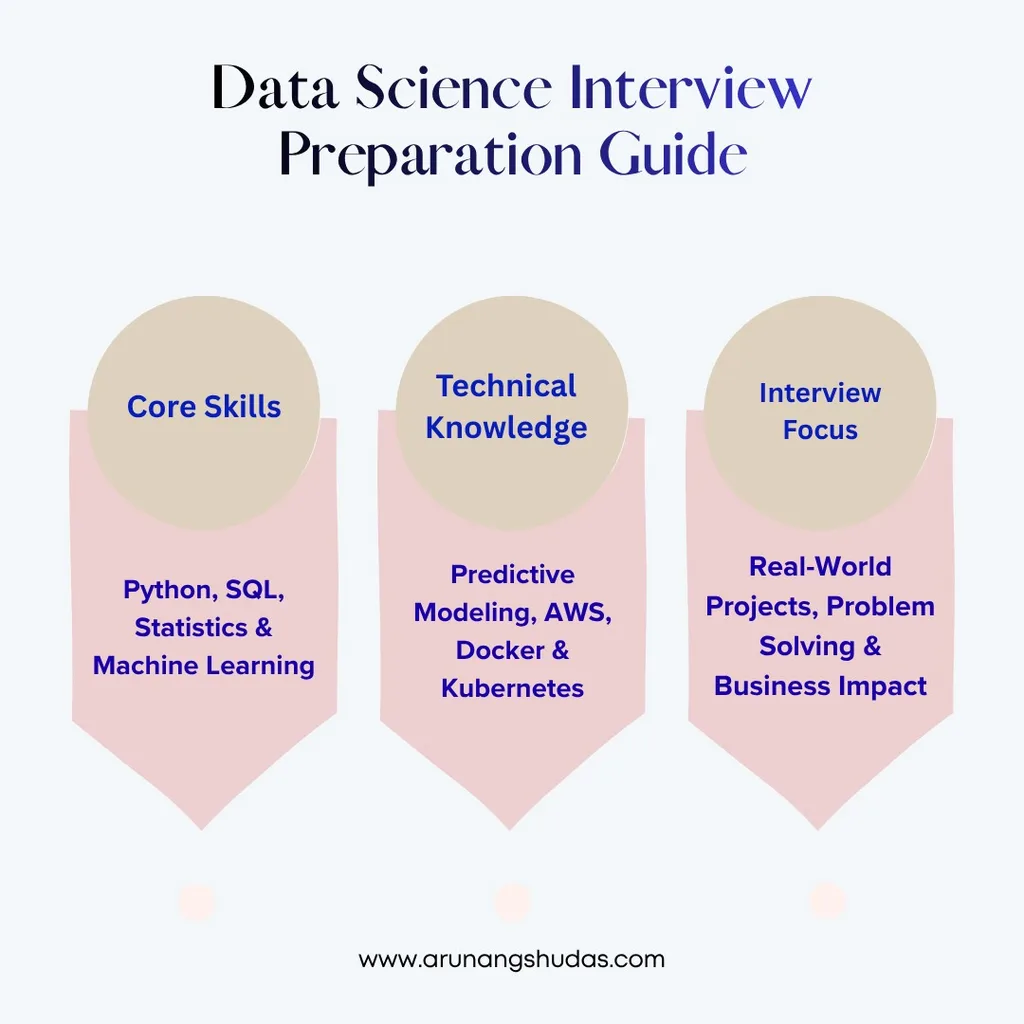
12. How to Prepare for Experienced Data Science Interviews
Experienced candidates should prepare across several dimensions instead of concentrating on machine learning algorithms alone.
Technical Preparation
Revise:
- Python programming
- SQL
- Statistics
- Machine learning
- Feature engineering
- Model evaluation
- Data visualization
- Experimentation
- Cloud platforms
- Deployment concepts
Project Preparation
Prepare two or three projects that you can explain in detail. For each project, be ready to discuss:
- Business problem
- Dataset
- Data-cleaning process
- Feature engineering
- Model selection
- Evaluation metrics
- Challenges
- Deployment
- Business impact
- Lessons learned
Behavioral Preparation
Interviewers may also ask:
- Tell me about a difficult data problem you solved.
- Describe a model that did not perform as expected.
- How did you communicate technical results to non-technical stakeholders?
- How do you prioritize competing analytical requests?
- Describe a disagreement with an engineering or business team.
13. Quick Revision Table
| Topic | Key Areas to Revise |
| Python | Data structures, Pandas, NumPy, functions |
| SQL | Joins, aggregations, CTEs, window functions |
| Statistics | Probability, hypothesis testing, distributions |
| Machine Learning | Algorithms, validation, feature engineering |
| Deployment | APIs, Docker, Kubernetes, cloud |
| Version Control | Git workflow and branching |
| Business | Metrics, experimentation, decision-making |

14. Final Tips for Experienced Professionals
The strongest interview preparation combines conceptual knowledge with practical problem-solving. Instead of memorizing answers, practice explaining why you selected a particular method and what alternatives you considered.
When discussing previous projects, clearly separate your individual contribution from the work completed by the wider team. Quantify outcomes where appropriate and explain how you validated your results.
Also prepare for follow-up questions. If you mention a machine learning model, expect the interviewer to ask why you selected it, how you evaluated it, how you handled data leakage, what happened after deployment, and how you would improve the solution.
Frequently Asked Questions
1. What topics are covered in data science interviews for experienced professionals?
Experienced-level interviews commonly cover Python, SQL, statistics, machine learning, data preprocessing, feature engineering, model evaluation, experimentation, system design, cloud platforms, and real-world project experience.
2. How should I prepare for a machine learning interview?
Review fundamental algorithms, model evaluation metrics, feature engineering, overfitting, regularization, cross-validation, hyperparameter tuning, and practical case studies. Also prepare to explain the machine learning projects listed on your resume.
3. Is Python important for experienced data science roles?
Yes. Python is widely used for data manipulation, statistical analysis, machine learning, automation, and building data-related applications. Candidates should be comfortable writing clean and efficient Python code.
4. Do experienced data scientists need cloud and DevOps knowledge?
The requirement varies by role. Positions involving production machine learning may require familiarity with cloud infrastructure, containers, CI/CD, monitoring, and deployment workflows. Other roles may place greater emphasis on analytics and modeling.
5. How can I answer project-based data science questions?
Use a structured approach: explain the business problem, data, methodology, technical decisions, evaluation process, challenges, results, and your individual contribution. Be prepared for follow-up questions about alternative approaches and improvements.
