


Preparing for a backend development role requires more than memorizing syntax. Strong candidates should be ready for Node.js interview questions covering JavaScript fundamentals, server-side development, APIs, databases, performance, security, and scalability. Candidates preparing for a Node.js backend interview may also encounter interview questions on HTML CSS, especially when the role involves full-stack responsibilities.
For developers targeting broader software engineering roles, full stack interview questions can cover frontend architecture, backend services, databases, and deployment. Similarly, front developer interview questions may test how well candidates understand communication between a frontend application and a Node.js server. This guide also includes practical coding interview questions with solutions to help candidates prepare for technical discussions and coding rounds.
What Is Node.js?
Node.js is a JavaScript runtime built on Chrome’s V8 JavaScript engine. It allows developers to execute JavaScript outside the browser and is widely used for building web servers, REST APIs, real-time applications, microservices, and backend systems.
Node.js uses an event-driven, non-blocking I/O architecture. This makes it particularly suitable for applications that handle many concurrent connections, such as chat applications, streaming services, dashboards, and API-driven platforms.
During interviews, recruiters commonly evaluate a candidate’s understanding of Node.js fundamentals as well as their ability to apply those concepts to real backend problems.
Why Prepare for Node.js Backend Interviews?
A backend developer is expected to understand how applications receive requests, process business logic, communicate with databases, authenticate users, and return responses efficiently.
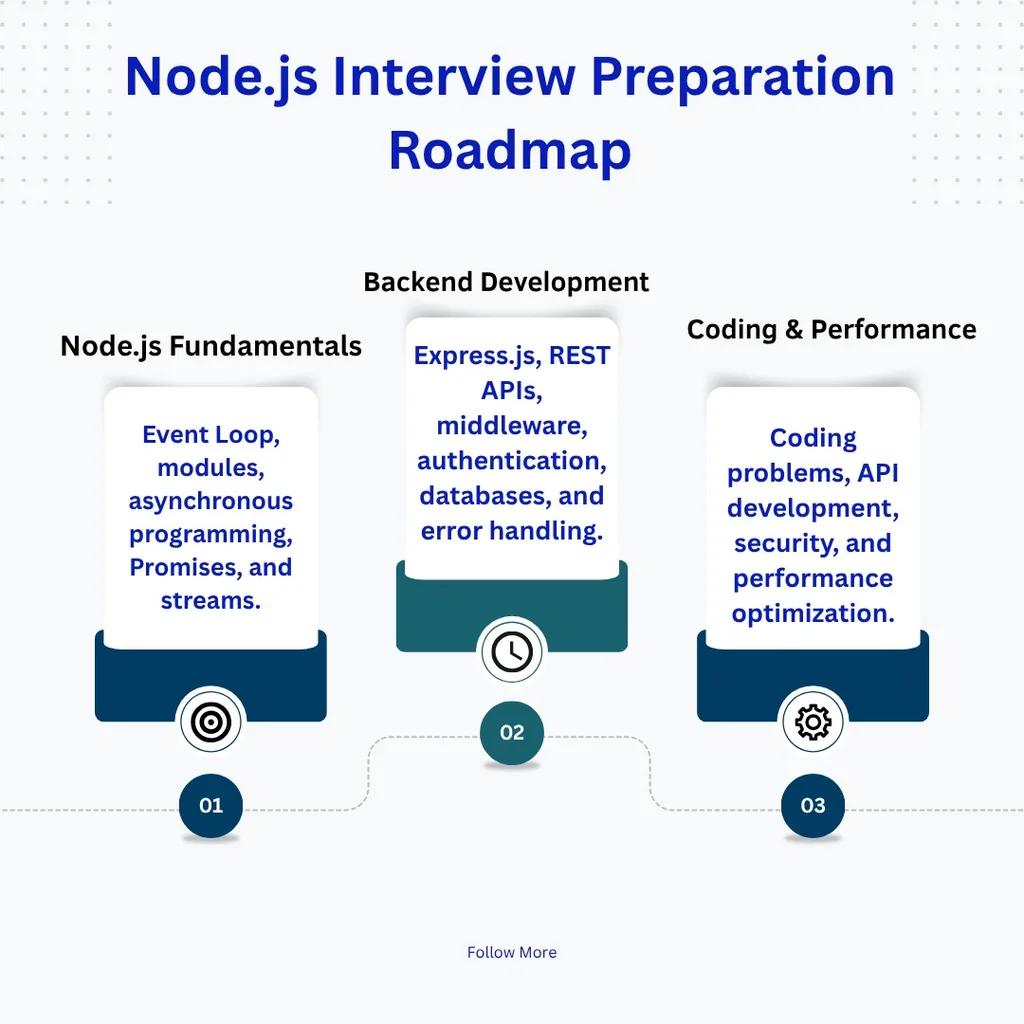
Important areas to prepare include:
- JavaScript and Node.js fundamentals
- Modules and package management
- Event-driven architecture
- Asynchronous programming
- Express.js
- REST API development
- Authentication and authorization
- Error handling
- Database integration
- Performance optimization
- Testing and debugging
- Security
- Deployment and scalability
Candidates may also encounter Node.js technical questions related to production architecture, memory management, streams, clustering, and event loops.
Basic Node.js Interview Questions
1. What is Node.js?
Node.js is an open-source JavaScript runtime environment that allows JavaScript code to run outside a web browser. It is commonly used for backend applications and server-side development. Developers preparing for backend roles may also compare Node.js concepts with topics covered in core java questions asked in interviews, especially when preparing for multiple backend technologies.
Node.js provides APIs for handling files, networking, HTTP requests, streams, operating-system functionality, and other server-side operations. Its event-driven architecture and asynchronous programming model make it suitable for building scalable backend applications and APIs
2. What are the main features of Node.js?
Some important features include:
- Non-blocking I/O
- Event-driven architecture
- Single-threaded JavaScript execution
- Fast V8 JavaScript engine
- Large npm ecosystem
- Built-in support for HTTP, file systems, streams, and networking
- Ability to build scalable network applications
3. Is Node.js a programming language?
No. Node.js is a JavaScript runtime environment. JavaScript is the programming language, while Node.js provides the environment and APIs required to execute JavaScript on the server.
4. What is npm?
npm stands for Node Package Manager. It is used to install, manage, update, and publish JavaScript packages.
A project generally uses a package.json file to define dependencies, scripts, project metadata, and configuration.
5. What is the difference between dependencies and devDependencies?
dependencies contain packages required when the application runs in production.
devDependencies contain packages mainly required during development, testing, linting, or building.
For example, Express may be a production dependency, while a testing framework may be listed as a development dependency.
Intermediate Node.js Interview Questions
6. What is the Node.js Event Loop?
The Event Loop is a core part of Node.js’s asynchronous architecture. It coordinates the execution of JavaScript callbacks and handles asynchronous operations without requiring JavaScript execution to block while waiting for I/O operations. Developers preparing for full-stack roles may also encounter React interview questions when interviews cover both frontend and backend technologies.
This architecture allows Node.js applications to handle many I/O-intensive operations efficiently. Understanding the Event Loop is important for answering Node.js technical questions and explaining how backend applications manage multiple concurrent requests.
7. What is asynchronous programming in Node.js?
Asynchronous programming allows operations such as file access, database queries, and network requests to execute without blocking the main JavaScript execution flow.
Node.js commonly handles asynchronous operations using:
- Callbacks
- Promises
- async/await
- Event emitters
For example:
async function fetchData() {

  const result = await getDataFromDatabase();

  console.log(result);

}
8. What is the difference between synchronous and asynchronous code?
Synchronous code generally executes sequentially and waits for an operation to finish before continuing.
Asynchronous code allows certain operations to complete later while other work can continue.
For backend applications that perform frequent network or database operations, asynchronous programming can improve responsiveness.
9. What are Promises?
A Promise represents the eventual completion or failure of an asynchronous operation.
It can have three states:
- Pending
- Fulfilled
- Rejected
Promises help developers structure asynchronous operations more clearly than deeply nested callbacks.
10. What is async/await?
async/await is syntax built on top of Promises that makes asynchronous code easier to read and maintain.
async function getUser() {

  try {

    const user = await fetchUser();

    return user;

  } catch (error) {

    console.error(error);

  }

}
11. What is callback hell?
Callback hell occurs when multiple asynchronous callbacks become deeply nested, making code difficult to read, test, and maintain.
Promises and async/await are commonly used to improve the structure of asynchronous code.
Express.js Interview Questions
Express.js is a popular Node.js web framework used to create APIs and web applications.
12. What is Express.js?
Express.js is a lightweight framework for Node.js that simplifies HTTP server development, routing, middleware management, request handling, and response processing.
Common Express.js questions focus on middleware, routing, error handling, authentication, and REST API design.
13. What is middleware in Express.js?
Middleware is a function that has access to the request object, response object, and the next middleware function.
Example:
app.use((req, res, next) => {

  console.log(req.method, req.url);

  next();

});
Middleware can be used for:
- Authentication
- Logging
- Validation
- Error handling
- Parsing request bodies
- Authorization
14. What is routing in Express.js?
Routing determines how an application responds to requests made to specific URLs and HTTP methods.
app.get("/users", (req, res) => {

  res.json({ message: "User list" });

});
15. How do you handle errors in Express.js?
Express applications can use centralized error-handling middleware.
app.use((err, req, res, next) => {

  res.status(500).json({

    message: "Internal server error"

  });

});
Centralized handling makes error responses more consistent and easier to maintain.
Node.js API Development Questions
Node.js API development is one of the most common areas tested during backend interviews.
16. How do you create a REST API using Node.js?
A typical REST API includes:
- Creating a Node.js project
- Installing Express
- Configuring middleware
- Creating routes
- Connecting a database
- Implementing controllers and business logic
- Adding validation and error handling
- Testing endpoints
- Deploying the application
Example:
const express = require("express");

const app = express();

app.use(express.json());

app.get("/api/products", (req, res) => {

  res.json({ products: [] });

});

app.listen(3000, () => {

  console.log("Server running");

});
17. What HTTP methods are commonly used in REST APIs?
| HTTP Method | Purpose | Example |
| GET | Retrieve data | Get users |
| POST | Create data | Create user |
| PUT | Replace/update data | Update profile |
| PATCH | Partially update data | Change email |
| DELETE | Remove data | Delete account |
18. How do you secure a Node.js API?
Common security practices include:
- Input validation
- Authentication and authorization
- HTTPS
- Secure password hashing
- Rate limiting
- Security headers
- Proper CORS configuration
- Protection against injection attacks
- Keeping dependencies updated
- Avoiding sensitive information in responses
Node.js Technical Questions for Experienced Developers
19. What is the difference between process and thread?
A process is an independent execution environment, while a thread is an execution unit within a process. Developers preparing for backend roles may also compare these concepts with topics covered in c sharp interview questions and answers, particularly around multithreading, processes, and application performance.
Node.js primarily executes JavaScript on a single main thread but can use additional mechanisms and worker threads for CPU-intensive workloads. Understanding processes and threads helps developers explain how Node.js handles concurrency and manages resource-intensive tasks efficiently.
20. What are worker threads in Node.js?
Worker threads allow JavaScript code to execute in separate threads. They can be useful for CPU-intensive operations that would otherwise block the main JavaScript execution thread.
Examples include:
- Image processing
- Large calculations
- Data transformation
- CPU-intensive algorithms
21. What are streams in Node.js?
Streams allow data to be processed progressively rather than loading an entire dataset into memory.
Common stream types include:
- Readable
- Writable
- Duplex
- Transform
Streams are useful when processing large files, network data, or continuous data sources.
22. What is clustering in Node.js?
Clustering allows a Node.js application to create multiple processes that can share server workload. This can help applications use multiple CPU cores.
23. How can you improve Node.js application performance?
Performance can be improved through:
- Efficient database queries
- Caching
- Connection pooling
- Compression
- Pagination
- Streams
- Load balancing
- Profiling
- Efficient asynchronous operations
- Avoiding unnecessary synchronous operations
Comparison of Backend Interview Topics
Candidates applying for different backend positions may see overlapping concepts but different technologies.
| Technology | Common Interview Focus | Typical Backend Topics |
| Node.js | Runtime and APIs | Event Loop, Express, REST |
| Python | Backend frameworks | Python, Django, Flask |
| ASP.NET Core | Microsoft ecosystem | C#, APIs, middleware |
| Java | Enterprise applications | Java, Spring, databases |
A Python technical interview may focus heavily on Python syntax, data structures, decorators, Django or Flask, while asp net core interview questions can focus on dependency injection, middleware, controllers, Entity Framework, and C# fundamentals.
Similarly, c sharp interview questions and answers may cover object-oriented programming, LINQ, delegates, async programming, and .NET concepts.
Node.js Coding Interview Questions with Solutions
Practical coding tasks are often used to evaluate how candidates think rather than simply checking whether they remember definitions.
24. Write a function to find duplicate values
function findDuplicates(numbers) {

  const seen = new Set();

  const duplicates = new Set();

  for (const number of numbers) {

    if (seen.has(number)) {

      duplicates.add(number);

    } else {

      seen.add(number);

    }

  }

  return [...duplicates];

}

console.log(findDuplicates([1, 2, 3, 2, 4, 3]));
This solution uses a Set to efficiently track previously encountered values.
25. Create a simple Express API endpoint
const express = require("express");

const app = express();

app.get("/api/users/:id", (req, res) => {

  const userId = req.params.id;

  res.json({

    id: userId,

    name: "John"

  });

});

app.listen(3000);
This example demonstrates route parameters and JSON responses.
Frequently Asked Backend Interview Comparisons
| Interview Area | Node.js | Other Backend Technologies |
| Language | JavaScript | Python, Java, C# |
| Popular Framework | Express.js | Django, Spring Boot, ASP.NET Core |
| Async Model | Event-driven | Depends on framework/runtime |
| API Development | Express/Fastify/NestJS | REST frameworks |
| Common Database Use | SQL/NoSQL | SQL/NoSQL |
Candidates preparing for a Java Backend Developer position should separately prepare Java language fundamentals, database concepts, REST APIs, Spring, and system design.
For Java-focused roles, java spring boot interview questions often cover dependency injection, Spring MVC, Spring Data, REST controllers, configuration, security, and application architecture.
Meanwhile, java developer interview questions can include collections, exception handling, multithreading, JVM concepts, and object-oriented programming. Common core java questions asked in interviews may also test inheritance, polymorphism, interfaces, abstraction, and Java memory management.
How to Prepare for Node.js Interviews
1. Strengthen JavaScript Fundamentals
Before focusing on Node.js, revise:
- Variables and scope
- Functions
- Closures
- Objects and arrays
- Destructuring
- Promises
- Async/await
- Error handling
- ES6+ features
2. Understand Node.js Internals
Do not limit preparation to definitions. Understand how the Event Loop, asynchronous operations, streams, buffers, and processes work.
3. Practice Express.js
Build small APIs using Express. Practice:
- Routing
- Middleware
- Controllers
- Validation
- Authentication
- Error handling
- Database integration
4. Build Real Projects
A practical project can help demonstrate your knowledge during interviews.
Useful project ideas include:
- Authentication API
- E-commerce backend
- Blog API
- Task management API
- Real-time chat application
- URL shortener
- Inventory management system
5. Practice Coding Problems
Solve problems involving:
- Arrays
- Strings
- Objects
- Hash maps
- Sets
- Searching
- Sorting
- Recursion
- Basic algorithms
Common Mistakes Candidates Make
Memorizing Without Understanding
Interviewers often ask follow-up questions. Memorizing a definition of the Event Loop is less useful than understanding why Node.js can handle many I/O operations efficiently.
Ignoring Error Handling
Production applications must handle failures gracefully. Be prepared to explain how you handle validation errors, database failures, authentication problems, and unexpected exceptions.
Focusing Only on Express
Express is important, but backend interviews can also test JavaScript, databases, HTTP, security, architecture, testing, and deployment.
Not Practicing APIs
Candidates should be comfortable explaining how a request travels from a client to a route, middleware, controller, database, and response.
Final Interview Preparation Checklist
| Preparation Area | What to Practice |
| JavaScript | ES6+, closures, promises, async/await |
| Node.js | Event Loop, modules, streams, buffers |
| Express | Routing, middleware, errors |
| APIs | REST, HTTP methods, authentication |
| Database | Queries, indexes, transactions |
| Security | Validation, authentication, authorization |
| Coding | Data structures and algorithms |
| System Design | Scalability, caching, load balancing |
Frequently Asked Questions
1. Is Node.js good for backend development?
Yes. Node.js is widely used for backend development, particularly for APIs, real-time applications, microservices, and I/O-intensive applications.
2. Is Node.js difficult to learn for backend development?
Developers familiar with JavaScript can transition to Node.js relatively quickly. However, production-level backend development requires additional knowledge of APIs, databases, security, testing, deployment, and architecture.
3. What should I study first for a Node.js interview?
Start with JavaScript fundamentals, then study Node.js internals, asynchronous programming, Express.js, REST APIs, databases, authentication, security, and coding problems.
4. What are the most important Node.js concepts for experienced developers?
Important topics include the Event Loop, asynchronous programming, Promises, streams, worker threads, clustering, error handling, API design, security, database optimization, and application scalability.
5. Are coding questions included in Node.js backend interviews?
Many backend interviews include coding tasks. These may involve JavaScript fundamentals, data structures, algorithms, API implementation, debugging, or practical backend scenarios.
