


Along with coding skills, you should be ready for the Software Development Interview. Solving complex problems using data structures and algorithms is one of the important skills that a hiring manager and recruiter seek in a candidate. Data Structures and Algorithms interview questions are essential for any beginner, mid-level or senior developer to perform exceptionally well in their interviews.
In many companies, the technical interview questions are used to measure logical reasoning, coding speed and problem-solving ability. This handout concentrates on the most common interview questions about algorithms and data structures and useful concepts, tips, and tricks for developers to succeed in technical interviews.
Why Data Structures and Algorithms Matter in Interviews
Efficient software development is based on data structures and algorithms. Data structure interview questions are used by interviewers to assess candidates’ ability to structure data, optimize performance and solve practical problems.
A good understanding of DS&A can bring the following advantages:
- Improved problem-solving skills
- Better coding efficiency
- Understanding of system performance (including the ability to interpret the results)
- Greater self-assurance when speaking with others in business situations.
- Better prospects for getting the best developer jobs
Having a good grasp of interview questions, especially in data structures and algorithms, helps developers excel in subsequent coding tests and technical evaluations.
Common Interview Formats for DS&A
| Interview Format | Description |
| Online Coding Tests | Performed on websites such as HackerRank, LeetCode, and CodeSignal. |
| Live Coding Interviews | Candidates solve problems while explaining their approach |
| Whiteboard Interviews | Work with a problem-solving approach and without an IDE |
| Take-Home Assignments | Completed Coding Projects in Real Life Within Time Limits |
Data structures interview questions are common across all formats as the employers want to gauge their analytical thinking and coding abilities.
Top Data Structure Interview Questions
The following interview questions about data structures are commonly asked during software engineering interviews.
| Data Structure | Interview Question |
| Arrays | The Maximum Subarray Problem is another variant of the Subarray Problem. |
| Strings | Find the longest substring that contains no repeating characters |
| Linked Lists | Detect a cycle in a linked list |
| Stacks | Validate balanced parentheses |
| Queues | Implement a queue using stacks |
| Trees | Check whether a binary tree is balanced |
| Graphs | Find the shortest path between nodes |
| Hash Tables | Identify the first non-repeating character |
| Heaps | Find the K largest elements in an array |
Example: Array Question
Question: Find the maximum sum of a contiguous subarray.
Approach:
- Use Kadane’s Algorithm
- Maintain current and maximum sums
- Traverse the array once
Complexity:
- Time: O(n)
- Space: O(1)
Essential Algorithm Interview Questions
Many questions about algorithms focus on optimization and efficient problem-solving.
1. Binary Search
Question: Search for an element in a sorted array.
Key concepts:
- Divide and conquer
- Logarithmic time complexity
- Efficient searching
2. Merge Sort
Question: Sort an unsorted array efficiently.
Important points:
- Recursive algorithm
- Stable sorting method
- Time Complexity: O(n log n)
3. Breadth-First Search (BFS)
Question: Find the shortest path in an unweighted graph.
Applications:
- Graph traversal
- Network routing
- Social media connections
4. Depth-First Search (DFS)
Question: Detecting cycles in a graph.
Applications:
- Pathfinding
- Dependency resolution
- Tree traversal
5. Dynamic Programming
Question: Calculate Fibonacci numbers efficiently.
Focus areas:
- Memoization
- Tabulation
- Overlapping subproblems
These are among the most common algorithms for interviews asked by technology companies.
Most Important Data Structures Every Developer Should Know
Arrays
- Easy data storage
- Fast indexing
- Widely used in coding interviews
Linked Lists
- Dynamic memory allocation
- Efficient insertions and deletions
Stacks
- LIFO structure
- Used in recursion and parsing
Queues
- FIFO structure
- Useful in scheduling and BFS
Trees
- Hierarchical data representation
- Foundation of search operations
Graphs
- Model networks and relationships
- Frequently appear in advanced interviews
Hash Maps
- Fast lookup operations
- Essential for optimization problems
If you want to use stacks to implement a queue, how do you do so?
Problem-Solving Framework for Technical Interviews
When solving technical interview questions, follow this structured approach:
Step 1: Understand the Problem
- Read carefully
- Clarify requirements
- Identify constraints
Step 2: Discuss a Brute Force Solution
- Start with the simplest approach
- Demonstrate logical thinking
Step 3: Optimize
- Improve time complexity
- Reduce memory usage
Step 4: Write Clean Code
- Use meaningful variable names
- Keep logic organized
Step 5: Test Thoroughly
- Consider edge cases
- Validate outputs
Interviewers often value your approach more than simply arriving at the correct answer.
Advanced Topics for Senior Developers
For senior engineer interview questions, companies may evaluate advanced algorithmic knowledge.
| Advanced Topic | Importance |
| Dynamic Programming | Optimization of complex problems |
| Segment Trees | Efficient range queries |
| Trie Data Structures | Fast string searching |
| Union-Find | Connectivity problems |
| Dijkstra’s Algorithm | Shortest path calculations |
| Kruskal’s Algorithm | Minimum spanning trees |
| Bit Manipulation | Performance optimization |
Senior candidates are expected to explain trade-offs, scalability considerations, and system-level impacts.
Master the Coding Interview: Data Structures Algorithms
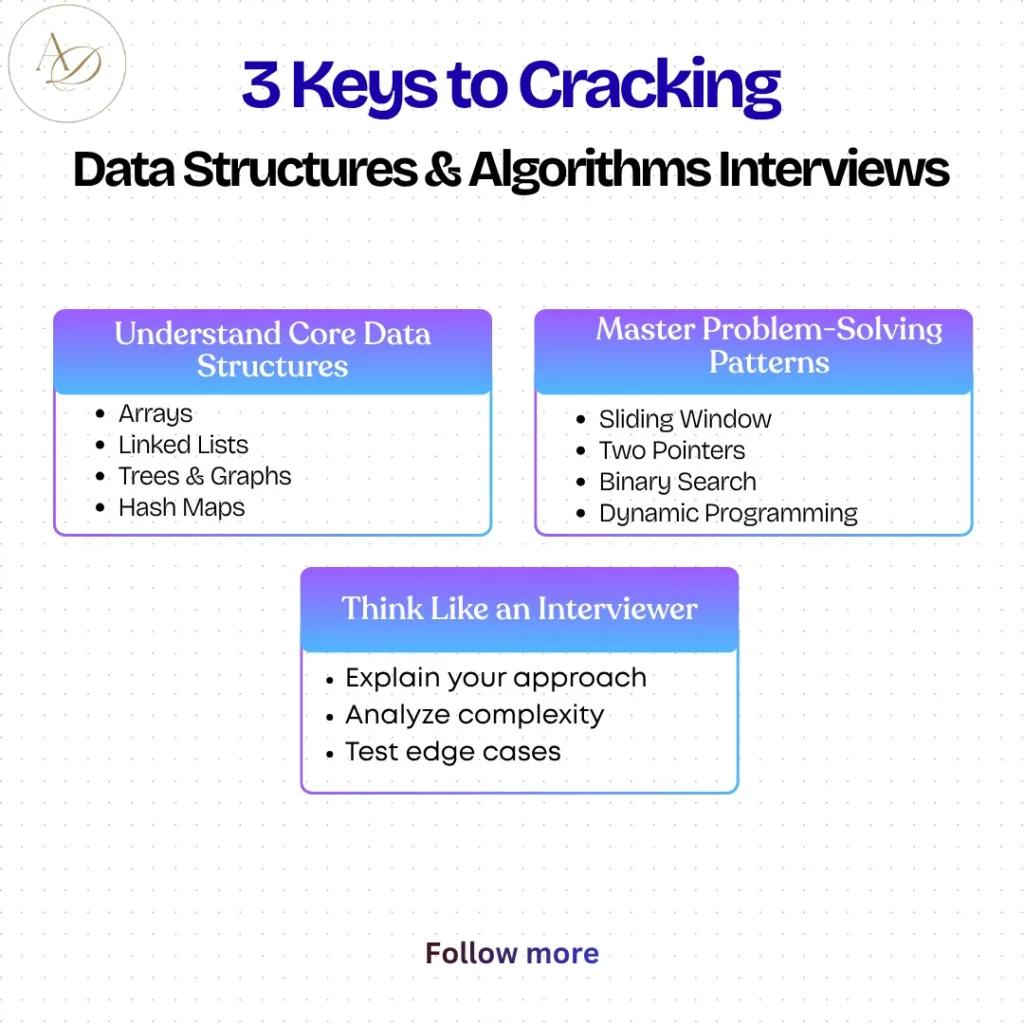
If your goal is to master the coding interview: data structures algorithms, focus on pattern recognition rather than memorizing solutions.
Recommended practice categories:
- Sliding Window
- Two Pointers
- Binary Search
- Backtracking
- Dynamic Programming
- Tree Traversal
- Graph Algorithms
- Greedy Algorithms
A structured learning plan helps developers solve unfamiliar problems more efficiently during interviews.
Best Resources for DS&A Interview Preparation
| Resource | Purpose |
| LeetCode | Coding interview practice |
| HackerRank | Algorithm challenges |
| CodeSignal | Technical assessments |
| GeeksforGeeks | Concept explanations |
| InterviewBit | Guided interview preparation |
| NeetCode | Pattern-based learning |
Consistent practice is the key to mastering software engineering questions commonly asked by top companies.
Common Mistakes to Avoid
- Memorizing solutions without understanding concepts
- Ignoring time and space complexity
- Failing to communicate thought processes
- Skipping edge-case testing
- Writing overly complex code
Avoiding these mistakes can significantly improve interview performance.

Conclusion
Good problem-solving skills, knowledge of data structures, and efficient application of algorithms are key to developer interviews. Developers can more confidently address the most complicated technical questions during interviews if they practice common data structure interview questions, learn popular algorithms used during interviews, and prepare for advanced senior engineer interview questions.
Be aware that practice, pattern recognition and communication of approach are keys to success in interviews. The more you can expose yourself to interview questions algorithm and data structure, the more comfortable and successful you will be in real interview.
FAQs
1. What are the most common data structures and algorithms interview questions?
Typical questions include array, linked list, stack, queue, tree, graph, hash table, binary search, sorting algorithm and dynamic programming.
2. How can I prepare for data structures interview questions?
Regularly practice coding platforms, understand basic concepts, solve the problems by category and go over time and space complexity analysis.
3. Why are data structures important in technical interviews?
Data structures enable the efficient organization of information, and show the candidate’s capability of solving a problem with an optimized solution.
4. What topics are commonly asked in senior engineer interview questions?
Some interview questions for senior positions include dynamic programming, advanced graph algorithms, system design concepts, scalability and optimization techniques.
5. How many coding problems should I solve before an interview?
75-150 quality issues, concentrating on major patterns, are the suggested number of problems to be solved by most experts, instead of concentrating on quantity.
